
Analysis of sugar stocks in the main importing regions up to end-September 2025
Last Tuesday (23), StoneX released its second revision for the global sugar balance in the 2025/26 season (Oct-Sept). With the official end of the 2024/25 cycle approaching, the deficit for the period is estimated at 4.7 million tonnes (gross value), bringing final stocks to their lowest level since 2016/17 – around 72.5 MMt. But, after all, how has the market been working with such a sharp decline in stocks during the season, in contrast to the falling prices on the New York exchange?
In this report, StoneX Market Intelligence will provide an analysis of exports by the three largest players, imports and stocks in the world's main sugar-buying regions, as well as a summary of the new estimates released last week.
Sugar exports, imports, and stocks worldwide
Since the beginning of the year, StoneX Market Intelligence Team reports have highlighted the scenario of sluggish imports in the global market and how this would impact (and continues to impact) prices on the exchanges. In the first quarter of 2025, the pace of trade slowed dramatically, and global import volumes were among the lowest seen in the last 10 years.
One of the hypotheses for this scenario was, naturally, the situation of the 2024/25 (Oct-Sept) global crop, which was deficient and would consequently have a smaller exportable surplus in the selling centers. However, this factor was not confirmed by the behavior of various indicators throughout the year, notably:
- The white premium averaged US$ 97/t in the first quarter of the year, suggesting weakened demand from refineries and/or sufficient refined supply in the Northern Hemisphere.
- Weakened export premiums in Brazil and Thailand.
- Deliveries upon the March, May, and July 2025 contract expirations at high levels and involving a wide range of delivery agents.
- The subsequent fall in sugar prices in New York, amid a steady increase in short positions by funds, refuted the theory that imports were falling due to the global crop deficit.
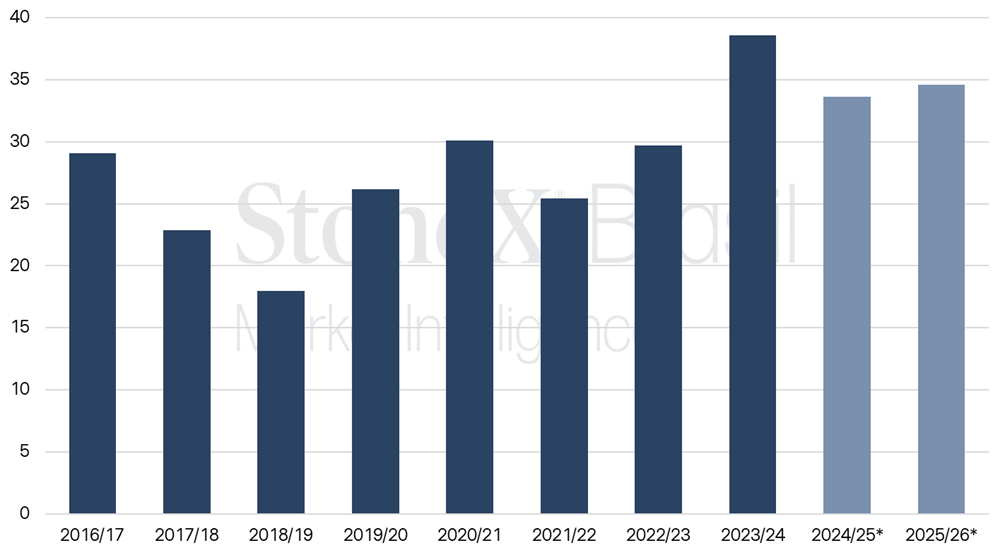
In this sense, the scenario that emerged was a decline in buying momentum until the third quarter of 2025 at a greater intensity than the decline in exportable surplus around the globe. In Brazil, for example, exports within the October-September 2024/25 calendar are expected to close at 33.7 million tonnes (tel quel), with an annual decline of 4.9 MMt (compared to the record in 2023/24). This decline, in turn, is greater than the country's production decline – of around 3.0 MMt in 2024/25 (Oct-Sept) – due to lower production in the second half of 2024, which suffered from increased cane impurities in Brazil's Center-South region.
Brazilian exports in the international Oct-Sept calendar (million tonnes)
Source: MDIC. Design and *estimates: StoneX.
In summary, this scenario forces Brazil to accumulate stocks, which should end the period with levels slightly above 11.0 MMt, an annual increase of 9.4%. Despite experiencing a year of mostly declining stocks in 2025, the third quarter of 2025 is expected to see the highest sugar production in history for the period, at 21 million tonnes, even higher than in 2023/24, increasing both export volume and domestic reserves. However, Brazil still tends to sell below its actual exportable surplus, which has been confirmed to be a matter of weaker import demand – to be addressed later.
In Thailand, the scenario is similar, with exports reaching nearly 7.0 million tonnes in 2024/25, but still below the potential for the period – closer to 7.5 MMt. In Asia, however, India is the most interesting case. During the crop, its production fell by 6 million tonnes (white value), and even so, the Indian government released an export quota – and the country is shipping a total of 800,000 tonnes in the cycle. With a slight decline in domestic consumption, India will see a drop of almost 3.0 MMt in final stocks in 2024/25. In other words, of the global deficit of 4.7 (gross value), 2.95 MMt is in India (which, paradoxically, exported 1.0 MMt more).
The three countries mentioned account for almost 70% of global exports, and we can conclude that two of them saw exports below potential (accumulated stocks) and the other exported above potential but saw a drop in stocks.
On the demand side, as already mentioned, there was one of the worst first quarters for imports in recent years and a better second quarter, but this was mainly driven by Chinese purchases. In fact, as expected, imports grew strongly in the third quarter and, even so, have not been able to generate higher prices – while a surplus 2025/26 (Oct-Sept) crop is just around the corner, and funds remain comfortable in their net short position.
Looking at the world's main sugar importing regions, the decline in sugar stocks in 2024/25 is robust. In the Middle East, domestic reserves are estimated to decline by 455 tonnes (raw value), or -12%, mainly due to lower imports from the United Arab Emirates, Iran, and Iraq. The decline is similar across sub-Saharan Africa (South, East, Central, and West of the continent), which sees a decline of almost 700,000 tonnes in final stocks in 2024/25.
In addition to the regions mentioned above, the United States and the European Union are also experiencing a decline in imports and domestic stocks. On the other hand, importing countries that have been accumulating stocks in 2024/25 through increased purchases are Egypt and, above all, China, which is heading for one of the third most significant quarters in terms of imports in the last 15 years.
Sugar imports in the world's main purchasing centers* (million tonnes)
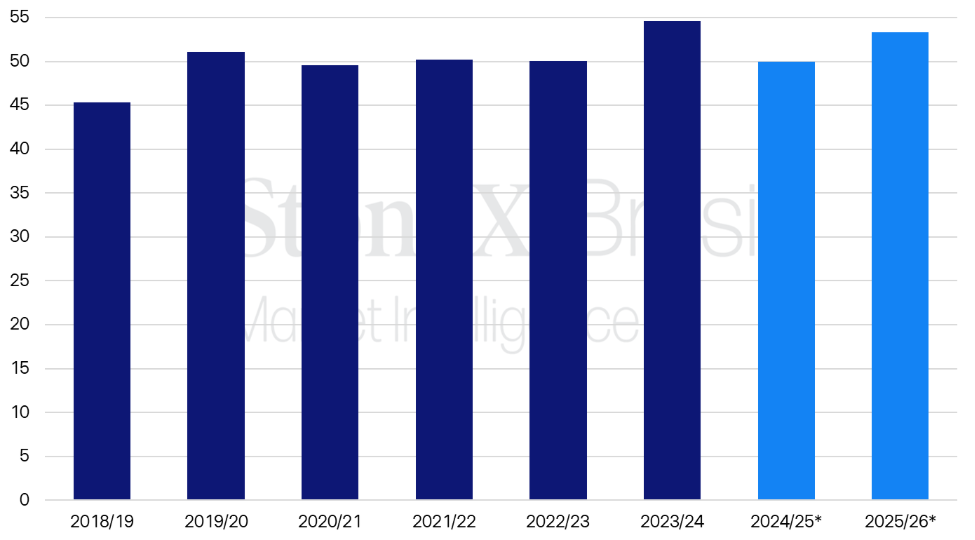
* In tel quel value, considering: Middle East, China, Indonesia, India (tolling), Egypt, Morocco, Algeria, Sub-Saharan Africa, European Union, United States, Canada, Bangladesh, and Pakistan – practically 80% of global volume.
What can be seen, therefore, is that buyers preferred to wait for prices to fall, expecting a steady supply later on, in order to increase imports – given the robust expansion of stocks in 2023/24, as illustrated in the chart below. In this year's case, the bet was spot on, as previously seen in the presentation on Brazilian production in the third quarter of 2025.
Sugar stocks in the world's main purchasing centers* (million tonnes)
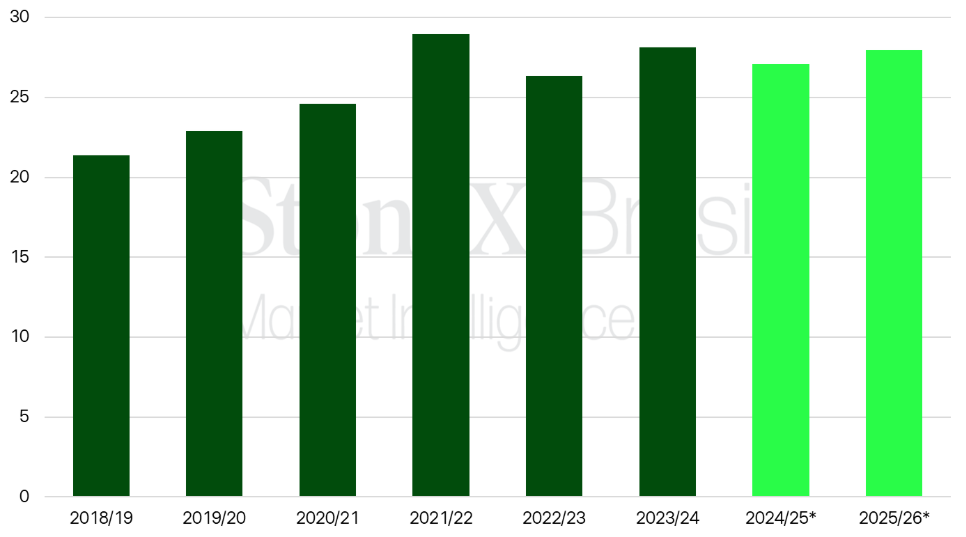
* In white value, considering: Middle East, China, Indonesia, India (tolling), Egypt, Morocco, Algeria, Sub-Saharan Africa, European Union, United States, Canada, Bangladesh, and Pakistan.
Considering this scenario, with import demand below exportable surplus in 2024/25, the 2025/26 season may be challenging. This is because, theoretically, countries now face lower stock levels and may continue to buy significantly at least throughout the fourth quarter of the year, when harvests in the Northern Hemisphere are still beginning. If demand for white/refined sugar grows, it will find lower available stocks from refineries compared to last year – which is mainly observed in the UAE and India (tolling) balance sheets.
This context tends to create stress in the white sugar market, which can be seen in the behavior of White Premium after the rollover from the October/25 contract to the March/25 contract. Although still uncertain, this is a risk that the market faces going forward, with emphasis on the months of November and December, when there will be less sugar available from mills in the Center-South (during its inter-crop period) and no exports from Thailand, as its harvest only begins in mid-December.
Summary of estimates for the global sugar balance published on September 23
Asia
For Asia, there were no substantial revisions. Overall, the continent is expected to experience productive growth in 2025/26, with the main players achieving annual growth in their crops (with the exception of China, which is expected to see a slight annual decline of 0.9%).
In India, the weather remained stable in July and August, with rainfall close to average. August saw better rainfall (5% above average) and reinforced the scenario of good water availability, with reservoir levels at high capacity, which is essential for the 2025/26 crop and also for the 2026/27 planting season. As such, StoneX maintains its estimate for India's sugar production at 32.3 MMt (+23% y/y), after a 4.5-million-tonne deviation to ethanol. The focus of attention now is on the possibility of exporting 2 MMt. However, Indian export parity is around US¢ 17-18/lb (depending on prices during the peak crop season), which does not economically justify new quotas.
In China, the low rainfall this year poses a risk to sugar beet production in Xinjiang (in the north), but domestic sugar production is expected to decline only slightly, by 0.9%, to 11.1 million tonnes. In Thailand, rainfall has been beneficial so far. As a result, Thai sugar production is expected to be 11.4 million tonnes (tel quel).
Pakistan is the country that brings the most uncertainty to Asian crops. After the crop failure in 2024/25, the 2025/26 season should see a recovery in production. However, the floods in Punjab are causing greater concern. Pakistani sugar production is expected to increase by 11.3% annually and end the 2025/26 harvest at 6.5 MMt.
Europa
With regard to the European continent, there was no revision in the production estimate. The 2025/26 crop is expected to see a 9.4% decline in planted area due to lower domestic sugar prices in Europe, which are discouraging producers. The projection for sugar production in the EU27 + UK remains at 16.0 MMt (-9.6% y/y).
On the one hand, planting began early in Europe, which gives sugar beets more time to develop. However, drier weather and above-average temperatures are causing concern about the quality and sucrose recovery of the plants. Another cause for concern is disease in the fields, mainly in Germany, which is also spreading to France.
In Russia, sugar production is expected to increase by 3.2% year-on-year, and StoneX maintains its forecast of 6.5 million tonnes for the 2025/26 cycle. In Ukraine, sugar production is expected to decrease by around 200,000 tonnes, reaching 1.5 million tonnes.
America
In America, StoneX has changed its projections for the 2025/26 crop. The estimate for sugar production in Brazil's Center-South region has been revised to 41.7 million tonnes (+4.4% y/y), and in the North-Northeast region, production has been revised to 3.7 million tonnes (-3.3% y/y). For the 2026/27 cycle (April-March), the Center-South should see a 20 MMt increase in crushing, a recovery in the TRS, and a still-high sugar-directed mix, albeit with a slight decline.
In the United States, the USDA remains optimistic for the 2025/26 crop. With rainfall at or above average, sugar beets are developing well. As a result, sugar production in the US is estimated at 8.6 MMt. In Mexico, the weather is also favorable for sugarcane, leading to an estimated sugar production of 5.1 MMt (tel quel).
Access the full report by clicking here.
INDICATORS
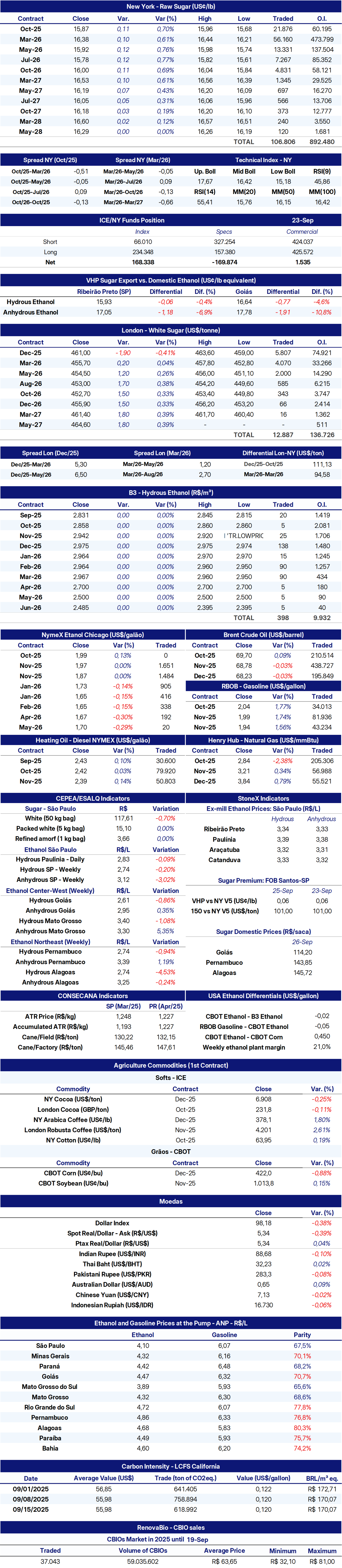
Sources: ICE, CEPEA, B3, ANP, NYMEX, CBOT, Central Bank of Brazil, California Air Resources Board (CARB), CONSECANA, StoneX. Design: StoneX.



