Please note this was written before the news about Silicon Valley Bank. The developments at SVB have raised uncertainty over financial risk and will be addressed in a separate note from us; meanwhile the rationale outlined below remains valid when purely considering underlying economic, rather than financial forces. That said it may tilt the balance of expectations towards a 25 point rise rather than 50, although the FOMC is unlikely to want to be seen to over-react on the short term
The U.S economy; doves win the week but the battle isn’t over
The markets suggest that NonFarm points to a 25-point rise – but the markets have been more benign than the Fed for a good while and a 50-point rise may well be on the cards
Watch for CPI on Tuesday 14th
The recent stream of economic information coming out of the United States, punctuated by Fed Chair Jerome Powell’s Congressional testimony, has had market expectations all over the place. Over the course of this past week, NonFarm Payrolls appeared to have swung the advantage in favour of the cautious over the more aggressive rate-watchers, with the markets nearing the end of the week with a more benign outlook that they started, over-riding Chair Powell’s testimony. Burrowing into the numbers, though, suggests that the Fed will not be impressed and will remain more aggressive than the markets are discounting. A 50-point hike should not come as too much of a surprise, but would likely put pressure on gold.
For example: -
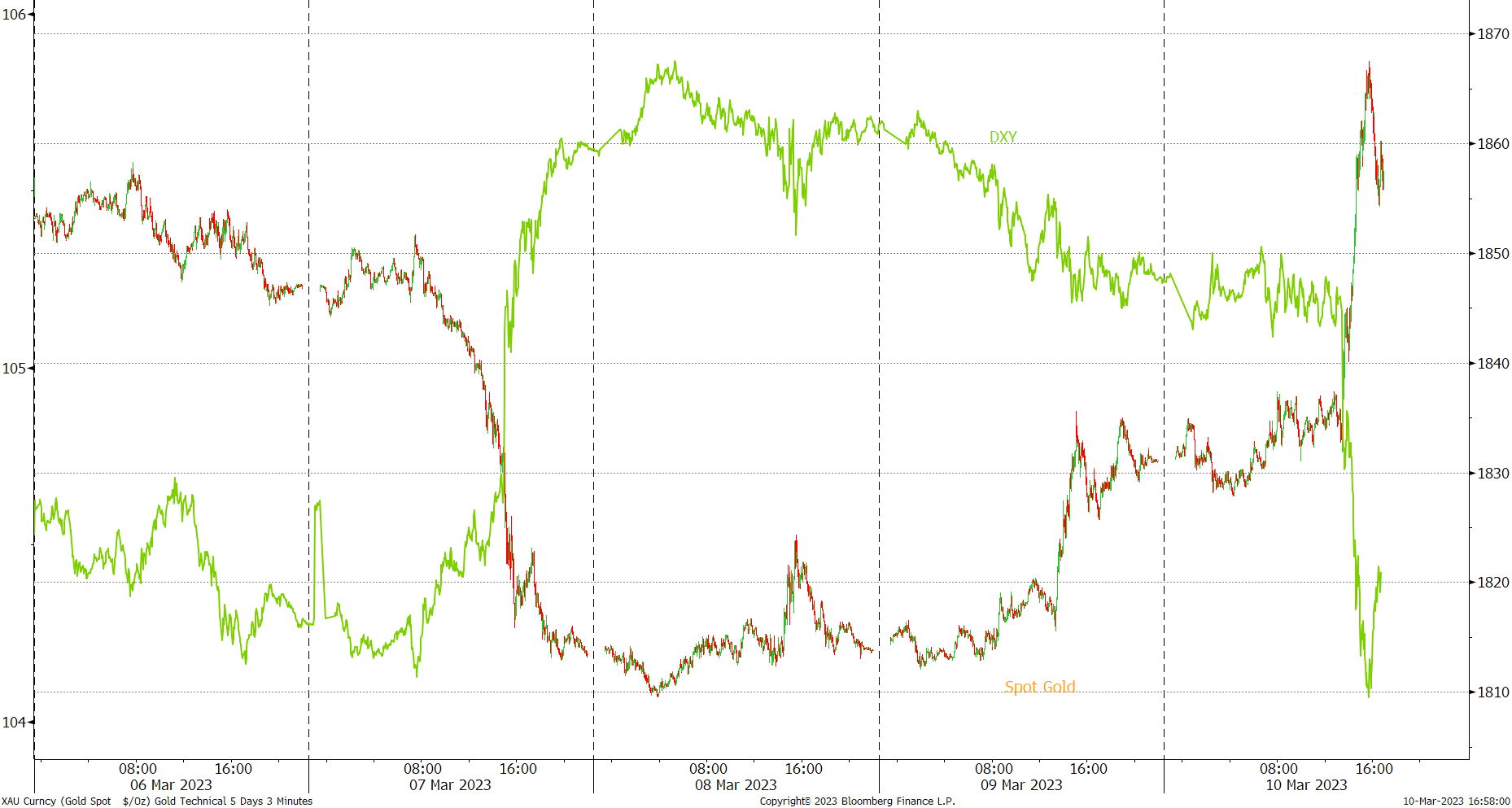
Gold and the dollar index, Powell and NonFarm week; three-minute intervals
Source: Bloomberg, StoneX
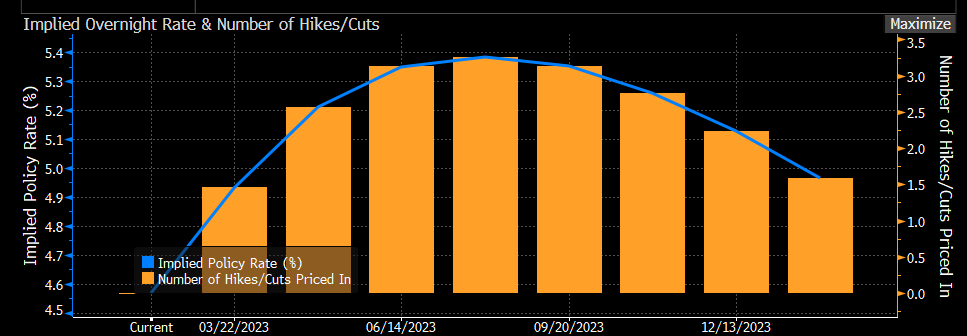
As we write the fed funds markets are discounting an implied 33 basis point hike at the Federal Open Market Committee (FOMC) meeting of 21-22 March, which means that they are veering more towards expecting a 25-point hike than 50. This does not mean that the Fed is thinking similarly.
The 50-25 debate has been raging for the past few weeks, with economic numbers pulling sentiment one way, then another. By the time Chair Powell had finished his Congressional testimony (Wednesday) the fed funds markets were leaning towards a 50-point hike. Then on Friday 10th we had NonFarm Payroll numbers, which prompted another change of tack in the markets.
There does appear to be an acceptance at the Fed that inflation has peaked, but there is also some concern that it may take time to revert to the 2% target and that there is therefore more work to be done in order to rein prices in. And rein it in, they are determined to do.
So all eyes now turn to Tuesday 14th, when CPI comes through (although the Fed prefers core PCE as its primary parameter).
Fed Funds Futures, mid-morning EDT, 10th March
Source: Bloomberg
So what have we got?
On the side of the doves:
- There is a continued slowdown in the United States’ housing market (low inventory a factor here), although the building permit numbers are starting to stabilise. The U.S. Median Rental Index peaked in the September quarter of last year and has eased very slightly since; at year-end. however, it was nonetheless 45% higher than at end -2017
- GDP growth Q4 2022 has been revised downwards to 2.7% quarter on-quarter and 0.9% year-on-year
- A slowdown in what had been an improving auto sector, with inventories rising
- NonFarm Payrolls suggest some heat has come out of the market – but it won’t be enough for the Fed, as the mood music there still revolves around inflationary forces.
- One element of the Beige Book (otherwise neutral, see below) was that “Several Districts indicated that high inflation and higher interest rates continued to reduce consumers’ discretionary income and purchasing power, and some concern was expressed about rising credit card debt”.
For the hawks: -
- Core Personal Consumption Expenditure number for January came in at 5.4% in the first week of March, after 4.4% in December
- Initial jobless claims are easing gradually, outstanding unemployment numbers are dropping (1.90M from 1.93M in mid-Feb.
- Job vacancies rising, latest at 11.0M (Dec) vs 10.4M in November
- Average hourly working week still rising, latest at 33.0 hrs from 32.9
Neutral
- The Beige Book (activity up to end-February) points to a slight increase in economic activity, albeit in only six of the twelve reporting Districts.
- Supply chain disruptions eased further
- consumer spending was steady;
- manufacturing stabilised.
- Demand for non-financial services eased in a few Districts, with loan demand declining and (this would be grist to the doves’ mill) delinquency rates edged higher.
The Committee
Apart from Chair Powell himself, recent comments have come from, among others,
- the President of the Richmond Fed, Thomas Barkin, who believes that the Fed needs to continue to raise rates, although at a slower pace than last year’s dramatic moves, when the fed funds target rate rose from zero to 4.3.
- Minneapolis Fed President Neel Kashkari has yet to decide between 25 and 50 points, noting also that the projections for the future are the key, rather than just the next data point.
- Atlanta President Raphael Bostic (not a voter in this round) says that historical evidence points up dangers in closing the cycle too quickly, and that a slowdown is welcome (we have seen this in the Minutes more than once recently).
Latest Minutes were released on 22 February: key points
- Wide diversion in views about the extent of a potential slowdown. Incoming data pointing to moderating inflation risks
- Survey of Primary Dealers and of Market Participants expected a 25-point hike in January; placed significant probability on a peak rate ranging close to 5%.
- Dollar depreciation stemming from China upturn, improving Europe, narrowing rate differentials.
- Real GDP growth bolstered by a jump in inventory investment.
- GDP forecasts revised upwards since December and unemployment revised modestly lower and a lower projected outlook for the dollar. Core PCE projected at 2.8% for this year and core inflation at 3.2%.
Jay Powell’s Congressional testimony; cautioning against slowing rate hikes too soon; “higher for longer” reappears, the inference being that the cycle will not slow or reverse until the peak rate has been reached. Powell notes that central banks (note the plural) would be prepared to speed up rate hikes if economic activity remains strong and sustained. As far as the Fed is concerned
“If the totality of the data were to indicate that faster tightening is warranted, we would be prepared to increase the pace of rate hikes.“
The key question, therefore, is; what is that peak rate deemed to be?
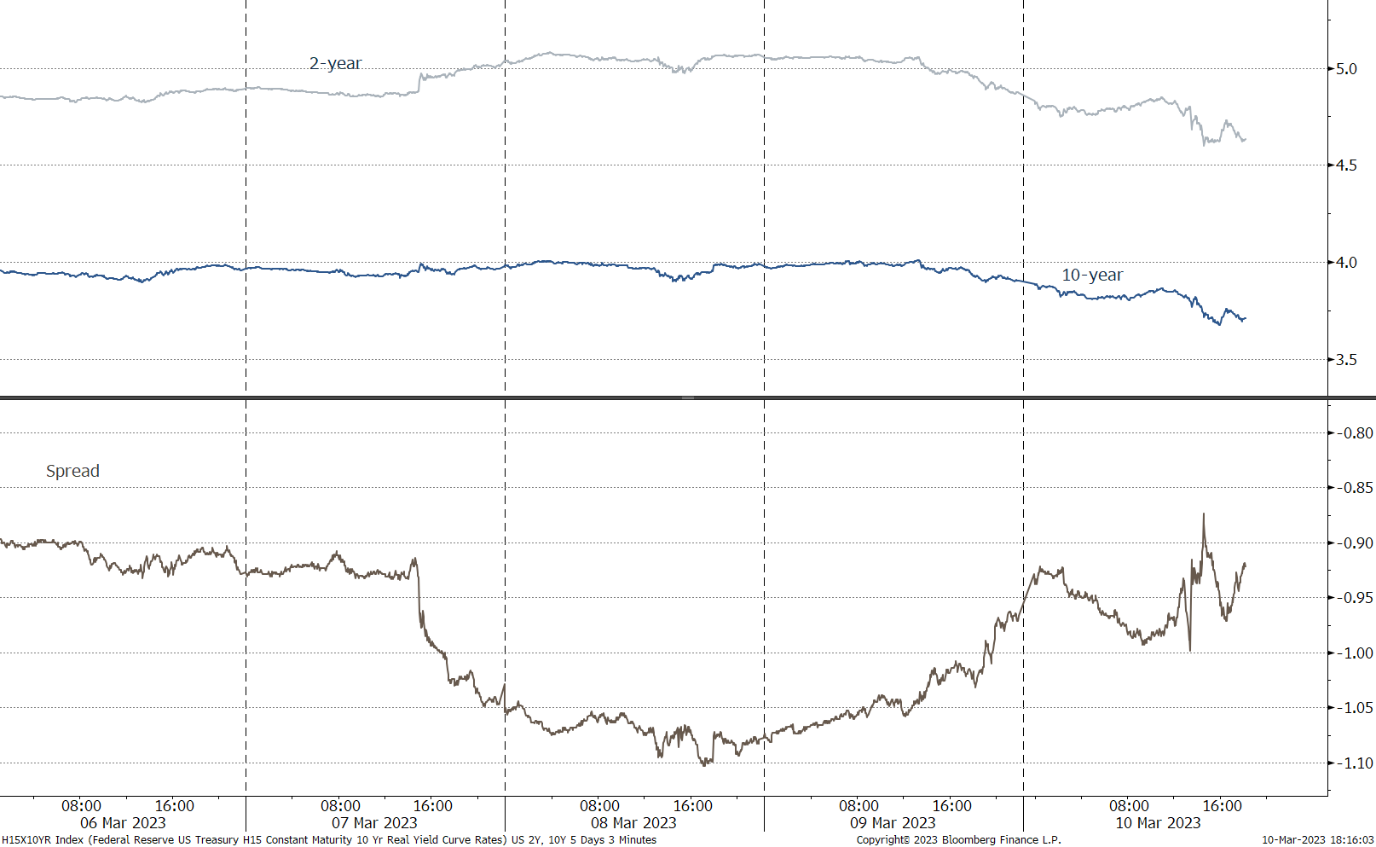
The chart at the start of this piece shows the reactions of gold and the dollar to Powell and then to NonFarm (net-net; dollar off, gold higher); this is what the 2-year – 10-year rate spread did;
Last week (three-minute intervals
Source: Bloomberg, StoneX
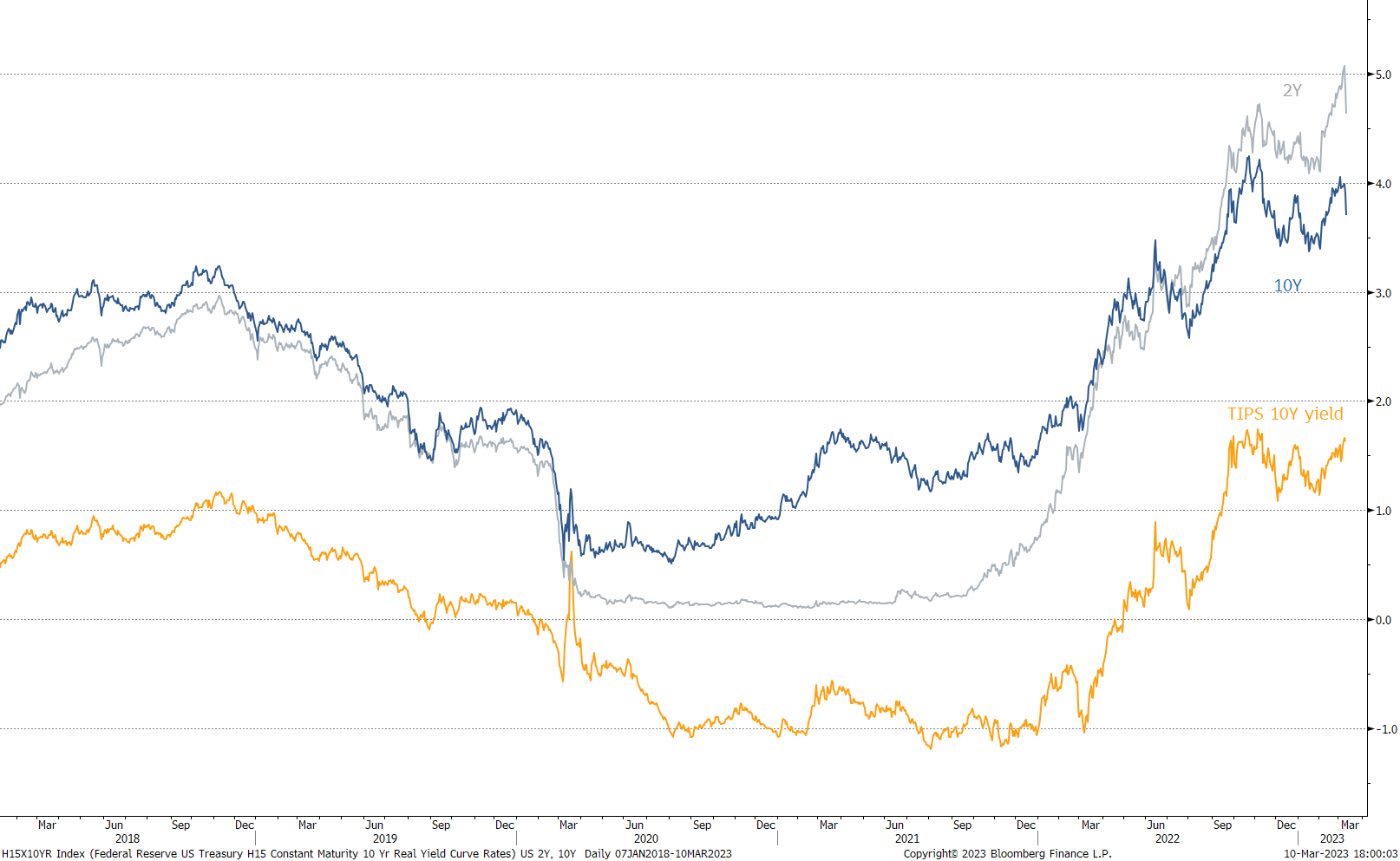
Five-year view, also including 10-Year TIPS (i.e. Inflation adjusted)
Source: Bloomberg, StoneX
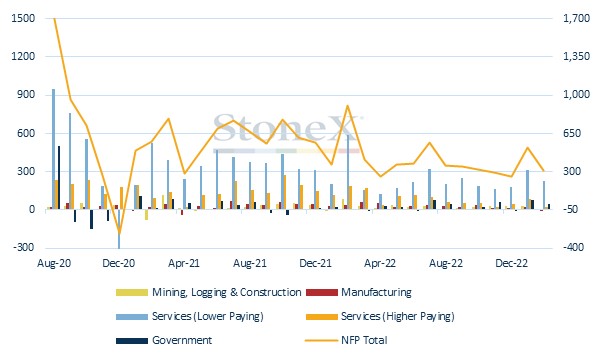
Inside the NonFarm numbers
Source: Bloomberg, StoneX
NonFarm Payrolls showed the labour market coming off the boil, but still at a very strong simmer. The headline number beat market expectations at 311k, although it was still well off the January spike of 504k and 25% below the average for the previous twelve months. The participation rate (percentage of the out-of-work population that is looking for employment) rose to 62.5%. The unemployment rate rose to 3.6% and the average working week dropped to 34.5 hours from 34.7.
While most of the NonFarm components suggest a slight easing in the situation, the headline figure shows that the market is still pretty tight and the Fed is likely to continue to see the market as closed to full employment.
And lying in wait…
Further forward the inflation numbers next week will also be closely watched CPI is currently called as follows: -
Headline 0.4% M/M, vs 0.5% in January; core 0.4%, unchanged for the January gain;
Headline Y/Y 6.0% down from 6.4% in January; Core 5.4% vs 5.6% the previous month.
While the Fed favours the core PCE, CPI will hold the markets in thrall. Hang onto your hats!