- September should end with below-average rainfall.
- The emergence of La Niña may mean that temperatures will be more favorable by the end of 2024.
- Estimates of the impacts of prolonged drought on coffee trees will depend above all on the temperatures that will be recorded until rainfall normalizes.
Accumulated rainfall for September 18-22
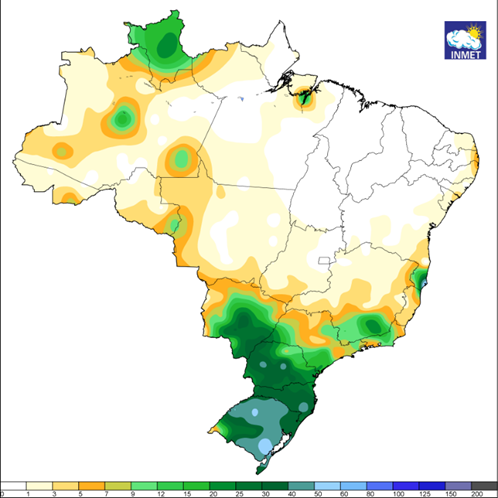
Between September 18 and 23, cold fronts from southern Brazil reached the Arabica coffee-growing regions of southern Minas Gerais, Matas de Minas and São Paulo (Mogiana and Rosp). In these areas, most municipalities recorded volumes of over 10 mm, with some receiving up to 30 mm of rain in the last five days. The increase in moisture has temporarily improved the water conditions of the crops and lowered temperatures, favoring Arabica coffee flowering. However, in the Cerrado, southern Bahia and southern Espírito Santo, rainfall was between 7 and 10 mm, with some cloudiness.
The coffee plantation's flowering depends on the species and the region. Most Robusta coffee regions are technologically advanced and have irrigation systems. So far, what our field team has observed and the records indicate is that flowering is well underway in Espírito Santo and Bahia, but noy in Rondônia, where, in September in particular, above-normal temperatures may have affected fruit development.
For arabica, there are two situations:
- In the more southerly regions of Brazil, such as Paraná and part of southern São Paulo, which have been favored with more adequate rainfall and temperatures, the first round of flowering took place in mid-August, and so far the fruit has developed to an acceptable level, as described by our field team.
- In the other regions, the rains induced significant flowering compared to the previous months. However, the percentage of fruit set and development will depend on the microclimatic characteristics of each region. During a field visit, our team reported that fruiting is not undergoing significant damage as a result of this first round of flowering, and the flower buds are healthy and vigorous so far.
In these coffee plantations, the production potential in recent crops has been significant, and this year's harvest has, as usual, left some mechanical damage, such as defoliation, but with good nutrition and sufficient rain, the plants can recover quickly.
Flowering was expected to be concentrated and uniform, indicating a possible increase in production potential. However, this expectation has been diminishing due to the prolonged drought. Major producing regions are facing more than 100 consecutive days without significant rainfall, as well as high temperatures, which has caused severe defoliation in the crops. The expectation is that, with the arrival of the rains, part of the crops will be able to recover, due to the plant's high resilience, especially in relation to the emission of new leaves.
A new estimate for flowering will be issued at the beginning of October.
Accumulated rainfall forecast
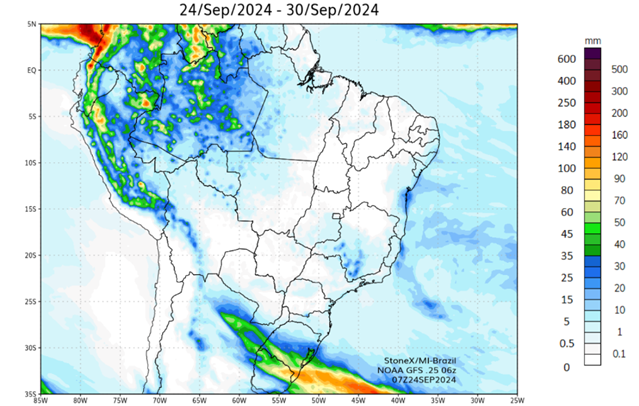
Source: StoneX.
The transition from September to October reveals a contrast in rainfall volumes. The monthly accumulation in the climatological norm, which was less than 100 mm in September, could easily exceed that mark in October in the Midwest and Southeast regions.
Brazilian climatological norm for September and October (1991-2020)
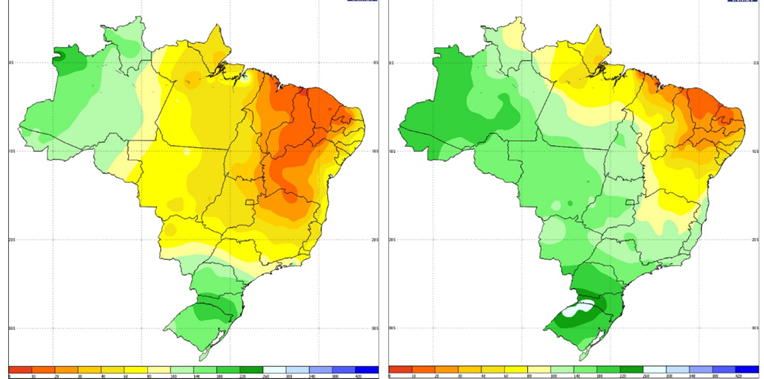
Fontes: Inmet
Throughout October, according to climatological norms, rainfall tends to increase gradually. In the last 10 days of the month, there could be rainfall of more than 50 mm, influenced by moist winds from the Intertropical Convergence Zone, which carry moisture from the equator to the Southeast and Center-West of Brazil.
Brazilian climatological norm for October (1991-2020) - 10-day period
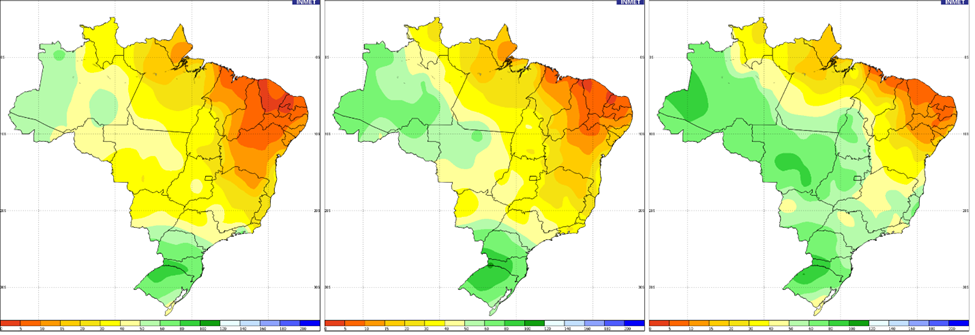
Source: Inmet.
With the emergence of La Niña in the September, October and November quarter (SON), volumes typical of tropical regions, with high temperatures and high moisture, are expected by the end of the year.
According to Inmet, for Robusta producing areas, the rainfall anomaly forecast for the months of October, November and December (OND) indicates that Rondônia will be below average (-10 mm), while the south of Espírito Santo will record above average volumes (+50 mm). For Arabica, most coffee-growing areas could record rainfall anomalies of between -10 mm and +50 mm. In terms of temperature, Rondônia should be 0.4°C above average, while Espírito Santo will see a rise of 0.2°C. For the Arabica regions in the south of Minas Gerais, parts of the Cerrado and areas of São Paulo, average temperatures could be up to 0.6°C above average, while other areas could see rises of up to 0.4°C.
Rainfall (mm) and temperature (°C) anomaly forecasts for October, November and December/2024 updated September 2024
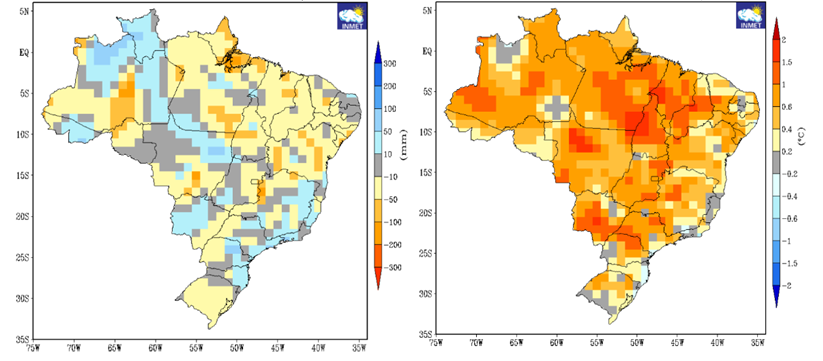
Source: Inmet.