StoneX logo

Weather and Climate Weekly Report

By: StoneX Intelligence Brazil, StoneX Intelligence Brazil

Harvest and Soil: Moisture Trends and Agricultural Planning*


The period of highest moisture in Brazil’s North, Center-West, and Southeast regions—characterized by intense cloudiness, convective rainfall, and moisture circulation—is coming to an end. In this context, systems such as the South Atlantic Convergence Zone (SACZ) and the Intertropical Convergence Zone (ITCZ) are losing direct influence over these areas. In this report, we analyze surface moisture levels at the end of May, compare them with previous months, assess the dynamics of this variable throughout the month, and present soil moisture forecasts for the upcoming days in June.

Monthly NDMI Analysis

The NDMI (Normalized Difference Moisture Index) is an indicator that reflects changes in soil moisture caused by rainfall, evapotranspiration, and vegetation development.

At the end of April, there was a noticeable reduction in yellow to reddish patches (indicating low moisture) in the Center-West, Southeast, and Tocantins regions compared to March. However, by the end of May, these patches returned and intensified, indicating a drop in soil moisture.

This can be observed in the NDMI monitoring, both in the expansion of affected areas (previously blue regions turning yellowish and greenish) and in the severity of the drought (more intense red spots) and the emergence of new areas with greenish tones—an alert sign, considering the dry season hasn't officially started yet.

Key affected regions include: the northwest of Minas Gerais and the Triângulo Mineiro, the outer areas of Goiás (particularly the northeast), eastern Mato Grosso, Tocantins (bordering the MATOPIBA region), the north and east of Mato Grosso do Sul, and most of São Paulo state (except the coast).

NDMI Index – February to May 2025 
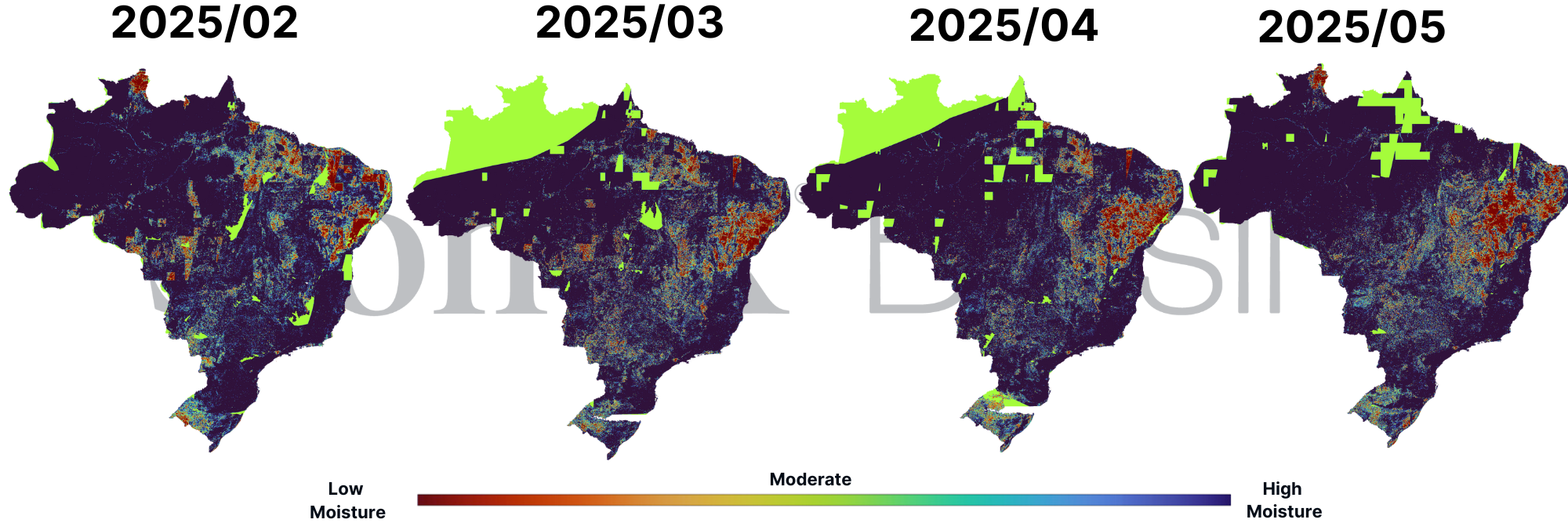
image-20250611195218-1

Sources: Copernicus prepared by StoneX

NDMI Dynamics in May and Rainfall Irregularities

Although total rainfall was above average in several parts of the North, Northeast, and Center-West, its distribution was highly irregular. Key observations include:

Heavy rains concentrated in just a few days;

  • Over 20 consecutive days without significant rain in states like Minas Gerais, Goiás, and Tocantins (as detailed in the previous weekly report).
  • Although the total rainfall during the transition months is a positive signal, the concentration in a few, likely intense, events is not ideal for proper soil water recharge.

Poor rainfall distribution can lead to rapid saturation of the upper soil layers, especially those with larger pores. When this happens, rainwater struggles to infiltrate deeper into the soil and ends up running off over the surface toward rivers and streams.

This effect is even more common in agricultural areas, where soil is usually compacted due to heavy machinery use. With less pore space, water infiltration becomes more difficult.

These conditions help explain the deterioration of NDMI values in regions like eastern Mato Grosso, Goiás, and northwestern Minas Gerais. Another contributing factor is the above-average temperatures recorded in recent months, which intensified water loss through evapotranspiration—the combined evaporation from the soil and transpiration by plants.

Dynamics of the NDMI Index for the Month of May
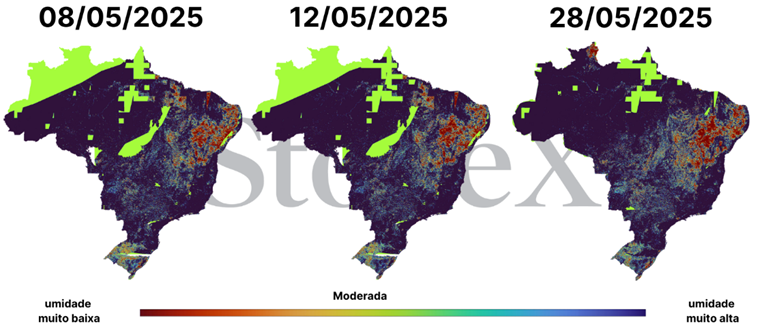
 

image 114108

Sources: Copernicus prepared by StoneX

Soil Moisture in June: Cold Fronts Benefit the Center-South, While Drought Expands in the Northeast

The forecast for the topsoil moisture layer, which includes the first 7 to 10 centimeters, is generally positive when compared to previous years. Soil moisture at this level is crucial for successful harvests, directly influencing the quality, yield, and ideal timing of harvesting crops like second-season corn (safrinha), coffee, and sugarcane.*. 

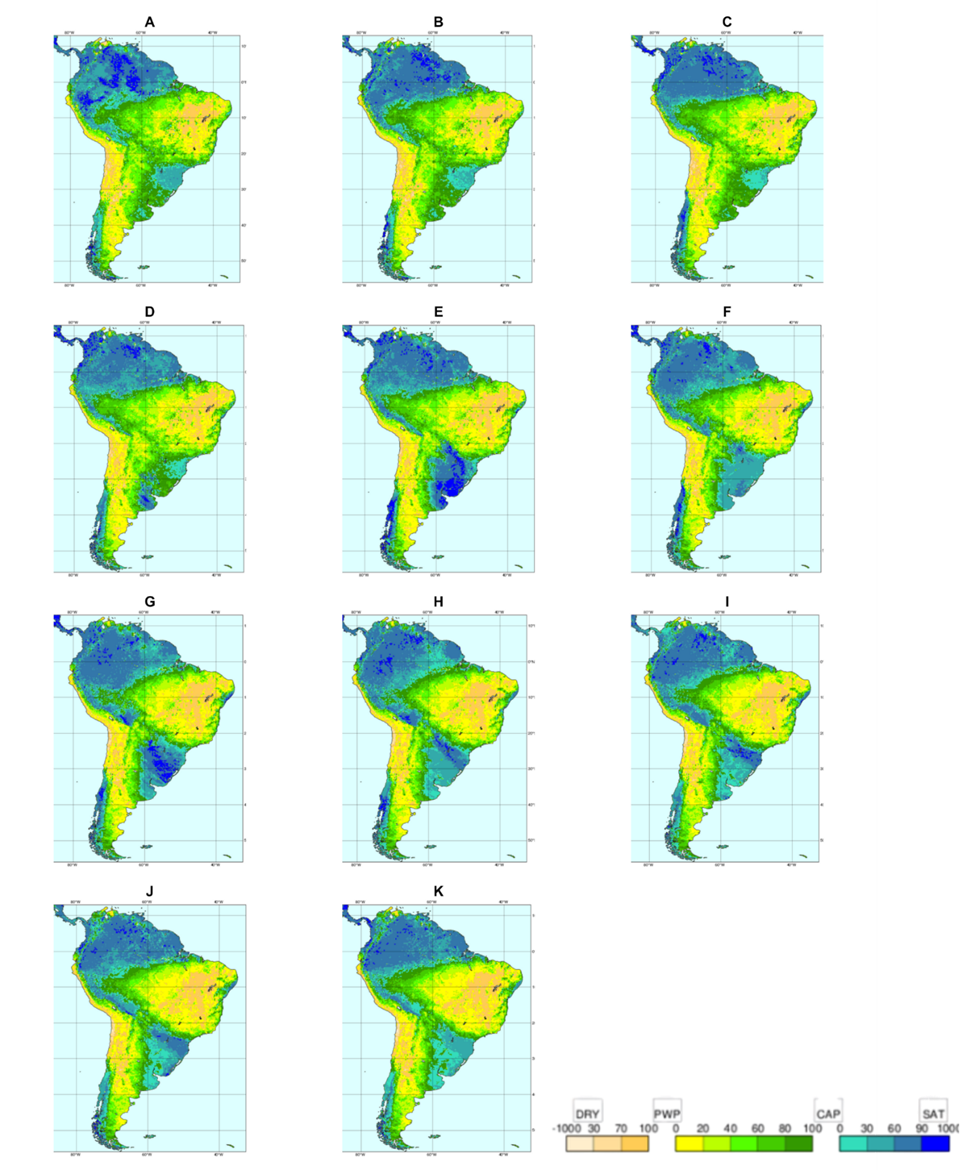
Soil moisture forecast for June 11–21, 2025, with daily maps: 11 (A), 12 (B), 13 (C), 14 (D), 15 (E), 16 (F), 17 (G), 18 (H), 19 (I), 20 (J), and 21 (K). Interpretation considers the topsoil layer and the following categories: Dry: dry soil. PWP (Permanent Wilting Point): water unavailable to plants. CAP (Field Capacity): optimal water retention. Sat: saturated soilimage 114109
Sources:ECMWF

In early June, a moderately strong cold front transported moisture across much of the Center-South of Brazil. The most benefited areas were Mato Grosso do Sul, southern Mato Grosso, and all of the Southern Region (except Rio Grande do Sul). Additionally, rainfall was recorded along the far eastern coastline of the Northeast, associated with humid trade winds from the ocean.

Forecast maps show a wide range of soil moisture conditions across the country. In some areas, the soil is nearing the wilting point (PWP)—when water is no longer available to plants—represented by yellow and brown tones. In others, the soil has reached field capacity (CAP) or even saturation, shown in green to bluish tones, indicating good or excessive water availability.

In western Brazil and peripheral regions, the soil shows intermediate moisture conditions (green-yellow tones), which support both harvesting activities and the transition into the dry season.

However, in the interior of the Northeast, there are already consistent signs of dry soil, with brown patches visible on the maps. These drier conditions are expected to expand further, possibly advancing into parts of the Southeast, as the dry days continue.

In the South, persistently high soil moisture levels reflect the continued influence of cold fronts. While beneficial for vegetation, excess moisture may delay grain drying and harvesting operations. Additionally, waterlogged soils increase the risk of plant diseases, requiring close attention to phytosanitary management.

In particular, Paraná and southern São Paulo should closely monitor soil conditions in the coming weeks to ensure effective harvest planning and mitigate potential losses related to excess moisture and disease pressure.

*When the topsoil layer is well hydrated, it becomes more manageable, reducing machinery effort and preventing soil compaction losses. Additionally, good moisture conditions at this final crop stage support plant health and help conserve the soil. This layer is also the most exposed to the environment, responding rapidly to sunlight, wind, and rain.


 

  • Coffee
  • Grains & Oilseeds
  • Energy
  • Renewable Fuels
  • Cocoa
  • Cotton
  • Sugar
  • Meats & Livestock

The StoneX Group Inc. group of companies provides financial services worldwide through its subsidiaries, including physical commodities, securities, exchange-traded and over-the-counter derivatives, risk management, global payments and foreign exchange products in accordance with applicable law in the jurisdictions where services are provided. References to over-the-counter (“OTC”) products or swaps are made on behalf of StoneX Markets LLC (“SXM”), a member of the National Futures Association (“NFA”) and provisionally registered with the U.S. Commodity Futures Trading Commission (“CFTC”) as a swap dealer. SXM’s products are designed only for individuals or firms who qualify under CFTC rules as an ‘Eligible Contract Participant’ (“ECP”) and who have been accepted as customers of SXM. StoneX Financial Inc. (“SFI”) is a member of FINRA/NFA/SIPC and registered with the MSRB. SFI is registered with the U.S. Securities and Exchange Commission (“SEC”) as a Broker-Dealer and with the CFTC as a Futures Commission Merchant and Commodity Trading Adviser. References to securities trading are made on behalf of the BD Division of SFI and are intended only for an audience of institutional clients as defined by FINRA Rule 4512(c). References to exchange-traded futures and options are made on behalf of the FCM Division of SFI . StoneX is a trading name of StoneX Financial Ltd (“SFL”). SFL is registered in England and Wales, Company No. 5616586. SFL is authorized and regulated by the Financial Conduct Authority [FRN 446717] to provide to professional and eligible customers including: arrangement, execution and, where required, clearing derivative transactions in exchange traded futures and options. SFL is also authorised to engage in the arrangement and execution of transactions in certain OTC products, certain securities trading, precious metals trading and payment services to eligible customers. SFL is authorised & regulated by the Financial Conduct Authority under the Payment Services Regulations 2017 for the provision of payment services. SFL is a category 1 ring-dealing member of the London Metal Exchange. In addition SFL also engages in other physically delivered commodities business and other general business activities which are unregulated and not required to be authorised by the Financial Conduct Authority. StoneX Group Inc. acts as agent for SFL in New York with respect to its payments services business. StoneX APAC Pte. Ltd. acts as agent for SFL in Singapore with respect to its payments services business. ‘StoneX’ is the trade name used by StoneX Group Inc. and all its associated entities and subsidiaries.
 
Trading swaps and over-the-counter derivatives, exchange-traded derivatives and options and securities involves substantial risk and is not suitable for all investors. Past performance of any futures or option is not indicative of future success. Indicators are not a trading system and are not published as a specific trade recommendation. The information herein is not a recommendation to trade nor investment research or an offer to buy or sell any derivative or security. It does not take into account your particular investment objectives, financial situation or needs and does not create a binding obligation on any of the StoneX group of companies to enter into any transaction with you. You are advised to perform an independent investigation of any transaction to determine whether any transaction is suitable for you. No part of this material may be copied, photocopied or duplicated in any form by any means or redistributed without the prior written consent of StoneX Group Inc.
 
© 2026 StoneX Group Inc. All Rights Reserved.

Satellite view of Earth at night showing illuminated cities across Asia and the Middle East

Discover more insights

Our subscribers have access to comprehensive market analysis from StoneX spanning commodities, equities, currencies and more.

Related articles for Coffee

Perspective: Morning Commentary for August 7

August 7 – The U.S. economy unexpectedly lost 23k jobs in July, dramatically below market expectations of an 80k increase and marking the worst Non-Farm Payrolls print since February. Furthermore, May and June were both revised sharply downward, with combined revisions showing 103k fewer jobs than previously reported. Outside of the healthcare sector, which added 22k jobs in July, the losses were very broad-based. Government payrolls saw the largest decline, shedding 53k jobs in July, the largest seen since October 2025, while June was revised down to show a loss of 10k jobs as well. The private sector at least saw growth, adding 30k jobs in July, now matching the month prior after it was revised down from the 49k initially reported, and substantially missing forecasts of 78k jobs being added. This is a sharp reversal in course from the largely better than expected U.S. labor data seen earlier this week.

Mike Castle
Mike Castle
  • Grains & Oilseeds
  • Energy
  • Dairy
  • Renewable Fuels
  • Cocoa
  • Coffee
  • Cotton
  • Sugar
  • Meats & Livestock
  • Forest Products

Daily Coffee Report 8/6/26

Daily coffee report

StoneX Coffee Team
StoneX Coffee Team
  • Coffee

Perspective: Morning Commentary for August 6

August 6 – This morning’s stronger-than-expected U.S. labor data offered markets some relief, reinforcing confidence in the economy while giving the Fed greater flexibility to raise rates should inflationary pressures reaccelerate in next week’s July data. Stock futures are pointing to a mixed open to start the day, with the tech-heavy Nasdaq showing the most weakness. The VIX has fallen notably from yesterday’s spike above 18.4 as it starts the day hovering just below the 16-mark. The dollar is quietly higher as it trades just above 99.8, holding in the tight range seen thus far this week as traders continue to digest data to shape expectations for the Fed’s next move, which we’ll dive into in more depth below. Long-term treasury yields have relaxed slightly from their recent spike, with 30-year yields starting the day trading just above 5.19%, while 10-year yields trade above 4.64%, and 2-year yields sit below 4.22%. Crude oil is modestly higher to start the session after sharp declines earlier in the week, with nearby WTI up 1.8% to trade at $76.40 and nearby Brent up 2.4% to trade at $81.40. Meanwhile, the ags are quietly mixed to start the day.

Mike Castle
Mike Castle
  • Grains & Oilseeds
  • Energy
  • Dairy
  • Renewable Fuels
  • Cocoa
  • Coffee
  • Cotton
  • Sugar
  • Meats & Livestock
  • Forest Products
StoneX: We open markets

Our market expertise, advanced platforms, global reach, culture of full transparency and commitment to our clients’ success all set us apart in the financial marketplace.

Reach

With access to 40+ derivatives exchanges, 180+ foreign exchange markets, nearly every global securities marketplace and numerous bilateral liquidity venues, StoneX’s digital network and deep relationships can take clients anywhere they want to go.

Transparency

As a publicly traded company meeting the highest standards of regulatory compliance in the markets we serve, our financials and track record are matters of public record. StoneX’s commitment to “doing the right thing over the easy thing” sets us apart in the industry and helps us build respect, client trust and new partnerships.

Expertise

From our proprietary Market Intelligence platform to “boots-on-the-ground” expertise from award-winning traders and professionals, we connect our clients directly to actionable insights they can use to make more informed decisions and achieve their goals in the global markets.