Volatility Watch: Summer Doldrums Arrive Despite Headline Risk
S&P 500, Treasury Bond, Gold, and Bitcoin Market Volatility Key Talking Points
- Despite relentless headlines, expected volatility across markets remains subdued relative to longer-term averages as we head through the proverbial “summer doldrums.”
- Gold’s anticipated volatility sits near the middle of the yearly range, while the yellow metal consolidates within its secular uptrend.
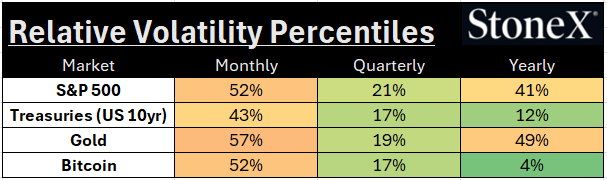
- Expected volatility for Bitcoin is in the lowest ventile (5%) looking back over the last year, reflecting the growing acceptance of Bitcoin as an emerging asset class.
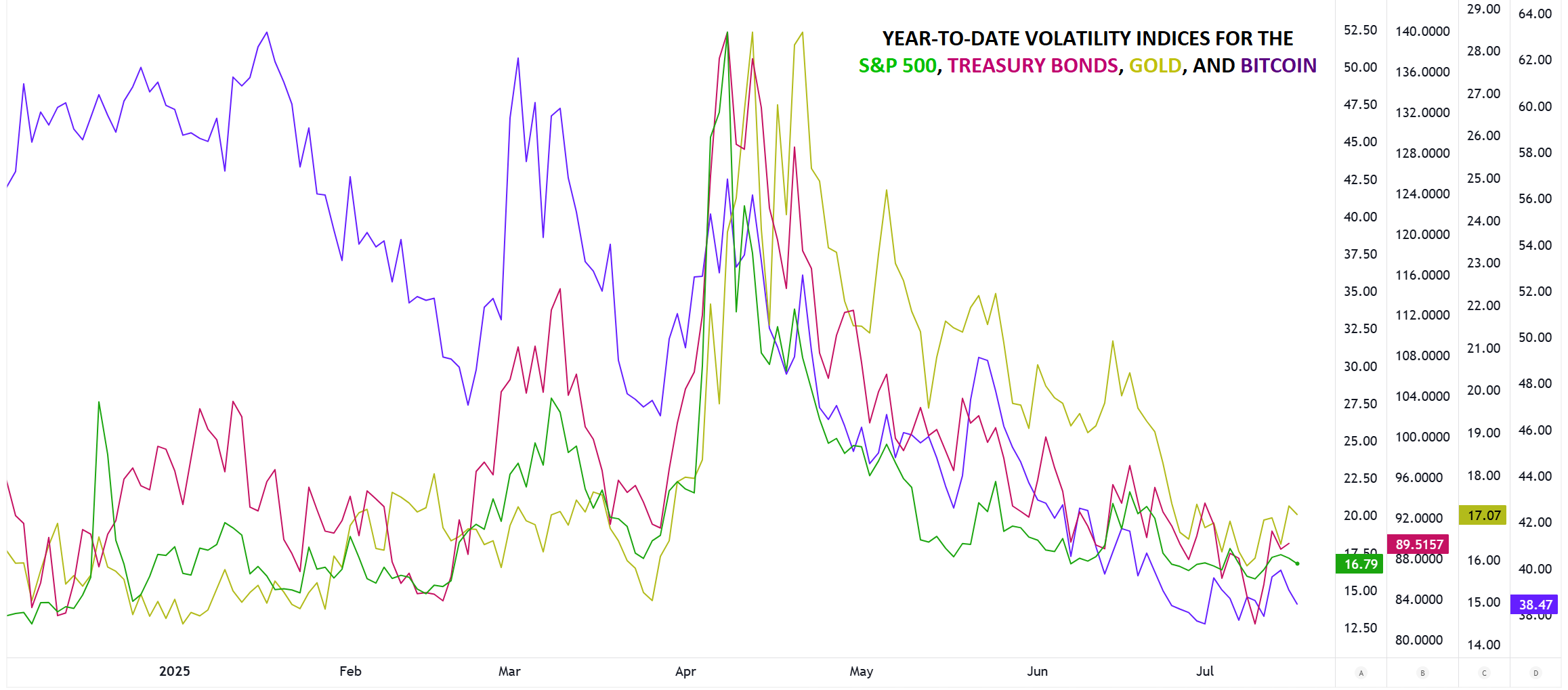
Below, we highlight how anticipated volatility in major markets has evolved so far this year, highlighting relative changes in expected market moves in the stock, bond, currency, and cryptoasset markets:
Source: StoneX, TradingView
As the table below shows, expected volatility for major markets currently sits in the middle of the range over the last month, but still generally low relative to the last quarter and year. Volatility in Bitcoin (DVOL) is particularly subdued, in the bottom ventile (in the bottom 5%) over the last month, quarter, and year:
Source: StoneX, TradingView
Detailed volatility outlooks for major markets follow:
S&P 500 Volatility Outlook (VIX)
Starting with the stock market, the VIX, Wall Street’s “Fear Gauge” of implied volatility in the S&P 500 remains below 18 as of writing, down more than two-thirds from the peak near 60 seen in early April. At this level, the VIX suggests that options traders expect daily moves of roughly 1.1% in the S&P 500 and weekly moves of about 2.5%. Compared to the average VIX reading of 19.5 since inception in 1990, anticipated stock market volatility over the next month is near average.
As of writing, we’re entering the Q2 earnings season, with analysts anticipating relatively low earnings growth near 5%. While ostensibly a downshift from recent quarters, these low expectations may set an achievable hurdle for companies to clear if the megatrend of AI-related capital expenditures continues unabated and operational efficiencies emerge.
Treasury Bond Market Volatility Outlook (MOVE)
Since the April spike, implied volatility in the Treasury bond market has trended consistently lower as traders pushed back any expectation of interest rate changes from the Fed until September at the earliest. With the MOVE index nearing its lowest level in 3.5 years and potential tail risks from US trade policy or the outside risk that President Trump fires Jerome Powell, there may be a case for volatility to pick up in the coming months, especially as leave the proverbial summer doldrums.
Gold Market Volatility Outlook (GVZ)
Gold itself continues to consolidate in a broad range between about $3150 and $3450, keeping the longer-term uptrend intact while allowing both realized and expected future volatility to recede back toward long-term baselines. As we’ve noted in previous reports, Gold is enjoying a secular bullish trend – which tends to bring generally lower volatility – amidst a falling US dollar and questions about the US’s position in the global economy. Expect continued bursts of volatility and quick reversions as long as the long-term uptrend remains intact.
Crypto Market Volatility Outlook (DVOL)
As in the far more mature stock, bond, and commodity markets, the outlook for Bitcoin volatility remains generally low. In fact, the expected volatility for Bitcoin is in the lowest percentile looking back over the last year!
As in the far more mature stock, bond, and commodity markets, the outlook for Bitcoin volatility remains generally low. In fact, the expected volatility for Bitcoin is in the lowest ventile (5%) looking back over the last year! Broadly speaking, volatility in the Bitcoin has generally declined since the blockchain’s “Genesis Block” in 2009.
Ultimately, growing acceptance of Bitcoin as an emerging asset class and a maturing set of increasingly institutional investors should continue to push Bitcoin’s volatility lower over time, regardless of near-term macroeconomic developments. Indeed, the simmering trade war appears to be supporting continued Bitcoin adoption as investors seek alternative investments outside traditional finance, potentially leading to rapid “buy the dip” behavior and even lower volatility until the current bullish cycle ends.
Looking ahead, the outlook for volatility broadly speaking could remain subdued through the (Northern hemisphere) summer given the long-term seasonal trends and lack of obvious immediate policy catalysts.
Follow the Global Macro Calendar
What are the major events and indicators on tap for the global economy that could charge volatility in markets and reshape deeper fundamental themes? Sign up for the updated Global Macro Calendar updated each week with a two week look ahead of the top events!
Sign Up
-- Written by Matt Weller, Global Head of Research, StoneX Self-Directed