

US ISM Data Points to Resilient Growth Across Manufacturing and Services
US ISM manufacturing and services PMIs signal resilient demand, although elevated prices and weaker services employment keep the Fed cautious.

Matt Simpson
- Interest Rates
By: Kathryn Rooney Vera, Managing Director and Chief Market Strategist
From the desk of our senior advisor, Jon Hilsenrath.
Summary: The Bureau of Labor Statistics reported a modest rise in its consumer price index in July, up 0.2% from June and up 2.7% from a year earlier, just shy of StoneX forecasts (+0.26% m/m, +2.8% y/y)). The increase was likely small enough to encourage Federal Reserve officials to reduce the target federal funds rate by a quarter percentage point to below 4.25% when they meet again in September.
Though inflation has run above the Fed’s 2% target for 53 straight months, officials will likely view consumer prices as stable enough to justify a reduction in interest rates, given recent signs of a weakening labor market. We have been saying a September cut was a close call and expressed concern about upside risks to inflation. Given the latest data, a rate cut looks likely, barring a surprise rebound in employment data for August or a surge in inflation readings before the Fed meets Sept. 17.

Skepticsm on an October Move: Having said that it is far from obvious that the Fed will quickly follow a September cut with another cut in October. Futures markets place a 66% probability on another cut in the fed funds rate in October to under 4%. That looks ambitious. If the Fed moves again, it likely will be in December and it will likely be twice this year, not three times.
Deeper Dive, Core of the Matter: Looking deeper at Tuesday’s consumer price data, there is reason to believe inflation will remain above the Fed’s 2% target for some time. The less-volatile core inflation index – excluding food and energy – rose 0.3% in July and was 3.1% higher than a year earlier (in line with StoneX forecasts of +0.31% m/m, + 3.03% y/y). Core inflation moved briefly to under 3% in the March through June period but resumed a modest uptrend. In June Fed officials projected core inflation would finish the year at 3.1%. Today we learned it is already near that mark, with tariff effects still seeping into national price data. In June Fed officials projected core inflation would finish the year at 3.1% … today we learned it is already near that mark, with tariff effects still seeping into national price data.
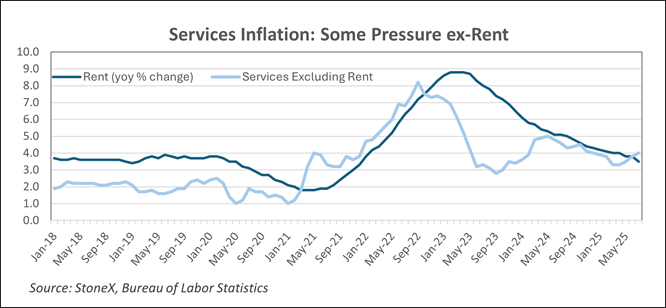
Rent Relief: The most important source of downward pressure is rent, which in July retreated to a 3.5% increase from a year earlier, the lowest rate since 2021. Inflation gain as much weight in the Fed’s favored personal consumption expenditure (PCE) price index, meaning downward inflation pressure in the Fed favors is more modest than in the CPI, a reversal of what happened during a rent surge in 2022 and 2023, when CPI outpaced PCE.
Services Pressure: Excluding rent, services prices were 4% higher in July than a year earlier, up from 3.3% in April. Medical care is causing some upward pressure – it rose 3.5% in July from a year earlier, after holding below 3% during the first six months of the year. The BLS’s next release of producer price index data Thursday warrants close watching, since PPI measures of hospital care feed directly into the Fed’s favored PCE price index, as does the PPI measure of airfares, which rose 4% in July based on the CPI measure.
The Tariff Story: On the goods side of the ledger, tariffs show signs of creating inflation pressure as expected – commodities less food and energy were up 1.2% in July from a year earlier, the largest increase in a couple of years. Import-heavy sectors showed scattered upward pressure, including furniture (up 0.9% for the month and 3.2% for the year); tools (up 1.6% for the month and 2.6% for the year); footwear (1.4% and 0.9%); car parts (0.9% and 2.9%); and window and floor coverings (1.2% and 7.2). Deflation in the consumer tech sector also shows signs of slowing. In the decade before the U.S. trade war with China started in 2018, consumer computer prices on average dropped 9% a year; in July they were down 2% from last year.
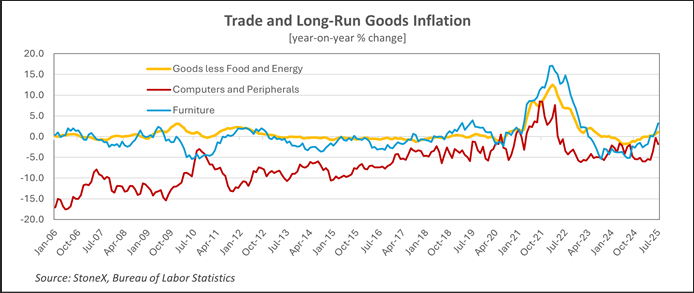
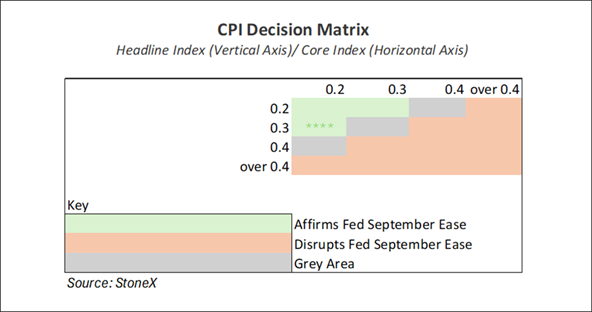
Globalization and an era of low tariffs created persistent downward pressure in goods prices during the 2000s and 2010s; since the U.S. adopted a pro-tariff strategy in 2018 core goods prices have tended to rise, and as the Covid episode showed, they’ve been vulnerable to supply shocks. This suggests that more of the work of holding inflation down must be done on the services side of the economy than before. Inflation has now held above the Fed’s 2% target for 53 straight months. The central bank doesn’t have the scope to ease aggressively as growth and hiring slow, unless it is prepared to lose credibility on returning to its 2% inflation goal. September ease is likely given the weak job market and another move in December remains in the cards. The futures market places a greater than 50% chance of three rate cut this year. That still looks improbable. The CPI report fell within the green zone of the CPI decision matrix that we circulated Monday, supporting our view that it moves the Fed toward a September ease.
The subsidiaries of StoneX Group Inc. provide financial products and services, including, but not limited to, physical commodities, securities, clearing, global payments, risk management, asset management, foreign exchange, and exchange-traded and over-the-counter derivatives. These financial products and services are offered in accordance with the applicable laws in the jurisdictions in which they are provided and are subject to specific terms, conditions, and restrictions contained in the terms of business applicable to each such offering. Not all products and services are available in all countries. The products and services offered by the StoneX Group of companies involve risk of loss and may not be suitable for all investors. Full Disclaimer. This content is not intended for residents of any particular country, and the information herein is not advice nor a recommendation to trade nor does it constitute an offer or solicitation to buy or sell any financial product or service, by any person or entity in any jurisdiction or country where such distribution or use would be contrary to local law or regulation. Please refer to the Regulatory Disclosure section for entity-specific disclosures. No part of this material may be copied, photocopied or duplicated in any form by any means or redistributed without the prior written consent of StoneX Group Inc. The information herein is provided for informational purposes only. This information is provided on an ‘as-is’ basis and may contain statements and opinions of the StoneX Group of companies as well as excerpts and/or information from public sources and third parties and no warranty, whether express or implied, is given as to its completeness or accuracy. Each company within the StoneX Group of companies (on its own behalf and on behalf of its directors, employees and agents) disclaims any and all liability as well as any third-party claim that may arise from the accuracy and/or completeness of the information detailed herein, as well as the use of or reliance on this information by the recipient, any member of its group or any third party.
© 2026 StoneX Group Inc. all rights reserved.
Our subscribers have access to comprehensive market analysis from StoneX spanning commodities, equities, currencies and more.
US ISM manufacturing and services PMIs signal resilient demand, although elevated prices and weaker services employment keep the Fed cautious.

Kevin Warsh's unexpectedly hawkish rhetoric in his debut press conference has challenged assumptions about the future direction of U.S. monetary policy and raised fresh questions about how independent the Federal Reserve can remain when markets come under pressure. As Treasury yields climb and risk assets weaken, investors are increasingly weighing whether inflation control or financial stability will ultimately shape the Federal Reserve's next move.

Kevin Warsh's first major test as Federal Reserve chair arrived just as June's jobs report badly missed expectations. The weak print rattled the dollar and opened a fresh window for Japanese intervention, though a single report is unlikely to shift the Fed's broader path.
Our market expertise, advanced platforms, global reach, culture of full transparency and commitment to our clients’ success all set us apart in the financial marketplace.
Reach
With access to 40+ derivatives exchanges, 180+ foreign exchange markets, nearly every global securities marketplace and numerous bi-lateral liquidity venues, StoneX’s digital network and deep relationships can take clients anywhere they want to go.
Transparency
As a publicly traded company meeting the highest standards of regulatory compliance in the markets we serve, our financials and record of accomplishment are matters of public record. StoneX’s commitment to “doing the right thing over the easy thing” sets us apart in the industry and helps us build respect, client trust and new partnerships.
Expertise
From our proprietary Market Intelligence platform, to “boots on the ground” expertise from award-winning traders and professionals, we connect our clients directly to actionable insights they can use to make more informed decisions and achieve their goals in the global markets.