Stocks Keep Rising But What Is Sustaining It: AI, Rate Cuts, Growth?
The major US equity benchmarks broached new record highs this past week, continuing a defiance of general fundamental threats. What is the market using for justification if pushed and what threats are set on the horizon?
Talking Points:
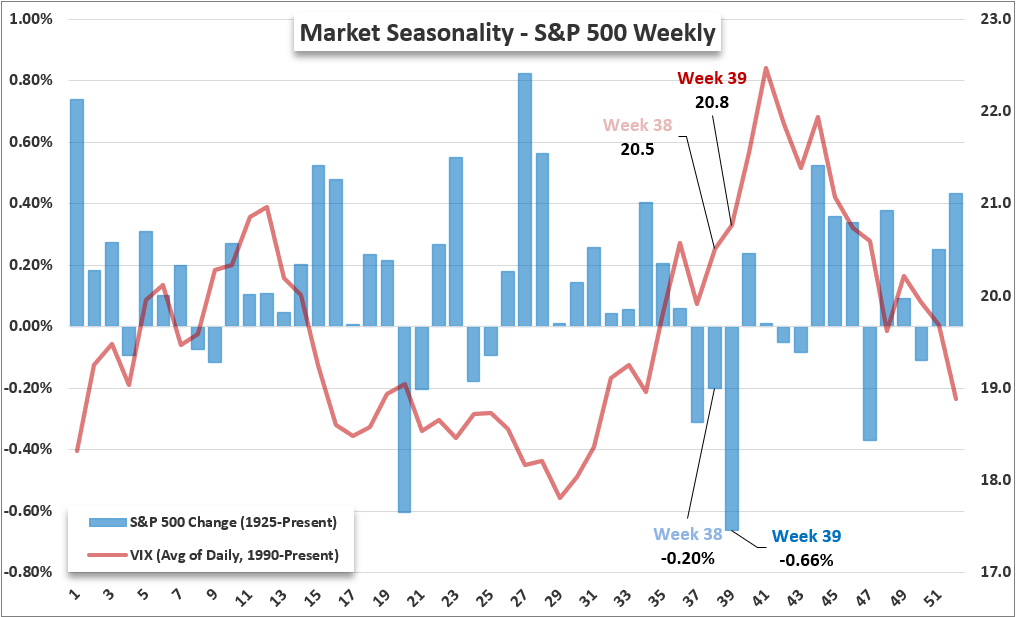
The 39th week of the calendar year has averaged out the worst week of the entire year looking back over 100 years of S&P 500 price action
Themes of fundamental concern have been readily sidelined by sheer speculative appetite, so what potential does scheduled event risk reasonably hold?
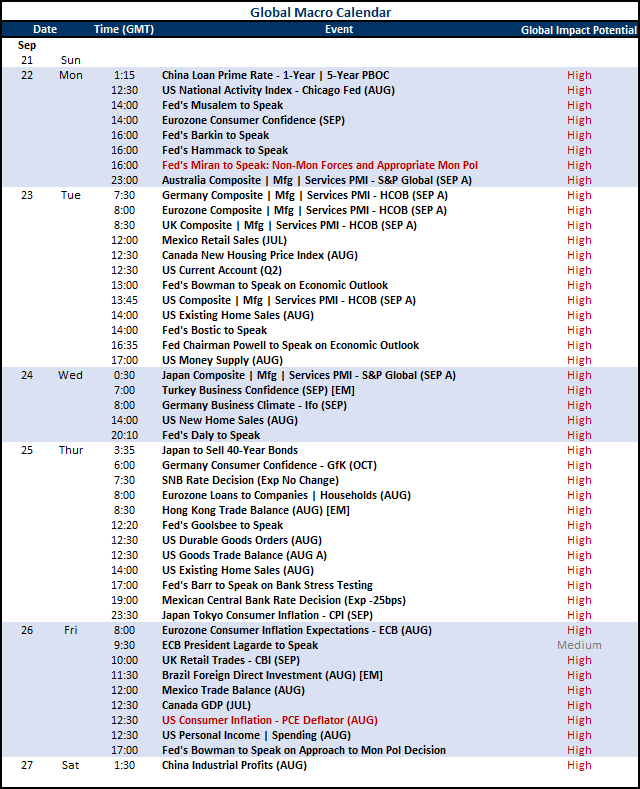
Top considerations for economic traction from the coming week’s calendar include a wide range of Fed speak, September PMIs and Friday’s PCE deflator
Expectations Run High on Speculative Reach Despite Seasonal Expectations
The markets continue to defy rumbling fundamental concerns and seasonal expectations to project their reach to record highs. The Nasdaq 100 and S&P 500 ended this past week at fresh record all-time-high closes. One may not find that unusual if they were to take the FOMC rate decision at its most basic – and charitable – interpretation as a market catalyst; but in reality, the potential inherent in the 25 basis point (bp) rate cut would have already been steeply discounted. Further, where AI is still quoted as a ‘reason’ for the market’s enthusiastic press higher despite more troubled conditions for traditional economics; the bullishness may not hold up to closer scrutiny. While markets may be pushing highs, conviction looks increasingly uneasy with their exposure and the ‘cost’ of building marginal exposure at these lofty heights.
S&P 500 and VIX Calendar Week Averages over 100 and 35 Years
Source: John Kicklighter, Standard & Poor’s
A Truncated Docket Without a Clear Fundamental Thread
That does not suggest that markets ‘have’ to reverse, but it does raise the risk that the speculative balance can reset with fairly limited warning. That is something to consider as we monitor the spotty course of systemically important themes (growth, monetary policy, fiscal deficits) against the backdrop of seasonal assumptions. The 39th week of the year – which we are entering – has averaged out the worst week for the S&P 500 in the 52-week calendar over the past century. We don’t have to fulfil that norm this year, especially given recent weeks’ divergence and skewed fundamental priorities, but it is remains a reminder against a backdrop otherwise defined by complacency.
Fed Speakers Look to Give Context After FOMC Decision Last Week
When looking for themes that may escalate to the level of importance that could redirect the river of speculative appetite, it is worth noting the run of Federal Reserve speakers scheduled over the coming week. Remember, the US central bank’s monetary policy update this past week. The group cut its benchmark lending rate 25bp to 4.00 – 4.25 percent as was heavily expected. However, the stated divergence from this moderate easing decision was very low. Further, the Summary of Economic Projections maintained that rate cuts through end of 2025 and 2026 wouldn’t be all that much more significant than was projected in the June update – and there was remarkably little easing projected to begin with. The measured easing of the US central bank relative to many peers already well into their dovish phase, and some significantly lower than the Fed’s benchmark, doesn’t seem to threaten significant escalation of the bearish view for the Greenback.
However, the US fiat’s issues may run deeper than a relative yield consideration. The anti-Dollar pressure has mounted against trade and fiscal policy that threatens America’s position in the global web. Looking over the calendar, there are a number of Fed speakers due to speak; and it is worth noting each person’s views at least in their first appearance after the rate cut. However, there are two outliers to pay special attention to: Fed Chairman Powell’s discussion of his economic outlook on Tuesday and White House-endorsed Stephan Miran’s discussion of ‘appropriate monetary policy’ on Monday.
Chart Monetary Policy Index of Economic Policy Uncertainty Index (Monthly)
Source: St Louis Federal Reserve Economic Database, Economic Policy Uncertainty Index
Growth Readings Have Been Trending Higher, But Beware Setbacks
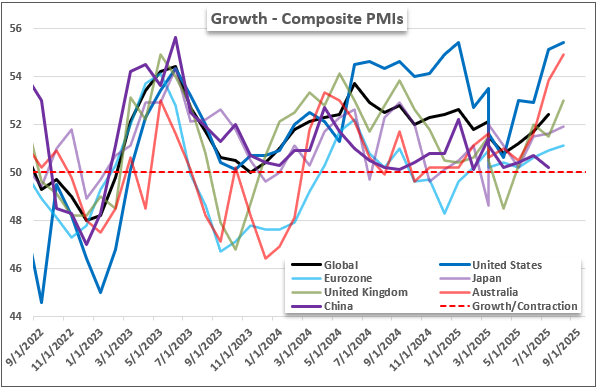
For more traditional consideration on the global macro docket over the coming week, we will have the run of advanced September PMI data from Standard & Poor’s for major economies from Tuesday through early Wednesday. There isn’t a particularly roaring endorsement from the consensus assessment of economic health and forward course in either data or policymaker forecasts. However, the last update from the PMIs seemed to reflect an impressive backdrop. The United States composite reading paced its major counterparts despite its headline-worthy shortcomings; but the overall trend was higher for further countries like Japan, the Eurozone, the United Kingdom and others.
Given the market is set to its default ‘long and lumber’ view, a favorable extension of growth forecasts would be welcome by macro bulls, but a tangible weakening could prove the more potent impact form the data. Should there by a throttling of economic activity in September, it would not bode well for challenging conditions expected moving forward.
Composite PMIs for Major Economies (Monthly)
Source: John Kicklighter, Standard & Poor’s
The Fed’s Favorite Inflation Indicator Due at the End of the Week
Of the top listings through the entire week, the peak event risk on the docket from my perspective is Friday’s PCE deflator. Monetary policy tweaks by the US central bank this past week certainly registered in market volatility, but few systemic trends were triggered despite a meaningful shift in policy stance – from neutral-hawkish to measured-dovish. It was remarkable that Fed Chairman Powell and crew did not yield to the White House’s heavy criticism suggesting the bank was too late and well off the projected appropriate target rate the President suggested. The Summary of Economic Projections barely lowered the 2025 and 2026 interest forecasts as growth and employment were seen moderating while inflation lurked in the background as a possible resurgent force.
In the dual mandate balance, the slow but steady rise in US unemployment is an economic trend that puts the policy group on edge; but so long as inflation readings remain uncomfortably high, there will remain a key dampener against more aggressive policy easing. With that same consideration, though, a softening in the Fed’s favorite price gauge could go a long way to offering the central bank its justification for stepping up accommodation.
Chart of DXY Dollar Index Overlaid With Implied Fed Cuts Through June 2026 (Daily)
Source: John Kicklighter, TradingView, ICE DXY Index, CME Fed Fund Futures
Follow the Global Macro Calendar
What are the major events and indicators on tap for the global economy that could charge volatility in markets and reshape deeper fundamental themes? Sign up for the updated Global Macro Calendar updated each week with a two week look ahead of the top events!
The subsidiaries of StoneX Group Inc. provide financial products and services, including, but not limited to, physical commodities, securities, clearing, global payments, risk management, asset management, foreign exchange, and exchange-traded and over-the-counter derivatives. These financial products and services are offered in accordance with the applicable laws in the jurisdictions in which they are provided and are subject to specific terms, conditions, and restrictions contained in the terms of business applicable to each such offering. Not all products and services are available in all countries. The products and services offered by the StoneX Group of companies involve risk of loss and may not be suitable for all investors. Full Disclaimer. This content is not intended for residents of any particular country, and the information herein is not advice nor a recommendation to trade nor does it constitute an offer or solicitation to buy or sell any financial product or service, by any person or entity in any jurisdiction or country where such distribution or use would be contrary to local law or regulation. Please refer to the Regulatory Disclosure section for entity-specific disclosures. No part of this material may be copied, photocopied or duplicated in any form by any means or redistributed without the prior written consent of StoneX Group Inc. The information herein is provided for informational purposes only. This information is provided on an ‘as-is’ basis and may contain statements and opinions of the StoneX Group of companies as well as excerpts and/or information from public sources and third parties and no warranty, whether express or implied, is given as to its completeness or accuracy. Each company within the StoneX Group of companies (on its own behalf and on behalf of its directors, employees and agents) disclaims any and all liability as well as any third-party claim that may arise from the accuracy and/or completeness of the information detailed herein, as well as the use of or reliance on this information by the recipient, any member of its group or any third party.
Our market expertise, advanced platforms, global reach, culture of full transparency and commitment to our clients’ success all set us apart in the financial marketplace.
Reach
With access to 40+ derivatives exchanges, 180+ foreign exchange markets, nearly every global securities marketplace and numerous bi-lateral liquidity venues, StoneX’s digital network and deep relationships can take clients anywhere they want to go.
Transparency
As a publicly traded company meeting the highest standards of regulatory compliance in the markets we serve, our financials and record of accomplishment are matters of public record. StoneX’s commitment to “doing the right thing over the easy thing” sets us apart in the industry and helps us build respect, client trust and new partnerships.
Expertise
From our proprietary Market Intelligence platform, to “boots on the ground” expertise from award-winning traders and professionals, we connect our clients directly to actionable insights they can use to make more informed decisions and achieve their goals in the global markets.