A De-escalation in US-China Trade Tariffs Has Buoyed the Base Metal Market, But for How Long?
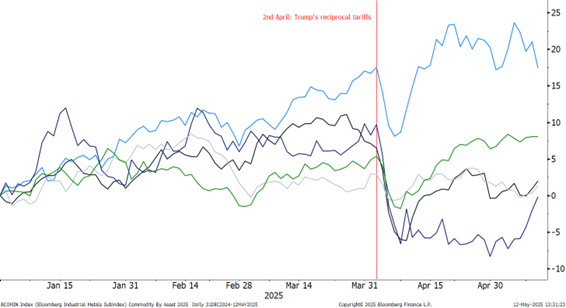
The base metal market has faced turmoil over the last six weeks, moving from the second-best performing commodity asset pre-2nd April ‘Liberation Day’ (supported by a weak US dollar, optimism over Chinese stimulus and tariff-independent supply risks), to the second worst performer upon rising global trade uncertainty, limiting the outlook for consumption growth. However, over the weekend, with a sharp de-escalation in global geopolitical tensions between China and the US, the outlook for base metals has strengthened. In the article below, we address the outlook for base metals in the weeks and months ahead.

The Parties commit to take the following actions by May 14, 2025:
The United States will (i) modify the application of the additional ad valorem rate of duty on articles of China (including articles of the Hong Kong Special Administrative Region and the Macau Special Administrative Region) set forth in Executive Order 14257 of April 2, 2025, by suspending 24 percentage points of that rate for an initial period of 90 days, while retaining the remaining ad valorem rate of 10 percent on those articles pursuant to the terms of said Order; and (ii) removing the modified additional ad valorem rates of duty on those articles imposed by Executive Order 14259 of April 8, 2025 and Executive Order 14266 of April 9, 2025.
China will (i) modify accordingly the application of the additional ad valorem rate of duty on articles of the United States set forth in Announcement of the Customs Tariff Commission of the State Council No. 4 of 2025, by suspending 24 percentage points of that rate for an initial period of 90 days, while retaining the remaining additional ad valorem rate of 10 percent on those articles, and removing the modified additional ad valorem rates of duty on those articles imposed by Announcement of the Customs Tariff Commission of the State Council No. 5 of 2025 and Announcement of the Customs Tariff Commission of the State Council No. 6 of 2025; and (ii) adopt all necessary administrative measures to suspend or remove the non-tariff countermeasures taken against the United States since April 2, 2025.
After taking the aforementioned actions, the Parties will establish a mechanism to continue discussions about economic and trade relations. The representative from the Chinese side for these discussions will be He Lifeng, Vice Premier of the State Council, and the representatives from the U.S. side will be Scott Bessent, Secretary of the Treasury, and Jamieson Greer, United States Trade Representative. These discussions may be conducted alternately in China and the United States, or a third country upon agreement of the Parties. As required, the two sides may conduct working-level consultations on relevant economic and trade issues.
Source: whitehouse.gov
What do you need to know?
- From 12:01am (EST) (0401GMT) on 14th May, China and the US will reduce trade tariffs rates on each other by 115%.
- This will result in total US tariffs on China standing at 30% (including the original 20% tariffs placed on China over February and March based on China’s reported failure to prevent fentanyl exports). Total Chinese tariffs on US good imports will stand at 10%.
- The US Administration has also announced that “de minimis duties” will be reduced to 54% from 120%, with a flat fee of $100 to remain. This is a reversal in stance from President Trump, who back in February ended the de minimis exemption by imposing a tax of 120% of the package value or a planned flat rate of $200 (set to come into effect in June). Note, the De Minimis Tax Exemption is a law that Congress passed on a bipartisan basis that allows shipments bound for American businesses and consumers valued under $800 (per person, per day) to enter the U.S. free of duty and taxes.
BBG Commodity Asset Price Performance YTD
Source: Bloomberg
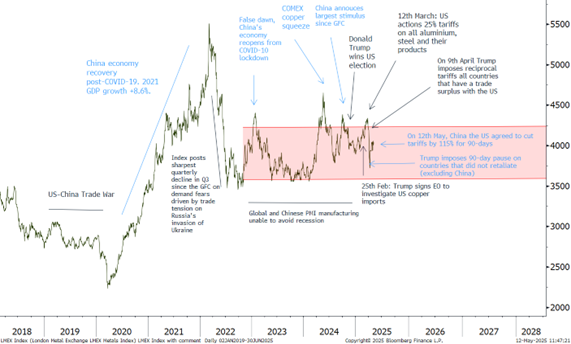
LME Base Metal Index
Source: Bloomberg
If we look at the price performance of the LME Base Metal Index (LMEX Index) over the last eight years, there are two key takeaways:
Firstly, an escalation in geopolitical tensions is in our view one of the most significant downwards risks to our price forecasts.
Indeed here, while geopolitical tensions can impact a commodity market in two ways
- A risk channel which is where financial markets overestimate the impact on supply resulting in higher prices (e.g., In Q1 2022, when Russia invaded Ukraine, copper, nickel, aluminium and tin recorded a record nominal high).
- An economic activity channel, with a shock to economic growth creating uncertainty in investment and demand, leading to lower prices.
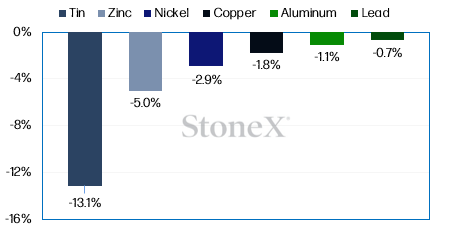
On average in base metals, we see the economic activity channel as having a longer lasting impact on prices. Over 2019 during the trade war between China and the United States, base metal prices were trapped in a sideways trading pattern. Meanwhile in Q3 2022, upon Russia’s invasion of Ukraine, base metals recorded the weakest quarterly performance since the GFC (base metals were the weakest performing commodity sector that year). Fast forwarding to where we are now, the move from US President Trump on 2nd April announcing reciprocal tariffs on all trading partners, alongside 100% tariffs on Chinese goods, resulted in each metal of the suite recording a negative price performance.
LME 3M Base Metal Price Performance (2nd April-12th May 2025)
Source: Bloomberg
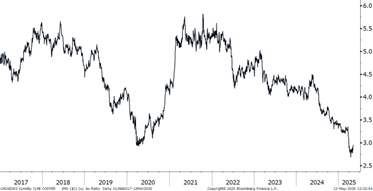
Copper: Gold Ratio
Source: Bloomberg
Secondly, over the last two and half years, it appears as though the LME base metal index has found itself a ‘new normal’ trading range, following the dramatic market moves inflicted by COVID-19.
Since the start of 2023, the LMEX index has been unable to successfully hold above this sideways trading channel.
Example of false dawns:
January 2023: The first time (since March 2020) that China reopened its borders to international visitors, dropping all zero-COVID restrictions.
May 2024: Investor speculation over copper’s long-term use in the green and digital transition versus a looming structural supply shortage caused a short squeeze on COMEX.
September 2024: China announces plans to release its largest level of stimulus since the GFC in order to support domestic growth.
March 2025: Tariff-driven supply risks creating temporary tightness within global supply chains for key metals such as aluminium and copper.
If we address these two key takeaways with current market developments, we expect a reduction in geopolitical tensions to provide only modest support to base metal prices in the near-term, with the impact of global tariffs yet to be fully reflected in hard economic data readings, while a further escalation in sector specific tariffs should not be ignored.
Key areas challenging the outlook for global industrial demand:
-
Global trade tariffs are reduced, although the risk of future escalation remains
While trade tariffs between China and the US are set to reduce by 115% on 14th May, the US administration continues to implement both broad based and sector specific tariffs on a global basis.
Snapshot of Current US Tariffs
|
Country/ Sector |
US Tariff Level |
Retaliation? |
|
China |
30% (from 13th May will enter 90-day consultation period) |
10% |
|
Canada & Mexico |
25% (excluding goods USMCA, oil at 10%) |
Canada 25% |
|
All other trading partners (ex-China, Canada, Mexico) |
10% (from 5th April will enter 90-day consultation period) |
EU pending |
|
Automotive & Parts |
25% (manufacturers of vehicles in the US will receive credit of the total manufacturers’ suggested retail price value that can be applied to duty free parts imports. 3.75% credit (3rd April-30th April), 2.5% second year. | |
|
Aluminium & Steel |
25% |
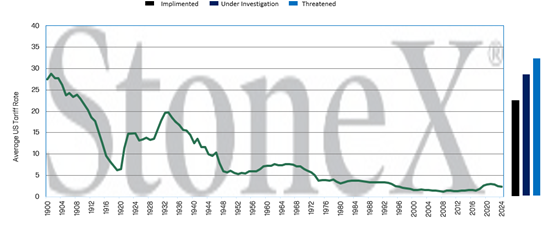
In addition, we expect potential tariffs of up to 25% to be announced on pharmaceuticals, semiconductors, timber/lumber, copper and critical minerals in the months ahead.
The Outlook for the US Average Effective Tariffs Rate
Source: Bloomberg
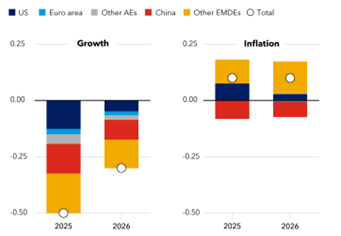
The IMF Downgrades Global Growth in April
|
IMF Global GDP Growth Forecast |
2025 |
2026 |
|
April meeting |
2.8% |
3.0% |
|
January meeting |
3.3% |
3.3% |
Source: IMF
IMF Global Outlook Spring Meeting “The Global Economy Enters a New Era”
Source: IMF
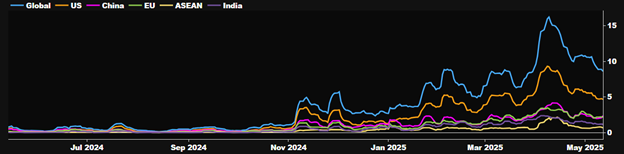
Trade Policy Uncertainty Remains Highly Elevated
Source: Bloomberg
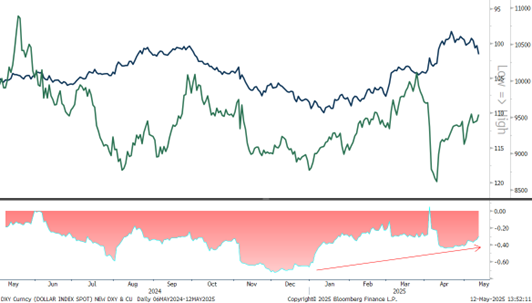
in the US Dollar Have Only a Modest Impact on Copper
Source: Bloomberg
-
Chinese Q2 growth prospects remain challenged despite stimulus efforts
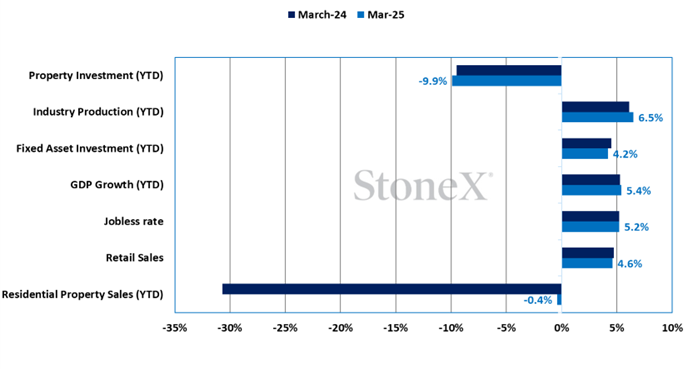
Over the last week (US-trade tariff reduction aside), Chinese policy makers have acted with urgency to provide broad based support to its economy upon the reality that on a Y/Y basis, hard economic data readings continue to disappoint. Indeed based on March figures Y/Y, while GDP growth and industrial production (IP) outperformed levels in 2024, we continue to see weaker retail sales (RS), fixed-asset investment (FAI) and an unchanged jobless rate, while property investment continues to record deeper declines. If we combine this with the fact that China’s Q1 GDP growth was supported heavily by front-loading of exports ahead of tariffs (~40% of total), the outlook for Q2 growth is turning more precarious for the largest producer and consumer of base metals.
On 7th May, Chinese policy makers (including the PBoC Governor Pan Gongsheng, China’s Securities Regulatory Commission Chairman Wu Qing and Head of the National Financial Regulatory Administration Li Yunze) announced broad based stimulus efforts:
- On 8th May, the PBoC will cut the 7-day reverse repo rate to 1.4% from 1.5%.
- On 15th May, the PBoC will cut the reserve requirement ratio (RRR) by 0.5%, with an aim of releasing 1tr yuan ($139Bn) in long-term liquidity.
- The RRR for automotive financial companies and leasing firms will be cut to 0.0% from 5.0%.
- Rates on structural relending tools for commercial lenders and pledged supplementary lending for policy banks will each decline by 0.25%.
- The housing provident fund loan rate will drop by 0.25%.
- The quota for technology relending loans will increase by 300Bn yuan to 800Bn yuan to support equipment upgrading, a consumer goods trade-in programme.
- A 500Bn yuan relending tool will be set up for services consumption and elderly care.
- The allowance for the relending tool for agriculture, small and medium-sized enterprises will be expanded by 300Bn yuan.
- Two stock market support tools with a total quota of 800Bn yuan will be combined
- A debt risk-sharing tool will be created allowing the PBOC to provide low-cost relending funds to encourage purchases of bonds of technology firms.
March Y/Y Comparison of Hard Chinese Economic Readings
Source: Bloomberg
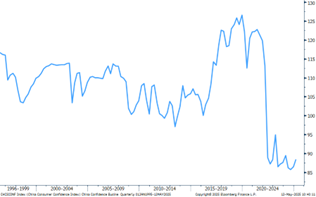
Chinese Consumer Confidence
Source: Bloomberg
China at Risk of Deflation
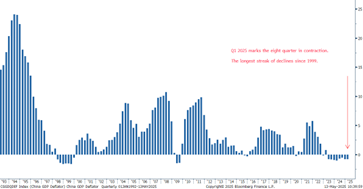
Source: Bloomberg
-
US monetary policy on hold for now?
A mixed picture between weakening soft economic data versus stable hard economic data of late, alongside rapidly changing trade policy, is likely to keep the Federal Reserve on pause when it comes to monetary policy decisions in the months ahead. This is especially true given the absence of a deterioration in the labour market, while the impact from tariffs on inflation is yet to be fully realised.
In our view, despite the pressure being placed on Federal Reserve Chairman Jerome Powell from President Trump to cut rates. We expect that the Federal Reserve will remain data dependent and continue to hold true to its dual mandate goal of balancing maximum employment and price stability in the country. Therefore, we forecast we will likely face just 0.5% of cuts this year, with the Fed likely on hold until at least June, before a decision can be made on monetary policy action.
LMEX Index & Copper Prices Post 100bps Decline in US 2Y Yields
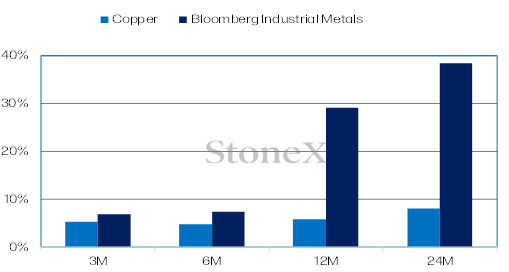
Source: Bloomberg
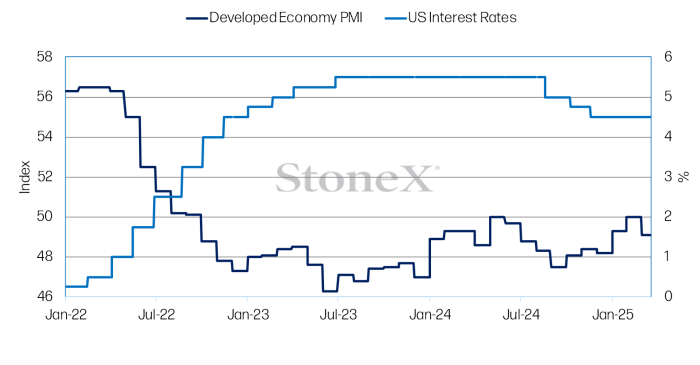
 Advanced Economies PMI Manufacturing Versus US Rates