Global
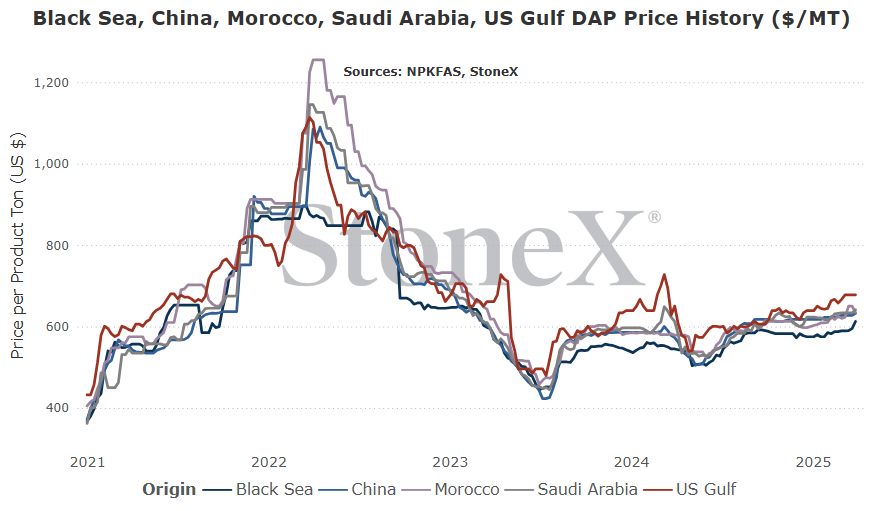
I think the global phosphate world has an issue and that issue is China.
Now, any rumors/stories/etc. linked to China always need to be taken with a bit of skepticism. It is VERY hard to find accurate info when it comes to future strategies. However, given how the last couple years have gone, the chance that China may further slow exports is certainly possible.
The recent storyline rumor has been that the Chinese government is going to further restrict exports of urea and phosphate. Recent strategies have checked both the boxes they set out to hit on: lower domestic prices and higher domestic inventories. So putting more restrictions in place would only make that better for their people.
If this strategy rumor becomes reality, the world will have a bigger issue on its hands in the form of higher prices.
Fortunately, we continue to hear that Saudi Arabian production is looking to increase...but that will take some time. It isn't as though they can wave a wand and their production increase millions of tons.
I do believe we will see values a bit softer as we move into Northern Hemisphere months. However, I think that price decline will mostly be muted by fears of Chinese exports slowing further. If China scales back, it will be very hard to see a substantial resetting of values.
Basically, the price floor keeps rising...

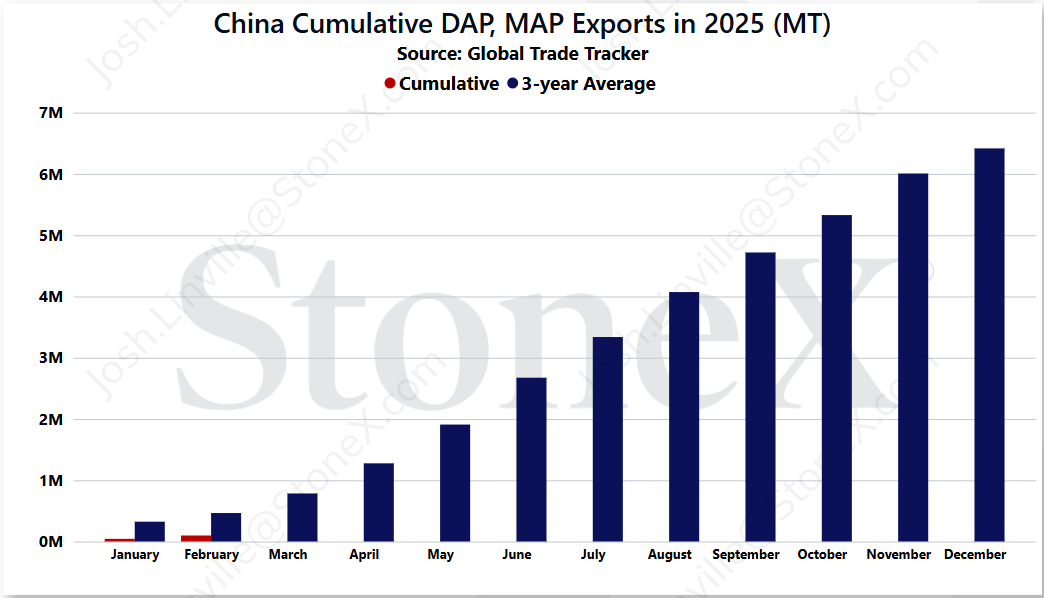
China Jan/Feb export data reflects very low exports, concerns rise globally
One of the big stories in fertilizer the last couple years, and a large part of why phosphate prices are so high globally, has been tied to lower Chinese flows.
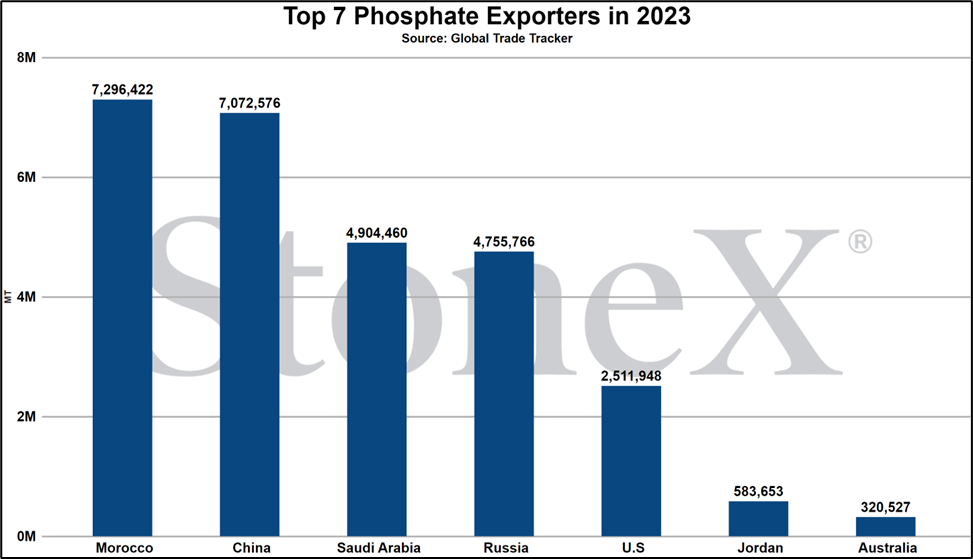
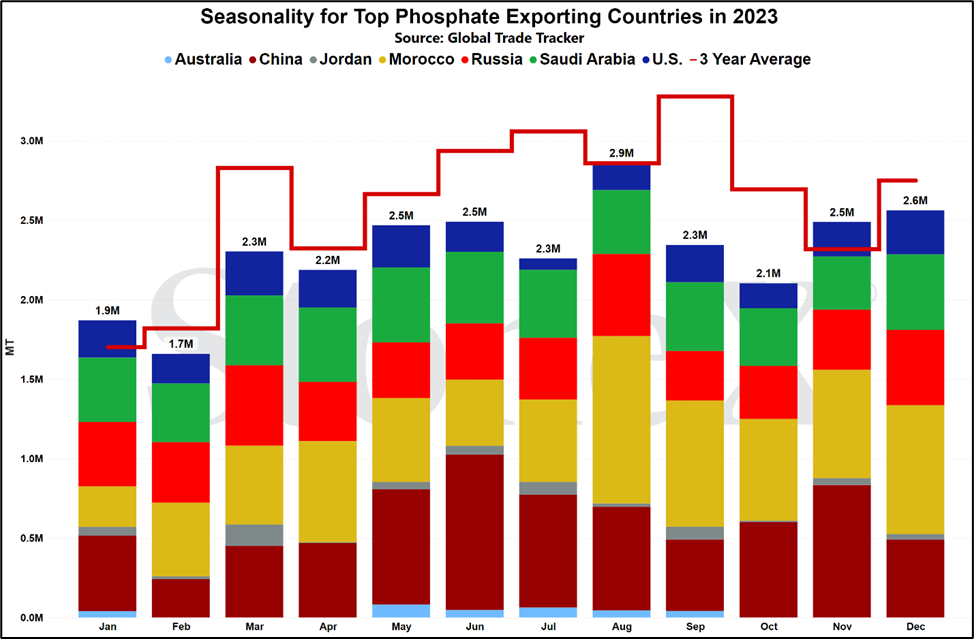
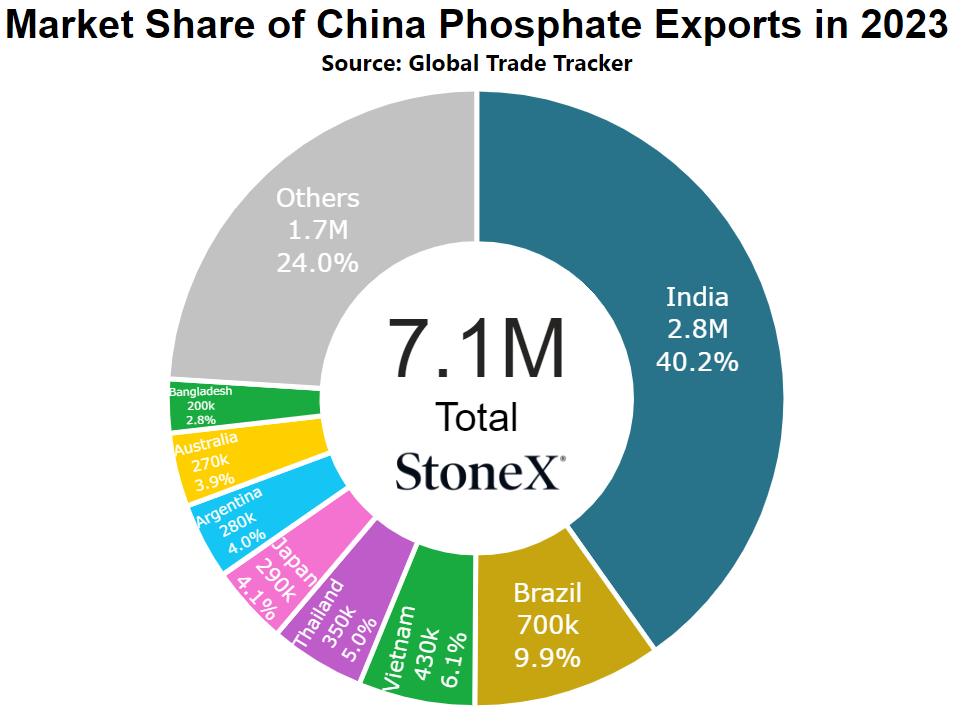
China has historically been the world's largest exporter with flows typically hitting 10M tons. That all changed after 2021. Since that time, their exports for DAP/MAP have been:
- 2022 - 5.6M
- 2023 - 7.1M
- 2024 - 6.6M
That is nearly 11M tons of DAP and MAP that have been removed from the global market over a 3-year span. How did it come to this?
When it comes to China, it is easy. It is government dictation. In late 2021, global fertilizers (phosphate included) saw prices skyrocket and fears build of product shortages. The Chinese government saw what had been happening and decided to take action. Rather than continue to supply the world, the government started to restrict exports with two goals (similar to urea):
- Ensure adequate domestic supplies
- Lower domestic values vs the world
They were successful on both fronts which was a loss for the world.
Anyone who had been hoping for these restrictions to be loosened in 2025 have been sorely disappointed.
January and February combined for only 98,000 tons exported. Even vs a fresh 3-year average export total which only reflects around 6.5M tons, this is significantly behind.
To make matters worse, there continue to be conversations in the fertilizer world that China may never resume their export place. While more of these conversations have centered around urea which is considered more an energy product, phosphate has been included in rumors/fears that these export restrictions are here to stay. The largest block of people in China are attached to agriculture. Keeping phosphate price low and well supplied helps to keep their biggest population happy.
Now, never count China out. As soon as we think we have them figured out, they do something completely different. We could see Chinese exports surge any day and it would not surprise me one bit...but that is not our current expectation. The current expectation is that lower than normal exports will become the norm. The fear factor is that significantly lower exports on phosphate will be the 2025 story.
What does this mean for Aussie farmers?
Long story short: with Chinese exports extremely low, global supplies remain tight and prices remain high. That will continue to buoy global price ideas, giving very little to no reason for Aussie prices to fall anytime soon.
Any market in the world is going to struggle to drop prices when the largest supplier pulls back like China did. There isn't a farmer in the world that isn't seeing the effects one way or another. Normally by this time of year, you might start to see some nervous sellers emerging as demand dries up. This year likely doesn't see that happening as long as China remains on this road.
Mosaic, N.A. largest phosphate producer, points to higher production outlook
While the major N.A. phosphate story over the last several years has been focused on U.S. tariffs against Russia/China/Morocco, another story has been lurking that is just as important.
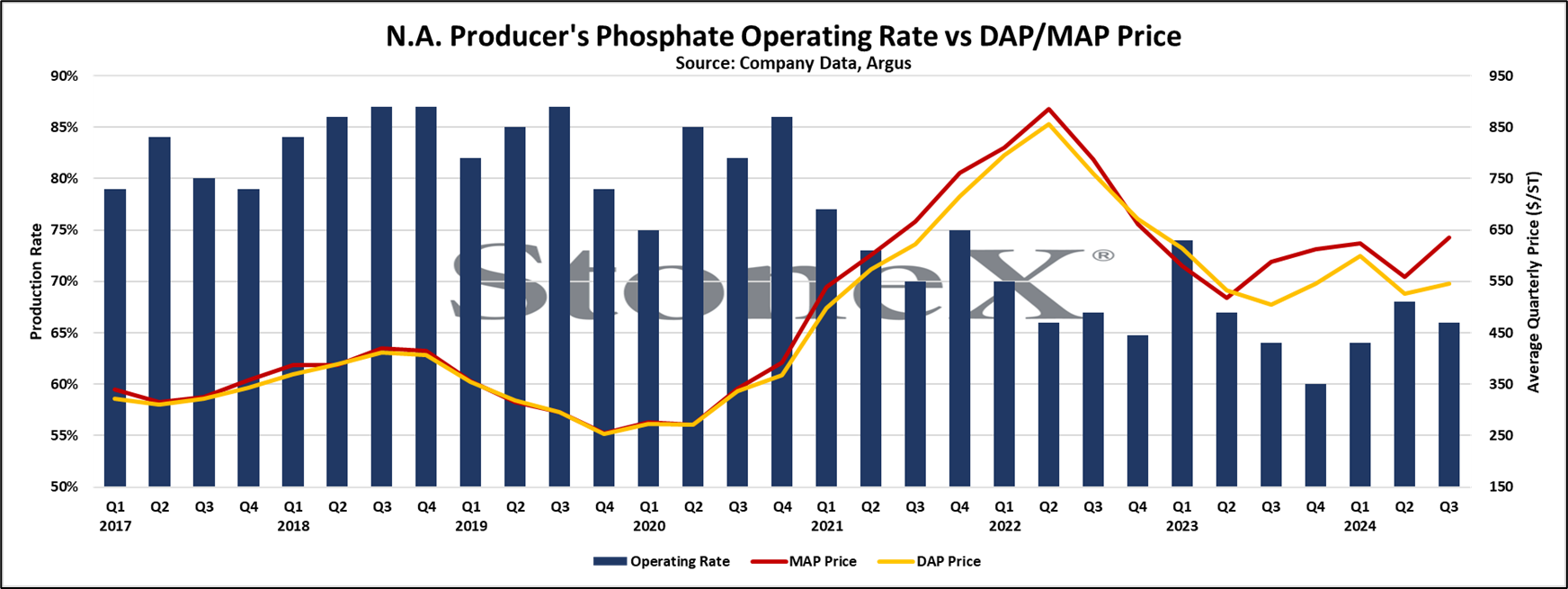
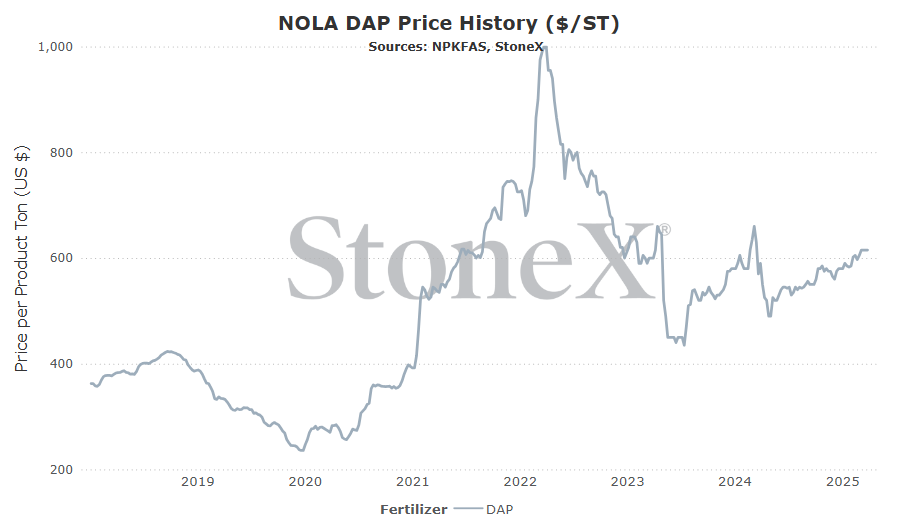
Prior to 2021, U.S. phosphate operating rates ran very well. So well that anytime the quarterly rate dropped below 80%, it was cause for concern and typically took a god like event to cause it. However, starting in 2021, operating rates have struggled to hit 75% and have only hit it/come close twice (Q4 '21 / Q1 '23). The graph below shows the operating rate by quarter, but has not been updated to Q4 '24. We now know that total...a fresh historic low of 58%.
Many people will point to this as a manual push by manufacturers to keep supplies tight and prices high. While I understand the POV and the anger associated with it, I do not share that. NOLA phosphate levels, except for some break out periods during peak demand, has largely been in line with global phosphate values. That means that NOLA phosphate has been ebbing and flowing with global prices that have done the same. Much of the N.A. high phosphate story is due to the lack of Chinese exports and heavy demand elsewhere around the world.
There has been signs of hope. During the most recent quarterly earnings call, massive N.A. phosphate producer Mosaic made mention of their hopes that operating rates will return to normal. They have been putting big efforts into restoring production, which makes sense looking at current market values. Why would a company reduce production purposefully in a period that has them making more money per ton than most other periods in history? Mosaic should be pressing to produce every ton possible, but equipment and facilities fail.
If these statements had been made a dinners/meetings/etc., I wouldn't be as excited. These types of comments can be made off the cuff. However, making these statements on something as important as an earnings call means they believe it. They are making these statements to their stock owners. The same stock owners that drive their retirement packages! Not wise to make promises you cannot keep in that scenario!
While having phosphate production return to normal will not solve every issue, it will certainly help free up more tons for the market. At this point, we will take any win we can get.
What does this mean for Aussie farmers?
Long story short: when one of the world's 5 largest phosphate producing nations starts to talk about increasing production rates, that means higher global supplies, and hopefully lower global values.
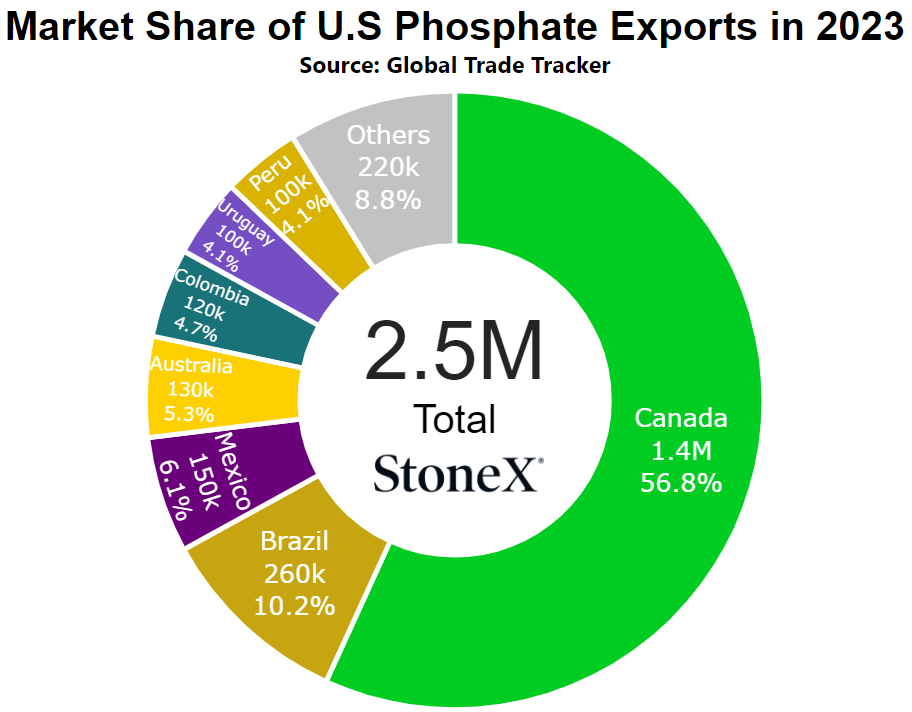
You might be scratching your head as to why I'm including this very U.S. centric story for the Australian update. It is because the U.S. is normally a top 5 producing and exporting nation for global phosphates. What happens there does matter to the world.
U.S. production has been suffering in the last few years, creating a situation where they need to import more product from places like Saudi Arabia. If they can get their production back to normal, that pushes back on those import needs. If Saudi Arabia loses that destination opportunity, those tons will look for new homes around the world.
The net result is lower global demand, higher global supplies, which should mean lower prices...hopefully.
President Trump tariff's could upend global phosphate trade routes
The biggest story of this week has been President Trump announcing tariff's on nearly every country around the world. Like most markets, fertilizer was left scratching its head and wondering what it would mean.
To have a better understand, we have to know where the U.S. phosphate market was to start with.
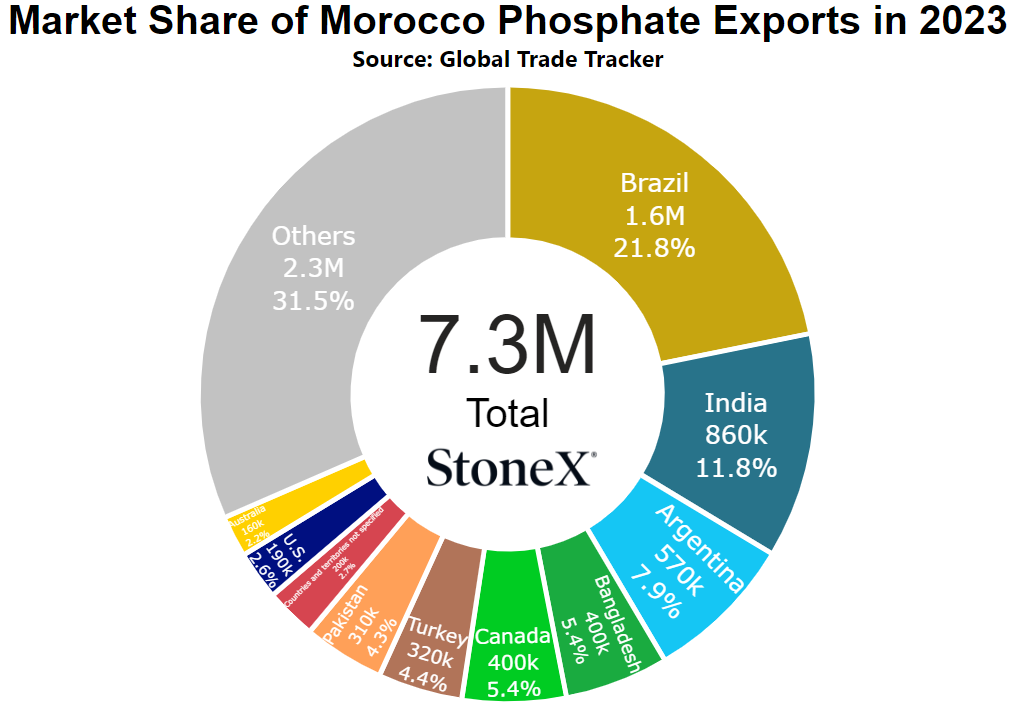
Tariff's were already in place against 3 of the 5 largest exporters in the world. Morocco/Russia/China all had tariff's in place in regards to phosphate and have been unwilling to send product there, even when the prices made sense. Rather than pay the tariff, they would rather support other free flowing customers.
The U.S. is one of the 5 top exporting nations, but production rates have been struggling the last few years (as shows in the graph above). While their export flows have slowed since production started to struggle, there have been tons leaving which has raised their import needs. Saudi Arabia quickly filled that void as they were one of the largest exporting nations and had no penalties/tariffs in place.
However, now that Trump made his announcement, that is no longer the case.
U.S. buyers are now left to wonder what will happen. North America has been hopeful that operating rates would improve and help lower the need for imports. The jury is still out whether North American phosphate production can cover North American phosphate demand, getting operating rates back to 80 - 90% would be a huge win.
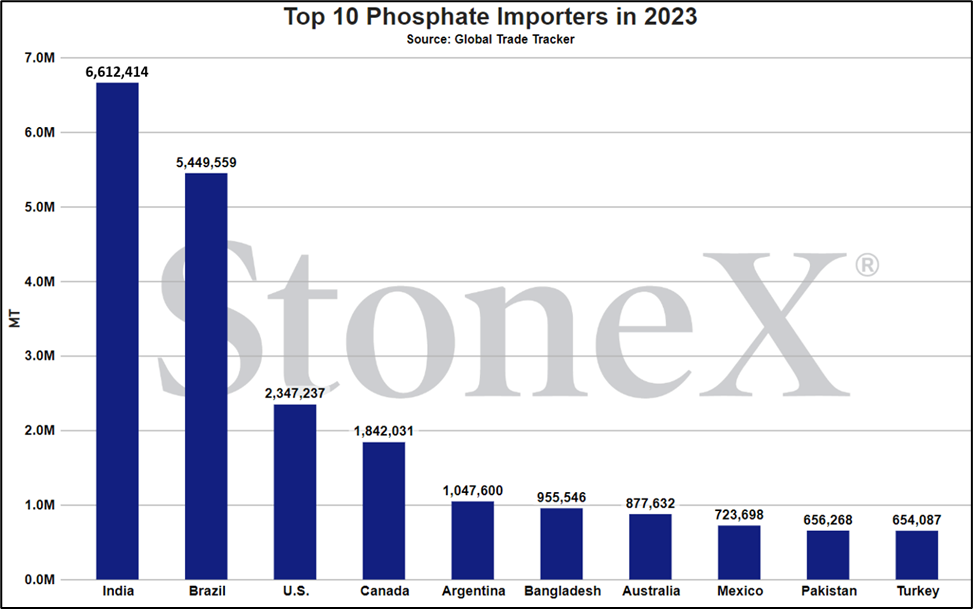
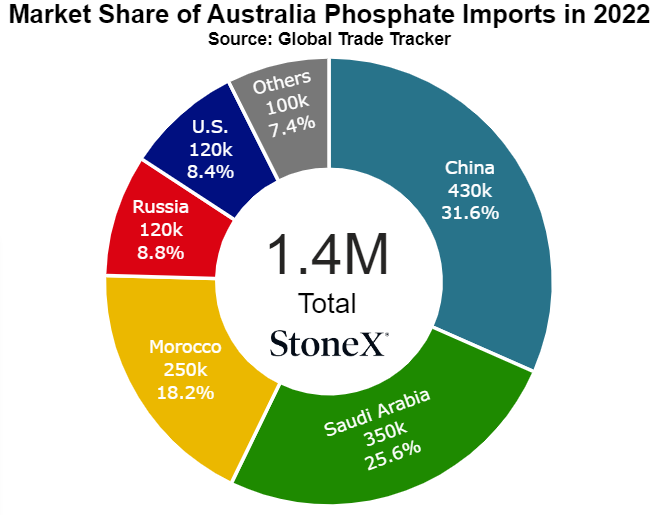
If that happens, the next question is where the flows that would normally come from Saudi Arabia would go. If the U.S. is much less the buyer they had been, those tons need to find a home somewhere. This is where buyers in places like Australia can rejoice a bit. Given the size of buyer that Australia is, no doubt this will become a more popular destination which could help alleviate some high prices.
Today, it is still too early to know all the details.
What does this mean for Aussie farmers?
Long story short: if the U.S. keeps tariffs in place long term and/or their production improves, it allows more tons to be available globally which should help soften price ideas.
There are a lot of moving parts with this. We do not know how nations around the world will respond to the tariffs. We do not know how long tariffs will remain in place. We do not know how U.S. operating rates will change in the coming months.
The hope is that it will all conclude with helping to lower global phosphate prices, but this will be a work in progress.
Price comparisons
Vs 30 days ago - 2% or approximately $10 higher
Vs 90 days ago - 6% or approximately $35 higher
Vs 6 months ago - 12% or approximately $65 higher
Vs 1 year ago - 4% or approximately $25 higher
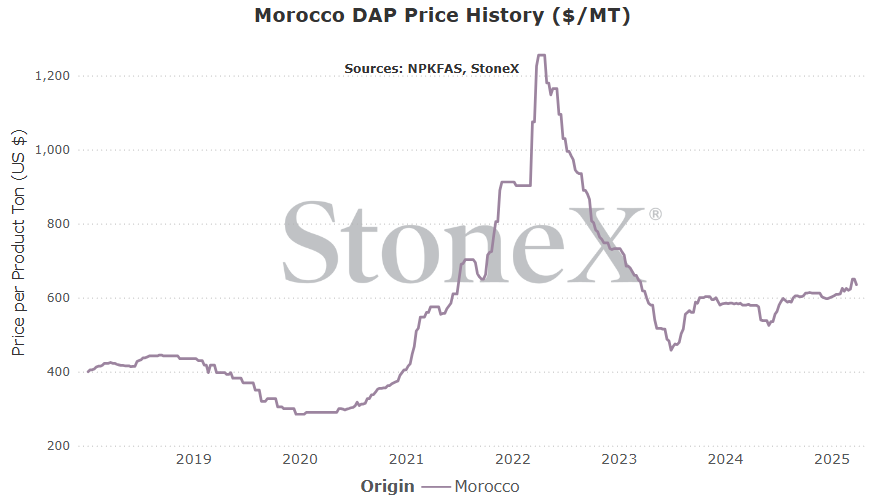
Morocco DAP price comparison
Number 1 global exporter in 2022
Price comparisons:
Vs 30 days ago - 2% or approximately $15 higher
Vs 90 days ago - 5% or approximately $33 higher
Vs 6 months ago - 5% or approximately $30 higher
Vs 1 year ago - 10% or approximately $56 higher
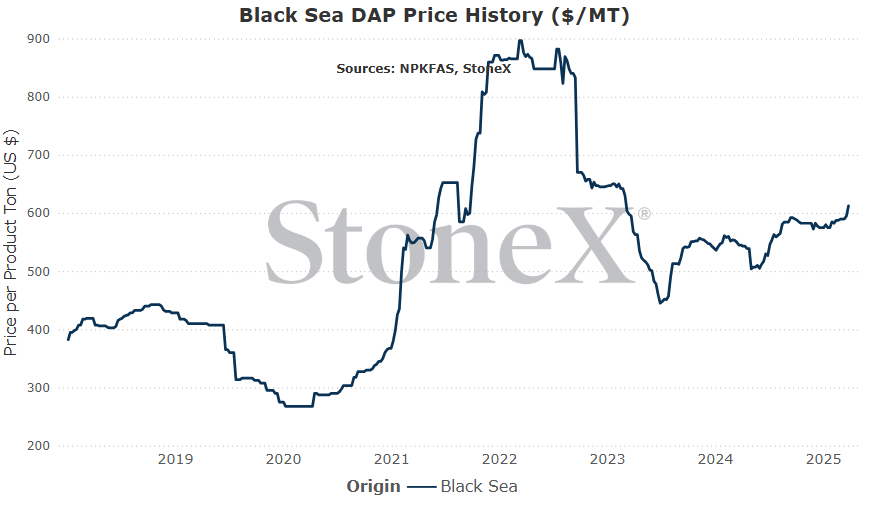
Black Sea DAP price comparison
Number 3 exporter of DAP/MAP in 2022
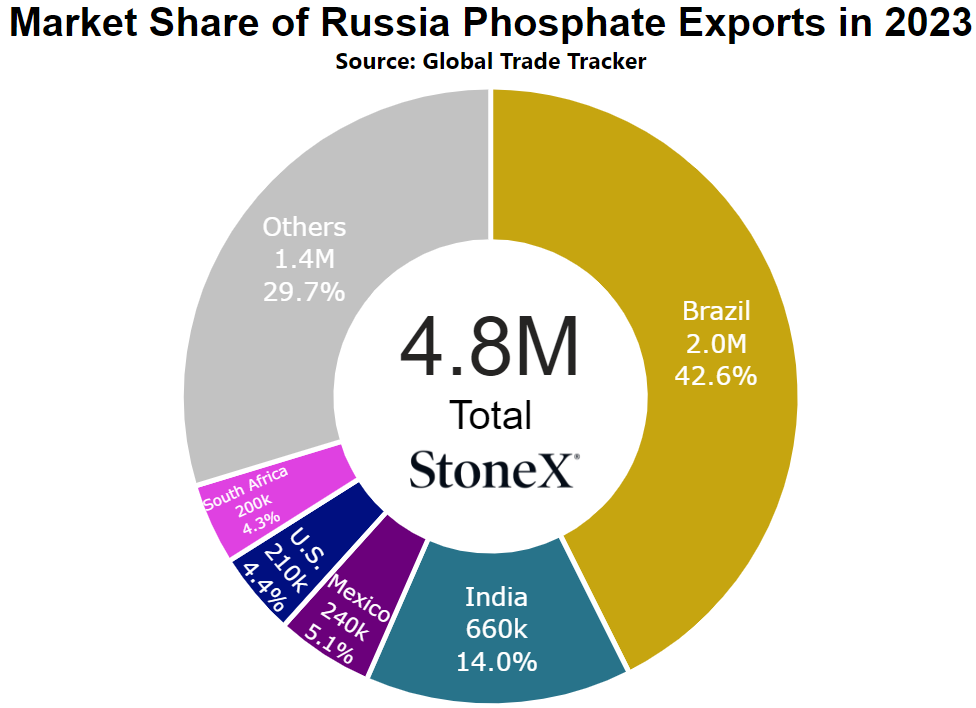
Price comparisons
Vs 30 days ago - 4% or approximately $23 higher
Vs 90 days ago - 7% or approximately $38 higher
Vs 6 months ago - 4% or approximately $23 higher
Vs 1 year ago - 12% or approximately $68 higher
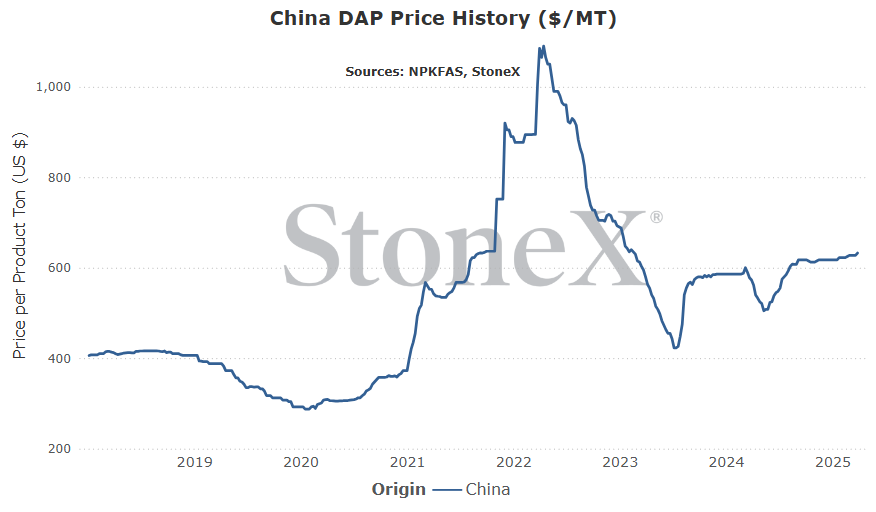
China DAP price comparison
Number 2 global exporter in 2022
Price comparisons
Vs 30 days ago - 1% or approximately $5 higher
Vs 90 days ago - 2% or approximately $15 higher
Vs 6 months ago - 2% or approximately $15 higher
Vs 1 year ago - 10% or approximately $60 higher
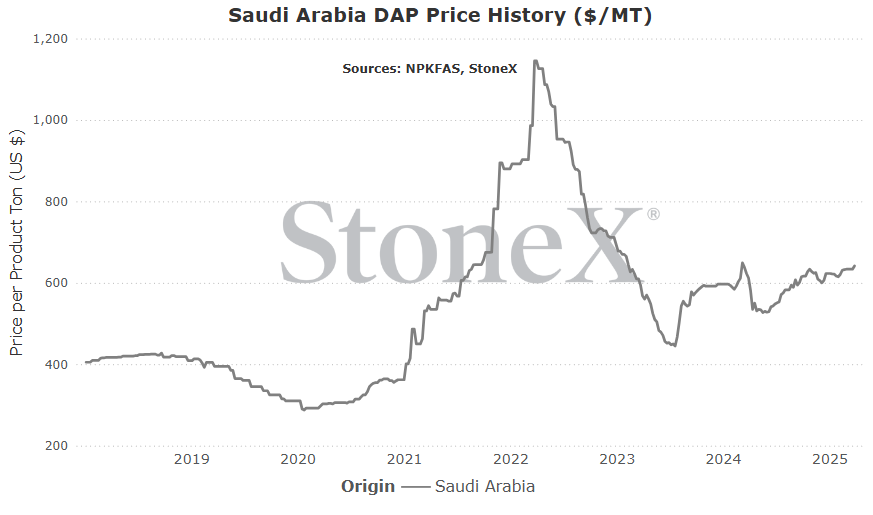
Saudi Arabia DAP price comparison
Number 4 global exporter in 2022
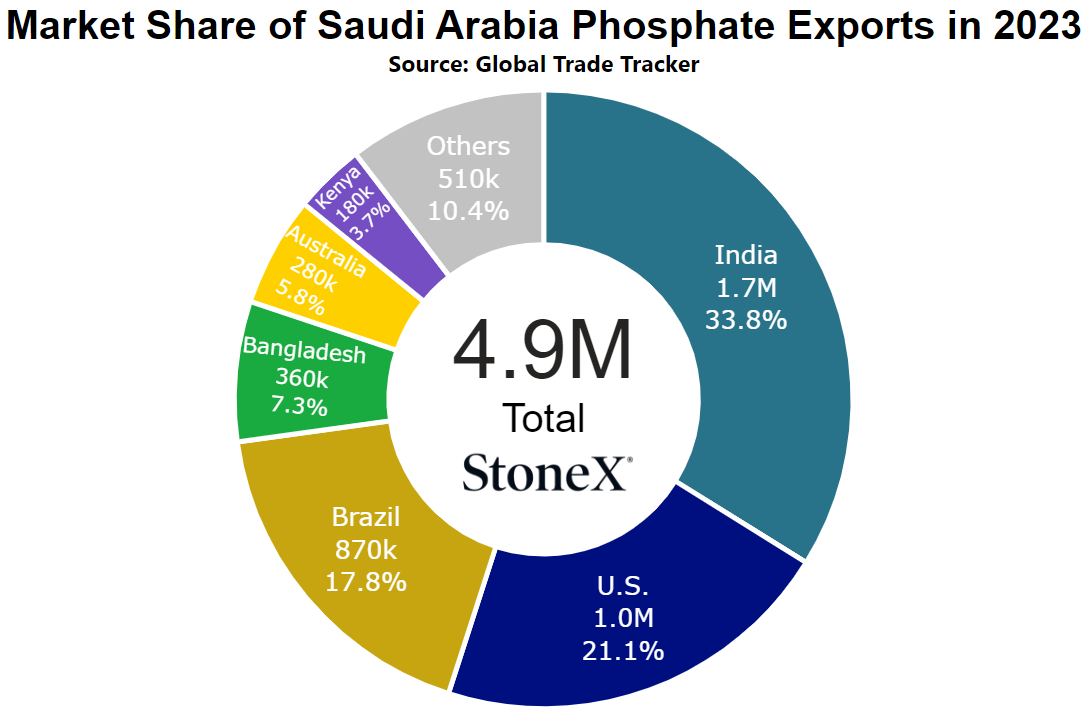
Price comparisons
Vs 30 days ago - 1% or approximately $8 higher
Vs 90 days ago - 3% or approximately $19 higher
Vs 6 months ago - 4% or approximately $27 higher
Vs 1 year ago - 5% or approximately $30 higher
- Chinese exports get even lower... – a large part of why global phosphate prices are as high as they are is due to Chinese exports failing to meet normal flows. In recent history, China would export 10M tons. In 2024, they only exported 6.6M tons. There are now signs that further cuts are going to be made. If that happens, the global S&D gets even tighter and prices will reflect that.
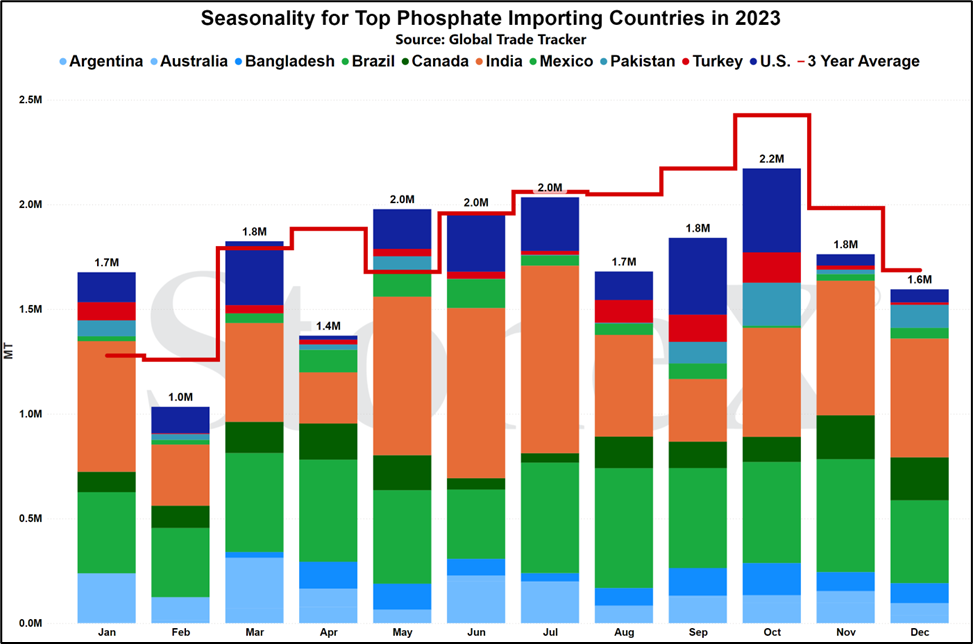
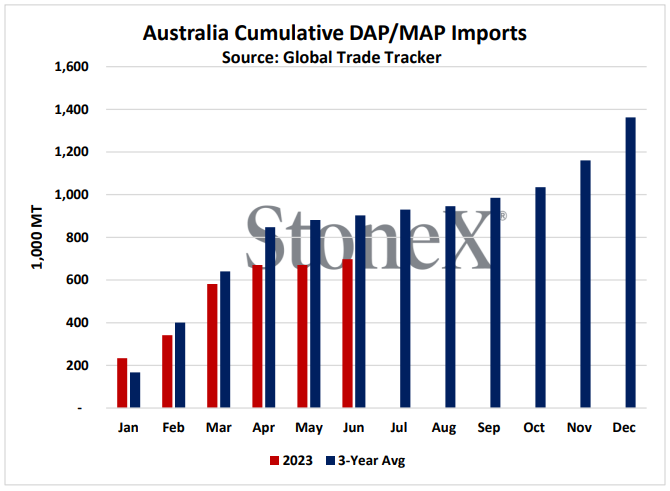
- Aussie demand surges at faster pace than imports – there is nothing being seen that points to a lack of overall supply so far. However, if there is a sudden surge where everyone goes at the same time, logistics can struggle to keep up. Ports can only unload so fast. Trucks can only haul so much per day. If demand paces ahead of supply, prices could rally a bit in an attempt to slow the market.
- Global values continue to rise – right now, there is a real chance that global values stay supported. India seems to be getting behind on supplies again. China could continue to slow exports. If global values start to climb, it makes sense that Aussie values do the same.
- Chinese government reduces export restrictions – the current global phosphate fear is that the Chinese government will restrict exports even further than they already are. However, never count them out. Just as soon as you think you have them figured out, they will do a 180. If we suddenly saw the Chinese government allow full free market exports, global values would likely fall quickly.
- U.S. tariffs cause Saudi Arabia to look for other buyers – a lot of this story still needs to be told. It is simply too early to know how it will all work out. However, if Saudi Arabia refuses to do business with the U.S. as a result, those phosphate tons will need to go somewhere. Australia can be an attractive marketplace.
- High prices delay/cut global demand – there is nothing good about current phosphate prices. While the global S&D is very tight, that likely will not cause global buyers to rush in to purchase. Why step in early to buy when it is as bad as it is today. Better to sit back and wait in hopes that things improve. Even if they do not, still better to wait and see. If enough of the world takes that approach, it can pressure global values for a time.
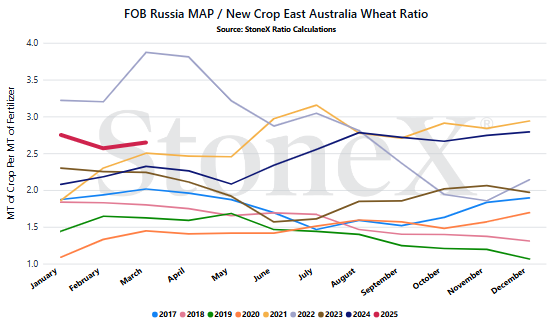
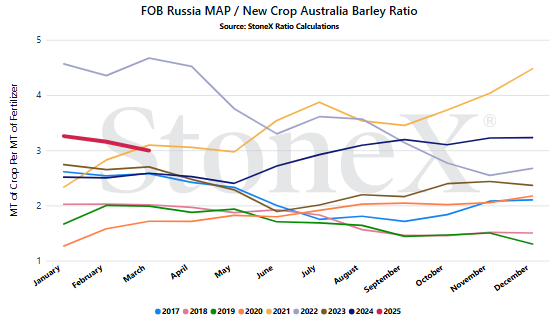
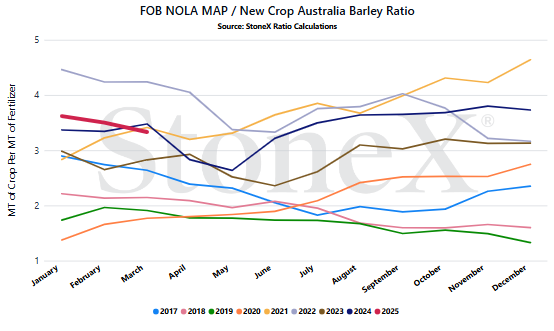
We believe that only looking at the flat price of either grains or fertilizer can be misleading:
-
Only selling grain can hurt you if fertilizer prices rise substantially
-
Only buying fertilizer can hurt you if grain prices fall
We look at the ratio "value" to get a better indication of where we are or how many bushels of X does it take to pay for 1 ton of fertilizer.
Would you rather:
-
Spend 4 ton of grain to pay for 1 ton of MAP
-
Spend 1.5 ton of grain to pay for 1 ton of MAP
When we compare the current ratio value against recent years, we start to see if we are high or low.
YOUR VALUES MAY LOOK DIFFERENT
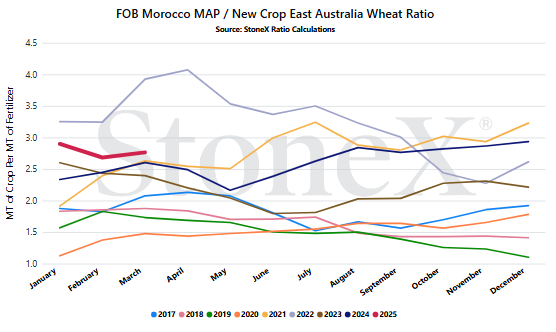
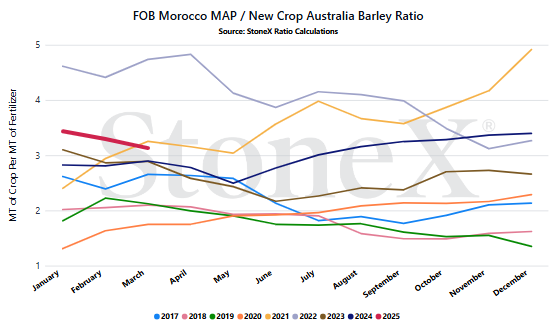
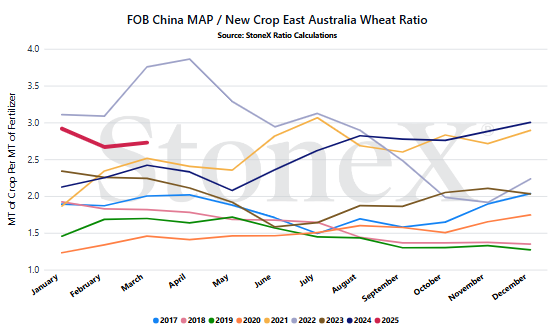
- China's export programs - this is easily the most important thing I'm watching. It is a short term event. It is a long term event. There isn't a farmer in the world that this doesn't affect. If the world sees the Chinese government restricting exports even further in 2025, that will place a very firm price floor in the market. China was the world's largest exporter of phosphate so the more restrictions they put into place, the higher global price ideas go. Their January/February export data certainly didn't fill me with confidence...
- Saudi Arabia's approach to increasing production, global manufacturer reactions - to help offset the China story is the rumor/reports that Saudi Arabia's Ma'aden company is going ahead with the 3rd phase of production which would add 3M tons per year of capacity. The good news is those 3M tons is almost exactly what China did not export in 2024. The bad news is it will take a while for it to be come operational. More important in my mind is how other producing nations react. Mainly Morocco. Best case scenario is they see Saudi Arabia boost production and feel they need to do the same to "keep up". That is where we would start to see some real price help.
- Does India need to catch up in a big way - just as important as export flows from China are, India buying patters are the same. They are the world's biggest buyer so if they move into a catch up mode, that will help buoy and/or drive prices higher.
StoneX Ratio Calculation
The ratio calculation is derived from Bloomberg historical grains values as well as fertilizer values from StoneX, NPKFAS, and Argus.
The calculation is simply dividing the fertilizer price by each grain price.
All data was sourced from StoneX unless otherwise noted.