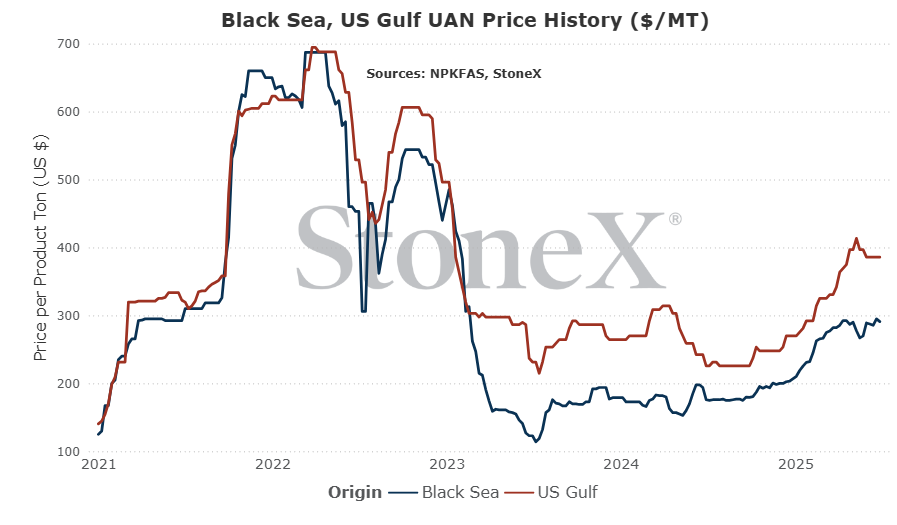
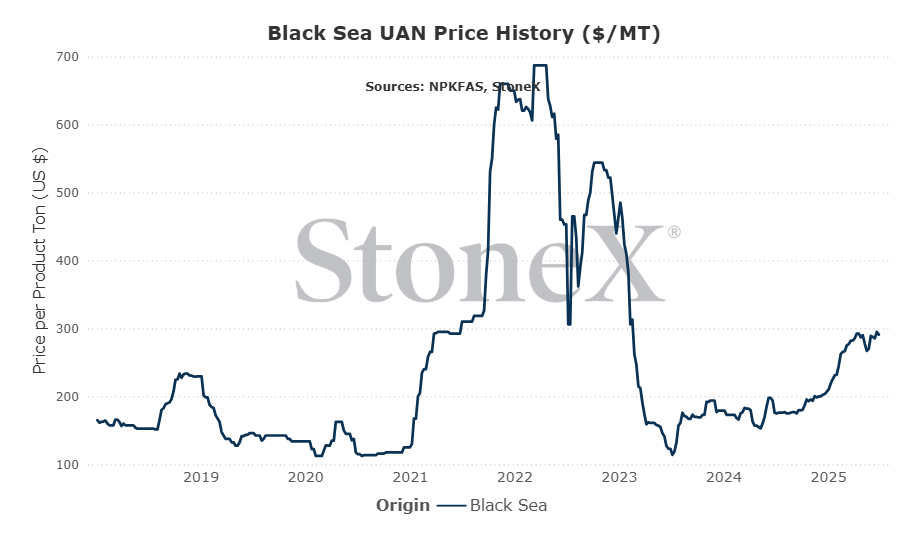
The intention of the below graphs are not to use to say "my price should be X based on this graph". These prices are derived from an FOB price point average. The intent is to show major global price movement trends. Your values will likely have significant basis difference (similar to your local grain price being different than the traded market price).
This graph is labeled as MT in USD currency.
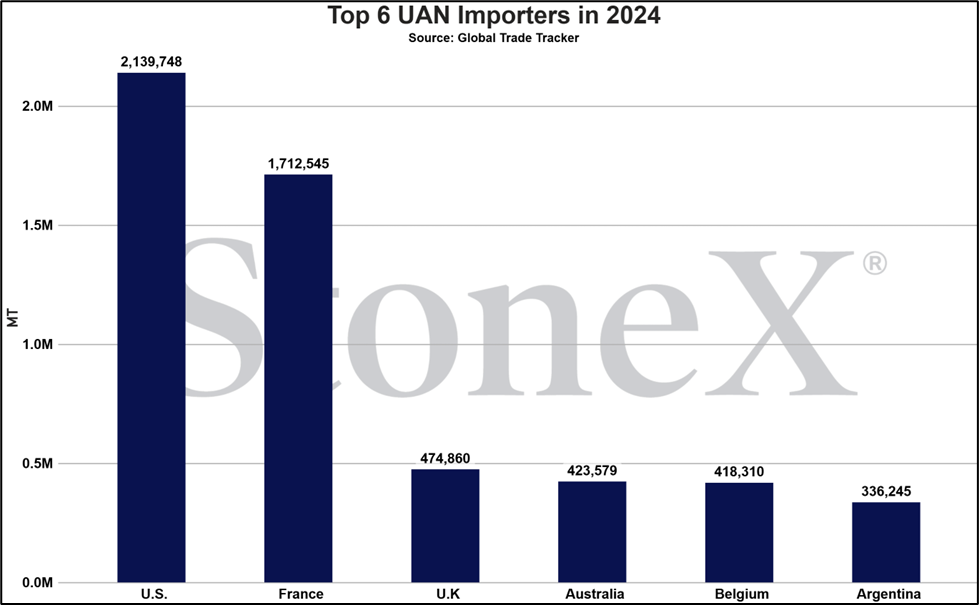
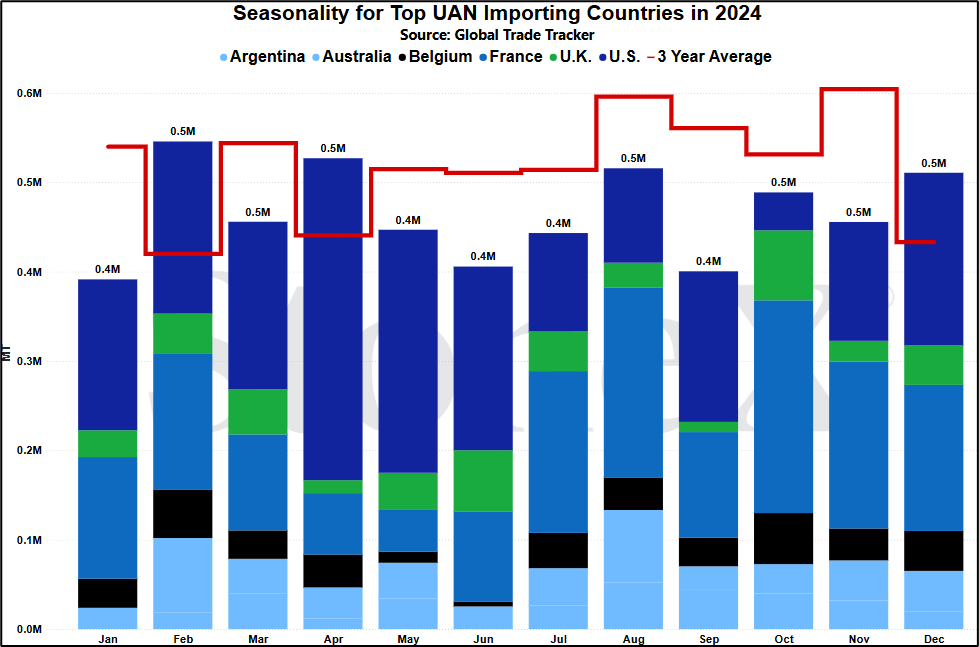
General global import/export UAN information
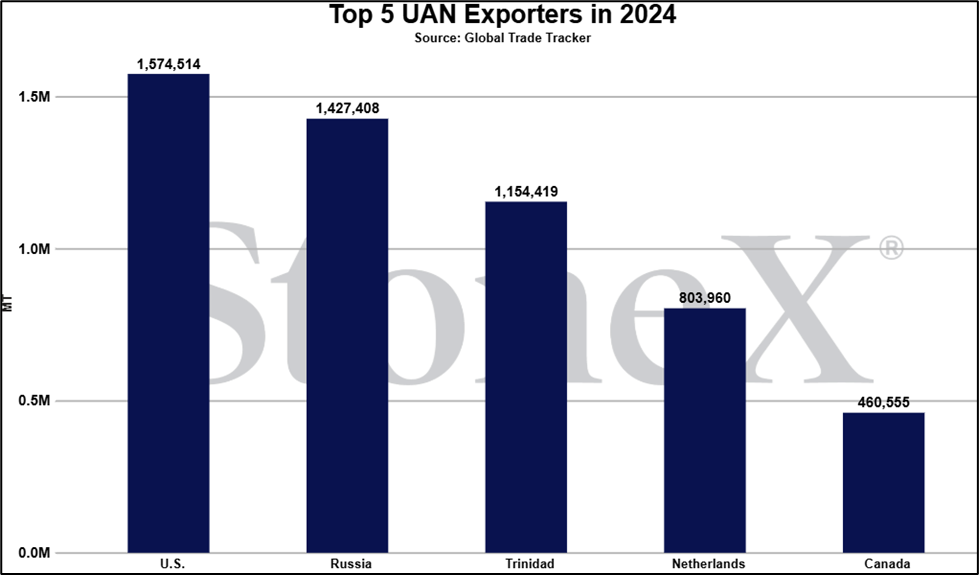
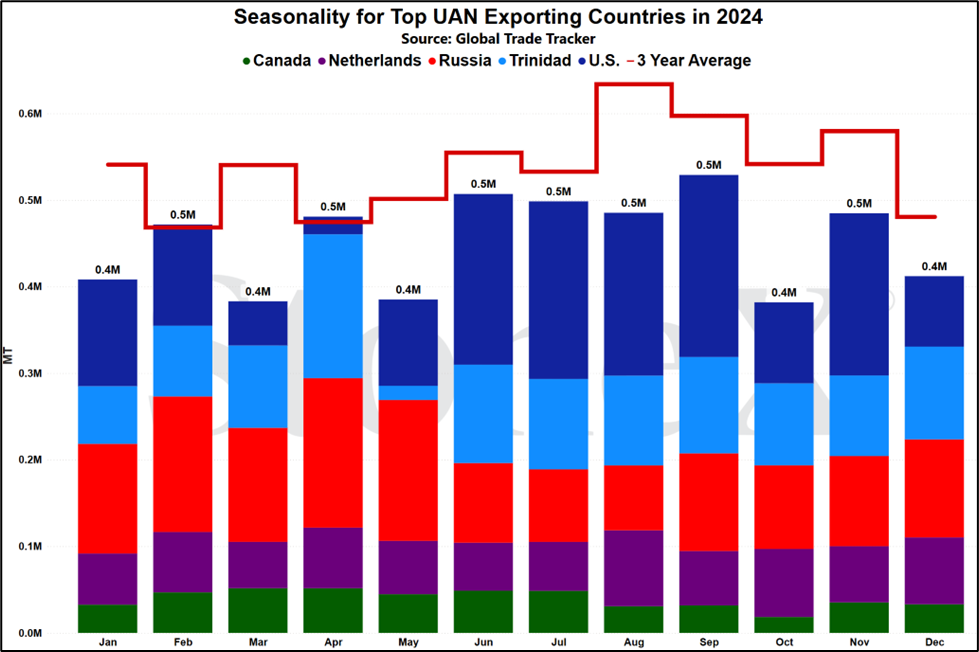
Europe moves to block Russia fertilizer, further changes global supply patterns
The world is growing much more tired of Russia's ongoing invasion of Ukraine and is deciding to take further steps to punish Russia for its actions.
Europe has stepped up in the last month with escalations.
There is no need to go into the dirty details of all the numbers and tariffs that the EU has imposed on Russia. A quick google search can find articles that describe what has happened much better than I can do. The long story short is that Europe has now made it very difficult for Russian fertilizers to flow to EU countries.
This could mean big changes for not only European UAN markets but global UAN markets.
Over the last few years, European nitrogen production has suffered due to excessively high natural gas input costs that occurred due to cheap Russian flows stopping. Today, only 75% of Europe's nitrogen fertilzier production is online which leaves European countries looking around the world for another 2M tons to replace. Russia has been able to step in and supply at least a chunk of those tons...until now.
These economic blockades, which increase in severity over the coming years if the invasion continues, will make it very difficult to justify sending product. This could have an impact on Russian production rates. The global UAN is nowhere near as robust in terms of production or demand locations. Russia losing access to the European market could very well force manufacturers to lower their production rates further.
From the European perspective, this makes it VERY rough for their UAN markets. With production rates down due to hit gas costs, Europe has been more reliant on outside tons to meet demand. Losing Russia will now push demand to places like the U.A. and Trinidad. Well, Trinidad production rates have been suffering due to insufficient gas supplies to those nitrogen plants. Next and almost last in line are tons from the U.S. That could prove to be more difficult this year following what happened last spring. UAN supplies across wide swathes of territory struggled to find product. It was not a price conversation, it simply was not available. Following that situation that had been feared and theorized for years, exports are going to be under more scrutiny than ever. Doesn't mean exports cannot happen, but it is going to be much more of a struggle.
All to say that Europe taking this step against Russia will likely have big ramifications for its UAN marketplace.
What does this mean for farmers?
For European buyers (and likely NA. buyers), this likely leads to higher price ideas. Europe blocking Russia supplies could have Russian UAN production rates lower. That reduces global supplies which is bullish. Europe should be forced to turn to North America for its needs and following the spring season situation there, the market is going to be very critical of any offshore exports. Still, exports are likely. North American supplies get lower as a result (bullish) and Europe may need to offer a higher price to convince manufacturers/exporters to ship product internationally and potentially face pushback from the market.
Essentially, it can all be summed up by "at least short-term bullish for the world".
Trinidad production issues continue
Trinidad, one of the world's largest exporters of UAN, continues to see manufacturing struggles that originate from natural gas input supply issues.
As we have talked repeatedly over the last several months, Trindidad production has been up and down all year and the primary reason is still a lack of reliable gas supplies. Supplies simply struggle to keep up with demand on a regular basis.
Now, there is hope on the horizon. Trinidad has been pushing to increase gas production and has approved the research and development of previously untouched waters and has gone as far to partner with companies/nations to develop these new gas fields. Unfortunately, new production is not something that happens over the course of months. Research takes time. Permits and planning takes time. Building the facilities to mine the gas takes time. Everything takes time. This is not a situation where we believe it will be months but rather years.
For now, unreliable production rates continues to be a limiting factor for their UAN manufacturing. If their production/supplies are lower, then that starts to change global trade patterns. Our primary focus will continue to be Europe demand either pressing hard on available Trinidad product...or being forced to the U.S. as a secondary option.
What does this mean for farmers?
It depends on where you farm, but it has impacts everywhere:
- European farmers - Trinidad production problems pushes Europe to try and buy more from U.S. manufacturers...who are already under scrutiny following the spring supply debacle
- North American farmers - if Europe comes calling for more tons, that is more competition that lowers N.A. supplies and allows prices to rise even further. After what happens this spring, the market is going to be much more "jumpy".
- Australian farmers - most of your UAN supplies come from the U.S. given the fact that Russian tons have been blocked. What happens in the U.S. happens to you.
For everyone around the world, global UAN supplies are already tight. Trinidad production suffering just makes a bad supply situation worse.
President Trump threatens Russia with tariffs, could block largest UAN supplier as result
President Trump is growing tired and impatient with Russia's continued invasion of Ukraine...and N.A./global UAN markets need to take notice.
Originally, Trump had threatened bold tariffs on Russia within 50 days if peace progress was not made. It appears whatever Russia's response to that statement was not positive because not too long after, that timeframe got shortened to 10 days. Not only would the tariffs impact Russia, but they would be placed onto any nation that did business with Russia.
It appears President Trump is not playing this time.
So what could that mean for UAN?
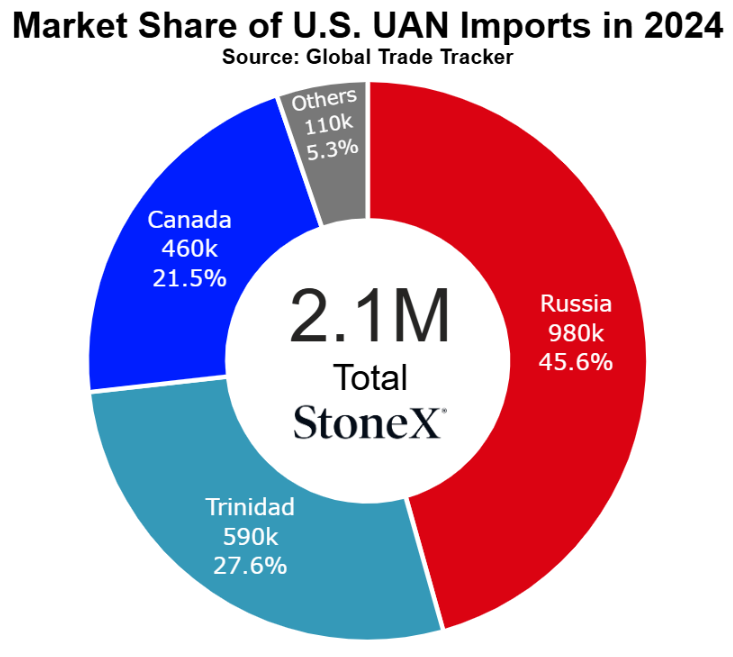
Well, for starters, it could be devastating for the N.A. market. The spring UAN situation was the nightmare scenario come true, with supplies near impossible to find during peak season. There were many factors that went into creating the scenario. However, one of the "help" factors were a decent chunk of imports. Almost half of the 2024 imports originated from Russia. Without that import lineup, the spring nightmare scenario could have been so much worse.
Which brings us to today...
It appears that Trump is going to follow through on his tariff threats against Russia. On the other side, Putin is not someone that likes being told what to do. He is resolute in his stance that Russia must take over Ukraine.
So if/when these tariffs get put into place, the U.S. / N.A. market can effectively write off Russian imports. Nearly half of the tons that flow into the U.S. will be gone. This will have a U.S. and Canadian impact. Yes, Canada has blocked Russia, but if the U.S. does the same, North America as a whole likely raises prices. Then, if Russia is forced to further lower or stop their UAN production, global markets likely see price support as global supplies drop.
This entire situation is still very fluid. For all we know, we may start next week with news that peace talks were successful and the war is coming to an end which could devastate global nitrogen values. Low likelihood, but not zero. Just know that if these U.S. tariffs on Russia get put into place, you need to watch your nitrogen/UAN values...

What does this mean for farmers?
Implementing heavy handed tariffs on Russia would be impactful on every UAN user in the world.
The heaviest blow would be for the U.S. / N.A. region which is so reliant on Russian product. The after effects would be on places like Australia and Europe who rely on the U.S. for a chunk or all of their UAN product. Then the world could see supplies lower and values higher as a result.
Everyone needs to watch the Trump/Putin dance...
N.A. UAN market outlook worse today than last year at this time
You might have read that headline and thought "oh, here we go again. One season on one product where product was tight and now Linville is going to lay that story over every product".
Trust me, I get it. You have had the market crying wolf for years and years on the tight supply story. "This is going to be the year that you cannot get product" has been told so many times that it was a joke between farmers. Even this last spring, it took so many factors coming together that it would be hard to repeat the situation.
I AM NOT saying that I guarantee that UAN will repeat the supply outage story in spring '26.
I AM saying that we are starting much closer to repeating that story than we ever have before.
- Low starting inventories - after this spring run, there was basically nothing left in the system. Storage was emptied. Sure, there are some tons here and there, but this is the lowest starting inventory we have seen since UAN became a common fertilizer type.
- Imports could be lower - President Trump does not appear to be playing this time. If Putin refuses to discuss peace, U.S. farmers could lose access to roughly half of normal imports.
- Exports could be bigger - Europe blocked Russian fertilizer flows and Trinidad continues to have production issues. They are not going to say darn it, we cannot find anything, let's just give up. They are going to find alternatives. The U.S. is an alternative...
- Nitrogen demand should remain high - it is FAR too early to make bold and firm claims on the 2026 crop mix, but we are starting this fertilizer year by plugging in 93M acres for corn. That is no small amount of nitrogen demand.
- Domestic production downtime will be sizeable - there are several domestic nitrogen plant downtimes planned for repairs. Nitrogen production is hard on equipment. Either plan for a repair cycle that takes time...or risk the plant breaking and having to fix it which takes more time.
Again, I am not guaranteeing a supply outage repeat and in no way and I trying to say "I told you so". However, many of the points above are points we discussed all winter and look where we ended. Each of these factors could be worse and could lead us to another story.
However, the opposite could be true. Maybe peace between Russia and Ukraine is possible. That would change things for the better. Maybe Trinidad production rates improve to normal. Maybe European production restarts. There is always a way for the market to go against our POV.
I just want to make sure I am doing my job and detailing how bad of shape UAN is in right now...
What does this mean for farmers?
If the above scenario plays out, it means tighter supplies and higher prices. Now, UAN still needs to stay "connected" to urea and NH3. If the price gets too high in relation, too much demand switches as farmers look to save money. However, I fully expect that we will see UAN maintain a healthy premium to the other alternative sources.
I also think there is a chance we repeat the supply outage story spring '26. I really hope I am wrong and there is a lot of time before spring to correct the situation.
All I am asking is to not take the market likely.
N.A. UAN summer fill programs expected in August
I went back and forth on adding this section but ultimately decided to touch on it.
Many of you might be getting frustrated with the lack of retailer UAN programs. Well, maybe many of you do not care because every input is stupidly high, the farming outlook stinks, and you do not want to think about it/make a decision.
...let's assume you are wondering why for the sake of this piece!!!!
Frankly speaking, the manufacturers have not released their programs.
That is how UAN works. With it being a smaller product in comparison, it is more controlled by the manufacturing side. With so many of the UAN market factors leaning in favor of the manufacturer, there is no reason for them to rush...so they haven't.
The expectation is that the programs will be released sometime in 1st half August. At that time, retailers will need to see how many tons they can secure and at what price. It will take time for them to get everything finalized before they can roll programs out to the farmer.
I suppose there are two reasons for me including this:
- To let you know you haven't missed anything. The UAN programs are still coming.
- To let you know not to beat up your retailer for not having a program. This isn't their fault.
Just keep your phone on 2nd half August.
NOLA/New Orleans, Louisiana
Number 2 global importer in 2022
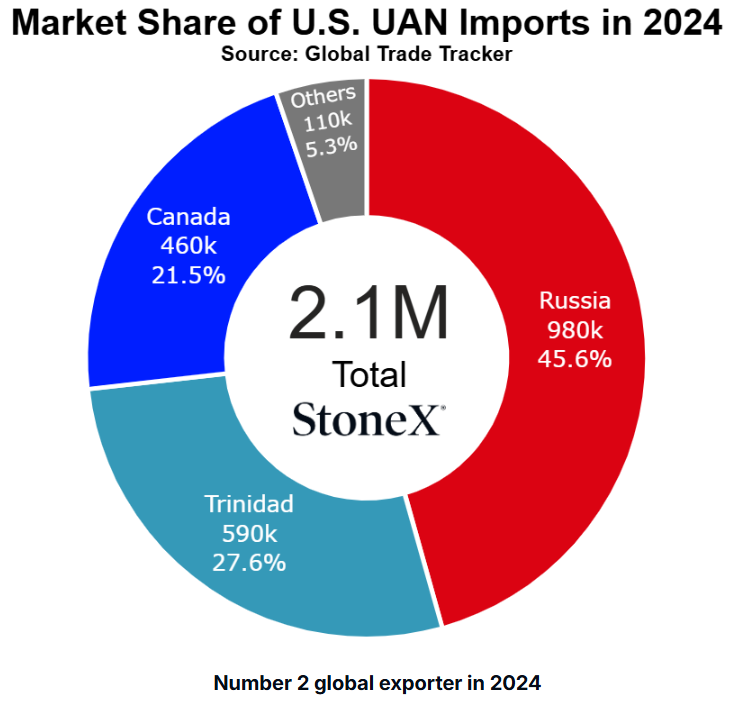
Number 1 global exporter in 2022
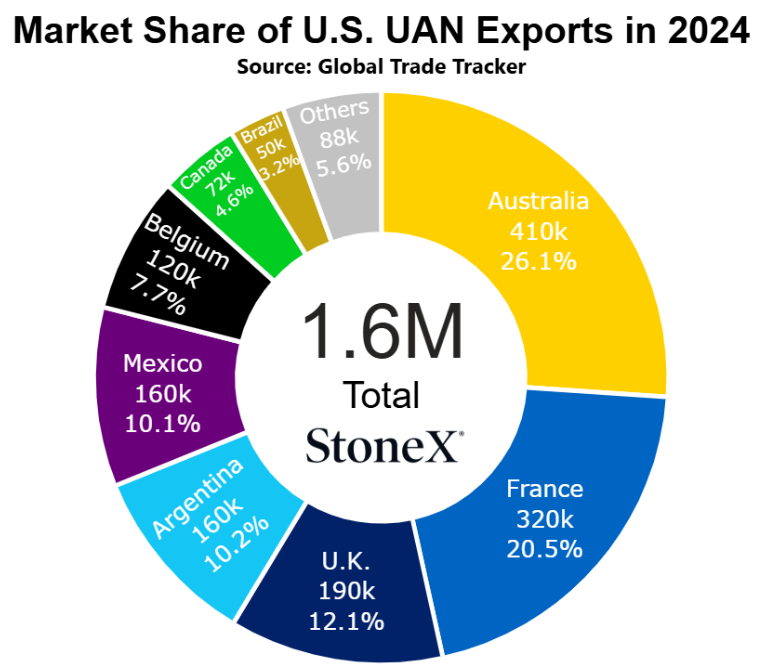
Price Comparisons
Vs 30 days ago - 0% or approximately $0
Vs 90 days ago - -3% or approximately $10 lower
Vs 6 months ago - 32% or approximately $85 higher
Vs 1 year ago - 71% or approximately $145 higher
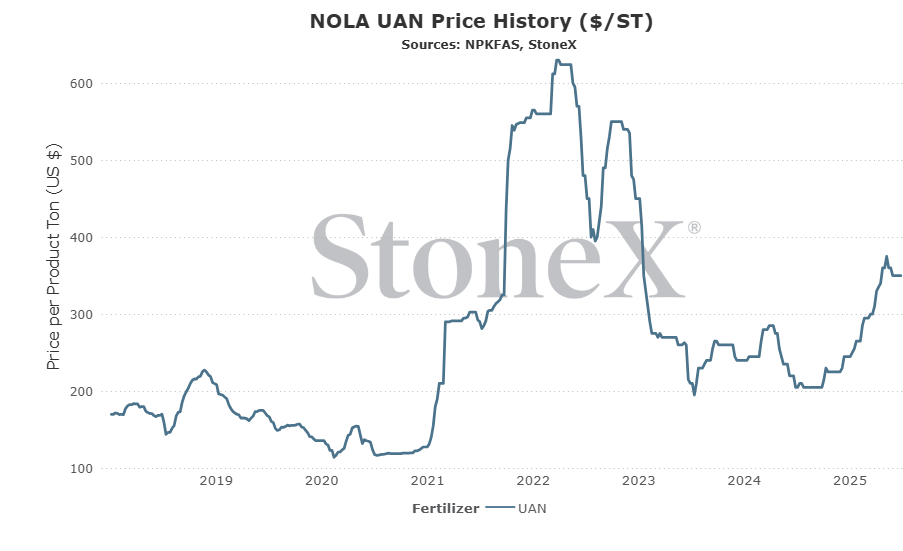
U.S. Midwest Average
Vs 30 days ago - -50% or approximately $208 lower
Vs 90 days ago - -46% or approximately $180 lower
Vs 6 months ago - -32% or approximately $98 lower
Vs 1 year ago - -16% or approximately $39 lower
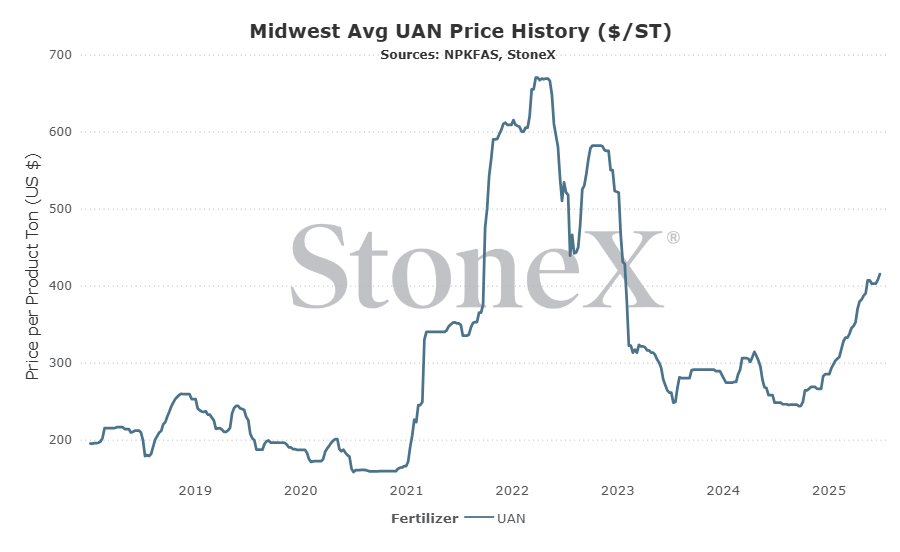
Black Sea (Russia)
Number 2 global exporter in 2022
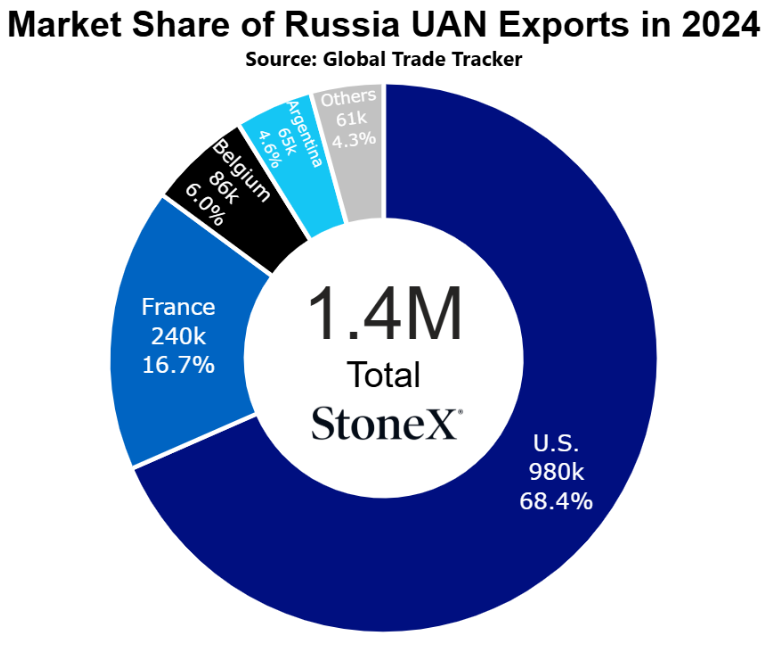
Price comparisons
Vs 30 days ago - -11% or approximately $32 lower
Vs 90 days ago - -11% or approximately $31 lower
Vs 6 months ago - 12% or approximately $28 higher
Vs 1 year ago - 47% or approximately $84 higher
- U.S. places heavy tariffs on Russia – President Trump is growing tired of Russia's continued invasion of Ukraine. So much so that he has now threatened Russia with massive tariffs if changes are not made within a 50-day window. Not only that, he sounds like he is threatening anyone who does business after that deadline. For the U.S./N.A. region, this could be very hurtful for UAN supplies. About half of the 2M tons imported into the U.S. are from Russia. If those tons are cut, supplies get slashed.
- Further production issues (mainly Trinidad) further tighten global supplies – the world is already dealing with very tight UAN supplies. European production at 75% of normal removes a couple million tons per year. Russian production rates have fallen since they have lost access to many of their sales destinations (Europe/Canada/Australia). Trinidad has been up and down. Trinidad seems to be the best chance at helping supplies, but can have the opposite effect if their production rates drop and stay low.
- Surge in grain values – I have heard some folks say "if we could get grain prices higher, it would help offset these fertilizer prices". I agree...to an extent. The issue I see is if grains were to jump higher, that would see buyers flocking which would ultimately force fertilizer prices higher still. In this case, I think higher grain prices hurt...
- Peace between Russia and Ukraine – yes, I know. Stupidly low liklihood. Why even discuss it? Well, because it can make a huge difference. If peace was found, Russia could demand return of relations which could see Europe/Canada/Australia open its doors once again. This would allow Russia to resume normal/higher UAN production rates. Russia could also demand Europe resume taking gas. If that happened, it may allow Europe to get back to 100% production rates, removing their dependence on the world. Again, low likelihood but big impact.
- Trinidad production normalizes and stays that way – it is hard to list this one because they have struggled so much recently. However, if they suddenly came back online and gas supplies stayed normal, they could go back to producing a lot of UAN. This would help build global supplies and be available to places like Europe. That would remove some European dependence on U.S. produced UAN, leaving more tons there for its farmers. It could change everything just enough to help prices drop a bit.
- Heavier N.A. switch to NH3 than anticipated – watch this one. Farmer economics stink right now. You are looking for the cheapest forms of everything, more than likely. NH3 fits that role. Some of you that struggled to find UAN this spring may be saying never again. That could lead more to fall NH3. If there is enough demand switching/destruction, there could be a lower priced impact.
We believe that only looking at the flat price of either grains or fertilizer can be misleading:
-
Only selling grain can hurt you if fertilizer prices rise substantially
-
Only buying fertilizer can hurt you if grain prices fall
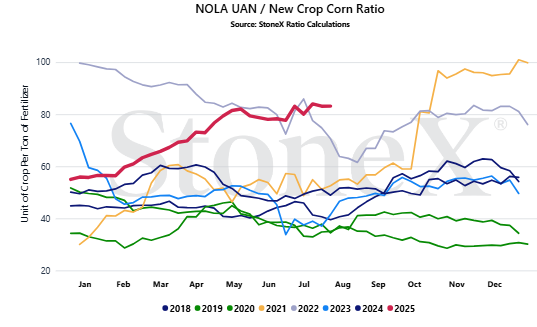
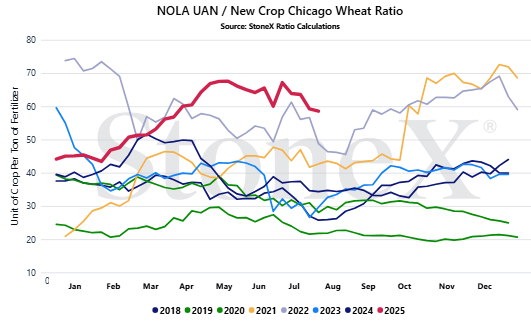
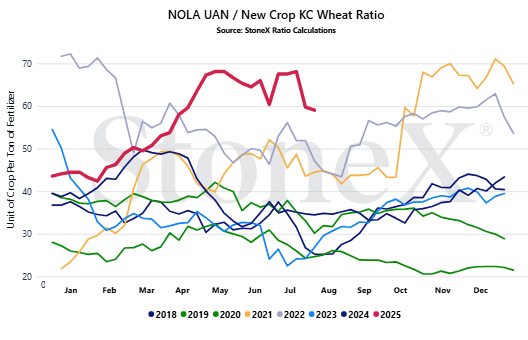
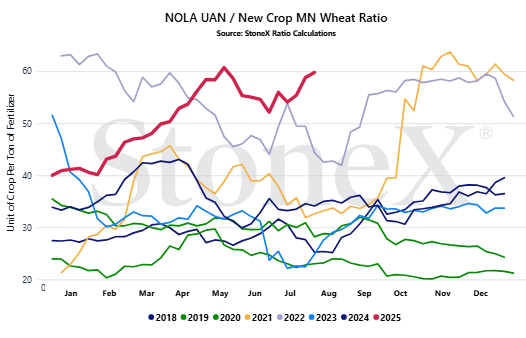
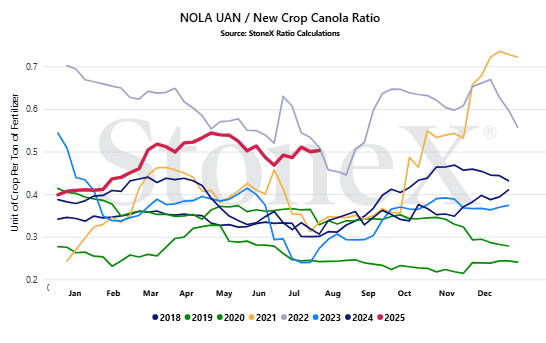
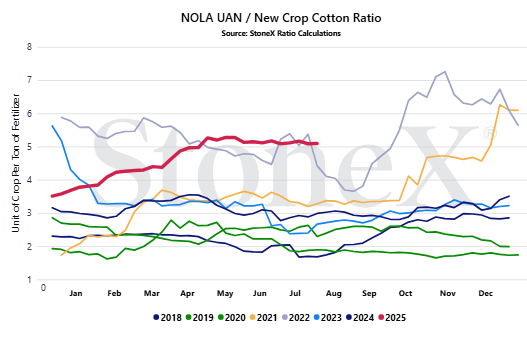
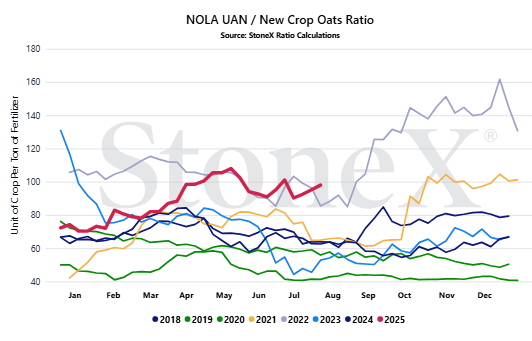
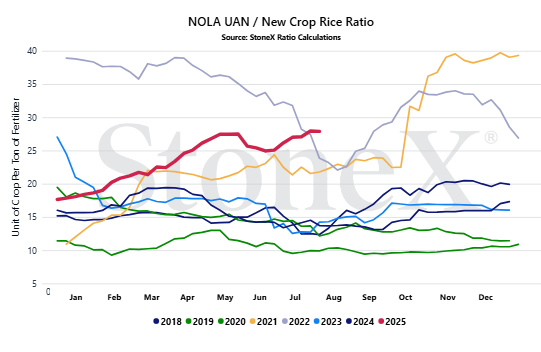
We look at the ratio "value" to get a better indication of where we are or how many bushels of X does it take to pay for 1 ton of fertilizer.
Would you rather:
-
Spend 100 bushels to pay for 1 ton of UAN
-
Spend 60 bushels to pay for 1 ton of UAN
When we compare the current ratio value against recent years, we start to see if we are high or low.
YOUR VALUES MAY LOOK DIFFERENT
This graph looks at the NOLA UAN price vs the flat grain price. There are no logistics on either product. Your location will look different due to fertilizer logistical costs, grain basis, etc.
- Trinidad production rates - kind of weird to throw this on as the most important focal point but as I was thinking through it, I think it is. Obviously there is not a lot of "free trade" around the world today in regards to UAN. Russia is normally the largest exporter, but Europe/Australia/Canada have blocked their flows. That has turned a lot of demand elsewhere. Trinidad jumps to the most important spot, in my opinion, to replace those tons but their production has suffered due to natural gas tightness. Gas supply issues can be resolved, but recent months are not filling us with confidence that they will. If Trinidad isn't there, that turns most everyone to the U.S. and it becomes a massive bidding war. The world needs Trinidad running well.
- Russian export options - Russia has not been able to access Australia and Canada since the early days of their Ukrainian invasion. Europe recently all but blocked Russian fertilizers. That leaves the U.S. for major buyers...and that clock is ticking. President Trump has run out of patience with Putin and put a 50-day timeline before massive tariffs take hold. If Russia loses the U.S., where else can they go? That could cause their UAN production to fall off which leaves the world even more tightly supplied.
- North American Fertilizer Year 2026 outlook - remember this last winter when I was warning about a possible supply situation in the spring and I went through all the reasons I thought it was possible? Today is worse. Much worse. Starting supplies are significantly lower. Exports could be bigger. Imports could be smaller. Domestic production could suffer with many plant turnarounds planned. Nitrogen demand is still expected to be huge. This does not guarantee a repeat of this last spring, but it puts the market much closer to that finish line.
StoneX Ratio Calculation
The ratio calculation is derived from Bloomberg historical grains values as well as fertilizer values from StoneX, NPKFAS, and Argus.
The calculation is simply dividing the fertilizer price by each grain price.
All data was sourced from StoneX unless otherwise noted.