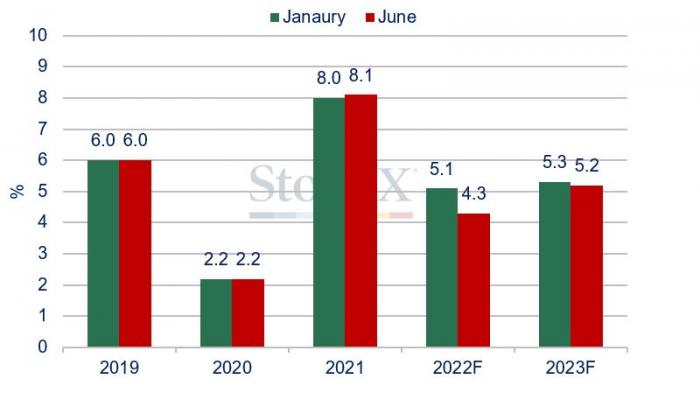
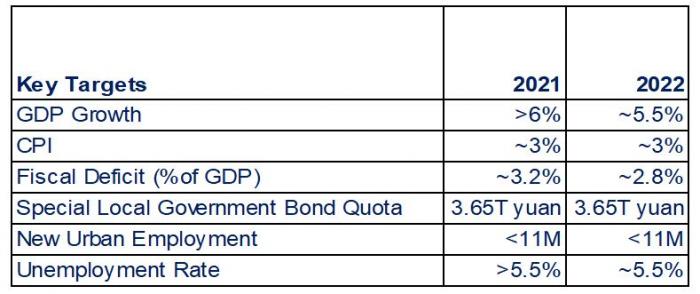
At the start of this year, the outlook for Chinese economic growth in 2022 was fairly robust, set to benefit from the Government utilising policy that focused on both long and short-term growth (incorporating cross-cyclical and counter cyclical policy), while monetary easing measures were widely expected to ensure stability in economic growth. Indeed, in January, based on World Bank projections, GDP growth was forecast at 5.1%, down from 8.1% in 2021. However, just six months into the year, the World Bank significantly downgraded its outlook for China, with growth (in its June outlook), set to reach just 4.2%, notably below the Government’s own target of 5.5% (set in the Two Sessions meeting in March). This dramatic alteration to projections has been driven by the resurgence of COVID-19 within the country (which practises zero-tolerance), while concerns remain over a weak real estate market (that was damaged by strict legislative policy to reduce highly leveraged debt last year), in addition to dampened ex-China growth expectations, weakening a key pillar of growth in the country, exports. Below we will look at the latest readings out of China in June to get a better understanding of overall Chinese economic growth as it stands.
WORLD BANK CHINESE GDP GROWTH PROJECTIONS (January Forecast versus June Forecast)
Type or use Ctrl+Shift+V here to paste source
China Policy Actions Taken in 2022
KEY TARGETS SET OUT IN 2022 NATIONAL PEOPLES’S CONGRESS (TWO MEETINGS)
Type or use Ctrl+Shift+V here to paste source
When it comes to Chinese policy, stability is the key term that is being used this year, after triple pressures of contracting demand, supply shocks and weakening expectations were identified as key threats to the country’s outlook. We expect for the year ahead that fiscal policy will remain proactive (concentrating on a front loading into infrastructure investment), while policy will remain accommodative, focusing on both long and short-term growth.
So, What Have We Seen?
We have already seen that the Government has stepped up its monetary policy easing, increasing outright credit, introducing tax rebates (which exceed 2020’s levels) and easing its stance moderately on the property sector, while the central bank has moved to cut key rates. However, given that new COVID-19 cases persists, it is unclear (as of yet) how effective policy has been, but we forecast that China will remain in the pro-growth camp over H2. It is worth noting here however, that stimulus is likely (as a whole) to remain somewhat modest in 2022, with the Government instead turning to structural tools to target weaker areas. Indeed, one of the key areas to watch this year is China’s spending on infrastructure, in which President Jinping promised an “all out” effort to boost, with the sale of special local bonds having soared to a multi-year high in June.
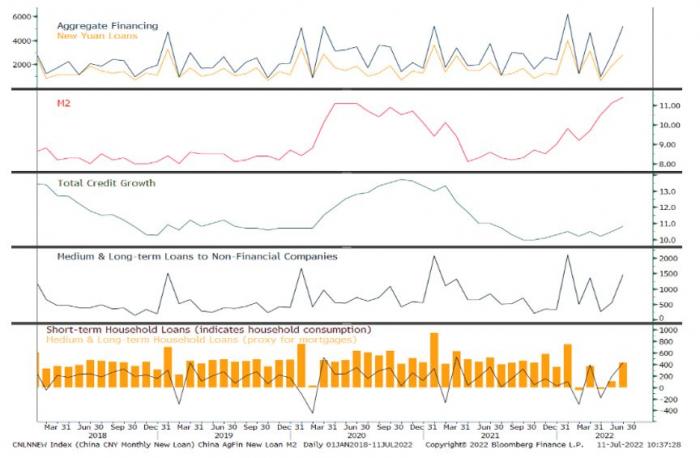
TOTAL SOCIAL FINANCING & NEW YUAN LOANS JUMP IN JUNE
Type or use Ctrl+Shift+V here to paste source
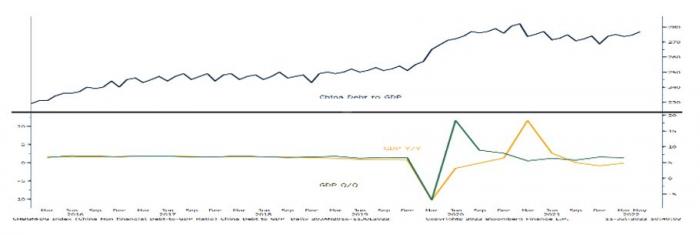
DEBT-TO-GDP RATIO COULD HIT A RECORD IN 2022
Type or use Ctrl+Shift+V here to paste source
• A second month of robust credit injections into the country has been underpinned by the PBoC encouraging lending, alongside a record level of local government bond issuances (and policy banks spending 1.1Tr yuan on infrastructure).
• M2 money supply grew at its fastest pace since November 2016
• Debt to GDP ratio is set to hit a record in 2022
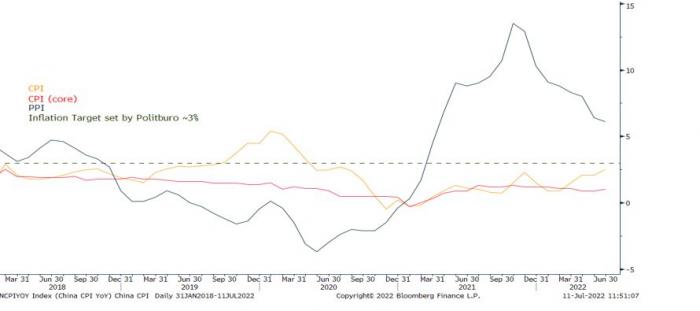
CHINESE INFLATION READINGS IN JUNE LEAVE ROOM FOR FURTHER MONETARY EASING
Type or use Ctrl+Shift+V here to paste source
• CPI lifted above market expectations to 2.5% in June, on the back of rising pork prices; however, core-CPI managed to remain somewhat stable, highlighting the weakness in demand (and spending) in the country.
• Meanwhile, PPI on a M/M basis remained steady (marking the first month since January that an expansion didn’t occur), with PPI on a Y/Y basis continuing to post slower growth.
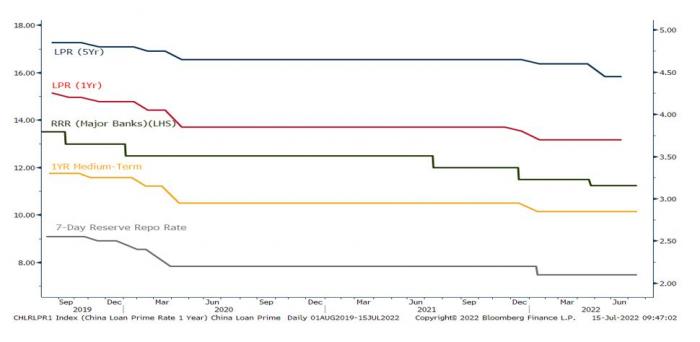
KEY INTEREST RATE CUTS IN 2022
Type or use Ctrl+Shift+V here to paste source
• Rate cuts have been used to help underpin economic growth in 2021 and 2022, and we suspect that further cuts will be made this year, although the 1Y medium-term rate was held steady in June.
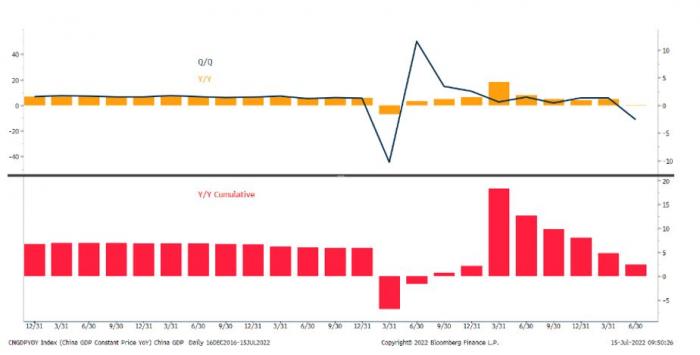
Q2 GDP GROWTH DISAPPOINTS
Type or use Ctrl+Shift+V here to paste source
• Chinese GDP dropped on a YTD basis to 2.5% from 4.8% by end Q1, driven by a Q/Q contraction of 2.6% (exceeding market expectations to the downside), with the Q2 Y/Y figure standing at just 0.4% (its second lowest level on record).
• These latest readings suggest that the Government’s target of 5.5% is unlikely to be met, which would make it one of the only times (bar 1998) it has been missed. (Please note, no GDP target was set in 2020).
• The weakness in growth is largely attributable to the multi month-long lockdowns that occurred in the country since March.
Where Are We Now With COVID?
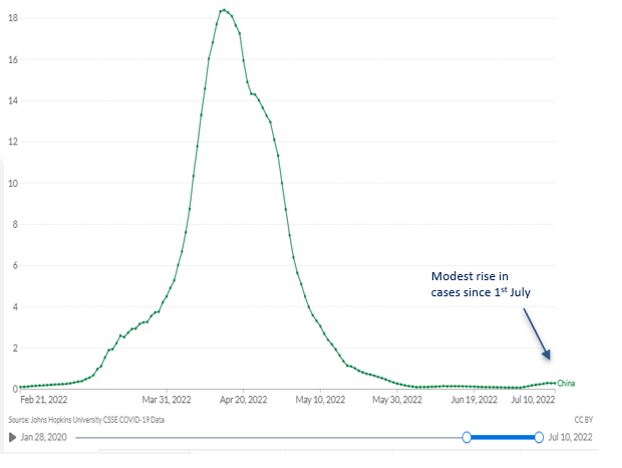
It appears that the spread of the virus is well under control, although new cases of a subvariant of Omicron are emerging, resulting in mass testing in Shanghai and partial lockdowns in some northern cities. However, currently there are no city-wide lockdowns, with the Government having recently moved to reduce quarantine times in the country from 14 days to seven.
What do we expect moving forward?
We think it is unlikely that we will enter large scale lockdown measures again, especially as the Government moves to set up more available mass testing PCR stations across the country (which should keep a tight tab on any smaller outbreaks). In light of this, the industrial sectors should be able to avoid shutdowns; however, the fear here is, that as new variants emerge, while their impact on health is less servere, their speed of contagion seems to grow.
DAILY CASES OF COVID-19 IN CHINA
Type or use Ctrl+Shift+V here to paste source
How is Domestic & External Activity Holding Up?
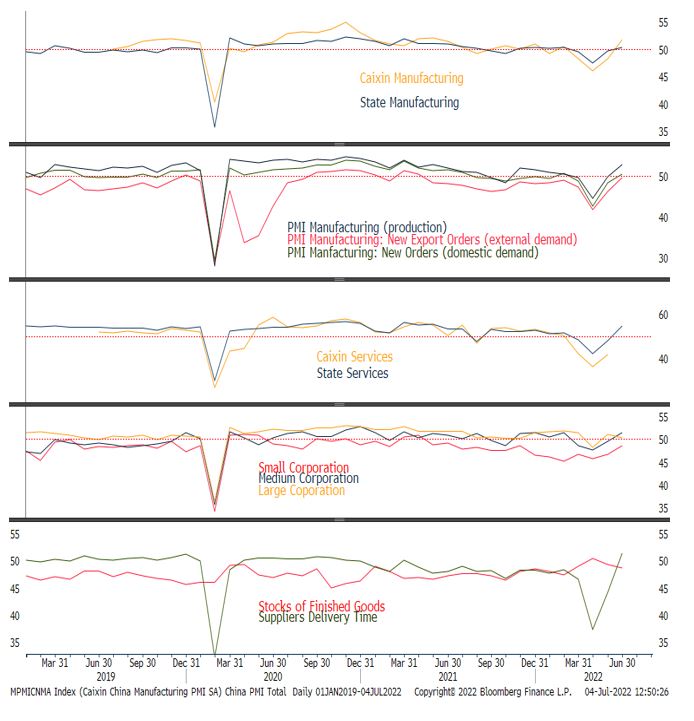
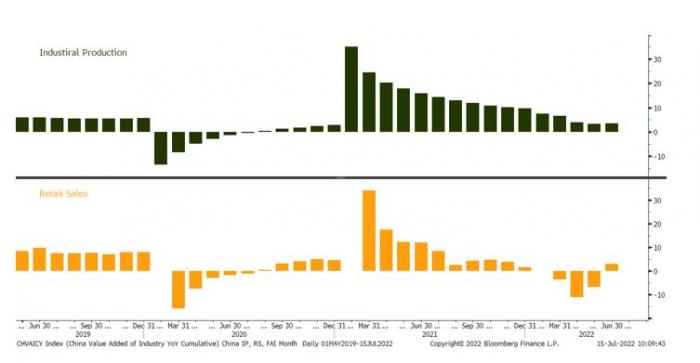
In the latest set of data regarding activity levels within China, we can see an overall improvement in output within June, with the latest figures for manufacturing and service PMI activity rising above 50 (into expansionary territory) for the first time since February, while industrial production and retail sales (on a M/M basis) lifted at their fastest pace since April 2020 and November 2021 respectively. However, despite the improvement realised in June, we remain cautious towards a robust H2 recovery given that supply chain issues remain (with delivery times at their highest level in six years) and new export orders (which reflect external demand), remaining in contractionary territory. Indeed, we forecast that recovery will differ by sector, with infrastructure and automotive sectors taking the lead (supported stimulus and tax rebates), while construction will remain weak on the back of lower investment and strict legislative policy in real estate.
KEY CHINESE PMI READINGS
Type or use Ctrl+Shift+V here to paste source
MONTHLY CHANGE IN RETAIL SALES AND INDUSTRIAL PRODUCTION
Type or use Ctrl+Shift+V here to paste source
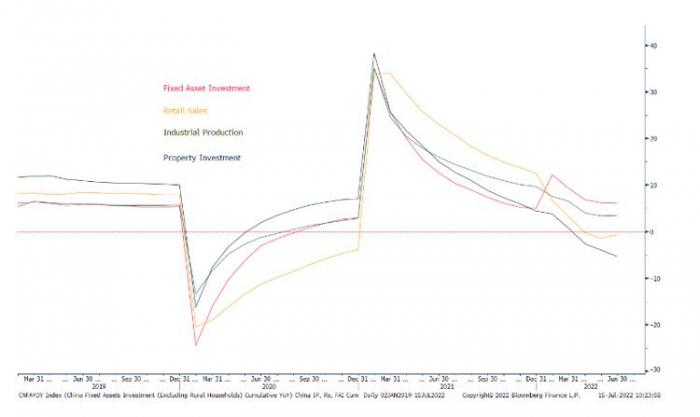
INDUSTRIAL PRODUCTION, RETAIL SALES, FIXED-ASSET INVESTMENT & PROPERTY INVESTMENT YTD
Type or use Ctrl+Shift+V here to paste source
• Property investments remain in contractionary territory, with investment having fallen by 5.4% on a YTD basis.
What Do The Latest Trade Figures Show Us?
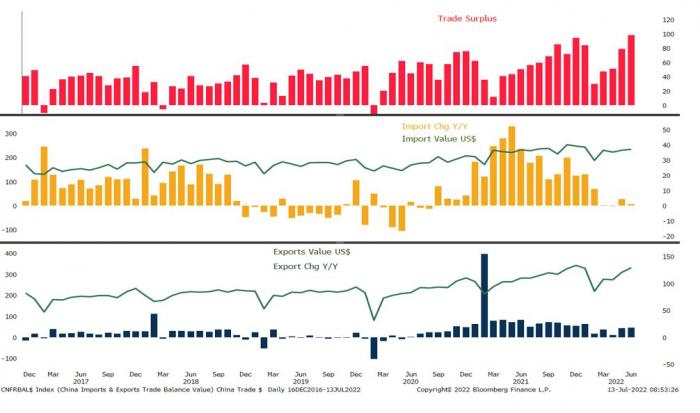
CHINESE TRADE
Type or use Ctrl+Shift+V here to paste source
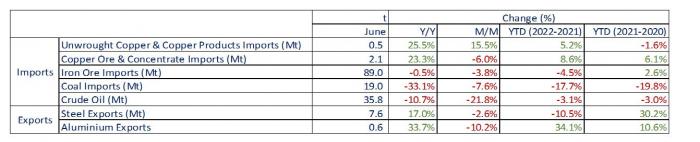
Top line figures are suggesting that June exports jumped well above market expectations at 17.9% (exceeding May’s rise and shrugging off a forecast for a decline). The lift is reflective of the country emerging from multi month-long lockdowns and inflation. Meanwhile, imports came in below market expectations and shrank M/M to just 1% from 4.1% in May, demonstrating weak domestic demand and high international prices for energy.
TABLE OF CHINESE TRADE BY COMMODITY
Type or use Ctrl+Shift+V here to paste source
If we look to commodities specifically:
For Imports
- We can see on a M/M basis a decline for iron ore, coal, crude, and copper ore. Here weak demand in China and elevated inventory levels are putting off further imports (in addition to high prices for energy products). It will be interesting to compare country-by-country trade imports (out in a few weeks), to assess if discounted prices for Russian products remain a key growth area for imports into the country (as we saw in May).
- Please note, the only bright spot for imports on a M/M basis arose from copper products, which could be signalling the start of a turnaround in demand in China (although may also be a consequence of higher imports from Russia).
For Exports
- Both steel and aluminium recorded their first monthly fall since February, which could suggest the beginning of a slowdown in external demand as inflation, monetary tightening, and uncertainty over the Russia/Ukraine war (keeping energy prices elevated in Europe), are leading to reduced growth projections.
Conclusion
Taking all of this into account, while we forecast that a recovery (of sorts) will occur in H2 within China, it will vary on a sector-by-sector basis, with supportive stimulus helping to underpin ‘new’ infrastructure, while a tight cap on mass testing for COVID-19 should help avoid further city-wide lockdowns. While boosted credit and tax rebates will support industries such as automotive and infrastructure, we don’t expect these measures to meaningfully lift two key areas of growth in China, its property sector and exports, with the health of exports largely dependent on the outlook for ex-China growth. We maintain our view that reaching a GDP target of 5.5% this year is unlikely, although inflation (as it stands) remains at a level suitable for further policy easing measures (such as rate cuts, that could occur later in the year). Until we see a meaningful return to physical demand in the country, base metal prices (with sufficient inventories) will remain lacklustre in the months ahead, although the coming online of new infrastructure projects (with a lag time of 3-6 months), should encourage an end-of-year pick up.