The base metal suite is currently hovering around its lowest level since end-2020, with demand destruction (at present) offsetting supply risks, as a ‘perfect storm’ of macro headwinds (in addition to a robust U.S. dollar) prevent any sustained rallies within the suite. In today’s commentary, we will play catch up to the key outcomes from the recently held ‘LME Week’ (24th-28th October).
LME Week – Our View
LME Week 2022 marks the second in-person event return (after COVID-19 lockdowns), with delegates ascending in London after a highly volatile year for base metal prices. Indeed, with copper, aluminium, tin and nickel having posted record highs in early March, the base metal suite then recorded its worst quarterly performance since the Global Financial Crisis in Q2 (with current prices around their lowest levels in two years). The key driver behind this volatility has been the market’s switch from supply concerns (upon the invasion of Russia into Ukraine), to demand concerns, with the outlook for global growth having been downgraded several times over the year upon tightening central bank policy, sustained high inflation (and energy prices), in addition to China’s unchanging attitude to zero-tolerance on COVID-19. To sum up the general sentiment of the event and the outlook for base metal prices – we have summarised key questions (and answers) that were posed over the week:
• How has sentiment changed year-on-year?
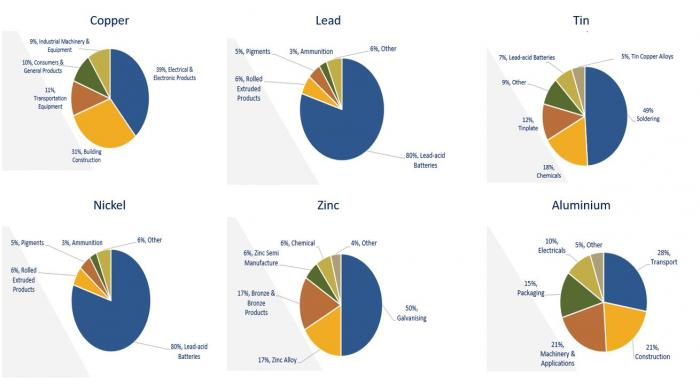
General sentiment was weaker in 2022 than in 2021 with respect to the outlook for base metal prices, with macro headwinds unlikely to change course dramatically in the near-term (3-6 months). However, attention was brought forward that individual metal fundamentals are likely to play a larger role in price direction in H2 2023 (than we have seen over the majority of 2022), especially given how certain sectors (such as automotive demand), will outperform weaker growth areas like construction. Please note, this will impact the suite differently, for example, lead has a 80% exposure to the automotive market, while certain metals in the suite like copper and aluminium have a greater variation in end use sectors.
BASE METAL END USES
• Will supply side risks offset macro headwinds?
Given what we have seen in H2; likely not, particularly given that current supply-rise risks from social and political unrest in South America, to European smelter disruptions (and power rationing in China), have only resulted in brief price support (with news being absorbed quickly before being once again offset by demand concerns). Indeed, within Europe, high energy prices that squeezed smelter margins (resulting in 320,000t and 1.1Mt of zinc and aluminium capacity being lost this year – equivalent to 26% and 16% of European capacity), has largely been unable to deter prices moving lower. Having said this, one caveat to this arises, and that is if we see outright bans on Russian material from either Europe or the LME on nickel, copper or aluminium. In this instance, we forecast that underlying fundamentals and global trade could be altered significantly. Please note, Russia accounts for 9%, 4% and 6% of nickel, copper and aluminium globally, with Europe holding high exposure to these exports.
• What will the timing be for a recovery in China?
We forecast that the timing of a pickup in Chinese physical demand for base metals will be longer than first expected. Indeed, pre-LME Week and pre-China’s National Congress Party, there appeared to be growing optimism in the market that a rebound in economic activity would take place; however, given that President Xi Jinping (who was elected for a third-term), all but concluded that China’s zero-tolerance stance toward COVID-19 would remain in place (in addition to the release of luck warm economic readings for September), the road of recovery looks to be stretched into Q1/Q2 2023.
• Do we expect to see more price volatility in 2023?
In our view, we think the chance of another year of volatility is highly possible, especially given the fundamental backdrop for the base metals, in which near-term tightness in the form of backwardations and low global inventory stock could provide a springboard.
• What are the hidden risks ahead?
This is a difficult question, with many possible answers (especially if we look back to the start of 2022 to now). However, the key outcome of LME Week, is that nothing is off the table, particularly with respect to geopolitical developments. It is important to be reminded however, this this is not just a negative narrative, as the markets could be just as easily surprised to the upside (for example by a faster than expected recovery in China, resolve to the Russia/Ukraine war or soft central bank landings in tightening monetary policy).
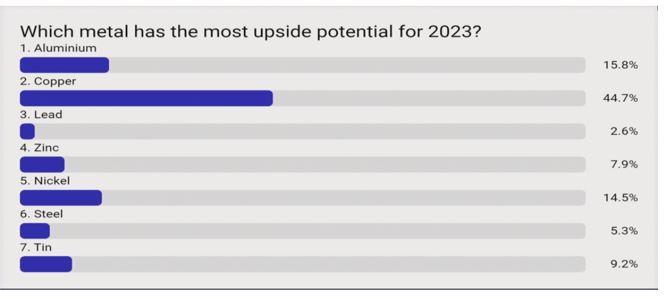
As part of LME Week 2022, we took part in the LME Week Seminar – Metal’s Debate, in which StoneX covered the argument for lead and zinc’s price outlook in 2023. To download a copy of the presentation, please follow this link here. Meanwhile, a live version on the event can be found on the LME website here.
LME WEEK SEMINAR – METALS DEBATE – VOTE ON BEST PERFORMING BASE METAL IN 2023
Reuters Base Metal Polls Display Weakening Price Outlook Ahead
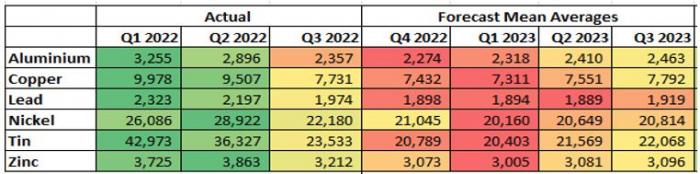
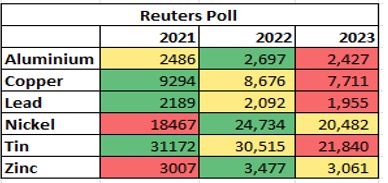
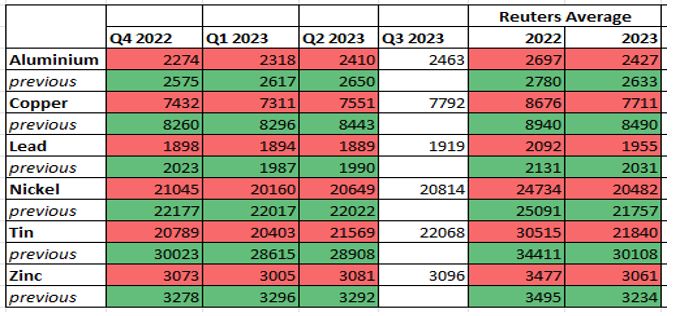
Every quarter, industry players (including StoneX) take part in the Reuters base metal polls (please note here, price forecast were concluded ahead of LME Week and China’s National Congress Party).
REUTERS POLL AVERAGE PRICE FORECASTS FOR THE BASE METALS (By Quarter)
REUTERS POLL AVERAGE PRICE FORECASTS FOR THE BASE METALS (By Year)
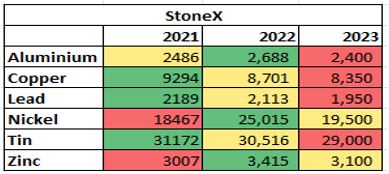
STONEX AVERAGE PRICE FORECASTS FOR THE BASE METALS (By Year)
REUTERS POLL AVERAGE PRICE FORECASTS FOR THE BASE METALS (Comparison to Q2 Forecast)
In conclusion, there appears to be a general theme that Q4 will record the lowest quarterly average prices in 2022, while average prices for 2023 will come in lower than recorded in 2022. In addition, if we look at the comparison in price forecasts taken from Q3 versus the most recent poll, prices have been downgraded in all cases.