As we progress into the second half of the year, copper prices are struggling to hold onto a positive price performance, with only a 3% gain YTD Y/Y (at the time of writing). This modest performance has arisen due prices being dominated by macro forces, namely the U.S. dollar, the outlook fon China and the health of global manufacturing. Having said this, it appears as though micro forces are starting to play an increasing role in price direction, and therefore are important to acknowledge. In the below commentary, we highlight a snapshot view for leading bullish and bearish parameters for copper, both macro and micro.
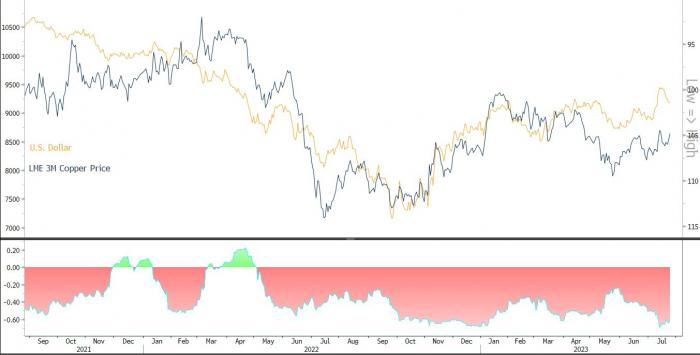
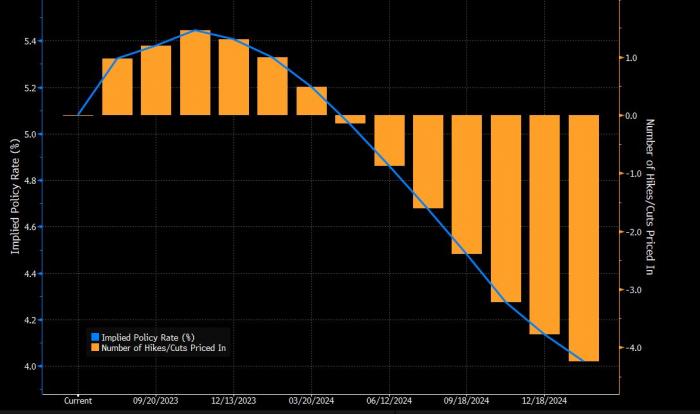
• Markets are raising their expectations that the end of the U.S. hiking cycle is in sight this year, placing downward pressure on the U.S. dollar. (Please note, copper has a largely negative correlation to that of the U.S. dollar).
The Outcome of China’s Politburo Meeting and Other Recent Policy Moves Provide Optimism for Higher H2 Demand
• China’s move to boost economic recovery will support copper intensive demand industries
To read in detail of recent Government and PBoC actions, please follow this link HERE
Meanwhile, please see below for our take on the outcome of the Politburo July meeting:
The Outcome of China’s July Politburo Meeting
Key Comments:
Headwinds Facing Recovery Were Highlighted
“Currently, China's economy is facing new difficulties and challenges, which mainly arise from insufficient domestic demand, difficulties in the operation of some enterprises, risks and hidden dangers in key areas, as well as a grim and complex external environment”.
Targets were Set
Top leaders pledged to "intensify macroeconomic policy adjustments, focus on expanding domestic demand, boosting confidence and preventing risks, and continuously promote the improvement of economic operations”.
Please note here:
• The terms ‘counter-cyclical’, ‘prudent monetary policy’ and ‘pro-active fiscal policy’ were once again mentioned.
• Domestic demand will be supported by boosting residents’ incomes to unleash the fundamental role of consumption in driving economic growth.
• Local special bond issuance to be sped up to help spur investment, there is a chance here that bond issuance could extend beyond the 3.8Tr yuan set in the Two Session meetings (as we saw in 2022).
• The Government will boost demand for automotive, electronics, household products and promote tourism.
• Property policy will be adjusted and optimised in response to “significant changes” in the supply and demand relationship in the property market. Here, we do not expect that Tier 1 cities will see significant restrictions ease, but it does show that the Government understands the housing market is undergoing a long-term adjustment. Overall, while home sales may be supported, investment is likely to remain weak given wider market stresses and low confidence in general towards the housing market.
• The Government will resolve local Government debt risks and formulate a basket of plans to resolve local debt issues.
• Improve the development environment for private firms, stabilise trade and foreign investment.
Expectation on Rate Cuts
Bloomberg are forecasting a 10bps cut to the 1Y-medium term lending facility and 25bps cut to the RRR in Q3 and then again in Q4.
Disappointing Chilean Production
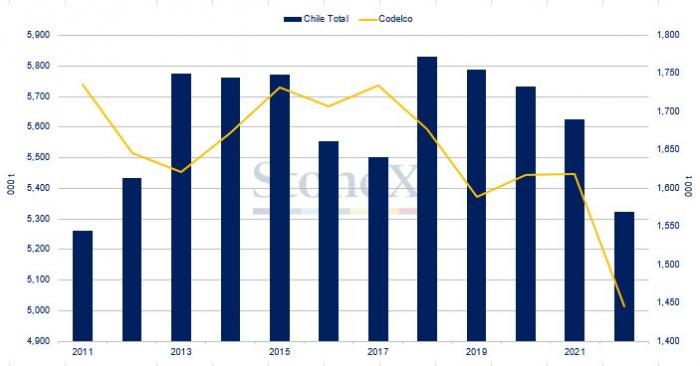
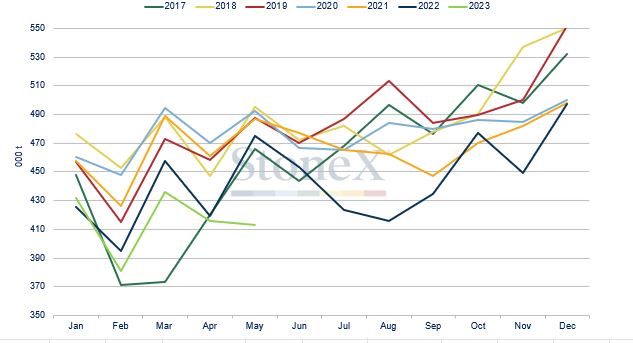
• Chilean production is set to be central to increased mine supply this year; however, with falling ore grades and operation issues (including drought conditions in the country), output this year has disappointed. On a YTD Y/Y basis, total production is down by 4.3% and well below five-year averages. Annual output from Chile has fallen continuously over the last four years, with 2022 production at its lowest level since 2011. As it stands, if we use current estimates, copper output is set to record a decline of 6.6% Y/Y.
China Copper Cathode Imports
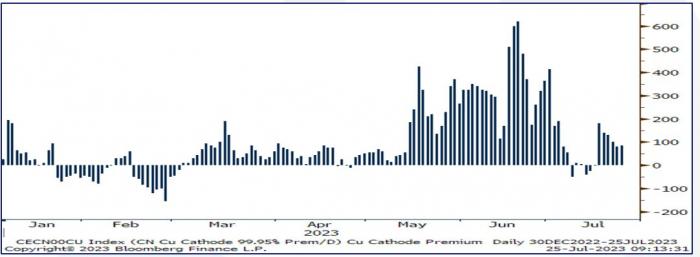
• The copper spot cathode premium (which is the difference between the copper spot price and copper front-month SHFE price), has remained in positive territory over the past week, highlighting increasing demand for spot material of late.
China’s Key Economic Readings Disappoint YTD
• China’s latest round of economic data for June highlighted a weak performance, with exports, imports, and property investment in the red, while fixed-asset investment remains below end-2022 levels.
Global Manufacturing Remains in Contractionary Territory
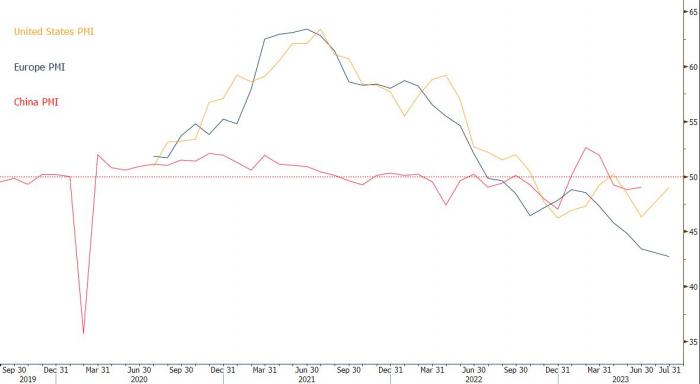
• Global PMI manufacturing readings remained in contractionary territory since August 2022
Copper Concentrate Treatment Charges Rise to Highest Level Since 2019
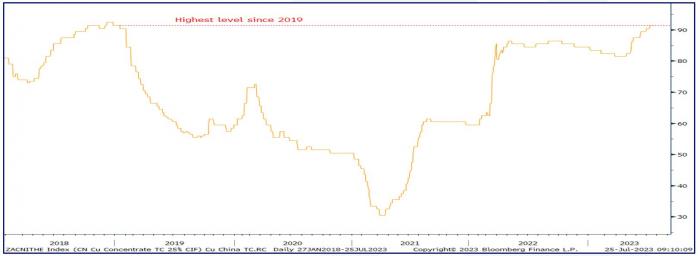
• Near-term supply appears plentiful, with China reporting copper concentrate treatment costs (TCs) at their highest level since 2019. Additionally, please note here that Chinese smelters and South American partners have reportedly confirmed that 2024 TCs will rise to $88/t from $76/t this year and $50/t in 2022.
Near-Term Supply to be Boosted by Imports from the DRC
• Near-term supply into China will also be supported by the return of imports of unwrought copper from CMOC Group Ltd Tenke Fungurume mine in the Democratic Republic of Congo (DRC). Please note, this follows a dispute over royalties payments with Gecamines with an export ban lasting from July 2022-April 2023. Bloomberg reported that ~50,000t per month of material will be exported from H2 (with 33,300t coming from built up stockpiles and 16,700/t coming from new production). During the export ban period, roughly 200,000t of stockpile material was built, resulting in forecast elevated exports over a six-month timeline. Please note, the DRC has recently become the third largest copper-exporting country, after Chile and Peru.
Peruvian Exports Jump 19% YTD Y/Y (January-May)
• Peruvian exports rose by 35% Y/Y and 6% M/M in May following the resumption of exports after shipments were impacted earlier in the year due to civilian protests. Please note, copper output in the first five months of 2023 rose 19% Y/Y.
Visible Exchange Stocks of Copper Jump to Six Week High
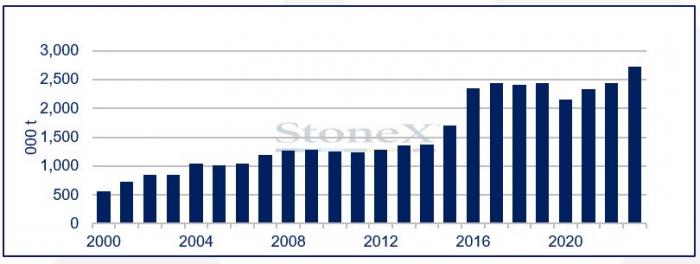
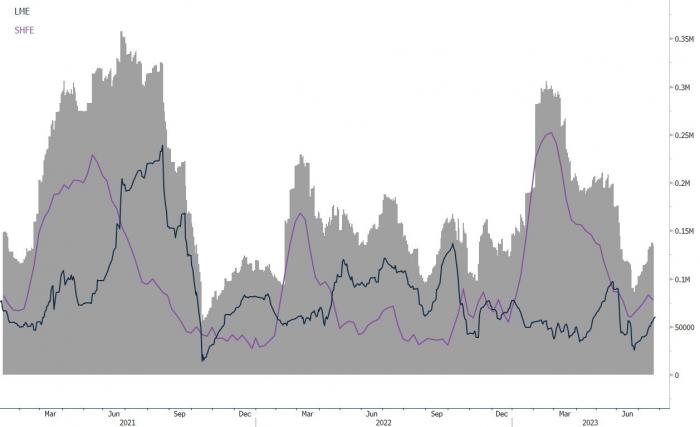
• Global copper visible stocks have recently surged to their highest level in six weeks, driven by inflows to LME and SHFE warehouses.
With copper prices having been unable to break into ranges recorded over the first four months of the year ($9210-$8,820/t), and prices over the last month remaining below $8,700/t, we forecast that price gains will be limited in the months ahead, unless we see a confirmed shift in the underlying fundamentals, especially demand. Here, with the near-term supply outlook remaining healthy, we would need to see a meaningful reduction in global stock levels and recovery in copper intensive end use sectors (such as construction, electronics, and the green transition). Of course, with higher for longer interest rates in the west dampening the demand outlook ex-China, focus on a recovery within China is becoming ever more important and it will be a waiting game to see if recent targeted monetary and policy stimulus can accelerate growth. Looking to upcoming headline readings, China will report its July PMI for manufacturing on 31st, which typically acts as a precursor for other data points over the month. At is stands, surveys are forecasting that manufacturing will remain in contractionary territory for a fourth month in July, falling to 48.8 from 49.0 in June. We forecast, therefore, that bearish sentiment towards near-term copper demand will dominate in the week ahead.