Please find our Q1 base metal outlook, which is part of our wider StoneX Global Commodities Outlook Q1 2022.
• Increased demand amid global supply bottlenecks has led to a drawdown in global inventories across the base metal suite, which will be key to supporting prices at historically high levels over Q1
• Supply risks will remain a key focus in Q1 across the suite, arising from COVID-19 led disruptions, to environmental pressures and growing geopolitical threats between countries such as Russia/Ukraine and China/Taiwan
• Demand will be supported by the improving outlook on global vaccinations against COVID-19, leading to improved consumer sentiment and fewer lockdown measures. As it stands, by year-end 2021, 54% of the global population was double vaccinated (based on WHO figures)
• China is forecast to soften its approach towards monetary and fiscal policy this year to support economic growth, with infrastructure investment to be front-loaded, supporting demand for the base metals
• The latest mutation of the COVID-19 virus, Omicron (which is believed to have high transmissibility), has resulted in the globe undergoing a fourth wave of historically high infection cases, resulting in the reintroduction of partial and full lockdowns within Europe and China. Those countries that practice zero –tolerance, such as China, could face the highest levels of disruption.
• China is forecast to see global GDP growth slump in 2022, from around 8% in 2021, as its economy tackles triple pressures of contracting demand, supply shocks and weakening expectations.
• A continued stretch on global supply chains is likely to lead to further disruptions, delays, and heightened costs; negatively impacting base metal heavy industries, such as the automotive industry, over H1 2022
• The threat of a pullback in western stimulus over the next year, leading to a deceleration in economic recovery and drop in consumption growth.
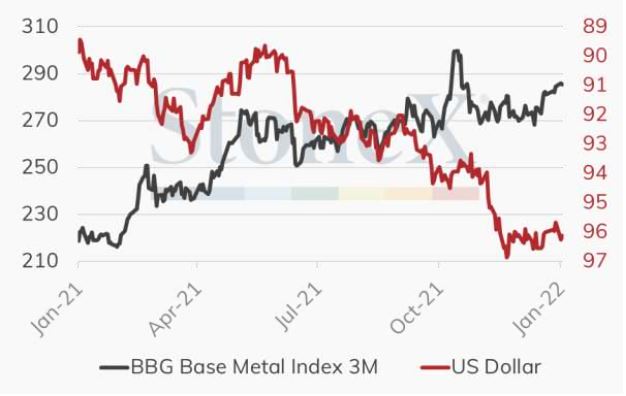
BLOOMBERG BASE METAL SUITE PERFORMANCE OVER 2021
Source for chart: Bloomberg, StoneX
Following a robust performance for the base metal suite in 2021, in which the Bloomberg index for the metals rose by 32%; we forecast a more moderate performance in 2022, with macro factors tilting towards slower global growth, while micro factors will remain supportive, helping to keep prices at historically high levels. Looking to Q1, the greatest uncertainty in our forecast is likely to be two-fold, firstly from the new mutation of the COVID-19 virus; Omicron, which in part has led to the globe undergoing a fourth wave of infection rises, despite 54% of the global population already having been double vaccinated (please note, we expect countries that practice zero-tolerance to undergo the greatest disruptions). The second area of uncertainty will arise from geopolitical developments between Russia and Ukraine and indeed between China and Taiwan, placing potential high risk on both the supply and demand side of the equation for the suite. Meanwhile, another factor to take into consideration is the growing global divide in economic recovery. Here we refer to the current differing stances taken by global central banks. Indeed, in the west, the minutes from the Federal Reserve’s December meeting have indicated not only a shift to a more hawkish stance on quantitative easing tapering, but policy members issued forecasts of at least three-quarter percentage point rate rises over the year, lending support, if only in the near-term, to the U.S. dollar. However, looking to China, given that GDP is set to slump to around 4-6% this year from 8% in 2021 (with triple pressures arising from contracting demand, supply shocks and weakening expectations), we have already seen the central bank adopt more accommodative policy in December, a theme likely to spill into 2022. We are mindful, however, that this support will remain pre-emptive, moderate, and indeed maintaining a view to the longer-term, combining both cross and counter-cyclical measures. Staying with China, a further significant area of interest will come from the country’s actions towards decarbonisation goals, which has, for the most part, been integral in supporting higher prices among heavy polluting metals such as aluminium and steel over H2 2021. Indeed, with Beijing hosting the winter Olympics over February, clear skies and reduced pollution will be a top priority, with the Government updating new targets, such as reducing aluminium emission by 5% by 2025 (announced on 29th December 2021). However, we do believe that it will be supply that is in focus in Q1, rather than demand, given the ongoing energy crisis around the globe, which has resulted in factory closures across Europe (for zinc and aluminium) and temporary exports bans in countries such as Indonesia.
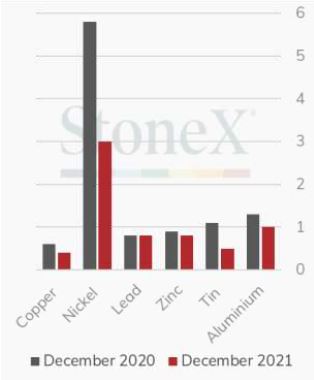
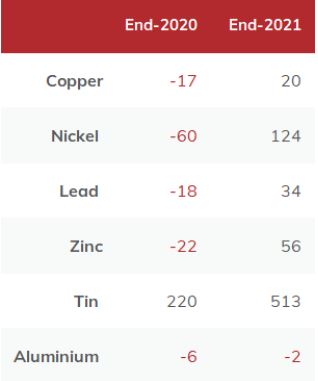
GLOBAL EXCHANGE STOCKS END-2020 VERSUS END-2021
Source for chart: Bloomberg, StoneX
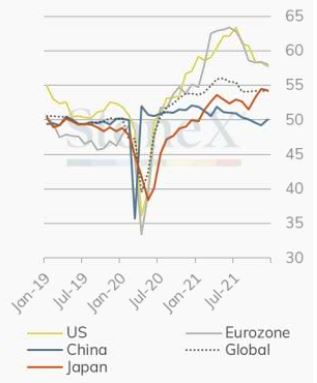
Looking to base metal demand, we forecast that growth is likely to struggle in Q1, with consumption hinging on how China balances its economic slowdown against use of policy, while COVID-19 remains a key headwind. Indeed, we have seen China adopt a more accommodative stance towards policy by reducing both its reserve requirement ratio and loan prime rate at the end of December, in addition to vowing to ‘frontload’ investment this year (likely via special local government bond issuance, which is aimed at supporting infrastructure demand). The ongoing energy crisis, commitment to environmental mandates and caution in easing regulations surrounding the property market are likely to keep consumption constrained. Meanwhile, the soaring cases of COVID-19 around the world will continue to hurt consumer sentiment and supply-chains. As it stands, Europe is at the epicentre of new cases (responsible for 50% of the world’s total), while cities such as Xi’an in China are facing their worst outbreak since Wuhan, in addition to the U.S. recently recording its largest single daily rise in cases (over 1M), marking a global record. Despite the current spread of the virus however, global stimulus is set to be pulled back this year, and we cannot foresee global manufacturing PMI readings returning to their peak in 2021, casting a shadow over consumption levels recorded last year. In addition to this, demand will be further affected by the lack of available materials, particularly associated with semi-fabricated products such as semiconductors, that are vital in sectors such as the automotive industry. Here consumption for metals such as aluminium, zinc, tin and lead will all be impacted, and we do not expect an easing in supply chains until H2 2022. Meanwhile, again with focus on China, heightened environmental restrictions ahead of the Beijing Olympics are likely to limit the output of materials such as steel (which are heavily energy intensive), limiting the requirement for metals such as zinc (please note ~50% of zinc’s end use goes into galvanising steel). One bright spot, however, will arise from the increased shift towards green policy, which favours ‘green metals’ utilised within new technologies such as electric vehicles (copper, aluminium and nickel), as well as in renewable energy infrastructure (zinc, aluminium and copper). Something to watch out for this year, will be developments associated with President Biden’s approved $1Tr infrastructure bill, in addition to renewable energy projects within China.
GLOBAL PMI READINGS
Source for chart: Bloomberg, StoneX
Turning to supply, which we believe will be the key driver behind elevated price levels over Q1, attention will be focused on developments both within China and Europe, while mine-side production in South America, will also play its part. Indeed, within China, the push towards lowering emissions via the country’s dual mandate (where total energy consumption and energy intensity is being monitored), will be a key tailwind behind metals such as aluminium, which lost between 3.3-3.8Mt of capacity last year as a result. Indeed, aluminium is likely to be the star performer across the base metal suite, as production could further be impacted by Indonesia banning exports of coal over January to protect domestic supplies (please note, China produces 56% of the world’s aluminium, with roughly 90% of smelters using thermal coal to create electricity and China being Indonesia’s largest importer). Meanwhile, both energy-intensive aluminium and zinc are facing building pressures from high energy prices for natural gas across Europe, in which several production companies including Glencore, Norsk Hydro, Alcoa and Alvance Aluminium Group (Europe’s largest aluminium smelter), have plans to place plants on care and maintenance or temporary closures until energy prices return to lower levels. The most significant risk to our forecast here will be if geopolitical tensions rise between Russia and Ukraine, which has the potential to significantly derail our forecasts. Meanwhile, the supply side for the base metals is already under tremendous strain with inventory levels having been drained over 2021, adding to expected price volatility over Q1. In fact, a good example to highlight here is copper, in which typically Q1 is a seasonal restocking period. If global inventory stocks are not built above Q4 2021 levels, this would mark the first time this has happened since 2009. Sticking with copper, supply risks are likely to support prices this year, as both Chile and Peru (which account for 2/3rd of the world’s copper mine production) grapple with uncertainty over the future of investment in the country amid unstable political landscapes. Although having said this, we do expect ample mine supply for copper this year, with the suite as a whole benefiting from higher price points, leading to favourable margins for producers. A further country of interest will be Indonesia, where it will be a wait and see game of whether President Widodo implements previously announced bans on copper concentrates and coal this year, while we expect healthy domestic output of NPI (amid new capacity expansions), to push the nickel market back into a surplus.