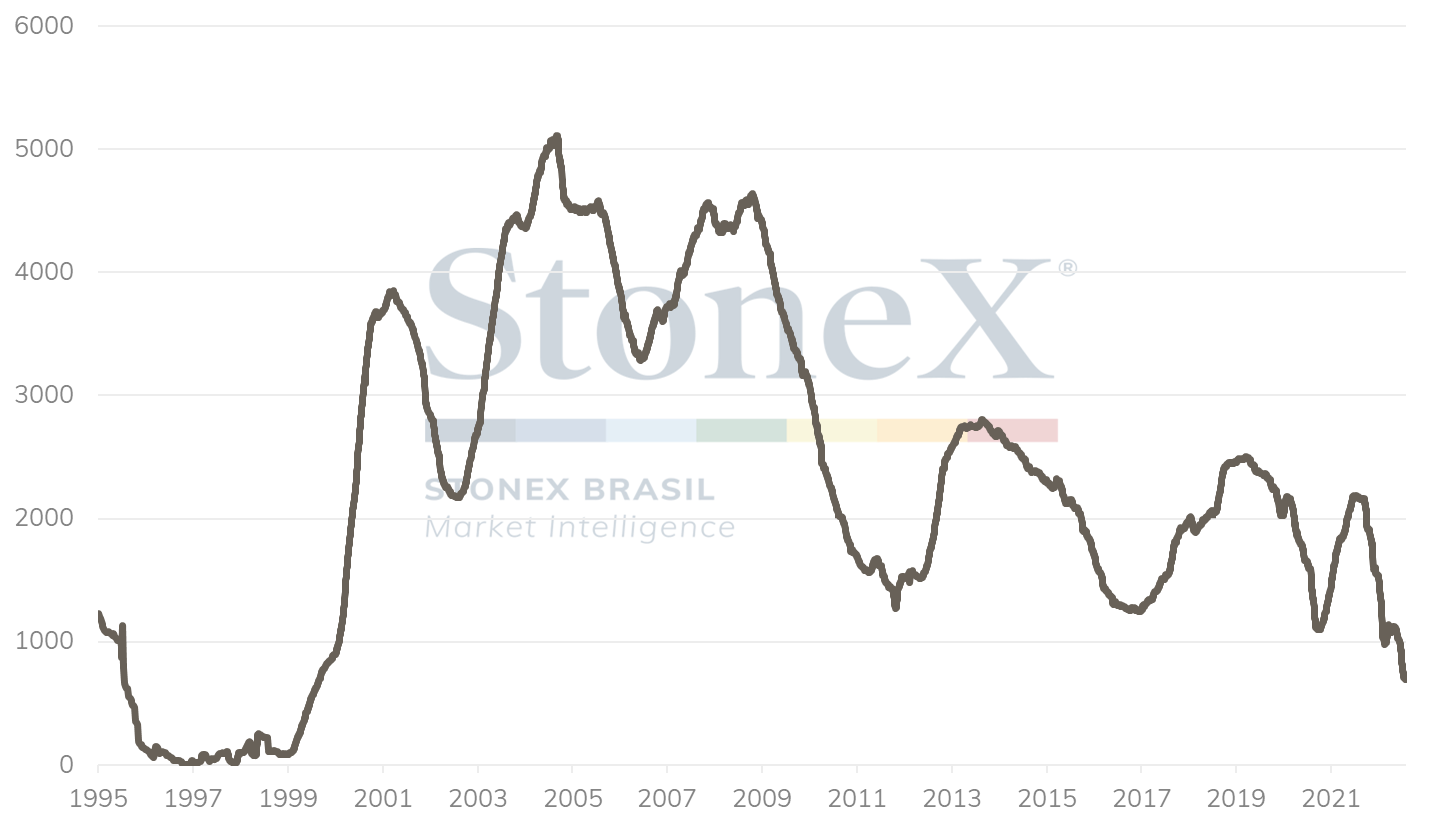
This year, certified stocks on ICE in New York have fallen from approximately 1.5 million bags to around 700,000 bags, a sharp drop of 837,000 bags, or 54.5% in volume. If we consider the time since stocks began their sharp downward trend in mid-September 2021, when ICE storage held over 2.1 million bags, the observed fall is over 1.4 million bags or 67.6%.
After July's reduction, stocks renewed their lowest level in almost 23 years, reaching levels not recorded since 1999. As can be seen in the chart, at that time, certified stocks were recovering after being at practically zero levels until 1998. Amid this scenario, agents have been asking how far these stocks can fall and whether they can repeat what happened more than two decades ago.
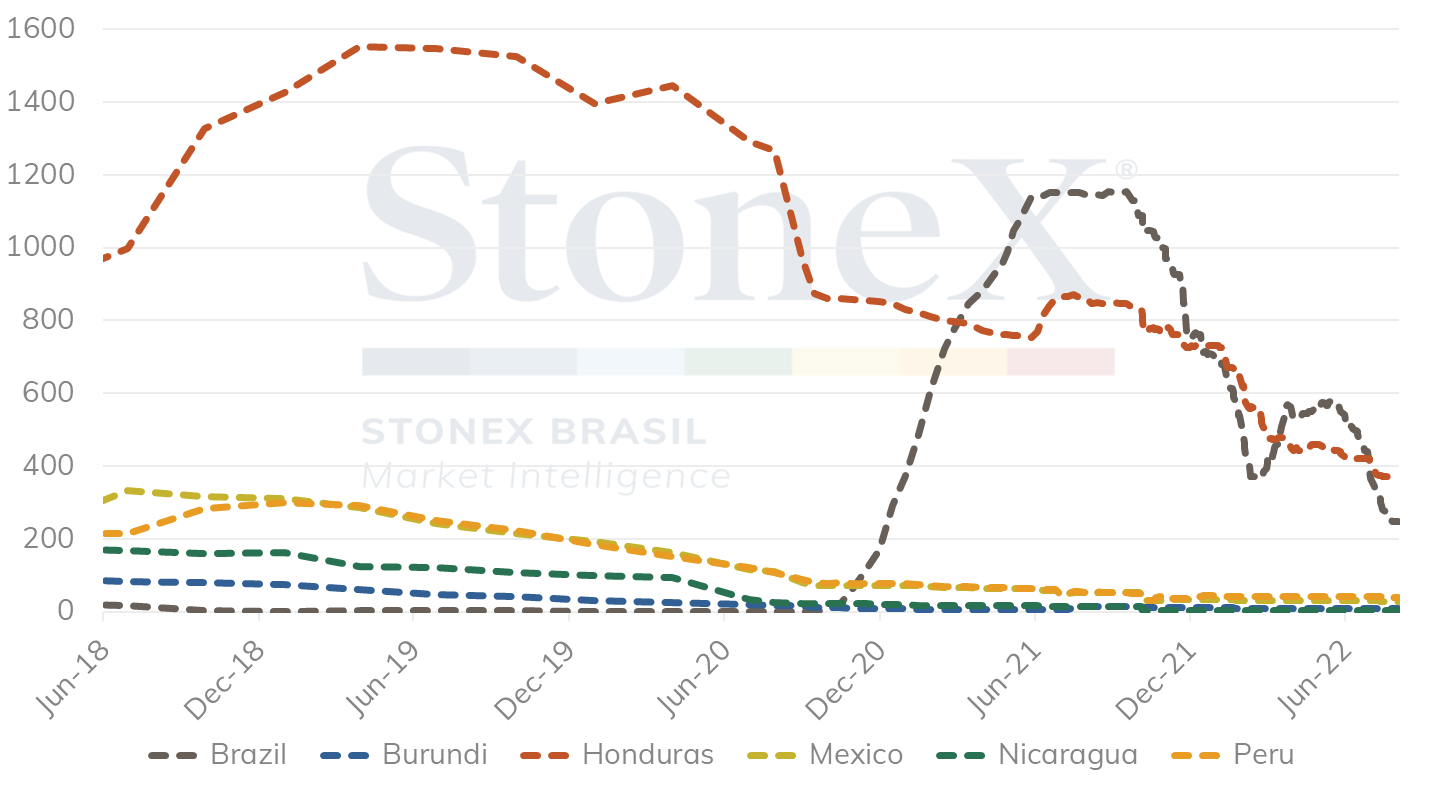
Certified coffee stocks by main origins at ICE NY (thousand bags)
Source: ICE. Design: StoneX.
Thus, it is worth remembering how the certified stocks' dynamics work and what their impact is on the market. At first, it is necessary to understand what would raise the interest of a commercial agent to certify his coffee on the stock exchange. A coffee exporting company, for example, that has contracts sold on the Intercontinental Exchange ICE, usually has three options for marketing the coffee, exporting it in the FOB (Free On Board) format, Export it and deliver it to destination CIF (Cost Insurance & Freight) or certifying it on the Futures Exchange. Accordingly, agents seek to make the deal that will bring them the most profit.
For ICE New York, the exchange has certification rules, which can apply a premium or a discount on the value quoted on the exchange for the coffee shipped, depending on the product's origin, as seen in Table 1.
In Brazil, the exchange offers a discount of 600 points, or US₵ -6.00/lb for coffee originating in the country. For example, if a Brazilian exporter wants to certify his coffee on the exchange at a given time, and the coffee is quoted at US₵ 200/lb, the exchange will pay the value after applying the discount of US₵ -6.00/lb, that is, US₵ 194/lb. Therefore, for certification on the exchange to become interesting, exporters need to purchase their product in the domestic market at a price that makes financial sense.
The price paid to originate the coffee needs to be significantly lower than the price observed on the exchange so that it will compensate for the US₵ -6.00/lb discounted by ICE, in addition to all logistical costs to place the coffee in the certified warehouses of the exchange, which the seller bears. In addition, it is worth mentioning that the exchange requires a specific standard for certification, with a high cost, requiring processing processes to reach the standard for certification on the exchange.
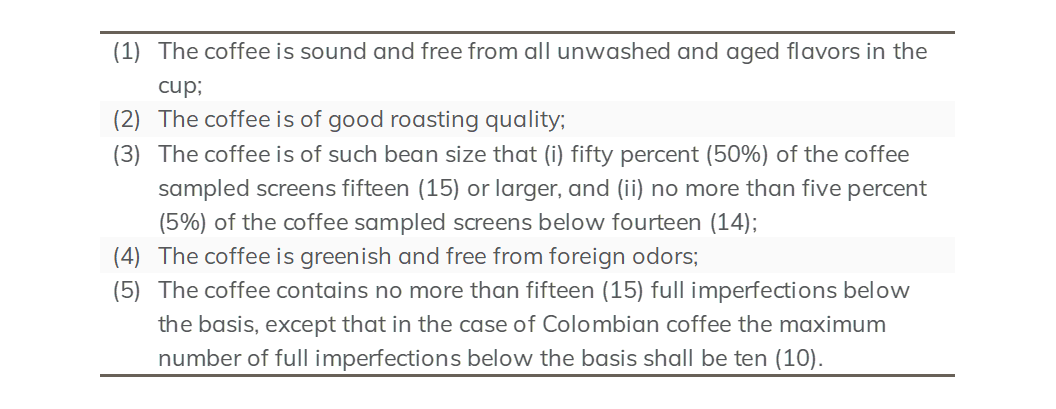
According to the rules of the exchange, these are the minimum standards for delivery under the Coffee "C” Futures Contract on the ICE/NY:
Focusing now on the main suppliers of coffee to the exchange, Brazil and Honduras. Historically, in the Brazilian case, the breakeven, that is, the differential between domestic and exchange prices to make the certification of a coffee attractive, used to be around US₵ -14/lb, in a calculation that considers the discounts that would be applied by the exchange for Brazilian coffee (US₵ -6.00/lb) and the logistical costs for the delivery, estimated then at US₵ -8.00/lb. As for Honduran coffee, there is no discount imposed by the exchange, and the logistical costs for certification were around US₵ -4.00/lb.
However, the reality as of mid-2021 has turned out to be quite different. Due to the severe logistical bottlenecks caused by the pandemic, export freight costs have taken off. In this context, breakeven differentials have retreated to significantly lower levels. StoneX estimates that the breakeven for certifying a Brazilian coffee on ICE is currently around US₵ -33/lb and may be even lower.
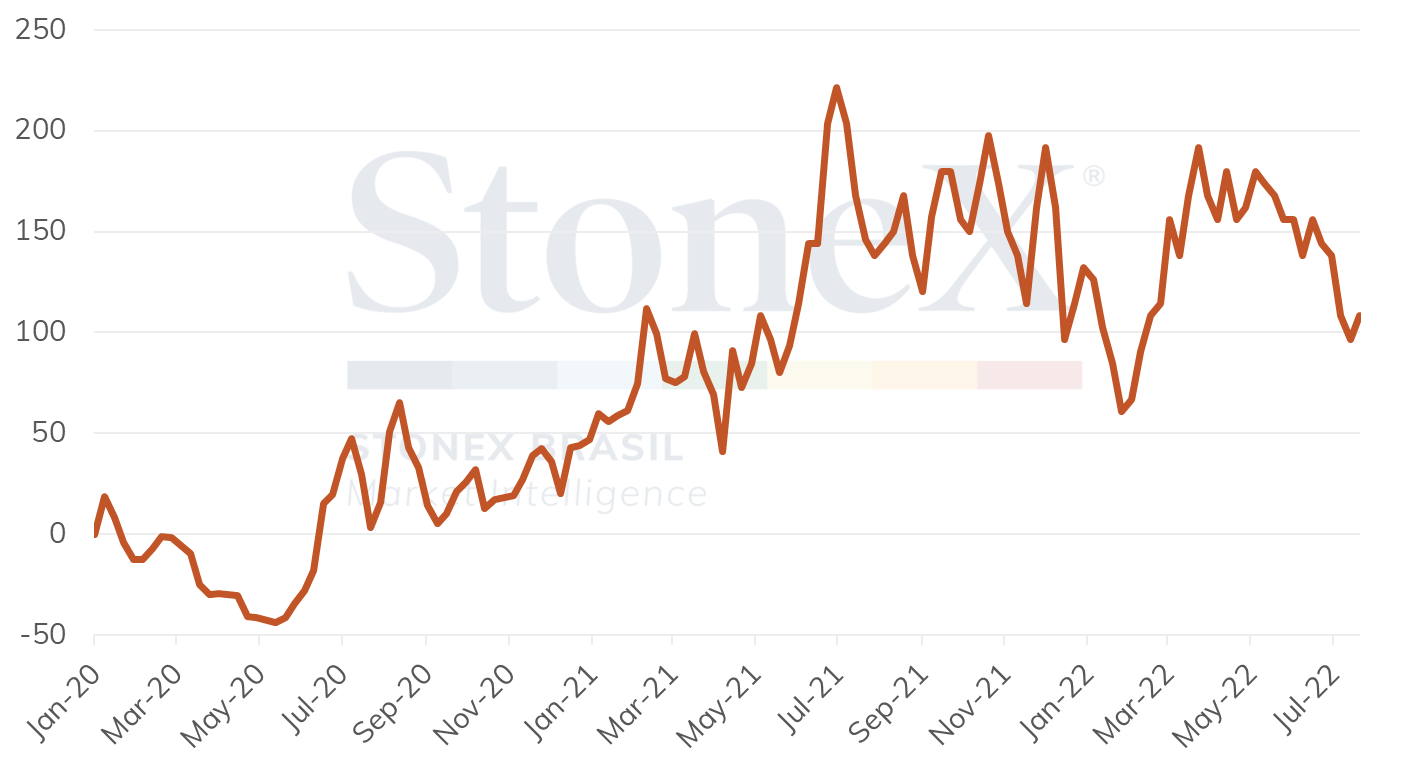
Given that the differential for an FOB coffee of Semi-Washed NY standard 2/3 FC 14/16 – which is not exactly the standard required by the exchange but comes close – was seen in mid-July at US₵ +3.00/lb, it becomes very unlikely that coffees of Brazilian origin will be certified on the exchange. In a hypothetical example, if an Arabica coffee futures contract in New York is quoted at US₵ 200.00/lb, if a company delivered the coffee to the exchange, it would receive US₵ 167.00/lb. If that same company sold that coffee FOB, it would receive US₵ 203.00/lb. Therefore, it becomes more profitable to trade the coffee FOB than to certify it on the exchange.
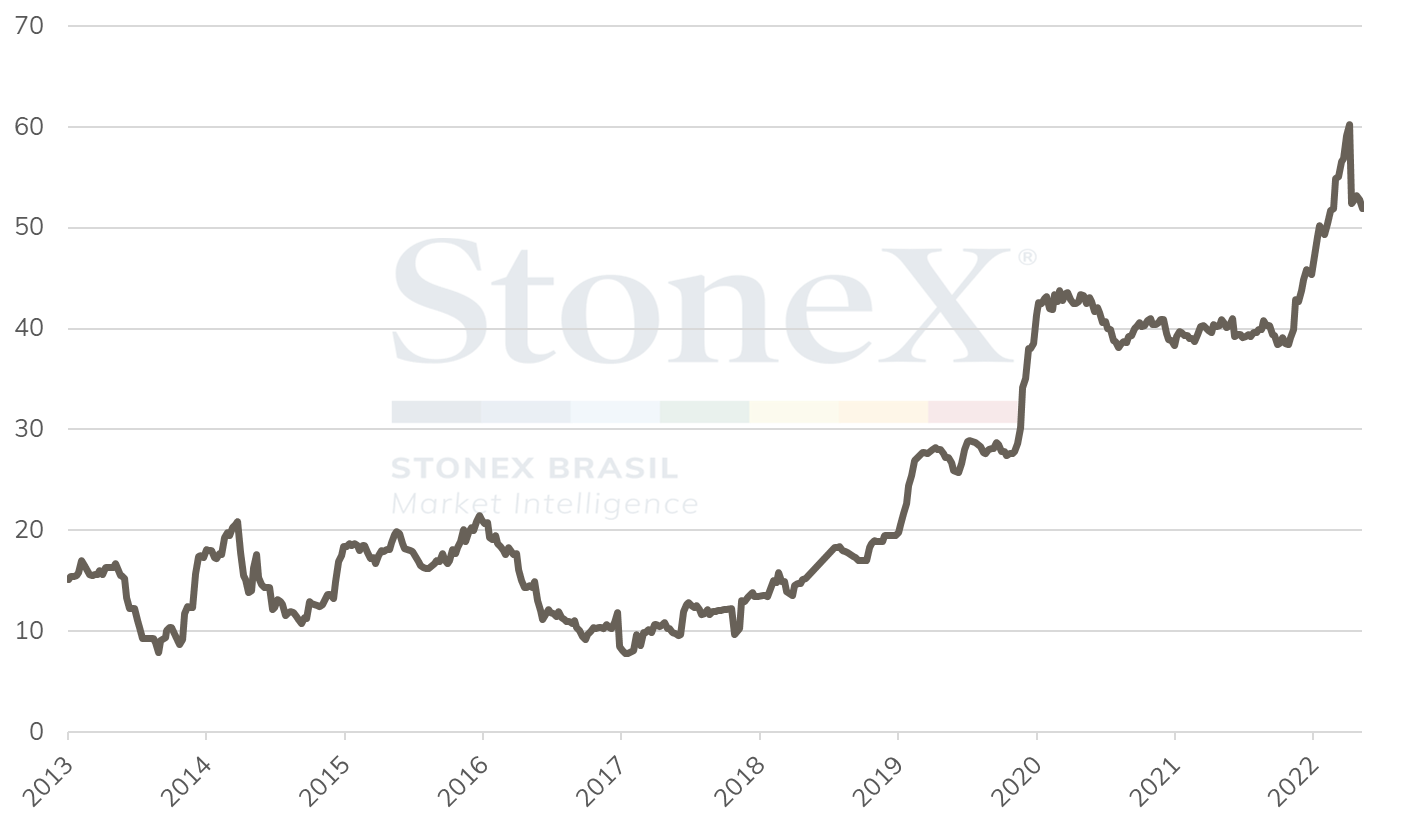
Prices differentials Index for mild arabica coffee in Central America, Colombia and Peru
in relation to the New York futures exchange (US¢/lb)
Source: StoneX. Design: StoneX. *Weighted average price differentials in Central America, Colombia and Peru.