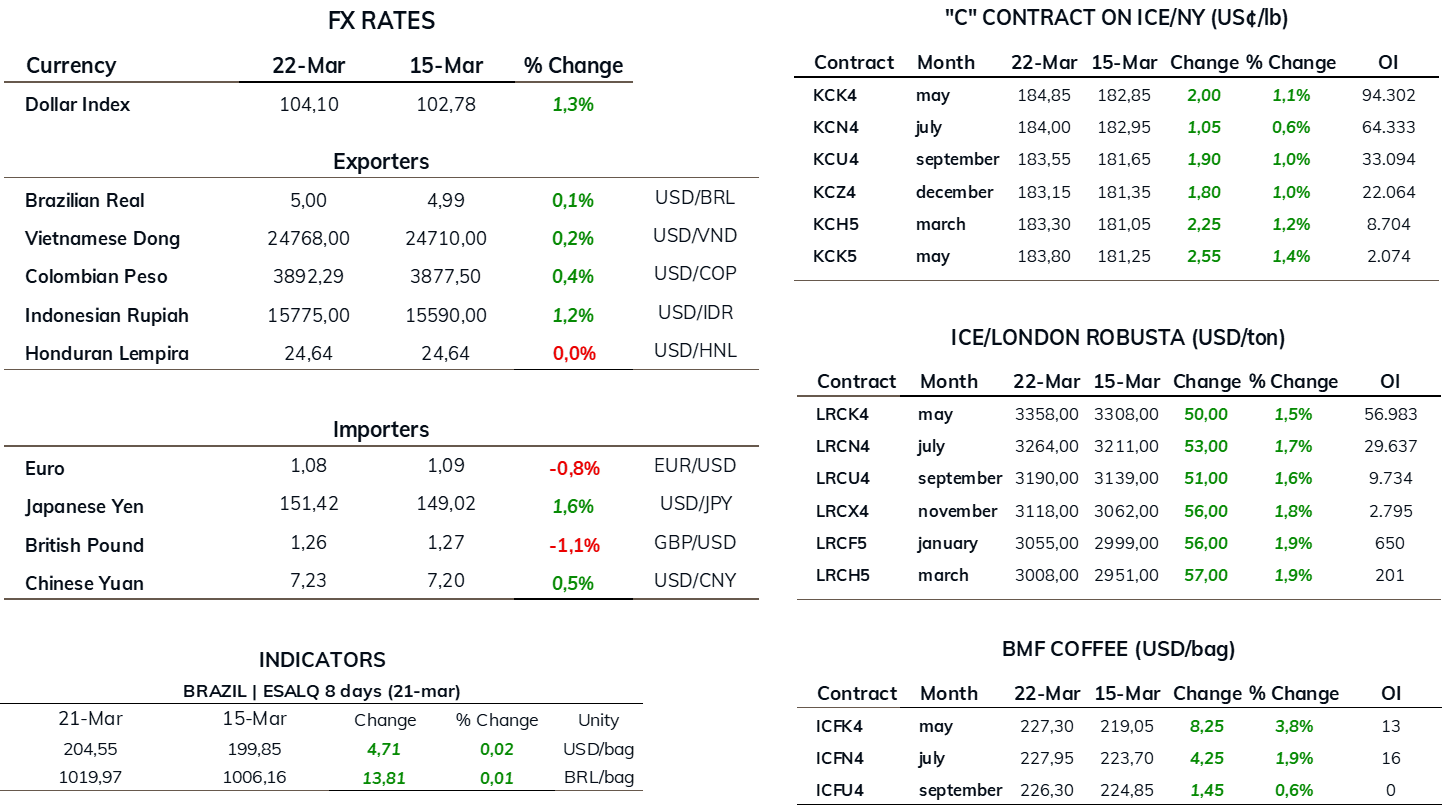
• Arabica coffee rose 1.0% on the week in New York, closing at US₵ 184.85/lb
• On the London exchange, Robusta coffee prices climbed 1.5% to USD 3,358/t
• Cepea indicator for Arabica coffee rises 1.5% to BRL 1,020.95
• Cepea indicator for Robusta coffee up 2.9% to BRL 913.83/bag
• Dollar Index up 1.3% to 104.10 points and USDBRL up 0.1% to 5.00
• Outlook is for greater coffee supply in 2024/25
• In the coming months, the focus will be on the release of USDA data
• Approaching winter may contribute to greater volatility
• Possible return of La Niña may support prices
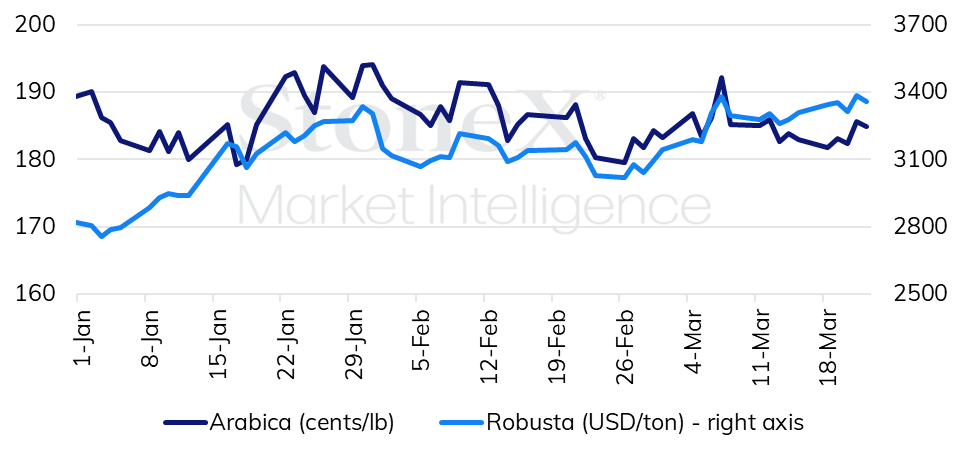
After ending the previous week with mixed results, coffee futures prices rose higher again last week. However, there was no clear trend for prices, with movements being impacted mainly by technical factors, short-term speculation and macroeconomic aspects. Despite the week's gains, if we look at the last few weeks, Arabica coffee prices have followed a sideways path, staying within the range between US₵ 180.00/lb and US₵ 190.00/lb.
In New York, the most active contract, expiring in May, ended the week up 190 points (1.0%), closing Friday (22) at US₵ 184.85/lb. In London, Robusta futures rose by USD 50/t (1.5%) to USD 3358/t. During this period, the Dollar Index climbed 1.3% to 104.10 points and the USDBRL pair rose 0.1% to USDBRL 5.00.
Trend in Arabica and Robusta coffee futures prices
On the Brazilian domestic market, coffee prices followed a similar trend, ending the week higher. The Cepea indicator for Arabica coffee rose 1.5% over the week, closing Friday (22) at BRL 1020.95/bag. For Robusta, the Cepea indicator rose even more, by 2.9%, to BRL 913.83/bag.
From the point of view of fundamentals, there were no major changes last week. As has already been mentioned in other editions of this report, despite the uncertainties regarding production projections in Brazil, there is a consensus that national production will be substantially higher in the 2024/25 season, with most estimates pointing to an increase of between 4% and 6%. As such, this scenario fuels optimism that the global supply and demand balance will be more comfortable next season. However, given the production problems of Robusta coffee in Asia, the expectation is that the balance for the variety will be tight, while the supply of Arabica improves.
Considering the release of important data, over the next few months market participants will closely monitor the release of the USDA attaché reports in producing countries, which are scheduled to be released between April and May, in order to anticipate what the agency's supply and demand balance will be, which in turn will be released in mid-June. In any case, the USDA is expected to indicate a significant increase in Brazilian coffee production and a global supply and demand balance featuring a larger surplus.
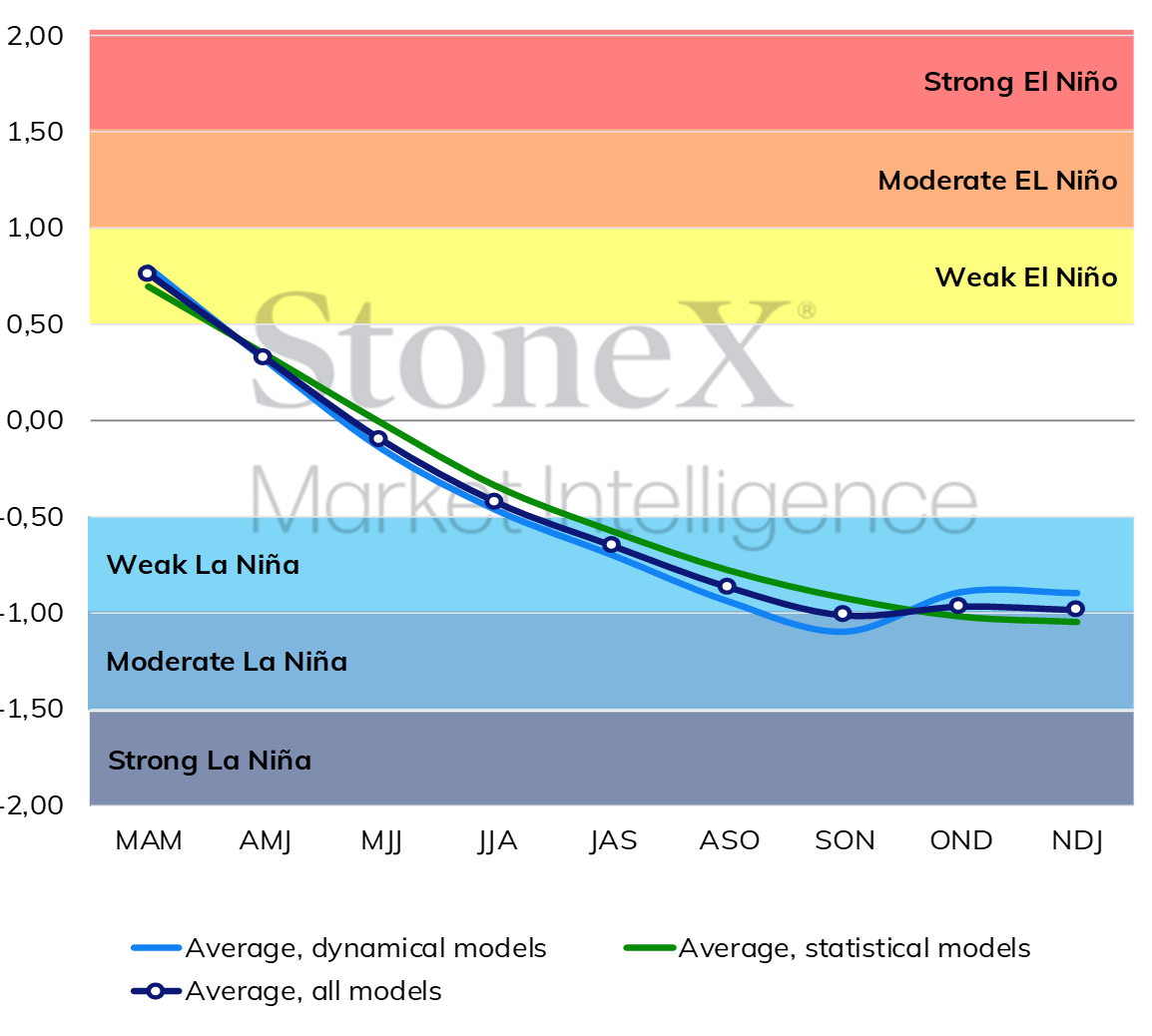
On the weather side, the oncoming winter and the possibility of a return of La Niña are the coffee market's main concerns. During the winter, the cold waves and the possibility of frost can act positively on prices and contribute to volatility. In addition, the US weather agency NOAA has pointed to a probability of over 60% of La Niña returning from the second half of the year and, if the phenomenon is of strong intensity, there is a possibility that it will impact coffee flowering in Brazil. A strong La Niña is related to delayed rainfall in the country's coffee belt, as happened in the second half of 2020 and 2021.
Projected change in the surface temperature of the Pacific Ocean (in ºC)