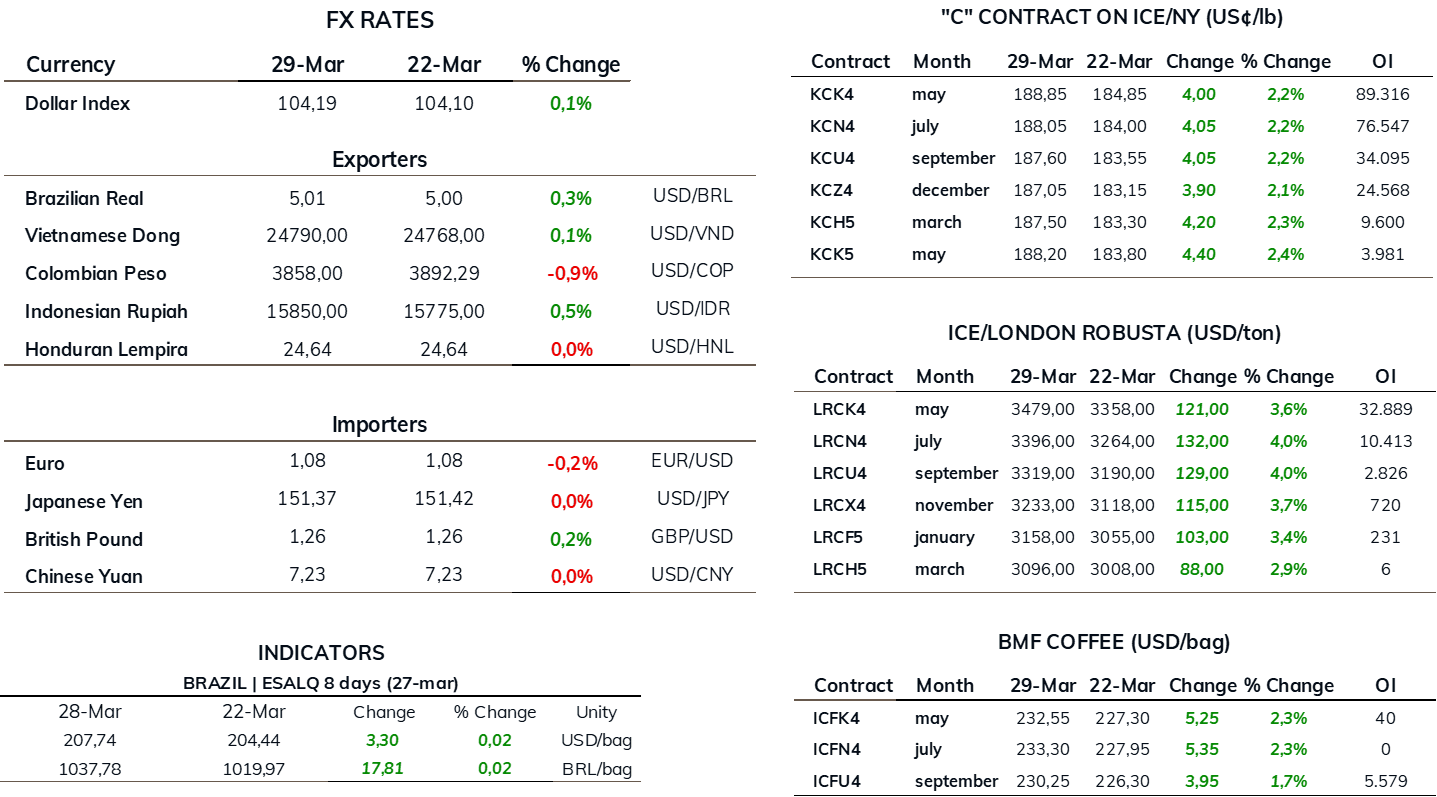
• Arabica coffee rose 2.2% over the week in New York, closing at US₵ 188.85/lb
• On the London exchange, Robusta coffee prices climbed 3.6% to USD 3,479/t
• Cepea indicator for Arabica coffee up 0.9% at BRL 1029.67
• Cepea indicator for Robusta coffee up 4.2% to BRL 952.42/bag
• Louis Dreyfus Company signed a binding agreement to acquire 100% of Cacique
• ECF: stocks in European ports down 41%
• Indonesian exports down 73% in March
• Vietnamese organizations release divergent export data
• Price difference between Arabica and Robusta coffee reaches lowest since 2017
Driven by technical factors and the actions of short-term speculative agents, Arabica and Robusta coffee futures ended another week higher. From the point of view of fundamentals, the scenario remains unchanged, with agents focusing on the start of the harvest in Brazil and weather events in the coming months, with the main focus on winter and the possibility of La Niña returning in the second half of the year.
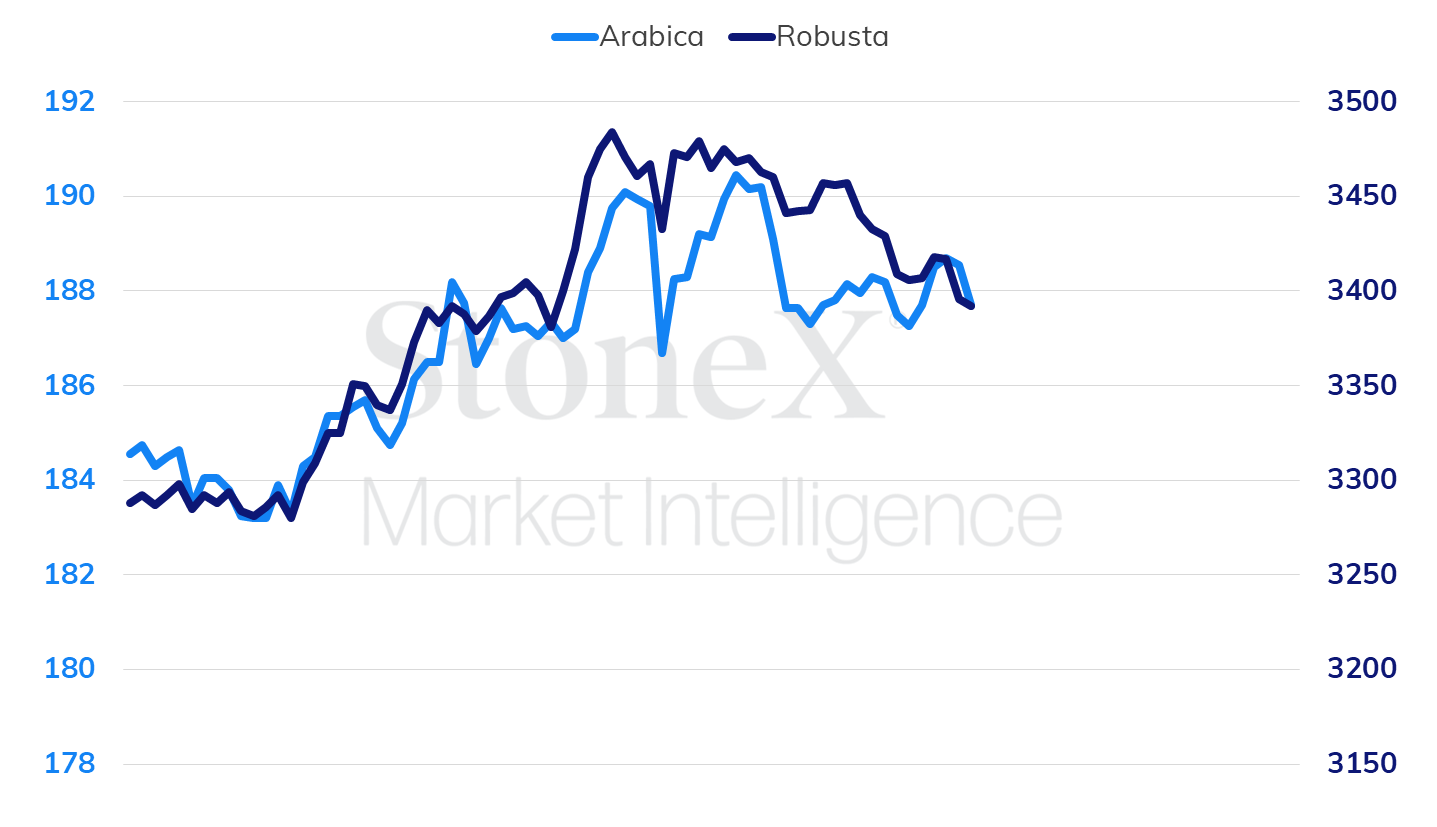
In New York, the most active contract, expiring in May, ended the week up 400 points (2.2%), closing Thursday (28) at US₵ 188.85/lb – the market was closed on Friday (29) due to the Easter holiday. In London, the May contract saw an even more intense rise, from USD 121/t (3.6%) to USD 3479/t. For the Robusta market, the limited supply in Asia continues to be a factor supporting prices.
Weekly intraday (most-active contract) – March 25 to 28
In Brazil, coffee prices on the domestic market also followed the movements abroad and ended the week higher. The Cepea indicator for Arabica coffee rose 0.9% to BRL 1029.67/bag. For Robusta coffee, the indicator pointed to a more intense rise of 4.2% to BRL 952.42/bag. Considering the Cepea coffee indicators, the difference between Arabica and Robusta coffee prices is the smallest it has been since the end of 2017, as will be discussed below.
Last week, it was reported that the France-based Louis Dreyfus Company (LDC) signed a binding agreement to acquire 100% of Companhia Cacique de Café Solúvel. According to Michael Gelchie, CEO of LDC, the acquisition aims to expand the company's operations, which have been active for more than 80 years in Brazil. In addition, the decision is in line with the company's strategy to diversify through higher value-added products, accelerating the company's soluble coffee business, which was recently started in Vietnam.
The European Coffee Federation (ECF) recently released data on coffee stocks in some European ports for the months of January and February. The stocks refer to the ports of Antwerp, Hamburg, Le Havre, Barcelona, Trieste, Genoa, Napoli, Tallinn, London, Felixstowe and Bremen. According to the organization, stocks totalled 6.9 million bags in January, down 41% year-on-year and 5.7% compared to the previous month. For February, stocks stood at 6.7 million bags, again down 41% year-on-year and 2.5% compared to January. In February, 28% of stocks were Robusta coffee, 33% natural Arabica coffee and 39% washed Arabica coffee.
Regarding the Robusta market, export data from Indonesia points to a sharp drop while data from different sources is confusing for Vietnam. According to the Indonesian government, the country's exports totaled 53,700 bags in February, representing a drop of 73% year-on-year. Accumulated exports for the crop year, which runs from April/23 to March/24, totaled 1.98 million bags, down 58% from the same period last year.
For Vietnam, some confusing data was released. According to the country's General Statistics Office (GSO), exports may have risen to 6.67 million bags in March, a volume 90% higher than in the same month in 2023. However, the figure is confusing and goes against what was reported by the Vietnam Coffee Association, which indicated that the country's exports could end 2023/24 with a 20% drop to 22.3 million bags, due to lower production caused by weather problems. In the coming days, the country's customs agency is expected to release official data on exports and shed light on this issue.
Price difference between Arabica and Robusta coffee hits multi-year lows on the domestic market
At the end of last week, the ratio between the Cepea indicators for Arabica and Robusta coffee reached a significant mark. In view of the strong rises in Robusta coffee prices on the international market, which has also been reflected on the Brazilian domestic market, the difference between the varieties has narrowed significantly. Considering the close of the Cepea indicators for Arabica and Robusta coffee last Thursday (28), the difference, or spread, between the two reached the BRL 77.25/bag mark. The last time this differential reached such a narrow level was in December 2017.
Cepea indicators for Arabica and Robusta coffee and the spread between the two (BRL/bag)
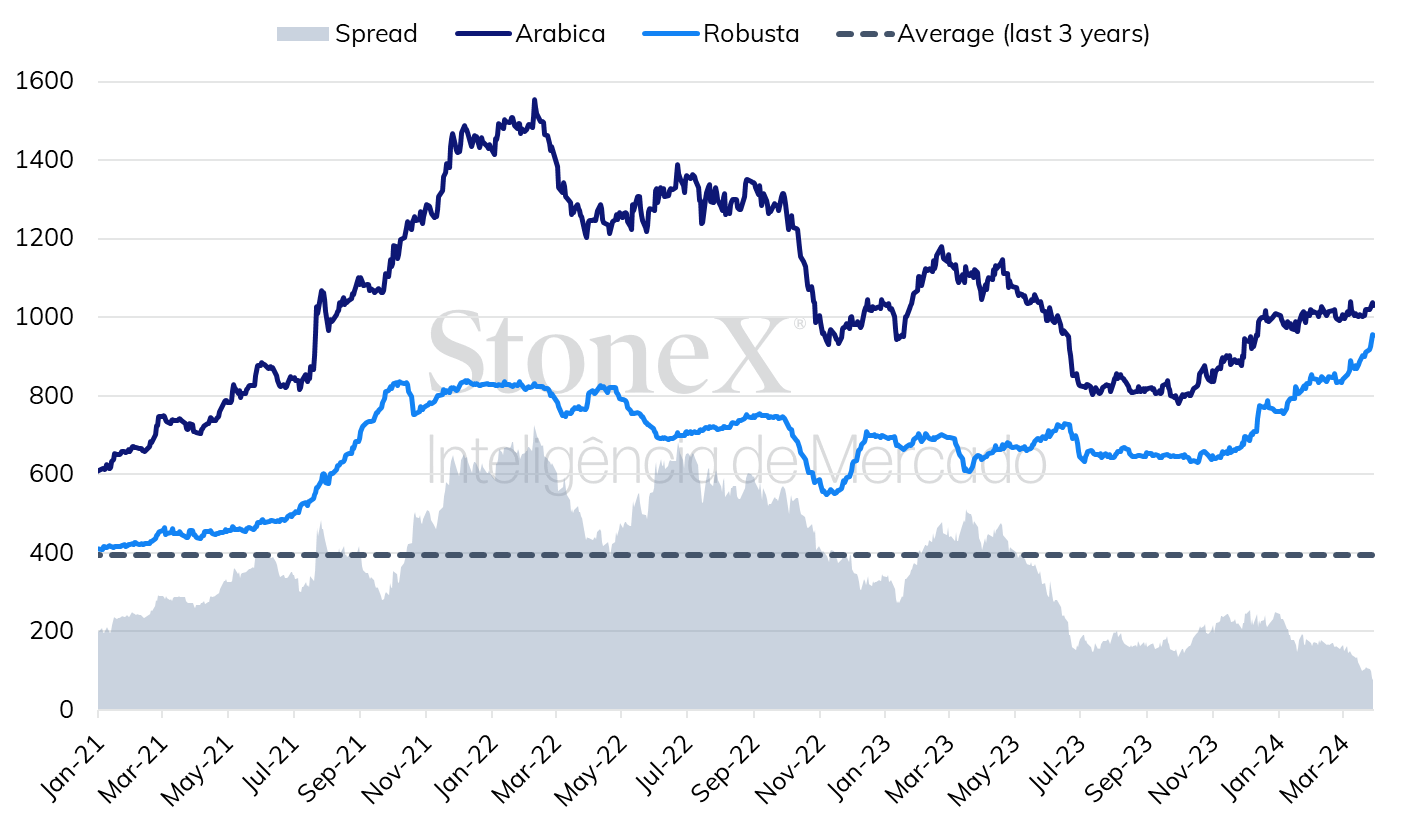
Source: Cepea. Design: StoneX.
For an idea of how low this indicator is, the average spread over the last three years has been around BRL 394.5/bag. It is important to remember that the rise in Robusta prices, despite estimates that Brazil will produce a large crop this year, is based on production problems in the main producing countries in Asia.
As such, the lower marks reached this year may reflect a movement on the part of the domestic industry to choose to increase the use of some Arabica coffee standards to the detriment of Robusta coffee, since the variety has faced greater competition from national and international agents. If this difference consolidates and remains for the next few months, it is possible that this movement will continue, with the industry once again adapting the blend in order to achieve better financial results.
INDICATORS