• Arabica coffee up 0.3% on the week in New York, quoted at US₵ 225.00/lb
• On the London exchange, Robusta prices rose 2.4% to USD 4104/t
• Dollar up 1.0% to USDBRL 5.43 on the week
• Cepea indicator for Arabica rises 0.9% to BRL 1,352.29/bag
• Cepea indicator for Robusta up 1.1% to BRL 1,206.91/bag
• Weather remains generally suitable for Brazil's crop
• As winter approaches, StoneX publishes new minimum temperature report
• NOAA reduces chances of a La Niña in the second half of 2024
• USDA projects larger surplus in 2024/25
• USDA becomes more optimistic about Robusta crops in Southeast Asia
• StoneX team follows harvest progress, with updates on yield, aspects, and vegetation conditions
Last week, with no major changes from the point of view of fundamentals and awaiting the release of the USDA report, Arabica coffee futures saw a small weekly increase, while Robusta prices gained strength amid the reduced supply scenario in Asia. On Friday (21), coffee prices came under pressure following the release of the USDA report, which pointed to a larger surplus in 2024/25, as will be discussed later.
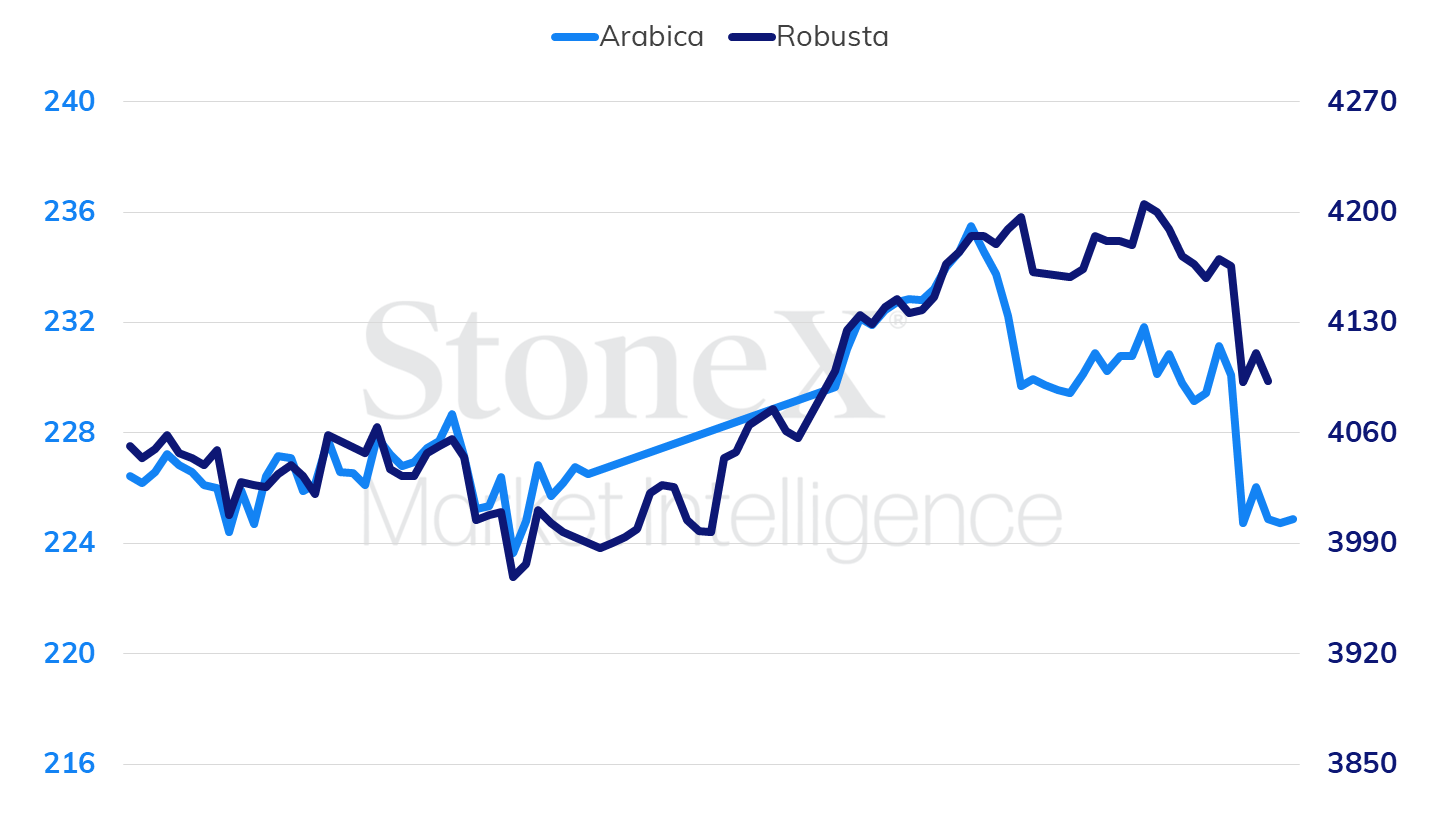
In New York, the most active contract, expiring in September, rose by just 0.3% to US₵ 225.00/lb. At the London terminal, despite the fall on Friday (21), prices ended the week up USD 95/t (2.4%) to USD 4104/t. During this period, the Dollar Index rose 0.2% to 105.80 points and the USDBRL pair increased 1% to USDBRL 5.43.
Weekly intraday (most active contract) - June 17 to June 21
On the Brazilian domestic market, prices followed the international trend and rose during the week. The Cepea indicator for Arabica was up 0.9% on the week, closing Friday (21) at BRL 1352.29/bag. For Robusta coffee, the increase was slightly higher at 1.1%, closing Friday at BRL 1206.91/bag.
In terms of fundamentals, now that the USDA report has been released, agents' attentions are turning to weather conditions and possible impacts on next season's production. For Vietnam, an adequate rainfall regime is still needed to ensure proper development of the 2024/25 crop. The latest weather data indicates that the country's coffee plantations have received adequate volumes of rain over the last 30 days, which has brought the accumulated rainfall in the regions over the period to close to or above the historical average. In addition, the models continue to point to significant volumes of rain for the next two weeks.
In Brazil, there are two major topics: the Brazilian winter and the possibility of La Niña returning in the second half of the year. With regard to minimum temperatures, the coming of a cold wave has been rumored in the market, however, the models indicate that minimum temperatures should not be lower than 10 Cº throughout the coffee belt, which makes any chance of damage in the coming weeks unlikely. However, any news indicating the onset of new cold waves could be bullish for prices and contribute to increased volatility. With this in mind, StoneX has resumed publishing its daily report forecasting minimum temperatures in coffee-growing regions, in order to closely monitor conditions over the coming weeks.
With regard to La Niña, the occurrence of the phenomenon in 2020 and 2021 was linked to delayed rainfall during the coffee flowering stage, which had a negative impact on production in 2021 and 2022. But the latest update from US agency NOAA has reduced the phenomenon's probability of occurrence from 80% to around 50% to 60%, and the models have also reduced its intensity, which is expected to be weak for a short period before returning to a neutral condition. As a result, there is no expectation of delayed rains or possible damage, which could act as a bearish factor for prices, especially if flowering is widespread in the country.
Probabilistic forecast and projection of changes in the Pacific Ocean surface temperature (ºC)
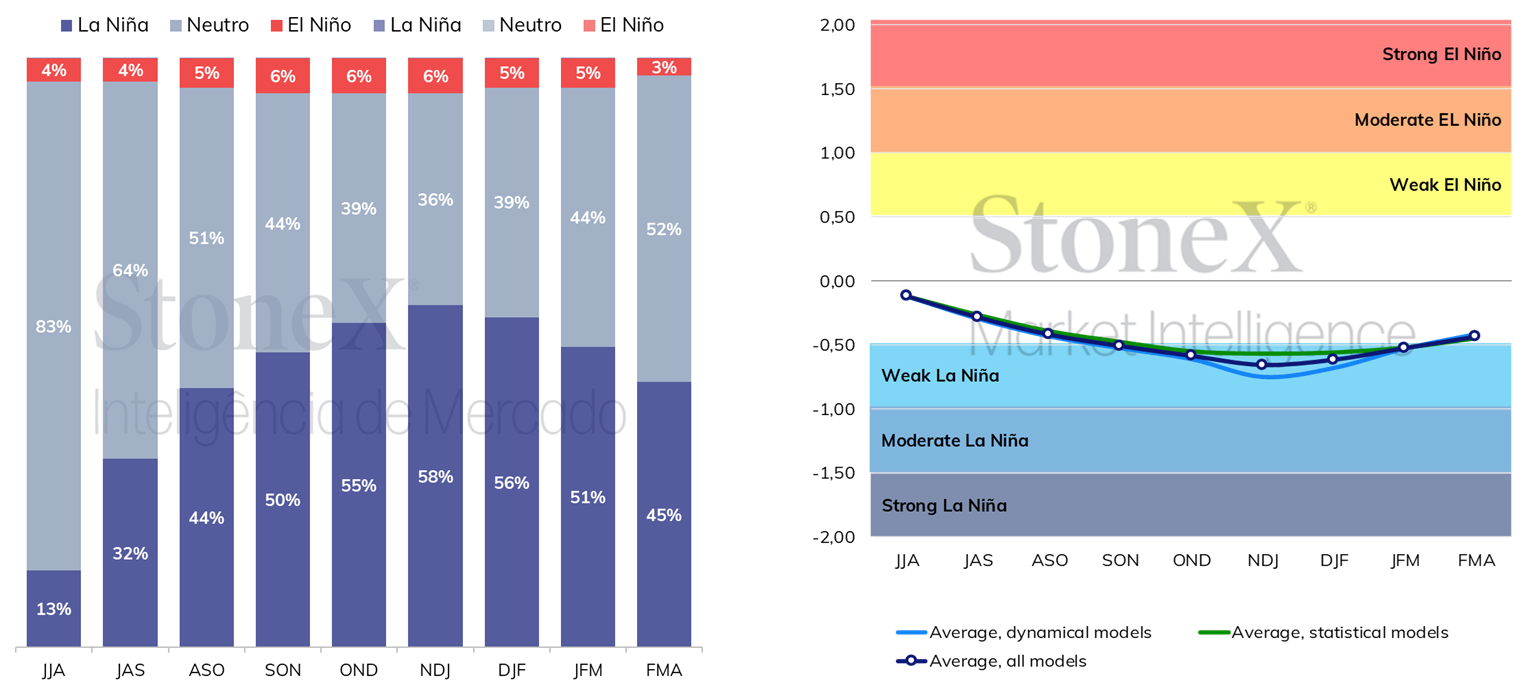
Source: IRI/CPC, NOAA. *Average of statistical models
In addition, in the coming weeks, market participants will be closely monitoring the release of export data from countries, especially Brazil, Vietnam and Indonesia. The reduced supply of Robusta coffee can be seen in the drop in exports in Asian countries and this has acted as a bullish factor for coffee prices, especially in the London terminal.
USDA projects larger surplus in 2024/25
Last Thursday (20), the US Department of Agriculture (USDA) released its outlook report for the global coffee market in 2024/25. According to the forecast, world coffee production is expected to rise by 4.2% next season and reach 176.2 million bags. Global production of Arabica coffee is estimated at 99.8 million bags, an increase of 4.4% compared to last season. For Robusta coffee, production is expected to rise by 3.9% to 76.4 million bags.
As for consumption, the department projects an increase of 1.8% to 170.6 million bags. This means that, in the USDA's opinion, the global coffee balance will have a surplus of 5.6 million bags in the 2024/25 season, substantially higher than the surplus seen in 2023/24, which was estimated at 1.6 million bags. As such, the report has a bearish bias for coffee prices, although there are diverging conclusions from the USDA and some agents when it comes to prospects for Vietnam and Indonesia output in 2024/25.
USDA: supply & demand balance and ending stocks (million bags)
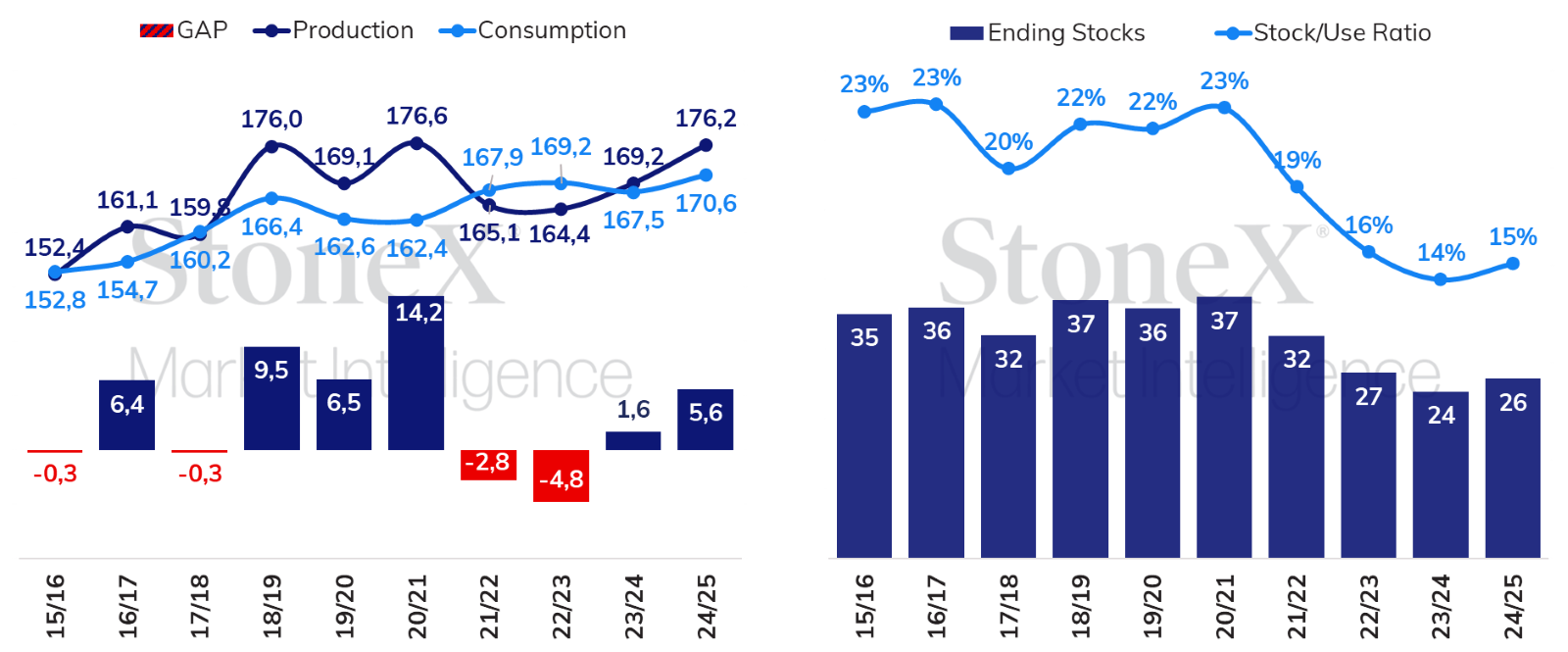
Source: USDA. Design: StoneX.
For some players, Vietnamese coffee production will be substantially lower than the 29 million bags estimated by the USDA. For Indonesia, the department projects a recovery of more than 33% to 10.9 million bags, a volume that is contested by some agents. Therefore, if production in these countries is even lower than the USDA's forecast, the supply and demand balance would have a smaller surplus. CoffeeNetwork estimated coffee production between 169 and 170 million bags, and consumption between 166 and 167 million bags, which would result in a surplus of between 2 and 4 million bags for the 2024/25 balance.
Also according to the USDA report, as a result of the greater surplus in production next season, ending stocks are expected to rise by 7.7% to 25.78 million bags, which increases the ratio between stocks and use from 14% to 15% in the 2024/25 season. The department also projects a 2.7% increase in global coffee exports, which are expected to reach 145.2 million bags.
-
Crop follow-up – Brazil
-
Over the last week, our team in the field has been in contact with producers, brokers, traders, and exporters in order to monitor the progress of the harvest in each of the coffee-growing regions. These contacts also provided other information, such as yields, the aspects of the coffee harvested, vegetation and flowering conditions for the 2025/26 crop.
Harvest progress remains very close to the average of previous years. There are no significant labor problems and the dry weather has contributed to the harvesting process in most regions. The big problem for the 24/25 crop, especially at the start of the season, was the uneven ripening of the fruit, which occurred as a result of several flowerings and long intervals of days between one and the next. Another factor that accentuates the unevenness in fruit ripening is that the grains from the first flowering compete more for nutrients and develop faster.
-
Coffee harvest pace in Brazil
-
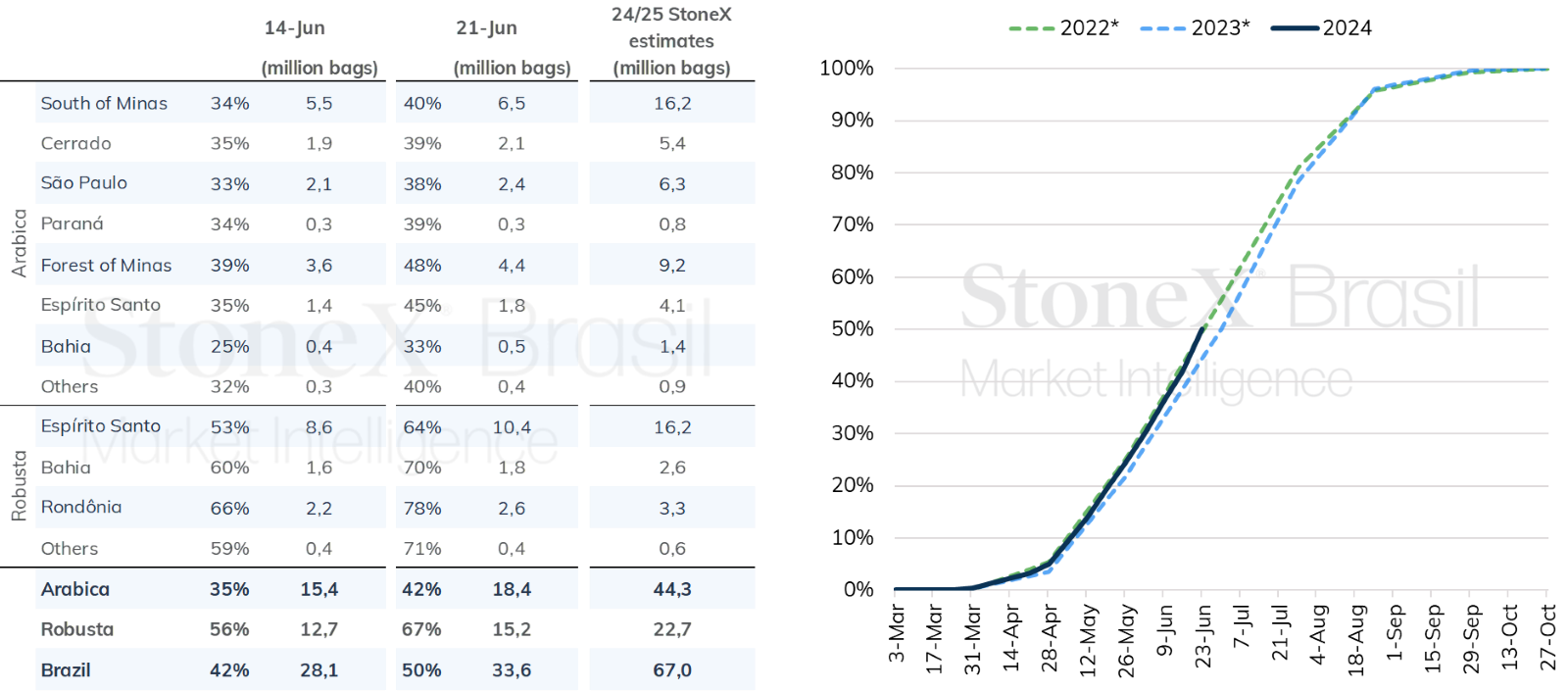
Source: StoneX. Design: StoneX. *Calculated based on Conab's harvest pace.
-
This large difference in fruit ripeness made it difficult for producers to decide on the ideal point to start harvesting, and due to the high percentage of green coffees at the start of the harvest and beans that were not yet fully granulated, the yield low yield and the aspects of the first coffees harvested were poor. As the harvest progressed and the number of unripe and poorly-ripened coffees decreased and the appearance and yields improved, but not to the point of being considered good so far.
From the information received to date, the crop could produce small beans. The percentage of grains with sieves 17 and above, which is a parameter for a crop with large grains, is lower than normal, reaching around 12% to 15% in the Cerrado, when the normal is around 30% to 35%. In the region known as Sul de Minas, the same sieve is between 20% and 25%, also below the 40% to 45% that would be close to normal for a year of good fruit development.
So far, yields for Arabica regions have been averaging between 500 and 540 liters for a processed bag, with Robusta yields averaging between 400 and 435 liters. It is worth noting that these are partial figures, and that they are likely to change by the end of the season, when we will carry out a new, more detailed survey at a more assertive time for data collection.
With regard to the vegetation conditions of the crops, we have generally seen a positive situation. The Robusta regions are nearing the end of the harvest and already looking ahead to flowering. The first Robusta flowering should take place at the end of July or the beginning of August, depending on the weather.
For Arabica, in some regions such as Matas de Minas and Sul de Minas, new crops and crops coming back from pruning are showing an induction of flower buds, and if we have rain with higher temperatures than normal, flowering could take place earlier.
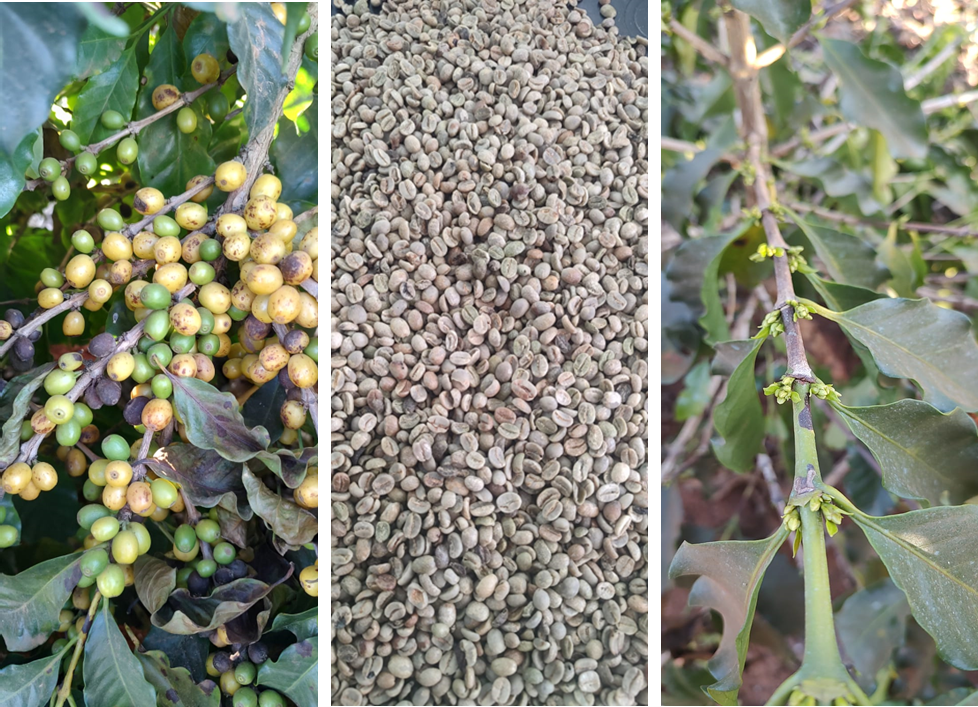
Source: StoneX. Southern Minas Gerais.
INDICATORS