• Arabica coffee up 0.9% on the week in New York, quoted at US₵ 228.95/lb
• On the London exchange, Robusta coffee prices rose 4.3% to USD 4185/t
• Dollar falls 2.4% to USDBRL 5.46 for the week
• Cepea indicator for Arabica coffee rises 1.4% to BRL 1,389.75/bag
• Cepea indicator for Robusta coffee up 1.1% to BRL 1,235.99/bag
• Reduced supply in Asia continues to support coffee prices
• Possible optimism about Brazilian flowering could put pressure on prices
• Cecafé to release June export figures on Wednesday (10)
• Cecafé data should point to a new export record
• NOAA to release La Niña update on Thursday (11)
• Colombian production up 23% in June
• Coffee harvest progresses to 65% in Brazil
• Coffee sales remain slow in some regions
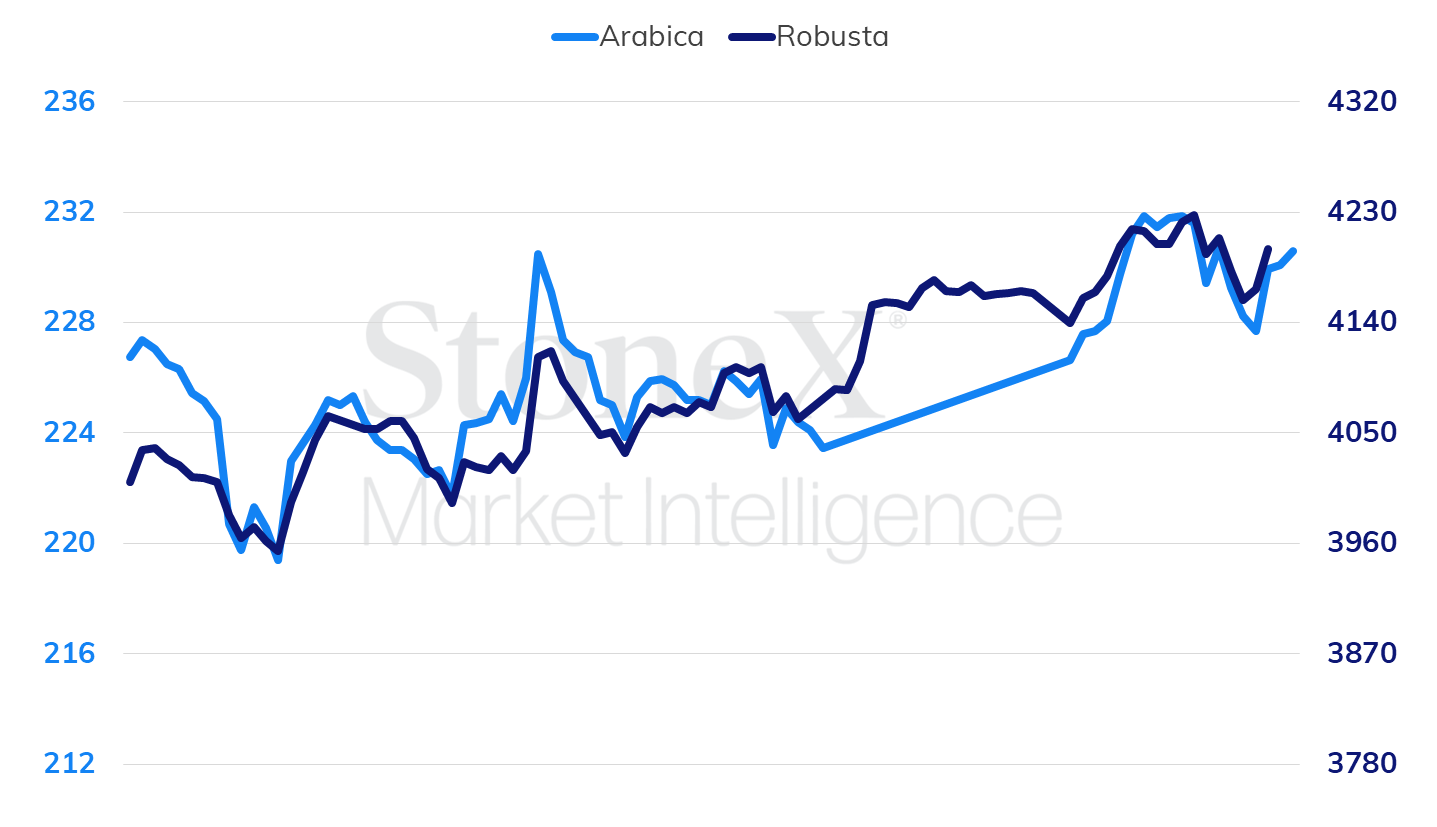
After ending June with an increase of 2.5%, Arabica coffee futures rose by just 0.9% last week, reacting to price movements at the London terminal. Arabica coffee ended Friday (05) quoted at US₵ 228.95/lb. In London, Robusta coffee prices ended June with an increase of just 0.6%, pressured at the end of the month by the large number of delivery notices for the July contract. However, last week, Robusta coffee started to rise again and ended the period with an appreciation of 4.3%, closing last Friday quoted at USD 4184/t.
There were fewer contracts traded last week due to the July 4th holiday in the US. In addition, with no major changes from the point of view of fundamentals, movements were predominantly impacted by technical factors. During the week, the Dollar Index fell 0.9% to 104.53 points and the USDBRL pair fell 2.4% to 5.46.
Intraday semanal (contrato mais ativo) – 01/07 a 05/07
On the Brazilian domestic market, Arabica and Robusta coffee prices followed the trend abroad and ended the week on a high, despite the 2.4% drop in the dollar over the week. The Cepea indicator for arabica coffee rose 1.4% to BRL 1389.75/bag and the indicator for Robusta coffee rose 1.1% to BRL 1235.99/bag. As will be discussed below, part of Brazil's coffee producers have been holding onto their production in the expectation of better prices, in addition to the fact that crops have yielded less than expected for the current harvest.
As for the fundamentals, there have been no major changes in recent weeks. With regard to the global supply and demand balance (S&D), on June 20 the USDA released a projection of a surplus of 5.6 million bags for the 2024/25 season, which in principle has a bearish bias for prices. However, this scenario is contested by market players, given the USDA's optimism for production in Vietnam (29 million bags [-0.3%]), Indonesia (10.9 million bags [+33.7%]) and Brazil (69.9 million bags [+5.4%]). As a result, most market participants expect a tighter S&D balance than that proposed by the department.
In addition, the scenario of limited supplies of Robusta coffee in Asia continues to be a bullish factor for prices in London and, consequently, for Arabica coffee prices in New York. Export data from the Indonesian customs authority indicated a 54% drop in exports from the island of Sumatra in May. For the coming months, there is an expectation of a partial recovery in shipments, given the start of the country's crop.
However, considering world exports of Robusta, these should only pick up again from December onwards with the new Vietnamese crop, whose harvest will begin in mid-November. Vietnam is still in the inter-crop period, a condition that is accentuated by the lower supply on the local market. As a result, preliminary data from the country's General Statistics Office pointed to a 40% drop in exports in June and differentials in the country continue to strengthen at around +USD 1000 per tonne.
In Brazil, the focus remains on the development of the crop in Brazil, the Brazilian winter and the outlook for the weather in the coming months. With regard to the harvest, there are several reports suggesting that yields in the current crop are lower than expected, which has a bullish bias and may justify agents revising their estimates. With regard to the winter, there is no expectation of frost in the coming weeks, but any new cold wave approaching the coffee belt could have a bullish effect on prices. In addition, as the crop progresses, agents will be focusing on the opening of coffee blooms in Brazil and adequate weather conditions are necessary to guarantee production potential for 2025/26.
This week will see the release of export data from Brazil and an update from the US agency NOAA on the likelihood of La Niña. On Wednesday (10) Cecafé will hold a conference to release export data for the month of June and take stock of the 2023/24 crop year, which ended in June. Cecafé is likely to report that Brazil set a new record for the volume exported in the 2023/24 season. The data released by Cecafé up to the month of May shows that in the crop year up to that month Brazil had exported 43.7 million bags, with a difference of just 1.96 million bags to the record seen in 2020/21, when the country exported 45.7 million bags.
With the inclusion of the volumes exported in June, the total exported by the country should easily surpass the exports seen in 2020/21. According to preliminary data from the Secretariat of Foreign Trade (Secex), Brazil exported almost 3.4 million bags in June, representing a 47% increase compared to June 2023; if Cecafé reports a figure close to the figure released by Secex, Brazil will record total exports of 47 million bags in the 2023/24 season. The strong increase in Brazilian exports is due to the significant growth in Robusta coffee shipments, a condition that has prevailed since the start of the 2023/24 season in Brazil due to the Robusta supply shock in Asia.
Brazilian coffee exports (million bags) 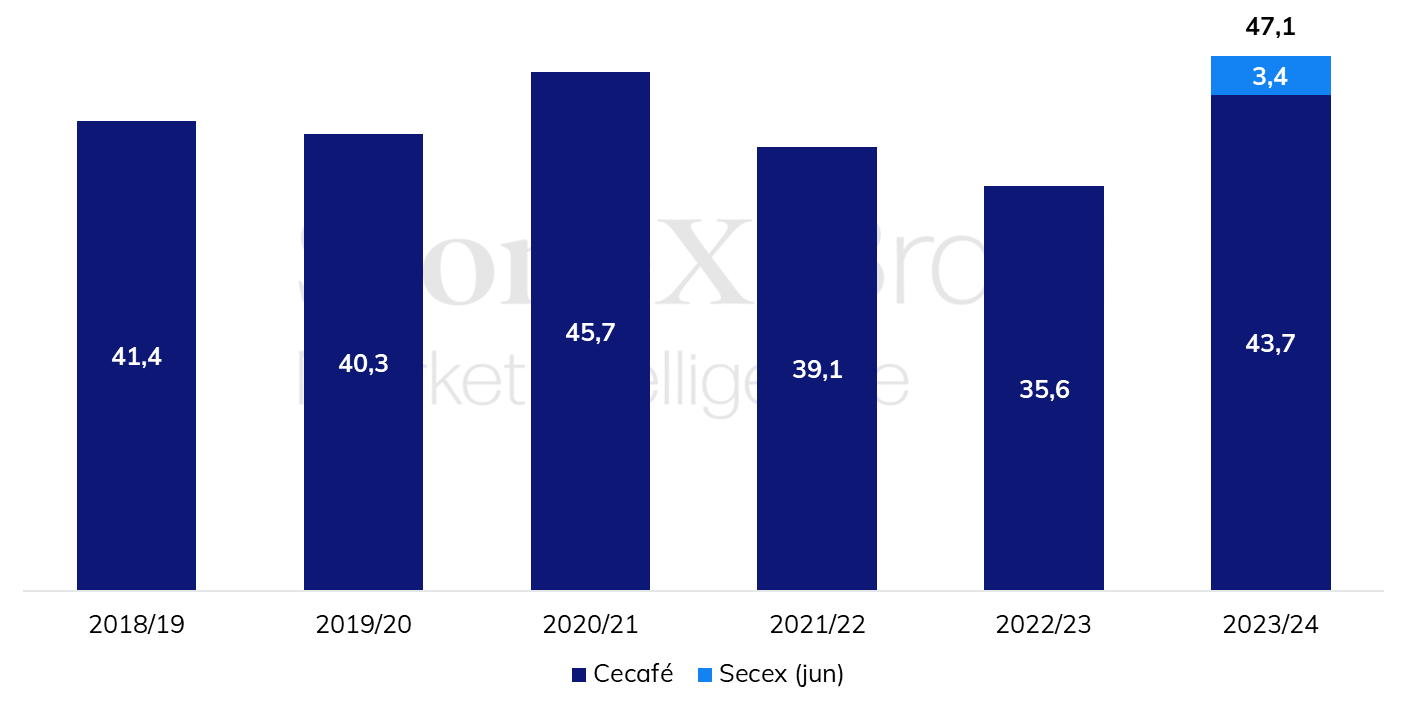
Source: Cecafé and Secex. Design: StoneX.
It will be extremely important to follow the release of data by the US agency NOAA, which will update on Thursday (11) the probability of La Niña occurring in the second half of 2024. The agency's last update substantially reduced the probability of the phenomenon occurring and its intensity. In a scenario of a weak La Niña or neutral condition, the expectation would be for favorable weather conditions for flowering in Brazil, with an adequate return of the rains. The wide spread of flowering in Brazil could fuel optimism about production in 2025/26 and act in a bearish way for coffee prices. However, if the phenomenon takes shape and La Niña reaches a moderate or strong intensity, the rains in Brazil's coffee belt could be delayed.
Finally, the progress of coffee production in Colombia is a factor with a bearish bias for prices. Under the effect of El Niño last year, the drier weather contributed to a proper flowering phase in the country, which favored the recovery of national production. The latest figures from the National Coffee Growers Federation show that Colombia produced 1.17 million bags in June, which represents an increase of 23% compared to June 2023. This brought accumulated production in the first half of 2024 to 5.82 million bags, an increase of 16% compared to the same period last year. In the last 12 months, Colombian production rose 14% to 12.14 million bags.
-
Crop follow-up
-
In the latest survey conducted by StoneX, it was found that the Brazilian crop is 65% harvested, with the Robusta coffee crop more developed, at 86% harvested, while the Arabica coffee crop has 55% of its total harvested. The pace of the harvest continues to accelerate compared to the previous year, reflecting the dry weather in the producing regions, which favored a better pace of harvesting in the producing regions.
-
Coffee harvest pace in Brazil
-
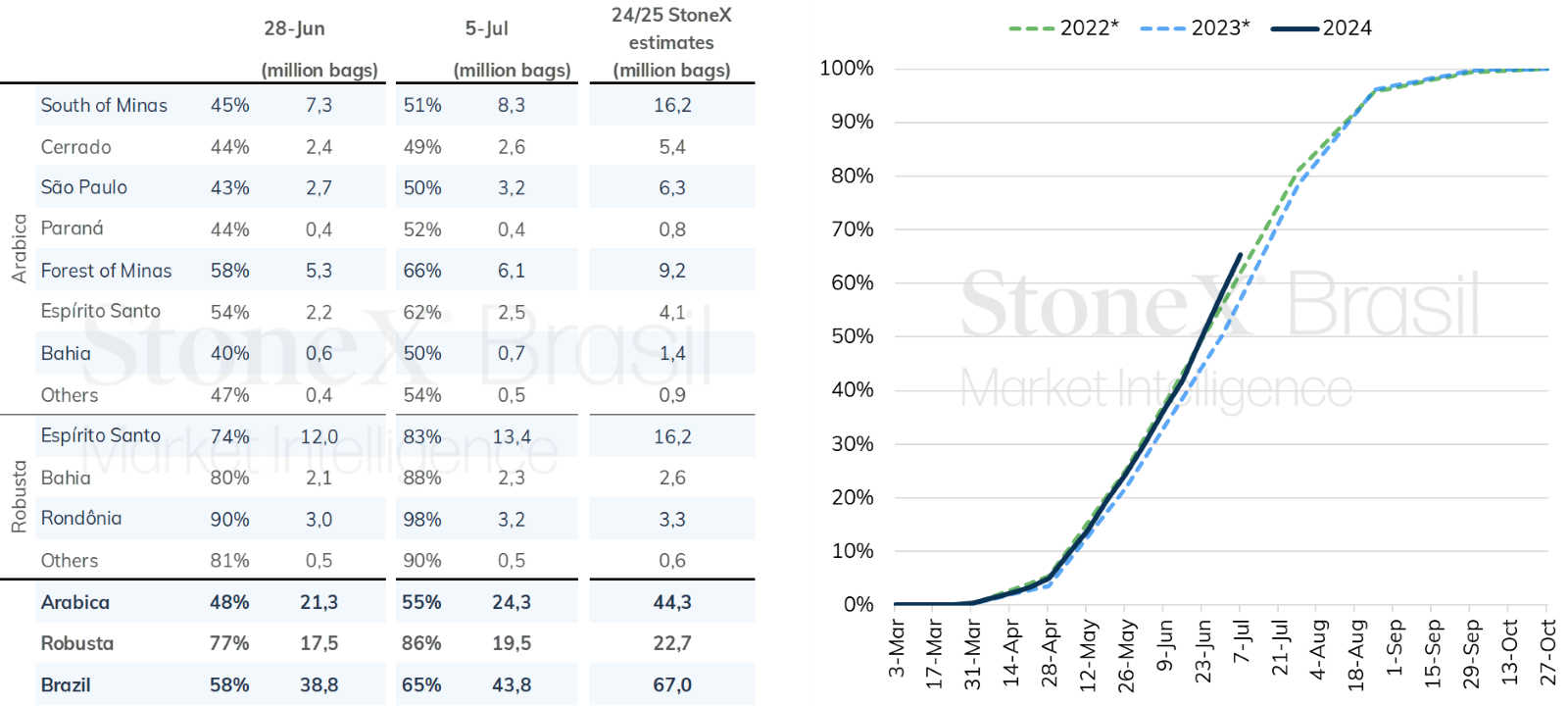
Source: StoneX. Design: StoneX. *Calculated based on Conab's harvest pace.
-
With regard to sales, Arabica producers in the South of Minas Gerais, Cerrado and São Paulo are generally cautious about sales, with a larger volume sold by small producers and through local traders. Larger producers, who have greater bargaining power, are more confident in their sales in the expectation of better prices. In addition, some companies are finding it difficult to source due to prices and the lower supply of coffees with larger sieves. In the Matas de Minas and Southern Espírito Santo regions, sales volumes are better due to the greater number of small producers who need to sell their production to honor their commitments.
In the Robusta coffee regions, sales are also down, with producers holding off on sales in the hope of better prices. This is due to the capitalization of producers and their greater bargaining power. In addition, other crops, such as black pepper, cocoa and papaya, have given producers good results.
INDICATORS