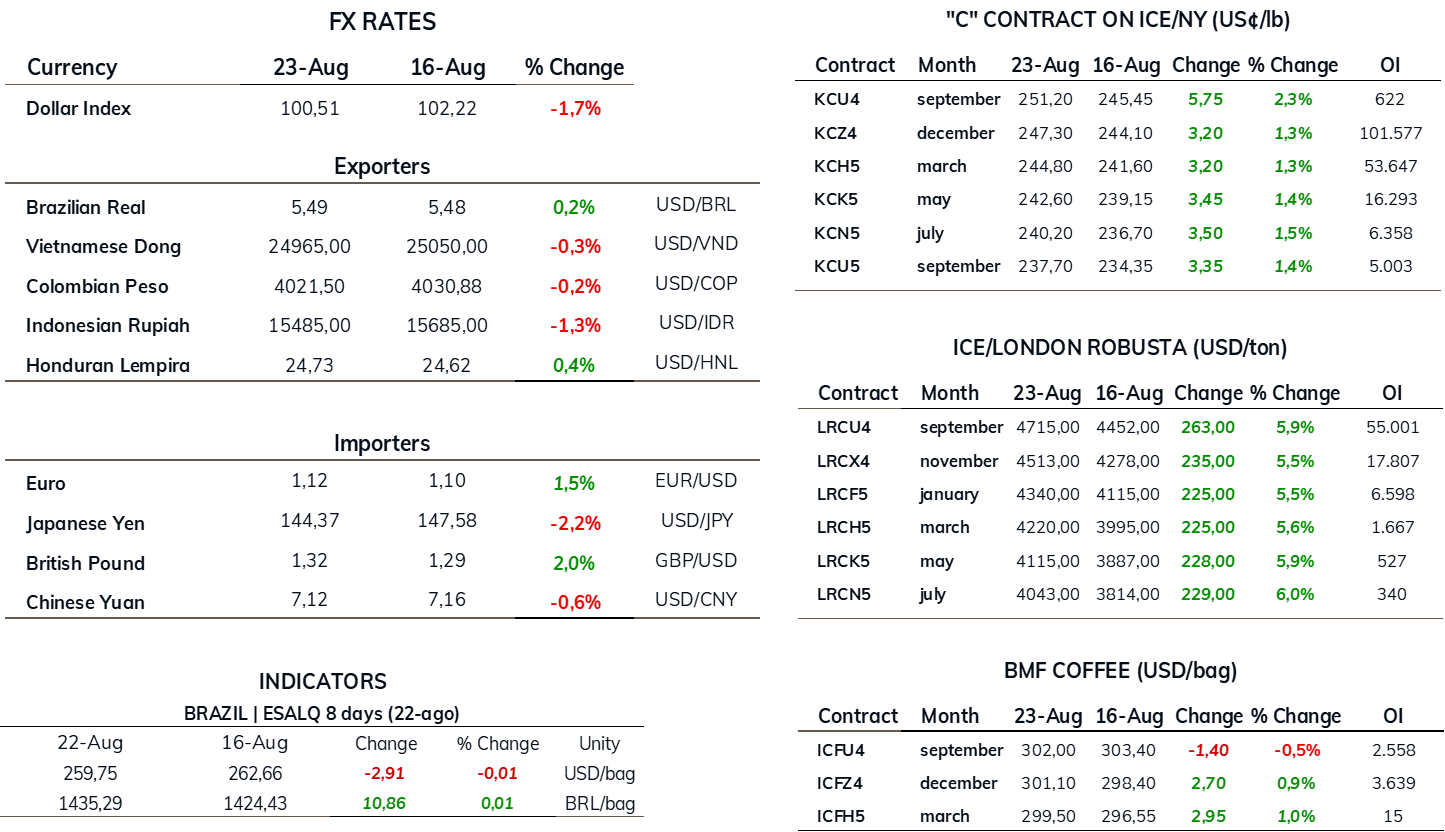
• Arabica coffee rose 1.3% on the week in New York, quoted at US₵ 247.30/lb
• On the London exchange, Robusta coffee prices jumped 5.9% to USD 4715/t
• The Cepea indicator for Arabica coffee rose 0.6% to BRL 1,432.53 /bag
• The Cepea indicator for Robusta coffee rose 3.8% to BRL 1,375.16/bag
• Dry weather in Brazil could negatively impact coffee flowering
• StoneX publishes special report on the pace of fertilizer purchases
• Latest NOAA update reduces likelihood of La Niña at the end of the year
• Dry weather should prevail throughout September
• Dry weather favors wildfires
• Conditions are only expected to return to normal in October
Coffee futures prices ended last week on an upward trend, reflecting agents' concerns about the weather in Brazil combined with some technical factors. While last Thursday (22) was the first notice day (FND) for the Arabica coffee contract due in September, this Tuesday (26) will be the FND for the Robusta coffee contract in London, which is closed this Monday (26) due to a public holiday in the country. Coffee prices were also influenced by the high volatility of the dollar during the week.
In New York, the contract expiring in December rose by 1.3%, closing Friday (23) quoted at US¢ 247.30/lb. In London, the most active November contact showed an even more intense rise of 5.9% to USD 4715/t. On the Brazilian domestic market, the Cepea indicator rose 0.6% for Arabica coffee and 3.8% for Robusta coffee, closing Friday at BRL 1,432.53/bag and BRL 1,375.16/bag, respectively. Amid great volatility, the USDBRL pair ended the week with a variation of 0.3%, quoted at 5.49.
Weekly intraday (most active contract) - Aug 19 to 23
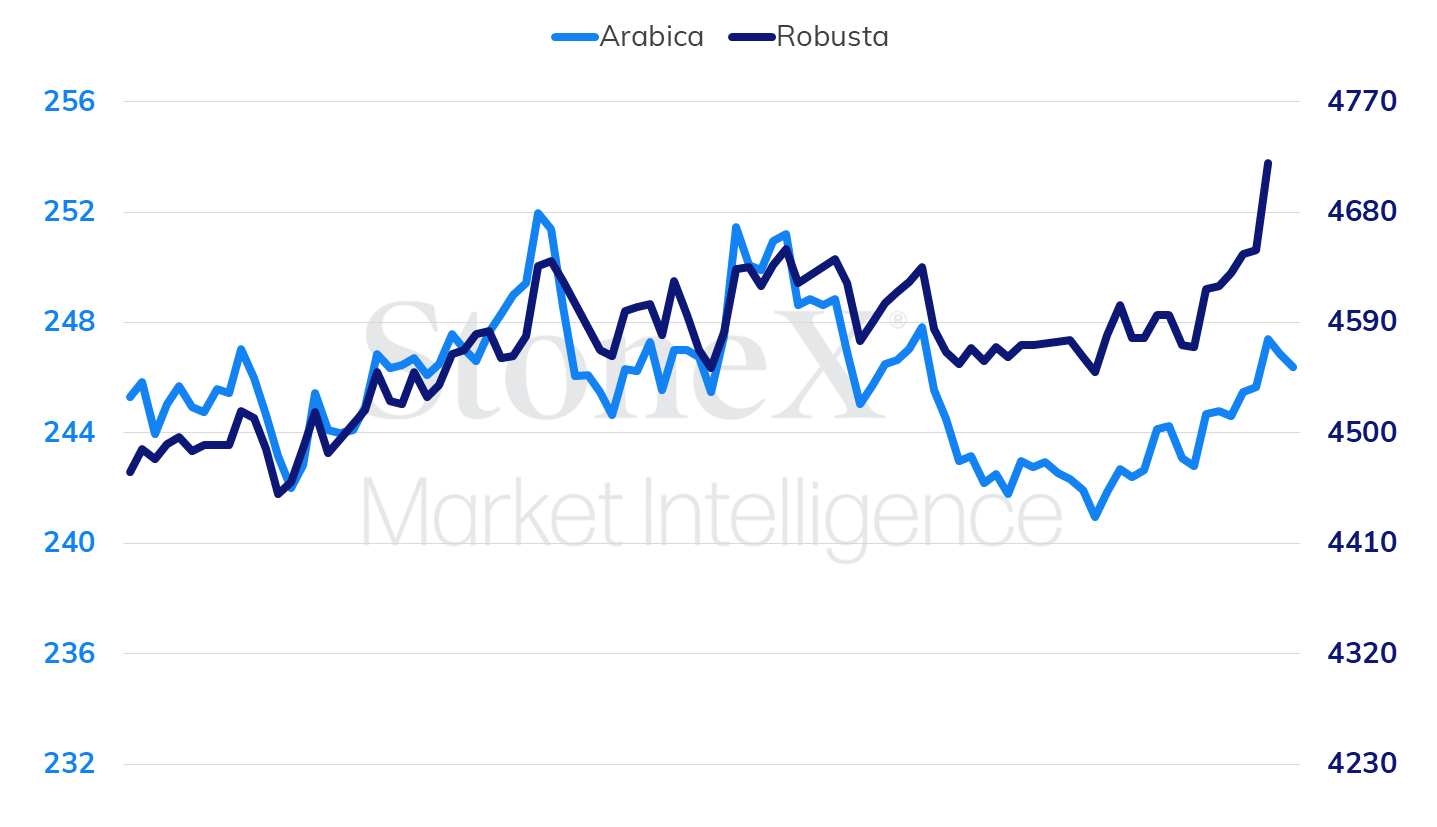
From a fundamentals point of view, the agents' focus continues to be on the weather in Brazil and the development of the initial stages of the 2025/26 crop. Flowering in Brazil's producing regions continues to progress, but the dry and hot weather has had a negative impact on these early stages of development. As will be analyzed below, the models indicate that the regular return of the rains should only happen from the second half of September onwards. As a result, the dry weather will continue to be a concern for agents and will act as a bullish factor for coffee prices.
In addition to the weather, another determining factor for next season's production potential is the producer's level of investment in input. To understand this situation, StoneX released an analysis of the exchange ratio between coffee and fertilizers and the pace of producer purchases in some coffee-growing regions in Brazil. The data shows a favorable scenario for Brazilian producers, with fertilizer purchases reaching 70% in the Cerrado by July. For more details, read the full analysis on Coffee and Fertilizers.
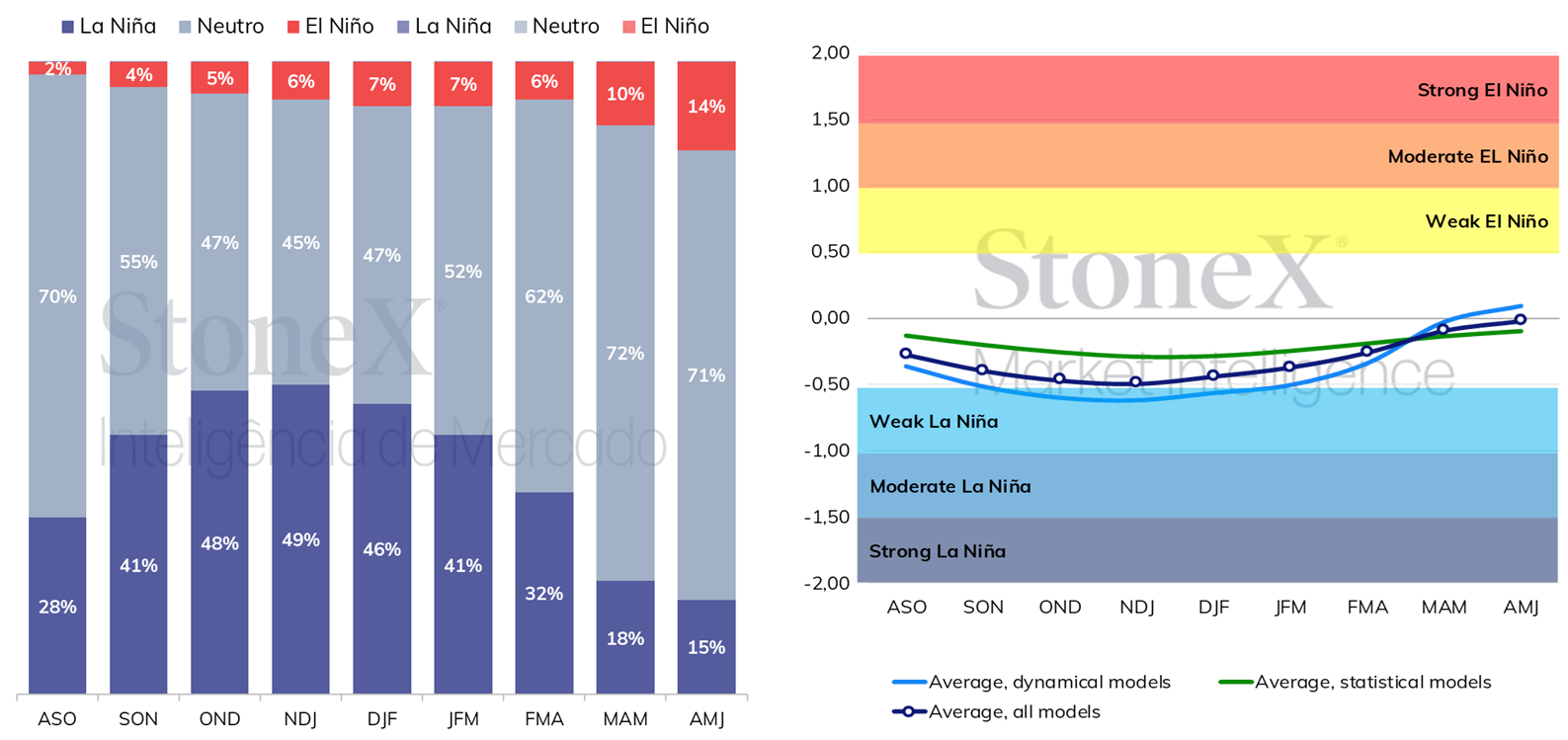
Last week saw the release of updated NOAA models for La Niña probability and projected Pacific Ocean surface temperature variations. The latest update reduced the probability of La Niña occurring in the coming months, with a fairly similar probability of the phenomenon occurring or remaining neutral. According to the model, there is a probability of between 46% and 48% of La Niña occurring between October 2024 and February 2025, while the probability of a neutral condition is between 45% and 47%. In addition, the temperature variation projection shows that if La Niña were to occur, it would be weak in intensity and short-lived in late 2024 and early 2025.
Probabilistic forecasts of La Niña/El Niño (%) and projected change in Pacific Ocean surface temperature (in C)
Source: IRI/CPC/NOAA. Design: StoneX.
Dry weather should prevail throughout September, with conditions only expected to return to normal in October
Over the weekend of August 24-25, a cold front brought moisture to the coffee-growing region in southern Minas Gerais. INMET weather stations recorded rainfall in the cities of Machado (66 mm), Varginha (2.2 mm) and Maria da Fé (26 mm) in the last 48 hours. However, this rainfall has not brought significant volumes to re-establish soil moisture, but it is inducing flowering in some coffee areas in this region.
The cold front, as it heads towards the ocean, will leave the weather open and dry, which could cause flowering to abort or low fertilization. No rainfall was recorded in the Cerrado. It is important to remember that in central and southeastern Brazil, rainfall has not been significant for more than 3 consecutive months. For the Cerrado region of Minas Gerais, Cemaden's Integrated Drought Index (IIS3) classifies the Cerrado between severe and extreme drought.
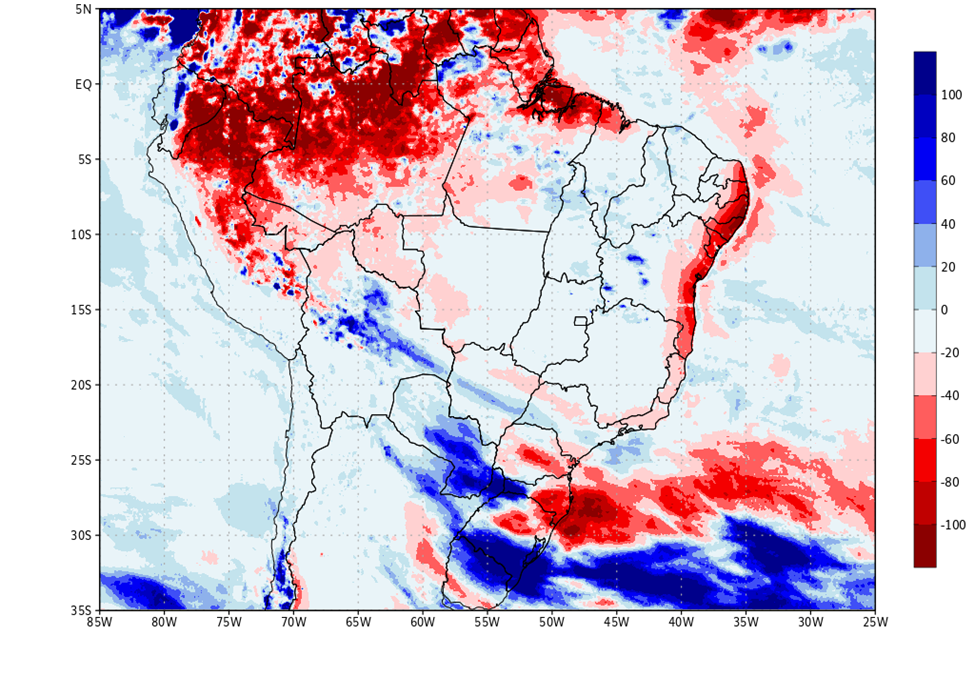
During the week of August 26-31, the presence of a polar mass that is settling in southern Brazil will reduce temperatures in the southeast of the country, especially in high-altitude areas. Precipitation anomalies for the month of August were characterized by a state of deficit, with the south of Minas Gerais and Espírito Santo standing out with negative values of between 20 and 40 mm.
Rainfall anomaly compared to the historical average of the last 30 days (mm)
Soure: StoneX.
Consecutive drought events and lack of moisture make the environment more prone to fires, increasing their frequency, intensity, size and severity. Dry vegetation is highly flammable and becomes a potential fuel and, in the presence of an ignition factor, can result in fires that spread rapidly, leading to environmental disasters. An example of this occurred recently, when clouds of smoke with toxic gases were seen in the skies over São Paulo, causing concern for the population's health. The consequences of these events for vegetation and coffee plantations have not yet been widely researched, but it is known that it damages the plants' photosynthetic activity.
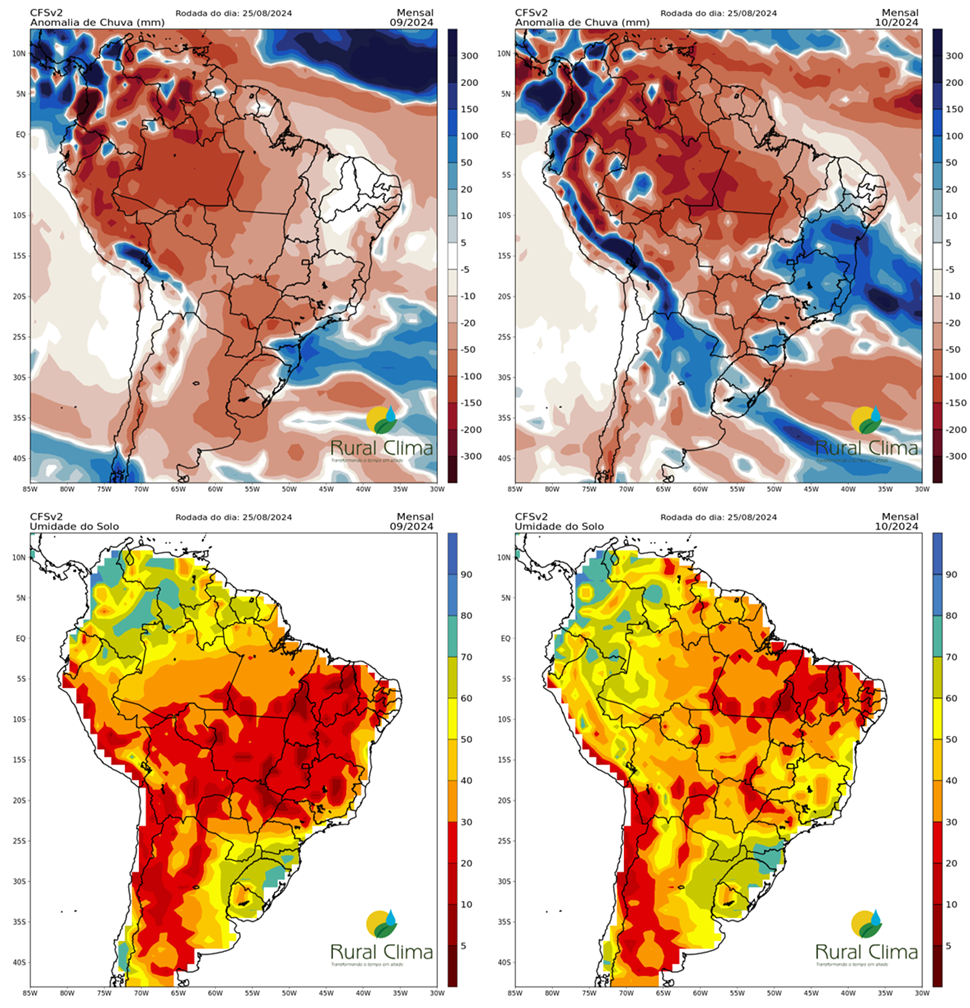
Coffee growers and agribusiness as a whole are eagerly awaiting the month of September and with it the start of the season of regular and voluminous rains, which are fundamental for the start of cultural practices, as well as for flowering and the development of weeds. However, models such as CFSv2 predict that rainfall in millimeters for the month will be below the historical average in the Cerrado and southern Minas Gerais, aggravating the water deficit. In October, rainfall will probably return to normal, but the expected volumes may not be enough to restore adequate soil moisture, reducing the availability of water for coffee plantations due to the low total volumes forecast.
Rainfall and soil moisture anomaly forecast for September and October
Source: Cemaden/MCTI.

INDICATORS