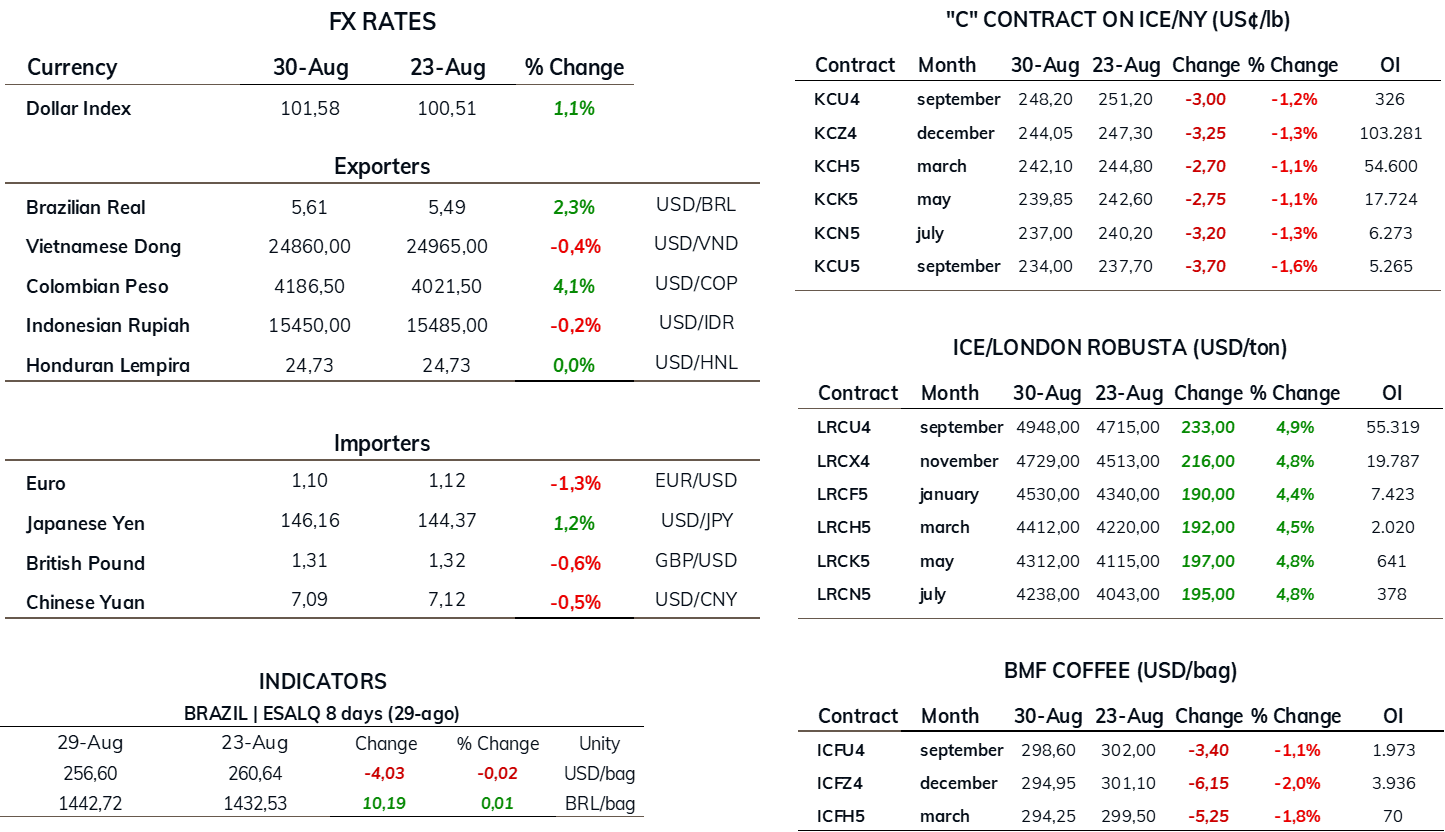
• Arabica coffee fell 1.3% in the week, but rose 6.5% in the month in New York
• In London, Robusta prices rose 4.9% in the week and 16% in the month
• Cepea indicator for Arabica coffee up 1.1% on the week and 2.3% on the month
• For Robusta, the Cepea indicator rose 7.9% in the week and 16.7% in the month
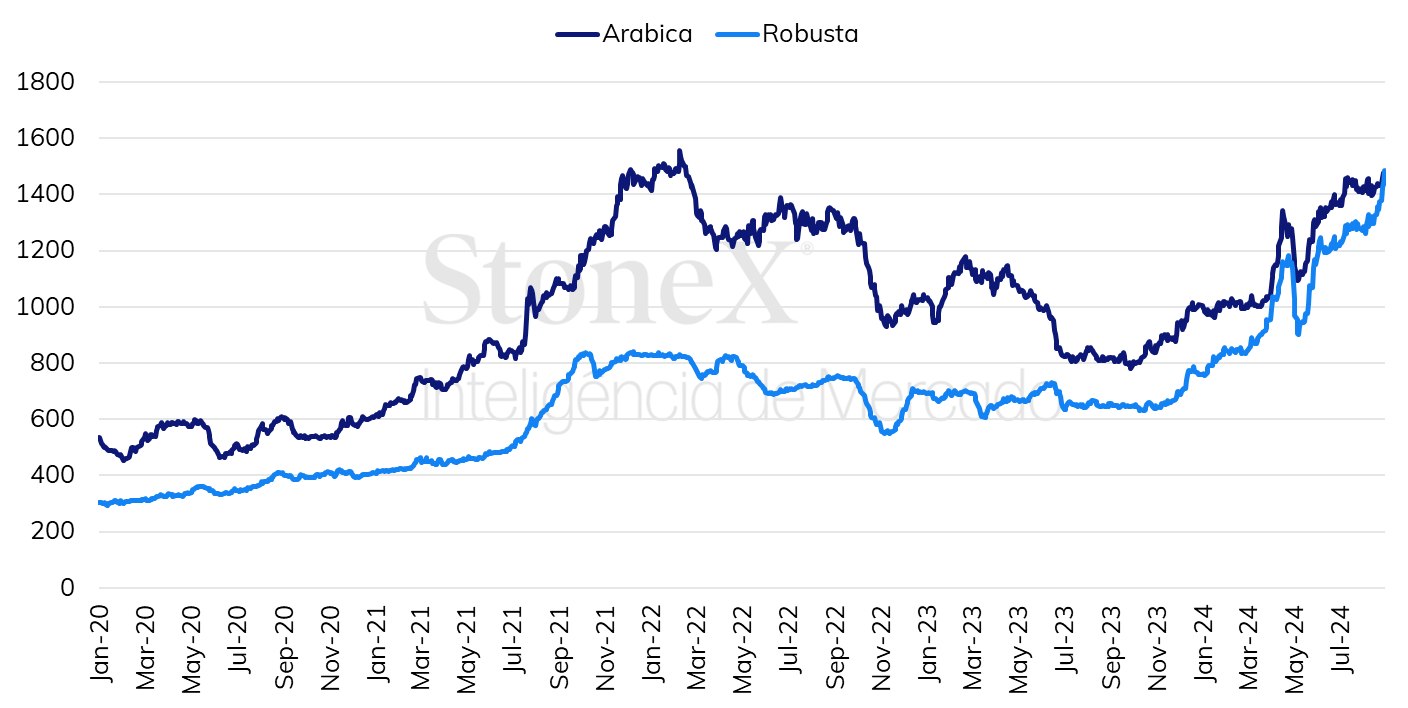
• Robusta coffee prices surpass Arabica coffee prices
• Reduced supply of Robusta coffee continues to support prices
• Preliminary data from Secex points to a 20% drop in exports
• Water deficit and above-normal temperatures are expected to continue
• Models point to rain in the last weeks of September
With no major changes in fundamentals, Arabica coffee futures ended the week down 1.3% to US¢ 244.05/lb, mainly due to the 2.3% rise in the dollar, which closed at BRL 5.61. On the other hand, futures prices for Robusta coffee advanced by 4.9% to US$4948/t, reflecting the unchanged scenario of restricted supply of the variety due to lower production in Asia and lower yields in Brazilian production.
On a monthly basis, both markets ended the period strongly up. At the US terminal, Arabica coffee prices rose by 6.5% over the month. In London, the advance was even more intense at over 16%. Prices followed this upward trajectory mainly due to the weather events that impacted the producing regions in August.
At the beginning of the month, the presence of a polar mass dropped temperatures and caused localized frosts in some regions, such as the Cerrado and Mogiana. Following this, the continued dry weather in the middle of coffee flowering acted as a bullish factor for prices. This scenario of adverse weather during flowering persists and should continue to impact prices in the coming weeks.
Weekly intraday (most active contract) - Aug 26 - 3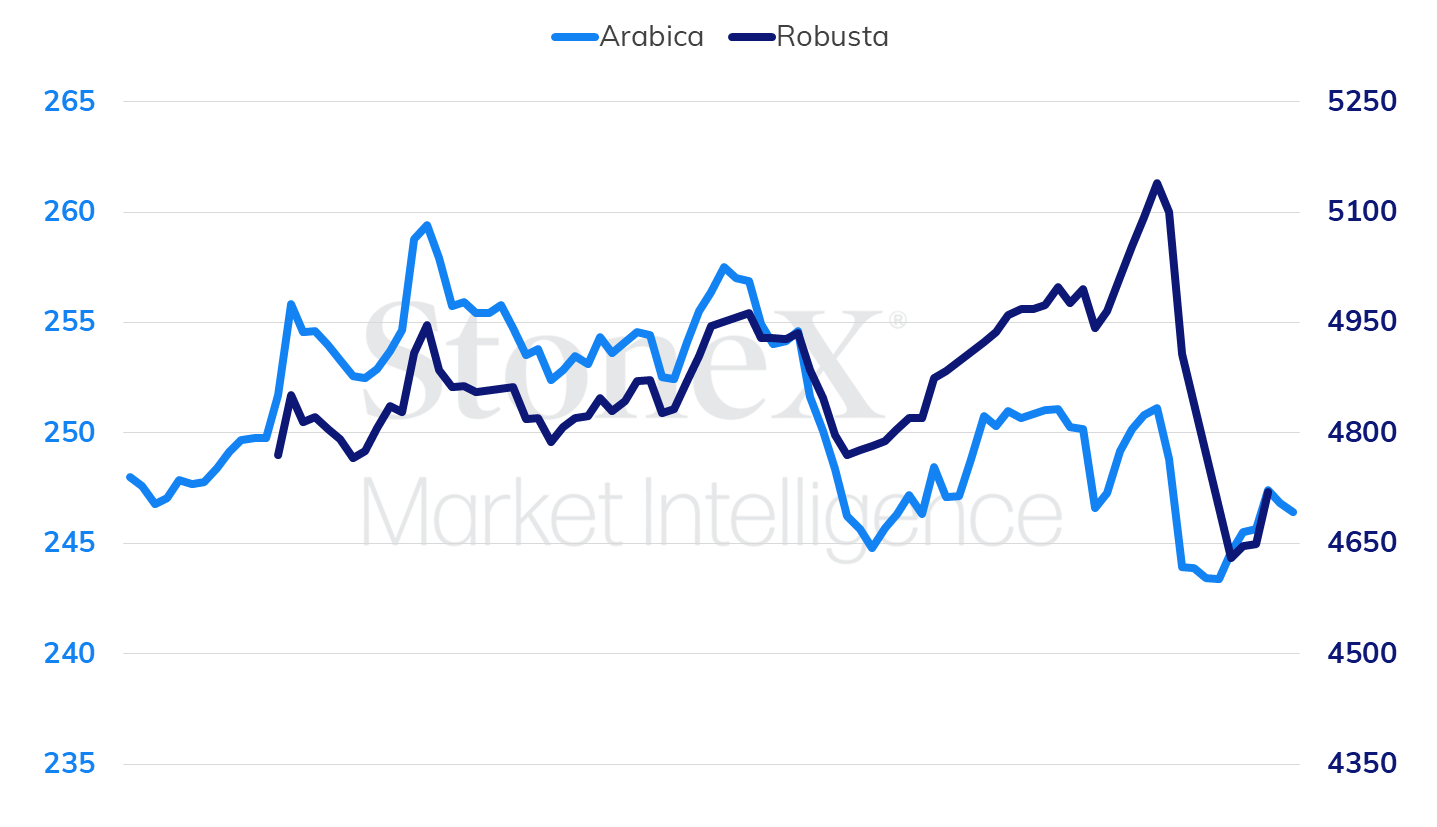
On the Brazilian domestic market, Arabica coffee prices also rose higher, with the Cepea indicator ending the week up 1.1% at BRL 1448.24/bag. On a monthly basis, Arabica prices rose by 2.3%. For Robusta coffee, the advance was even more intense, with the Cepea indicator for the variety rising 7.9% in the last week and 16.7% in the monthly comparison.
In addition, for the first time Robusta coffee was traded above the prices practiced on the Arabica market. The Cepea indicator for Robusta coffee closed last Friday at BRL 1483.95/bag, 2.5% higher than the indicator for Arabica. As mentioned earlier, the reduced supply of Robusta coffee in Asia and lower-than-expected production in Brazil has resulted in strong price advances for the variety.
Cepea indicator for Arabica and Robusta coffee prices in Brazil (BRL/ bag)
Source: Cepea. Design: StoneX.
From a fundamentals point of view, the scenario remains practically unchanged, with market participants keeping an eye on the weather in Brazil and the early stages of development of the 2025/26 crop. The persistence of dry weather in the middle of the opening of flowering will continue to support coffee prices, given the risk to next season's production potential.
For proper flowering and, consequently, good productivity, significant volumes of rain and good distribution over time are necessary. In addition, at this time, it is essential to restore moisture to the environment and alleviate the current state of deficit or lack of water. So far, abnormal volumes of rain and temperatures have been observed in the producing regions, which is increasingly affecting the productive potential of crops for the 2025/2026 crop.
In addition, there will be repercussions from the countries' export data for August, especially from Brazil, which should be released by Cecafé next week. The release of data that points to a reduction in the pace of exports tends to act positively for prices, as it would show a condition of lower availability of coffee and possible logistical problems in exports. Preliminary data from the Foreign Trade Secretariat (SECEX) indicated that Brazil had exported 2.6 million bags up to the fourth week of the month, which represents a drop of 20% compared to the same period in 2023.
August was characterized by drought and extreme temperature events
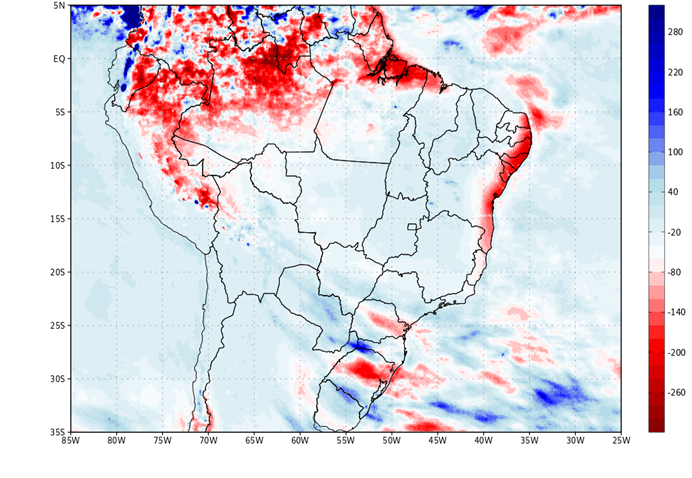
The month of August for the Southeast and Center-West regions of Brazil was characterized by dryness and extreme temperatures, which aggravated the state of water deficit in Brazil's main coffee-growing regions. The South of Minas Gerais, Cerrado Mineiro and Mogiana accumulated more than 110 days without effective rainfall (more than 10 mm over 10 days).
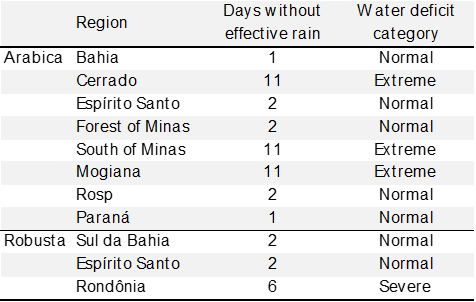
Source: StoneX.
Rainfall anomaly compared to historical average - last 60 days (mm)
Source: StoneX.
Above-normal temperatures, with short and intense periods of variation due to cold spells and the presence of polar masses, characterized the month. One example was in Patrocínio, where, on one day, minimum temperatures of 2.3 degrees were recorded during the cold fronts, and three days later, the minimum temperatures were above 16°C. The month of August ended with the establishment of a hot air mass in the center of Brazil, which will generate an atmospheric blockade and trigger another heatwave at the beginning of September for the entire Center-West and Southeast regions of Brazil
September continues with dry and hot weather, and significant volumes of rain are expected only towards the end of the month, with the onset of spring
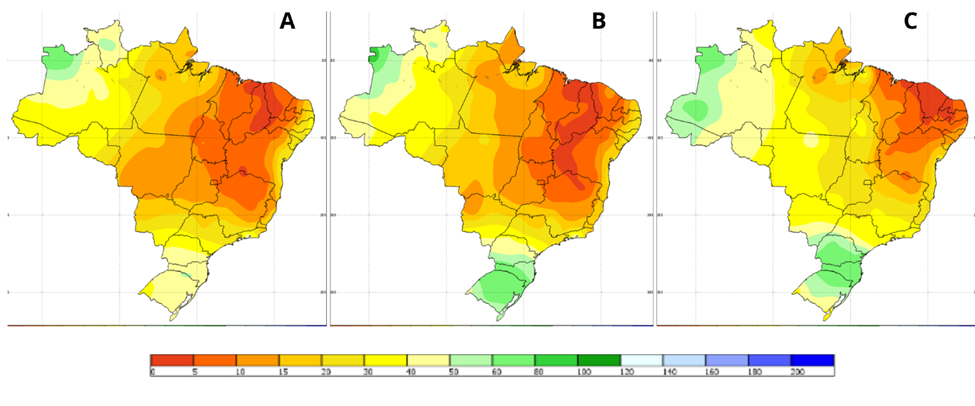
In the month of September, rainfall volumes are normally expected to vary between 19 and 30 mm in the Bahia region, between 59 and 67 mm in Espírito Santo, between 41 and 69 mm in the Cerrado, between 55 and 64 mm in Matas de Minas, between 69 and 73 mm in Sul de Minas, between 59 and 63 mm in Mogiana, between 55 and 71 mm in Rosp and between 72 and 99 mm in Paraná for the Arabica producing regions. For the Robusta producing regions, such as Rondônia, the expected volumes vary between 76 and 86 mm, between 72 and 92 mm in the south of Bahia, and between 62 and 69 mm in the north of Espírito Santo. Normally, these volumes of rain are expected to be effective and have a distribution that gradually transforms the landscape from a dry season to a wetter one.
Climatological normals for Brazil 1991-2020. Accumulated rainfall for the month of September: A) 1st 10-day period, B) 2nd 10-day period, C) 3rd 10-day period
Source: Inmet .
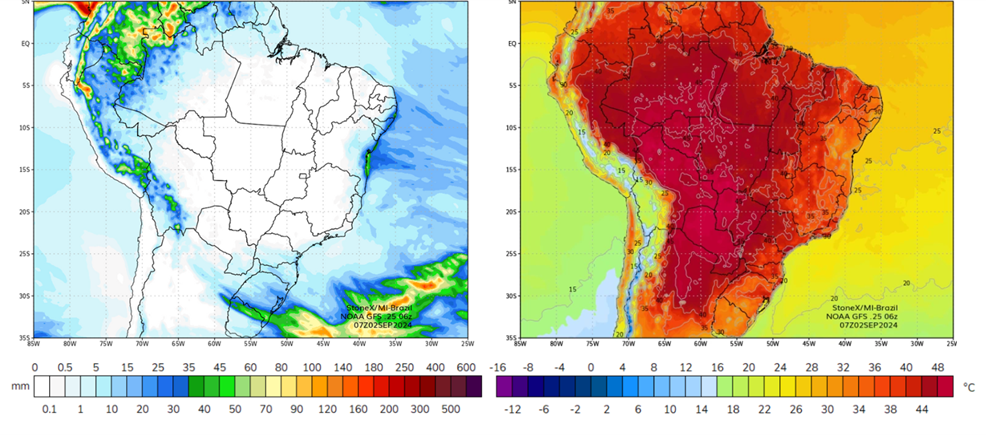
However, according to the GFS model, dry weather will persist for the first 15 days of September, with maximum temperatures exceeding 32 - 34°C
Forecast of accumulated rainfall (mm) and maximum temperature (degrees) from the GFS model between September 2nd and 15th.
Source StoneX.
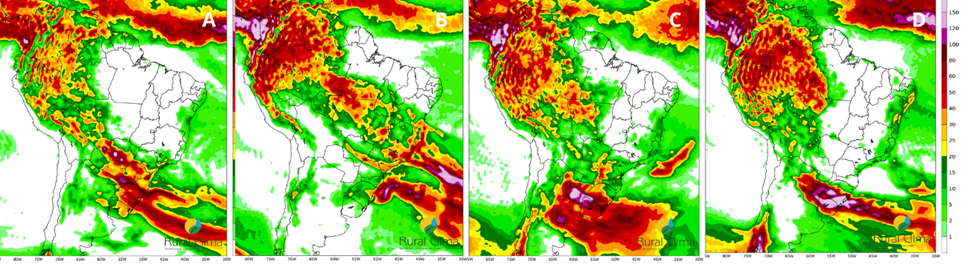
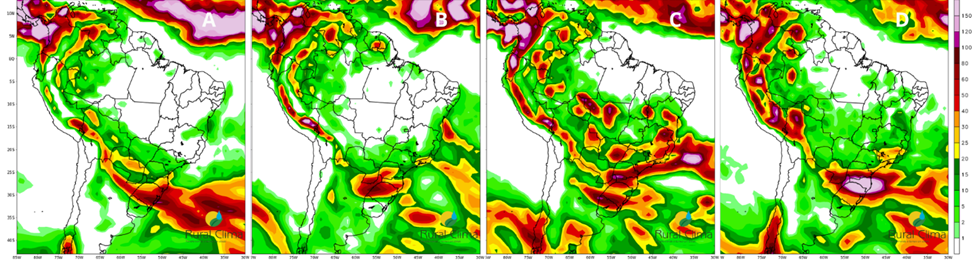
The models indicate that, after September 15, it is possible that there will be significant rainfall in the south of Brazil, and the moisture could reach the coffee-growing regions. The month of September is therefore expected to see a concentration of rainfall in the last two weeks. However, there are some divergences in the forecasts of the ECMWF and GFS models for the medium term, in terms of volumes, distribution and duration of accumulated rainfall, which should be monitored.
Accumulated rainfall forecast (mm) for the months of September and early October, according to the week: A) September 15 to 21, B) September 22 to 28, C) September 29 to October 5, D) October 6 to 12. Data from the ECMWF model run on September 1, 2023.
Source: Rural Clima
Accumulated rainfall forecast (mm) for the months of September and early October, according to the week: A) September 15 to 21, B) September 22 to 28, C) September 29 to October 5, D) October 6 to 12. Data from the GFS model run on September 1, 2023.
Source: Rural Clima.

INDICATORS