- Coffee market retreats with rain arriving in producing municipalities
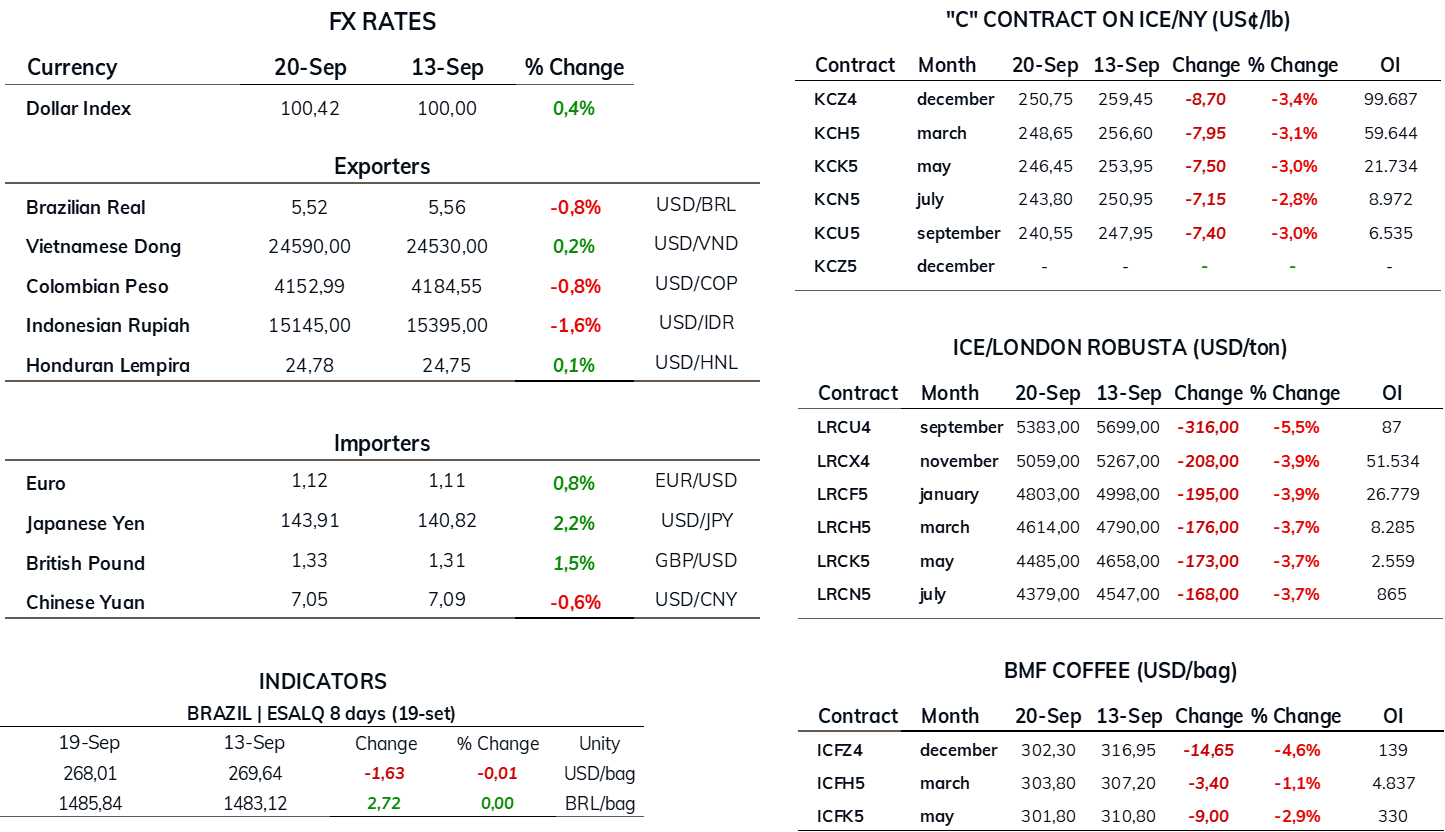
- New York coffee contract falls 3.4% to US$250.75/lb
- Robusta futures fell 3.9% to USD 5059/t
- Dollar declines 0.8%, favoring the Brazilian currency ahead of the interest rate cut
- In Brazil, Robusta coffee prices surpass Arabica for the third time since 2016
- European Union pressured to postpone implementation of EUDR
- Conab reduces Brazilian coffee production estimate for 2024/25 by 6.8%
- Rain returns to coffee belt, but significant volume is only expected in October
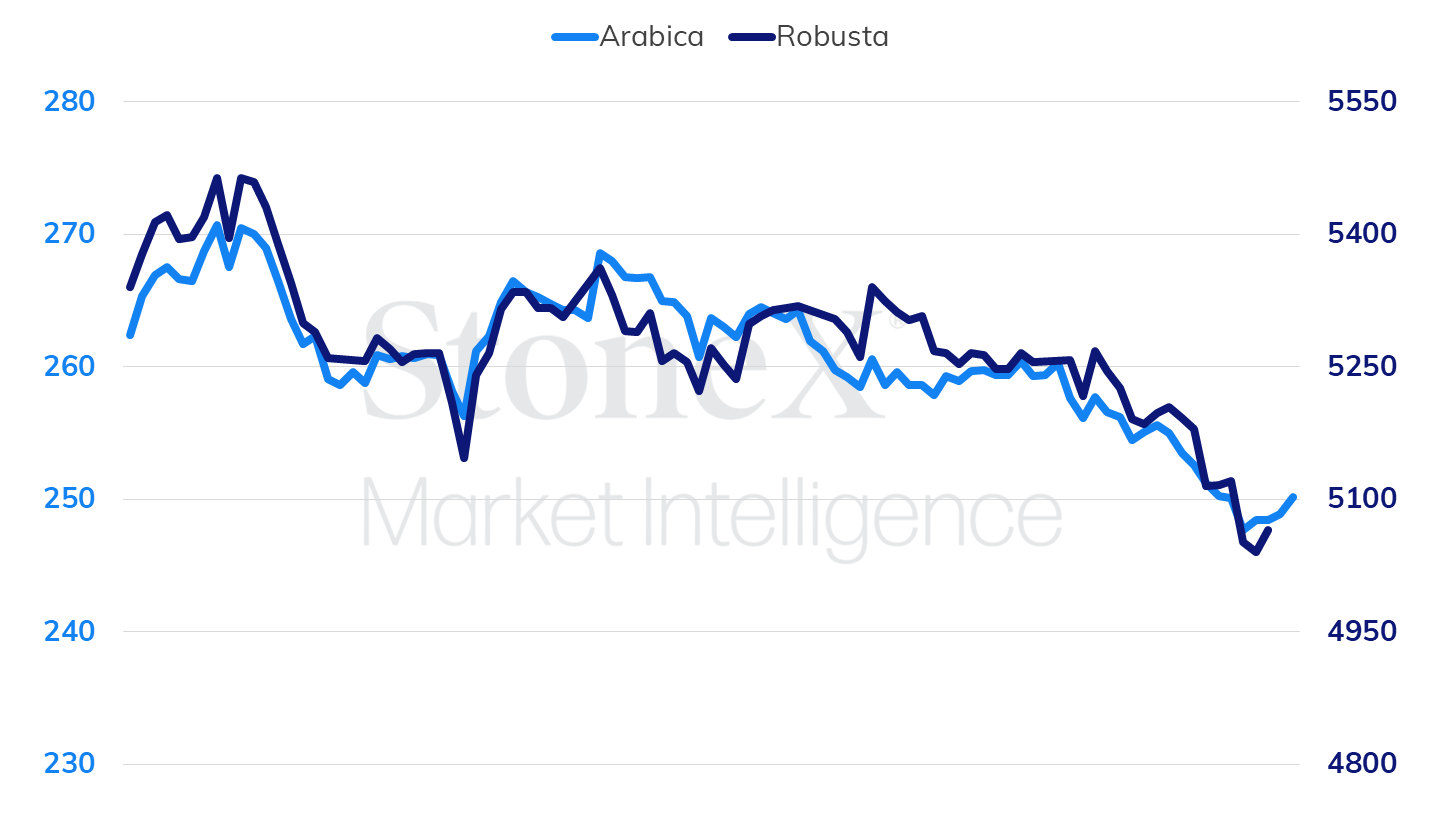
Last week, coffee futures prices reacted to the return, albeit localized, of rain in Arabica-producing municipalities in the south of Minas Gerais and the Cerrado Mineiro, ending the week down. Prices began the week supported by concerns about dry weather in Brazil. However, after reports of the onset of rain in some municipalities, prices reversed the trend and ended Friday down sharply.
In New York, the most active contract, expiring in December, ended Friday (20) at US¢250.75/lb, down 870 points (-3.4%). At the London terminal, the drop was USD 208/t (-3.9%) for the November contract, which closed the week quoted at USD 5059/t. During the week, the dollar fell 0.8% to USDBRL 5.52 - the 0.50 pp cut in the basic rate by the Fed in the United States and the 0.25 pp increase by the Brazilian Central Bank widened the interest differential and favored the Brazilian currency. For more details read the Weekly FX Outlook.
Weekly intraday (most active contract) - September 16 to 20
On the Brazilian domestic market, coffee prices followed the trend observed abroad and retreated. The Cepea indicator for Arabica coffee fell by 1.5% to BRL 1460.14/bag. For Robusta, the indicator slumped by 3.4% to BRL 1468.87/bag. Since the end of August, Robusta coffee prices have been on average 2% higher than Arabica prices, according to Cepea data. However, the difference, which reached BRL 51.9/bag (3.7%), narrowed at the end of last week to BRL 8.73/bag (0.6%).
This is the third time that the price for Robusta has exceeded Arabica. This also happened for a brief period in October 2016 and January 2017, when Brazil was facing a Robusta supply shock due to the drought caused by El Niño, which lasted almost three years (2014, 2015 and 2016). According to USDA data, between 2014 and 2016 Brazilian Robusta production fell from 17 to 10.5 million bags.
Difference between Robusta and Arabica coffee prices (BRL/ bag)
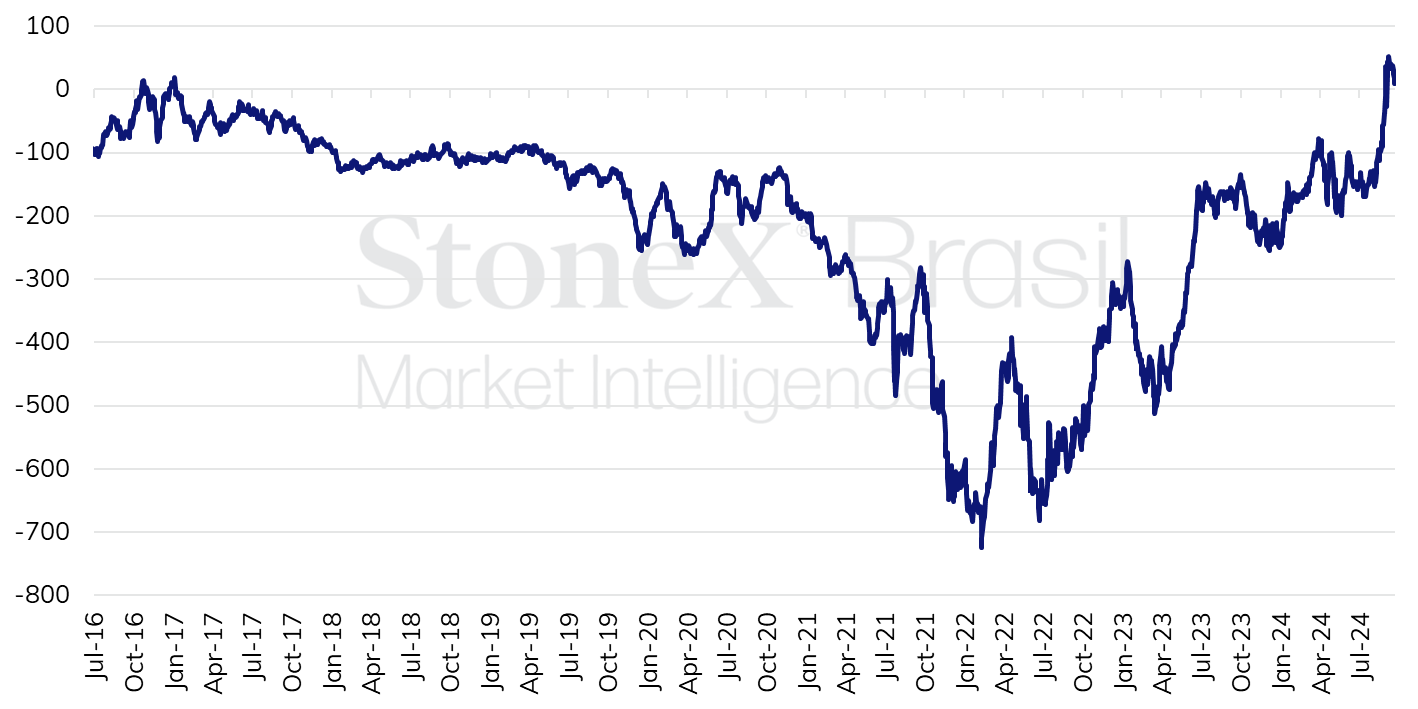
Source: Cepea. Design: StoneX.
The European Union's new legislation against deforestation, known as the EUDR, which bans the import of products from deforested areas and will come into force in 2025, has been one of the hot topics in the coffee market. The new legislation creates a series of requirements to prove the origin of products, which could make it difficult or even prevent imports into the European bloc. As far as coffee is concerned, Brazil is seen as the country that is best prepared to comply with the new legislation. In an interview with Financial Times, the Chairman of the Lavazza Group, Giuseppe Lavazza, warned that if the legislation is implemented, European roasters would have to source almost all of their coffee demand from Brazil, as the country would be the only one prepared to implement the new rule.
From a marketing point of view, the impact in the short to medium term has been a rush by European importers to build up stocks before the end of 2024, before the legislation comes into force. However, there is a lot of pressure for the European Union to postpone the implementation of the law. In addition to coffee, the new rule would also affect other agricultural products exported by Brazil to the European bloc. In September, the Brazilian government, via a letter sent by the Minister of Agriculture, asked for the law to be postponed, arguing that the legislation represents a serious concern for several of the country's exporting sectors. Other international organizations are also calling for the law to be postponed.
Last week, the National Supply Company (Conab) reduced its estimate for Brazilian production in 2024/25 by more than 4 million bags (-6.8%), from 58.8 to 54.79 million bags. Arabica coffee production was reduced by 2.5 million bags (-6%) to 39.6 million bags. For Robusta, the reduction was 1.5 million bags (-9%) to 15.4 million bags. With the new estimate, Conab's data points to a drop of 0.5% compared to 2023/24. Despite the adjustments, most in the market do not agree with Conab's projections.
Since last year, in addition to the production problems in Vietnam and Indonesia, part of the advances in prices can be attributed to the logistical problems caused after the outbreak of the war between Israel and Hamas. Since then, the Yemeni group Hutis, which supports Hamas, has started attacking ships in the Red Sea, the main route between Asia and Europe, forcing ships to change their route around the African continent, which has led to significant increases in sea freight costs. Recently, an article published by Coffee Network pointed out that there had been a 13% drop in sea freight prices compared to the previous week. The data indicates that costs are still higher than pre-covid levels, but may indicate a trend towards a return to normal.
In the coming weeks, the focus will continue to be on flowering and the return of the rains in Brazil. In addition, participants will keep an eye on the release of export data for September, which should be published at the beginning of next month. With regard to the weather, the areas of the Southeast, especially in the south of Minas Gerais and the Cerrado, continue to be dry, but with more moisture after this weekend's rain. The low moisture will persist, with a significant amount of precipitation expected on September 29th. However, regular rains should return after the second week of October. For more information read the Weather and Climate Weekly Report, scheduled to be published tomorrow on the StoneX intelligence portal.

INDICATORS