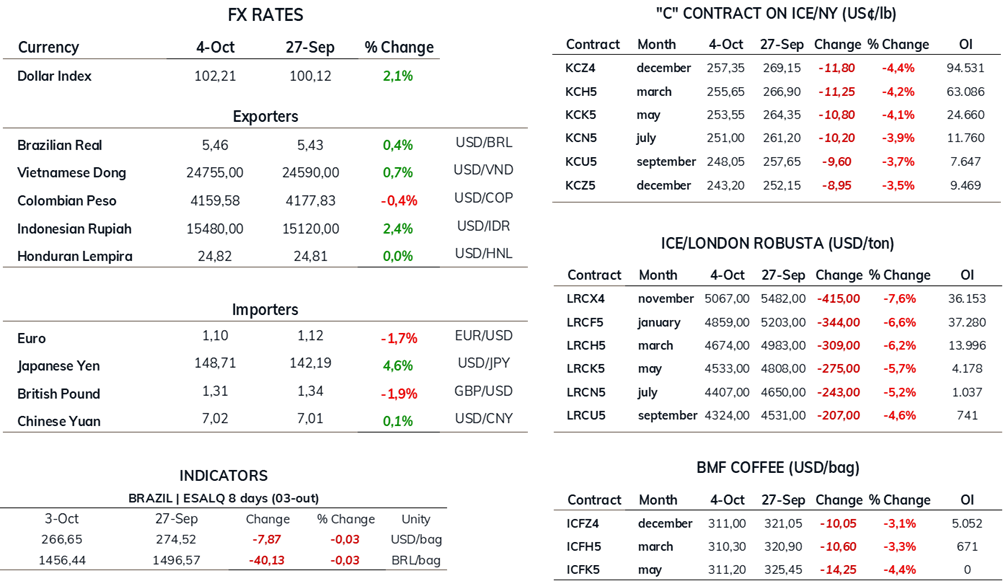
• Arabica coffee drops 4.4% on the New York Stock Exchange, quoted at US¢ 257.35/lb
• Robusta coffee prices fall 7.6%, to USD 5067/tonne on the London Stock Exchange
• Dollar advances 0.4% against the Brazilian real
• Rain forecasts in Brazil put pressure on coffee prices during the week
• European Commission proposes postponing the anti-deforestation law
• Vietnam's exports remain weak, but revenues rise significantly
• Cecafé to release Brazil's September export data this week
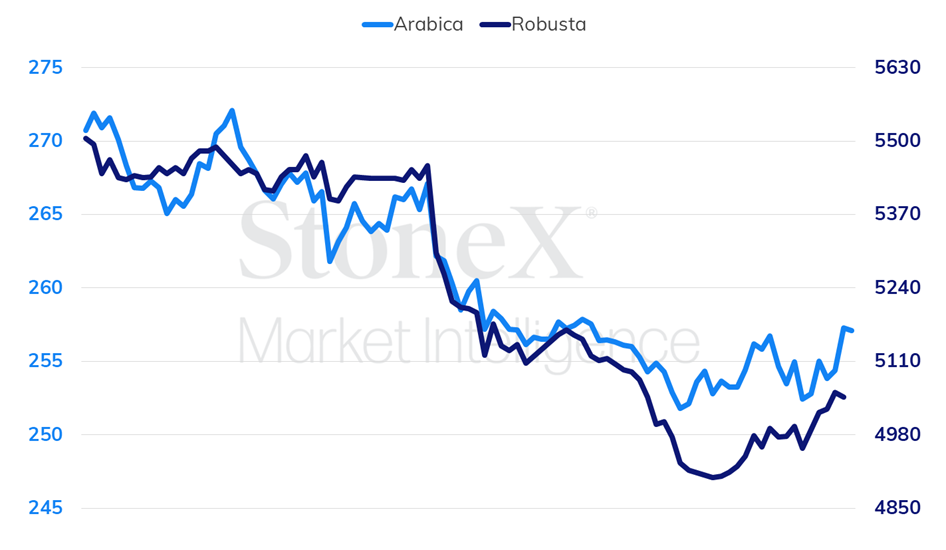
Last week saw a decline in both Arabica and Robusta coffee, as the market made some corrections after reaching high levels the previous week. The December/24 contract for Arabica coffee fell 4.4% on the New York Stock Exchange, closing at US¢ 257.35/lb. Meanwhile, Robusta coffee closed at USD 5067/tonne on the London Stock Exchange, a weekly drop of 7.6%. In addition to technical corrections, which typically occur after intense rises, two main factors contributed to the declines.
Weekly Intraday (most active contract) – 09/30 to 10/04
First, the weather, which has been influencing prices for a few weeks, showed prospects for milder and wetter conditions in producing regions. The arrival of moisture to the coffee belt tends to reduce fears that the next crop might lose even more potential, although some may already be compromised due to last month’s drought.
This weekend, some rains were already observed in certain areas. However, forecast models indicate that starting on October 10th, volumes are expected to increase in both extent and intensity. According to the Cosmos forecasting model, the first South Atlantic Convergence Zone (SACZ) of the year is expected to form, with moisture corridors coming from Ecuador and the Amazon, which should impact the Southeast region. Follow daily forecast updates on StoneX’s interactive Weather Tables. The Weather and Climate Weekly Report, scheduled for next Tuesday (8), will provide more details on the occurrences of the past few days and expectations for this moisture corridor.
The predicted rains continue to impact prices at the start of this week, with the most active Arabica coffee contract on ICE retreating 4.1% on Monday's session, closing at US¢ 246.85/lb, the lowest level since September 12. This trend may persist as rains are recorded in the second half of the week.
On the other hand, although the rains bring relief to short-term concerns, it is possible that the damage in areas with the first blooms is irreversible due to the long dry period after the flowering. StoneX's field team is assessing the situation and is expected to provide more details on potential impacts on productive capacity in the coming weeks.
Another important news was the European Commission's proposal to delay the implementation of the European Union's Deforestation Law (EUDR) by 12 months. The law, initially scheduled for December this year, requires companies to prove that their commodity exports, such as coffee, are not associated with deforestation, with products needing to present documentation and traceability.
The decision was a response to requests from industries and governments, including Brazil, claiming they need more time to adapt to the new requirements. The postponement proposal still needs approval from the European Parliament and member states, which will be closely monitored by the market. However, the expectation of a delay already alleviates concerns about the impact on coffee exports to Europe.
In Vietnam, the General Statistics Office reported that coffee exports from January to September 2024 totaled 18.3 million bags, a drop of 11.5% compared to the same period last year. Despite the volume reduction, revenue increased by 37.8%, reaching USD 4.3 billion, reflecting high prices in the international market.
These figures continue to show the tight supply in the global market, supporting high prices even with lower shipment volumes. The start of the harvest in Vietnam, scheduled for the end of October, will be closely monitored by operators, as the conditions of this new crop may influence the balance of global coffee supply.
This week, in addition to weather being the main influencing factor, the market will monitor the release of official Brazilian coffee export data for September by Cecafé. Preliminary government estimates suggest an increase in shipments, which could reach about 4 million bags, representing growth of over 30% compared to September last year. If these numbers are confirmed, they will reinforce the perception of firm short-term demand, with importers accelerating purchases to replenish stocks before the new European law comes into effect.
INDICATORS