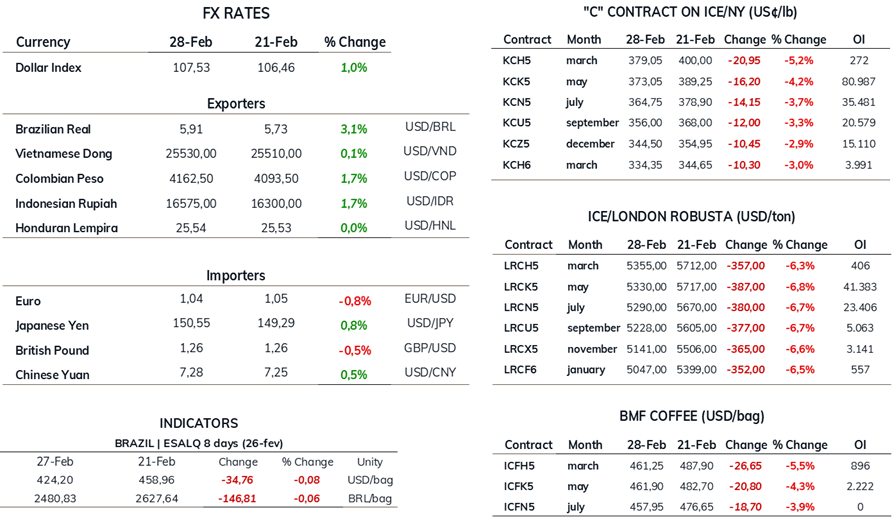
• Arabica coffee reached US¢ 373.05/lb on ICE, a 4.2% weekly drop
• Robusta coffee fell 6.8%, closing at USD 5330/t on the London exchange
• Dollar appreciation contributed to downward pressure on international prices
• Pending stocks remain above 100,000 bags, potentially becoming certified
• Climate models diverge regarding rainfall in the coffee belt
• Harvesting in Brazil may put pressure on prices
• Participants will keep an eye on Brazil’s export data in February
• Consumer coffee inflation rises in Brazil, the US, and Europe
After ending the previous week with significant declines, Arabica and Robusta coffee futures fell again last week. The outlook for improved weather conditions in Brazil and expectations of increased certified Arabica stocks have pressured prices. Additionally, the strengthening of the dollar also contributed to this movement in international terminals. In New York, the most active contract, maturing in May, fell 4.2% to US¢ 373.05/lb. In London, the most traded contract dropped 6.8%, closing at USD 5330/ton.
In the Brazilian domestic market, coffee prices also ended the week lower. The CEPEA indicator for Arabica coffee registered a 1.4% decline in monthly variation as of Thursday, the 27th, and a 3.4% drop for the week, reaching R$ 2472/bag. For Robusta coffee, the CEPEA indicator showed a 4.2% monthly decline, along with a 2.9% drop in the last week, closing the period at R$ 1985/bag.
Weekly intraday (most active contract) – 02/24 to 02/28
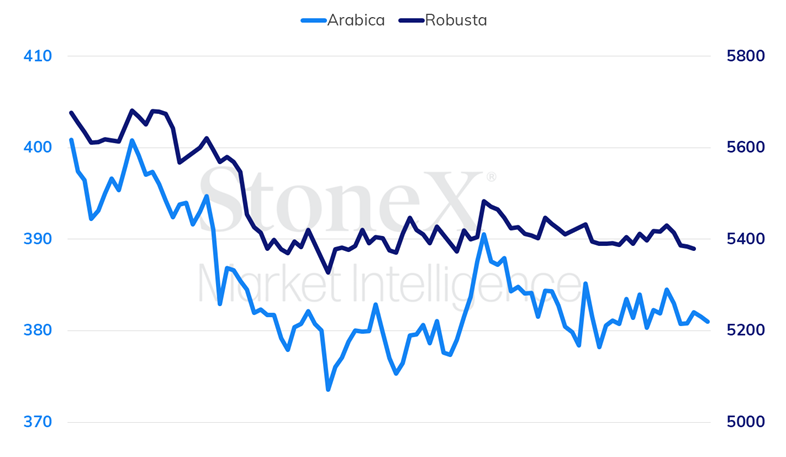
Besides market fundamentals, the dollar's behavior has significantly influenced prices. A strong surge was observed at the beginning of the year. From late 2024 until the peak recorded on February 13, the New York contract rose 35%, while the dollar fell 6.7% against the real. This inverse correlation between the dollar and coffee prices became evident last week: Arabica coffee fell 4.2%, while Robusta dropped 6.8%, in contrast with the dollar's 2.8% appreciation, reaching R$ 5.899.
In the climate scenario, dry and hot weather in the first weeks of February raised concerns among market participants, as Brazil is in the final stage of coffee crop development. Over the next 15 days, American and European climate models diverge. The European model is more optimistic, forecasting up to 80 mm of rainfall in southern Bahia, Espírito Santo, eastern Minas Gerais, and parts of Cerrado Mineiro, while São Paulo could record up to 50 mm. In contrast, the American model is more cautious, predicting significant rainfall only in southern Bahia and northern Espírito Santo.
Limited coffee supply continues to be a bullish factor, especially during Brazil's inter-crop. However, the new crop's arrival may ease supply constraints and exert downward pressure on prices. In 2025, Arabica production is expected to be significantly impacted due to adverse weather conditions in late 2024, affecting coffee flowering. StoneX has already estimated a 10.5% decline in Arabica production, forecasting 40 million bags. On the other hand, Robusta coffee production is expected to grow by around 21%, reaching 25.6 million bags, which may ease concerns about Robusta supply. In the coming weeks, various companies will update their projections for Brazilian production, while the US Department of Agriculture (USDA) will release its first estimates in May, followed by the final global supply and demand report in June.
Another key point will be Brazil’s coffee export data for February, published by the Brazilian Coffee Exporters Council (Cecafé). Logistical issues have impacted exports, with over 600,000 bags accumulated and not shipped in January due to bottlenecks. Cecafé's January report showed that Brazil exported 3.97 million bags. Still, logistical challenges persist, affecting Brazilian export performance.
Another relevant factor is inflation's impact on global coffee consumption. According to IBGE data, inflation over the past 12 months until January 2025 exceeded 50% in Brazil. In the US, inflation reached 14.6%, while in the European Union, the roasted and ground coffee index hit 8.2%. The sharp price increase may impact global consumption, raising concerns among market participants.
Given this scenario, a combination of bullish and bearish factors will continue to influence prices. On the bullish side, key factors include potential climate concerns in Brazil, lower supply in the physical market during the inter-crop (the harvest in Brazil will begin in April, with an accelerated pace from May onward), and logistical challenges. On the other hand, the expectation of an increase in certified Arabica coffee stocks in New York, the growth of Robusta production in Brazil, and the impact of inflation on global consumption are factors that may put downward pressure on prices. Regarding certified stocks, it is worth noting that pending stocks still exceed 100,000 bags, which means that if they are approved in the grading process, they may be included in the official stocks of the New York Exchange.
INDICATORS