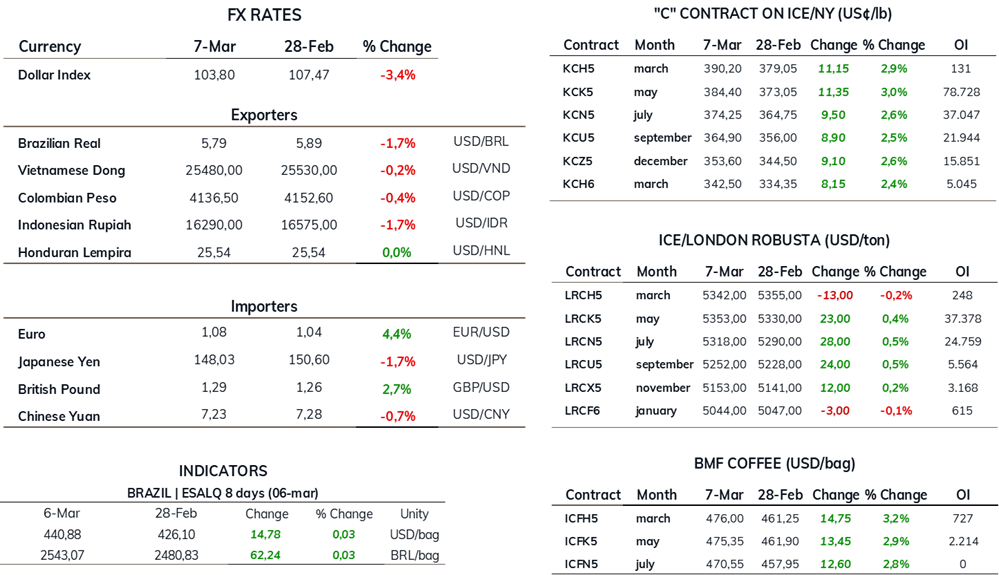
• Arabica coffee closed at US¢ 384.40/lb on ICE, a weekly increase of 3.0%
• Robusta coffee rose 0.4%, closing at USD 5353/t on the London exchange
• The US dollar fell by 1.7% over the week
• Secex: Brazilian exports fell by more than 20% in February
• Coffee production and exports in Colombia increased
• Reduced exports from Vietnam reflect lower production
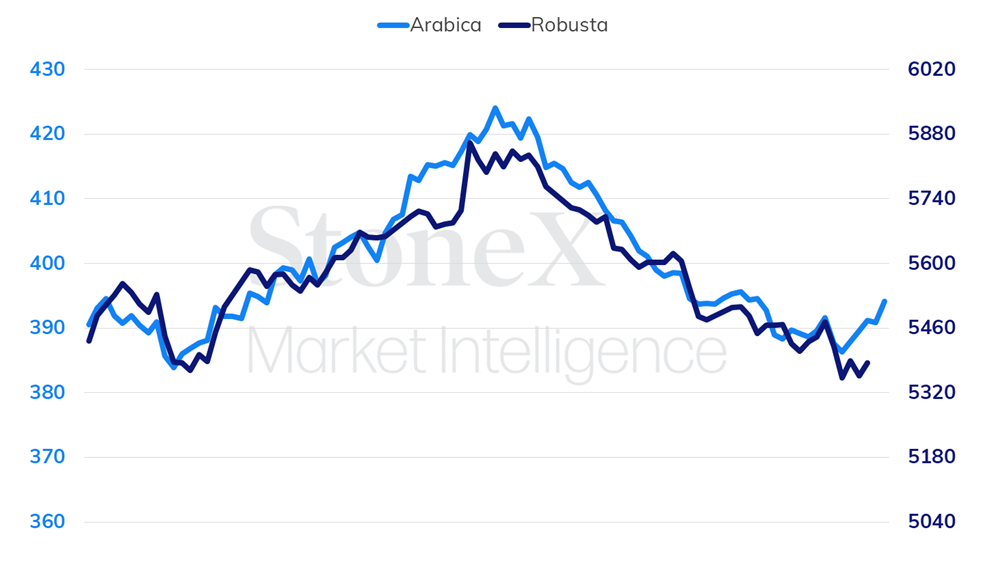
In a highly volatile week, futures prices for both arabica and robusta coffee ended the period higher. In the first three sessions of the week, prices saw significant gains, with the most active contract in New York reaching a high of US¢ 418.55/lb and closing Wednesday, March 5, at US¢ 409.95/lb. However, in the following days, prices retreated. Over the week, the May futures contract in New York recorded a 3.0% increase, closing the week at US¢ 384.40/lb. In London, the movement was more modest but still positive, with a 0.4% rise, closing at USD 5353/ton.
With no major fundamental news, market movements were driven by technical factors. Additionally, the week was marked by the Carnival holiday in Brazil, and from Thursday onward, a large part of the market participants in the United States attended the National Coffee Association (NCA) convention, held in Houston, Texas.
In the Brazilian domestic market, prices also rose: the Cepea indicator for arabica coffee increased by 1.3%, reaching BRL 2,514.82/bag. On the other hand, the robusta coffee indicator saw a slight decline of 0.2%, closing at BRL 1,981.46/bag. The weaker performance in the domestic market is linked to the 1.7% drop in the US dollar over the week, which closed last Friday (March 7) at USDBRL 5.79.
Weekly Intraday (Most Active Contract) – 03/03 to 03/07
With no significant changes in fundamentals, the coffee market continues to be influenced by a mix of bullish and bearish factors. On the bullish side, limited physical market supply, expectations of a smaller arabica crop in Brazil for the 2025/26 season, and logistical bottlenecks affecting exports stand out. Conversely, inflationary concerns, which could lead to a decline in coffee consumption in the coming months, deserve attention as a bearish factor. Additionally, the significant increase in robusta coffee production in Brazil is another key element. As mentioned in previous reports, StoneX's initial estimate, released in November, indicated a nearly 21% rise in Brazilian robusta coffee production, reaching 25.6 million bags. StoneX continues conducting field surveys and will release an updated report with revised projections for Brazil’s 2025/26 crop by the end of March.
This week, the market will closely monitor the release of Brazil’s coffee export data. The last report, covering January, showed that the country exported 3.97 million bags, a 1.6% decline compared to the same period last year. For February, data has not yet been released by Cecafé, but preliminary figures from the Foreign Trade Secretariat (Secex) indicate a 20.5% drop in exports, totaling 2.87 million bags. It is important to highlight that Brazilian exports continue to be impacted by logistical bottlenecks, as previously reported by Cecafé.
Recently, Colombia’s National Federation of Coffee Growers (FNC) released the country’s production and export data for January. In 2024, Colombia recorded coffee production of 13.99 million bags, a 23.4% increase from the previous year and above the historical average. Colombian exports totaled 12.32 million bags for the year, growing 16.5% compared to 2023 and nearly 4% above the historical average. In January alone, Colombian coffee production reached 1.35 million bags, up 41.4% from the same month last year and 40.5% above the five-year average. The country’s exports also rose in January, reaching 1.15 million bags, an annual increase of 23% and a 16.8% rise compared to the five-year average.
Monthly Coffee Production in Colombia (Million Bags)
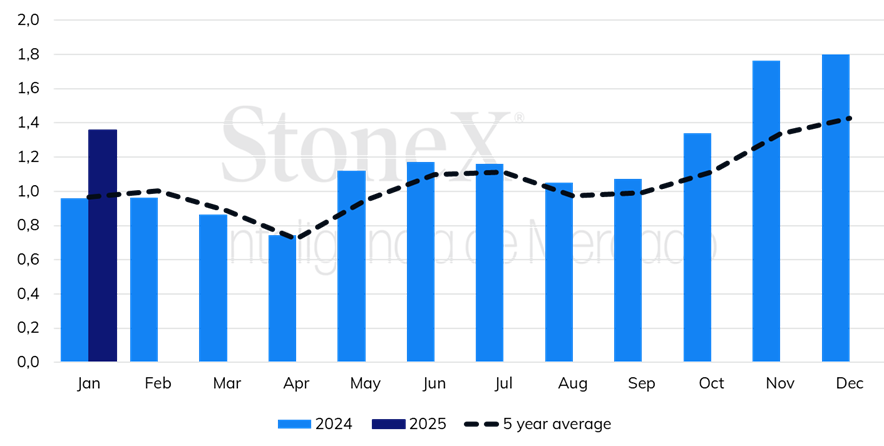
Source: FNC. Design: StoneX.
Another key point is Vietnam’s coffee exports. According to the latest customs data, the country exported 2.8 million bags in February, a 5.24% increase compared to the same month last year. For the 2024/25 crop year, covering October 2024 through January, Vietnam’s total exports reached 8.98 million bags, 29.6% lower than the same period in the previous crop year. This decline reflects lower-than-expected production, impacted by adverse weather conditions that affected Vietnamese coffee growers.
INDICATORS