
Reporte Diario de Café 8/4/26
Daily coffee report
StoneX Coffee Team
- Coffee
By: StoneX Intelligence Brazil, StoneX Intelligence Brazil


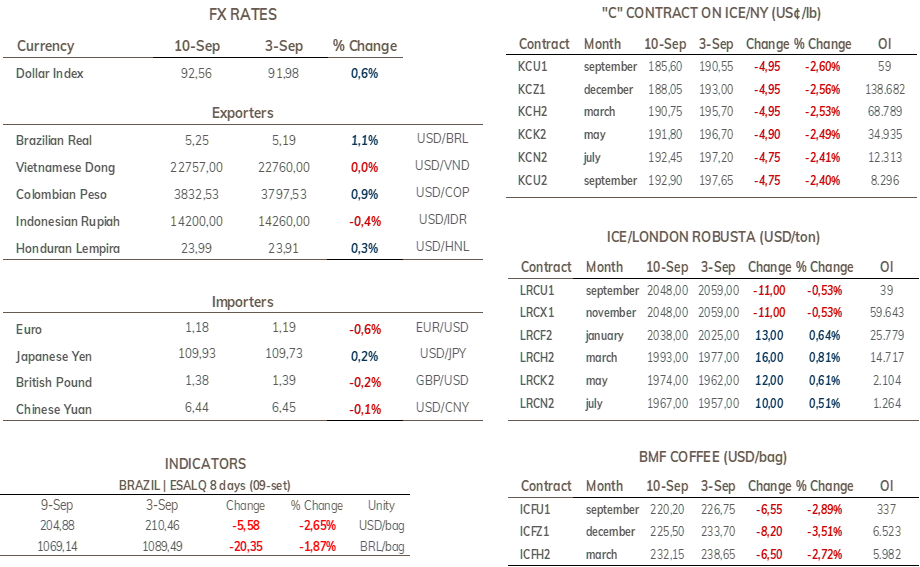
• Arabica coffee prices dropped by 495 points (2.56%) in NY, while the Cepea indicator dropped by 0.68% to BRL 1,074/bag
• Robusta falls USD 11 (0.53%) in London, 500 VND/kg (1.25%) in Dak Lak, but appreciates BRL 11.40/bag (1.57%) in Brazil
• Dry weather in Brazil continues to concern the market
• Market consensus that S&D balance will be negative in 2021/22
• ICO points to a substantial reduction in production in 2021/22
• NOAA report increases to 70-80% the probability of La Niña occurrence
• Colombia suffers from excessive rainfall
• Asia container shortage
• Index Funds helped to weigh on prices in the latest COT report
• With inflation and political instability in focus, USDBRL appreciates by 1.4% in the week
• Prices of ground coffee increased 7.5% to the Brazilian consumer in August
• With political scenario on the radar, the week should hold a volatile FX market
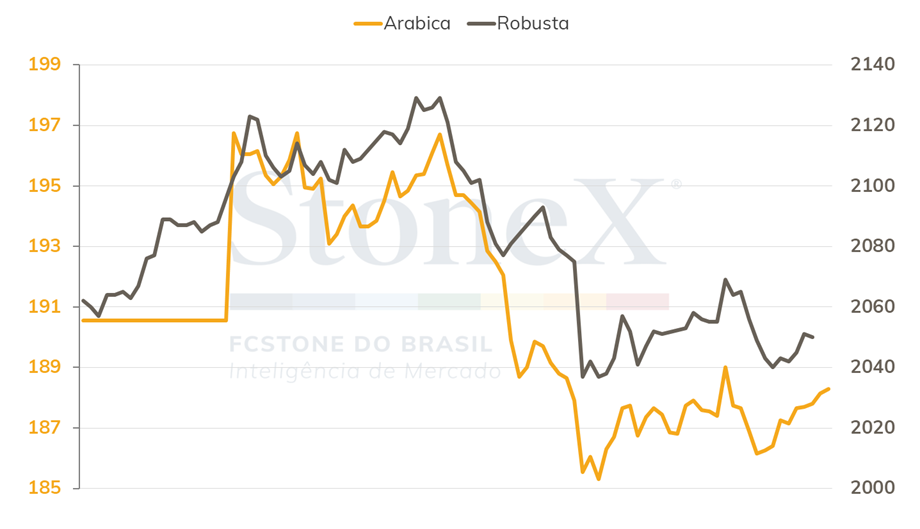
Market sentiment remains bullish due to the negative balance in 2021/22, logistical problems, and weather factors from a fundamental perspective. As commented in the last report, it is a consensus that the S&D balance will be negative in 2021/22 – estimates for the supply and demand balance range from -2.6 million to -13 million bags. In addition, several countries are facing problems exporting coffee, such as Peru, Colombia, Brazil, Vietnam and Indonesia. Unfortunately, there is no expectation of a solution to these problems in the short term.
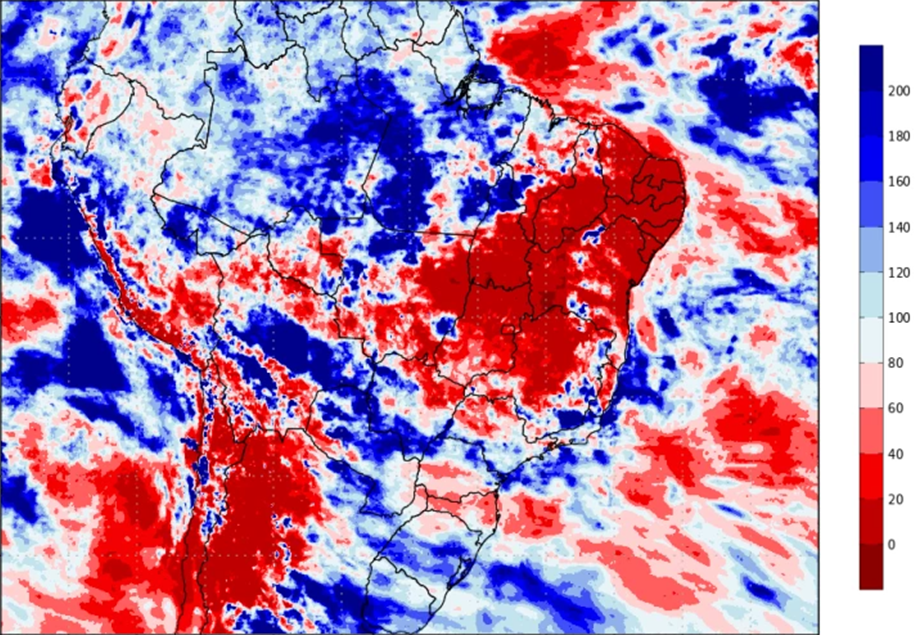
Regarding the weather, some producing regions in Brazil received substantial rainfall, such as Matas de Minas, Sao Paulo, Parana, Espírito Santo, Bahia and Rondônia regions. Some municipalities in the southern region of Minas Gerais, the largest national producer, recorded between 30 and 60 mm in the last 60 days. However, the volume is still below the historical average, especially in the northern part of the region, which can be seen on the rainfall anomaly map. The Cerrado region continues with volumes well below the historical average, with accumulations between 5 and 20 mm in the last 60 days. The rainfall observed in Matas de Minas, and the south of the state of Espírito Santo was enough to start the flowering process of the crops, and these volumes are closer to the historical average. The northern region of Espírito Santo did not receive good rainfall volumes, but the observed volumes associated with irrigation contributed to the beginning of Robusta flowering in the state. In addition, the latest GFS model has pointed to mostly dry and hot weather over the coffee belt in Brazil in the next 14 days.
In Colombia, excessive rainfall has caused problems. There have been reports that the rainfall has destroyed roads and led to production problems in the country. The situation in Colombia could get even worse, as NOAA's models have increased the chance of a La Niña to 70-80% at the end of this year and the beginning of next year. The La Niña occurrence between December and February is associated with an increase in rainfall in Colombia, Central America and Asia, which can generate logistical, production and quality problems. It is important to note that Colombia is harvesting its main crop starting in September. In addition, starting in mid-November, Central American countries and Vietnam will begin their harvest period.
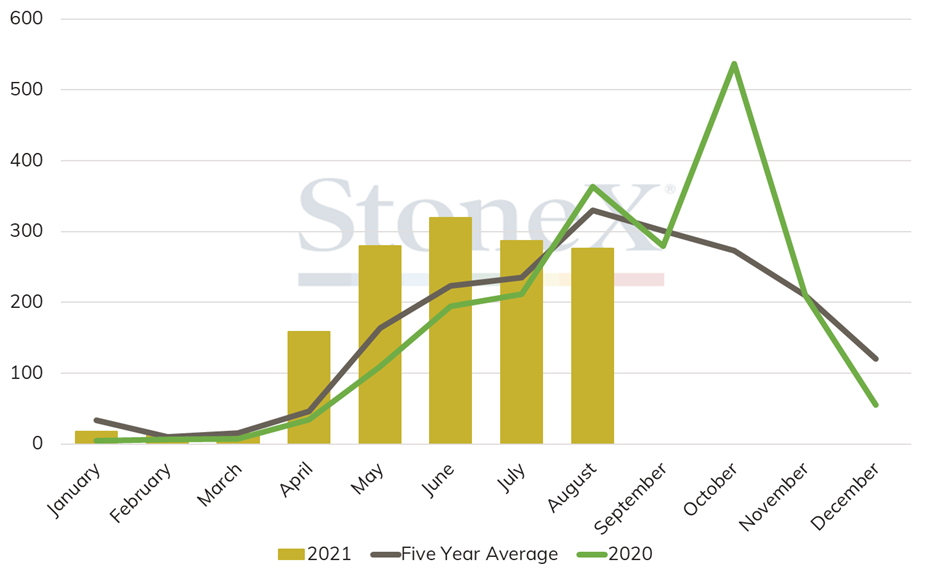
As covered in other editions of this report, logistical problems caused by the Covid-19 pandemic led to delays in coffee shipments in several producing countries. In Brazil, preliminary export data, released by Secex, pointed to a 10% reduction in exports in August. The Coffee Exporters Council (Cecafé) data has not been released yet but should be in line with the trend indicated by Secex. There is no official calendar, but Cecafe's data should be released early this week.
The Green Coffee Association (GCA) report should also be released this week, bringing data on the volume of coffee stocks at American ports. The GCA stocks report is an important indicator of the US domestic coffee market. For example, the latest GCA report showed a 5% increase in stocks between June and July, but the volume seen in July was still 13.9% lower than in July of the previous year.
In Brazil, the CEPEA indicator for the Arabica fell 0.68% to end the week quoted at BRL 1,073.90/bag. On the other hand, the CEPEA indicator for Robusta pointed to an increase of 1.57%, ending at BRL 735.73/bag.
The Arabica of inferior quality advanced compared to Arabica coffee with finer standards. According to StoneX Brazil's risk management consultant, Raphael Morais, exporters and trading companies are less active in the spot market, focusing on receiving future coffees due to logistical problems, which have hindered exports and trade in the international market. On the other hand, more intense activity has been noted in the domestic industry amid a sharp reduction in coffee supply and rising prices.
The strong demand from the industry for the lower-quality Arabica coffees and the Robusta variety has supported prices in the domestic market and contributed to the price difference decrease between the lower- and the higher-quality Arabica coffee. Raphael recalls that during the same period last year, the LG 600 1x1 coffee (600 defects, with 1% impurity and 1% undertone) was traded at around BRL 350.00/bag, while the type 6 coffee was seen at around BRL 600.00/bag, with the difference between the standards at around BRL 250.00/bag (-41.6%). In the last few days, the same pattern, LG 600 1x1, traded at BRL 950.00/bag, while type 6 was seen around BRL 1,080/bag, pointing to a difference of only BRL 130.00/bag (-12%).
The latest Commitment of Traders (COT) report, released by the CFTC, informed that between September 31 and September 7, spec funds increased their long positions in futures and options to 52,419 from 49,839 the previous week, a net increase of 2,691 in their long positions to 36,511. An increase like this usually tends to act in a bullish manner for prices. However, during the period, the most active contract in New York retreated 195 points, closing September 7 at US₵ 193.95. The index funds contributed to this movement, as it does not necessarily follow the coffee market trends. As a result, index funds reduced their long positions by 3,514 and short positions by 782 contracts, reducing their net long position by 2,732 contracts to 58,570.
As we approach the end of the October 2020 to September 2021 coffee year, final assessments of the global balance sheet are being made. Typical for the coffee market, forecasts for production and consumption vary but the a consensus view is that the coffee year will end with a supply surplus as an on-year crop from Brazil and good yields from many of the other producers surpasses a stagnant demand impacted by the global COVID-19 pandemic.
Most recently, the International Coffee Organization (ICO) issued their August coffee market report, revising both their production and consumption forecasts for the period.
For production, the ICO slightly raised their estimate by 0.02% from 169.604 million bags forecast last month to 169.644 million bags. Consumption was revised lower by 0.3% from 167.584 million bags to 167.011 million bags. Overall, the 2020-2021 coffee year is now expected to end with a 2.633 million bags.
“The supply/demand ratio is expected to tighten, as total supply is forecast to be only 1.6% higher than demand in coffee year 2020/21, as compared to 3.1% in 2019/20. With the expected substantial reduction in output from Brazil as a result of the recent frost and climate-related issues in many other exporting countries, total supply is expected to fall below world consumption,” the ICO noted in their report.
This is by far the lowest forecast for a surplus in the industry, with CoffeeNetwork estimating a surplus between 11 and 12.8 million bags, the USDA forecasting a surplus of 12.66 million bags and various other firms seeing a surplus ranging from 4.5 to 10.5 million bags.
While the ICO’s consumption figure is in-line with other forecasts, their estimate for production is significantly lower. Wide-ranging forecasts stem from many issues in the coffee sector, including the lack of transparency and the consequent challenges in accurate reporting of production. To maintain data consistency, the ICO converts production data from a crop year basis to a marketing year basis depending on the harvest months for each country, which could account for some discrepancies in their forecasts versus others.
Looking ahead, focus will begin to shift to the global 2021-2022 crop year, with the earliest estimates already expecting a shift to a global supply deficit. While the ICO did not provide forecasts for this period, they did note “a substantial reduction of world production is expected in coffee year 2021/22 as some important origins have been affected by climate-related shocks.”
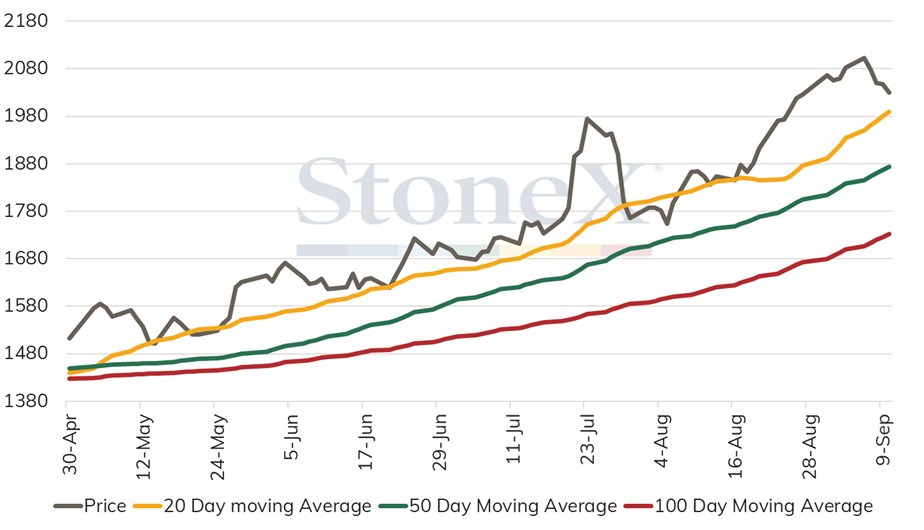
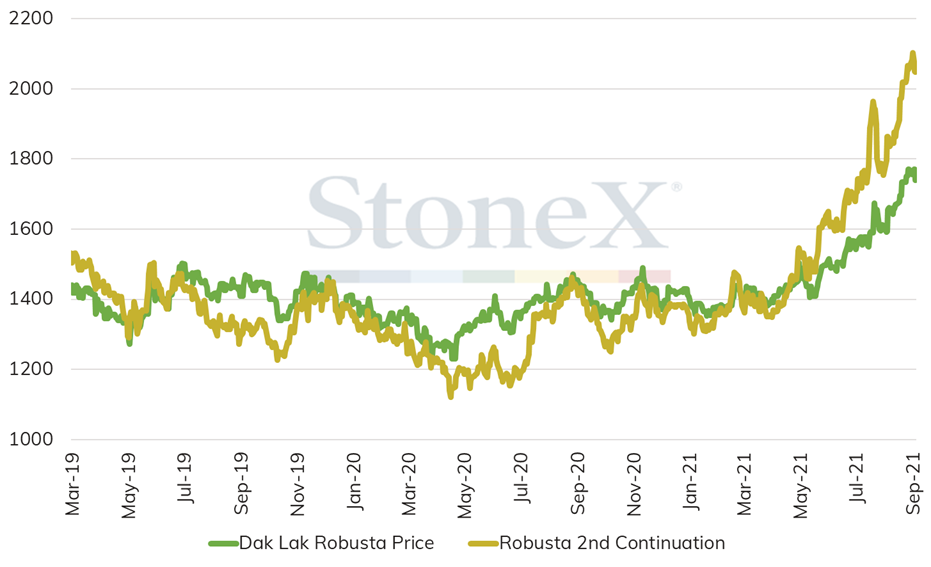
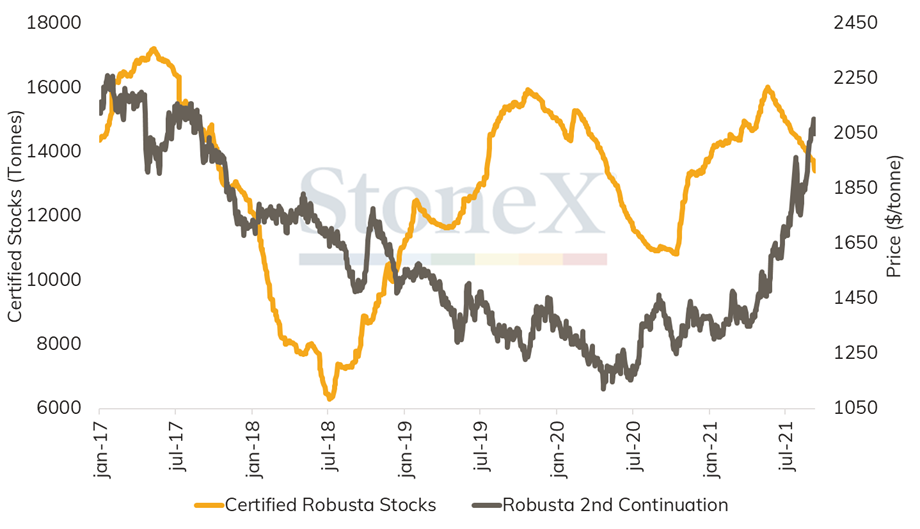
The certified stockpile for Robusta declined by 332t last week, to total 13,414t (2,235,667 bags) which marks the smallest the stockpile has been since December 2020. The lack of gradings continues to be the driver behind the stockpiles gradual drawdown, with ICE not having submitted a gradings report since 24th May.

The StoneX Group Inc. group of companies provides financial services worldwide through its subsidiaries, including physical commodities, securities, exchange-traded and over-the-counter derivatives, risk management, global payments and foreign exchange products in accordance with applicable law in the jurisdictions where services are provided. References to over-the-counter (“OTC”) products or swaps are made on behalf of StoneX Markets LLC (“SXM”), a member of the National Futures Association (“NFA”) and provisionally registered with the U.S. Commodity Futures Trading Commission (“CFTC”) as a swap dealer. SXM’s products are designed only for individuals or firms who qualify under CFTC rules as an ‘Eligible Contract Participant’ (“ECP”) and who have been accepted as customers of SXM. StoneX Financial Inc. (“SFI”) is a member of FINRA/NFA/SIPC and registered with the MSRB. SFI is registered with the U.S. Securities and Exchange Commission (“SEC”) as a Broker-Dealer and with the CFTC as a Futures Commission Merchant and Commodity Trading Adviser. References to securities trading are made on behalf of the BD Division of SFI and are intended only for an audience of institutional clients as defined by FINRA Rule 4512(c). References to exchange-traded futures and options are made on behalf of the FCM Division of SFI . StoneX is a trading name of StoneX Financial Ltd (“SFL”). SFL is registered in England and Wales, Company No. 5616586. SFL is authorized and regulated by the Financial Conduct Authority [FRN 446717] to provide to professional and eligible customers including: arrangement, execution and, where required, clearing derivative transactions in exchange traded futures and options. SFL is also authorised to engage in the arrangement and execution of transactions in certain OTC products, certain securities trading, precious metals trading and payment services to eligible customers. SFL is authorised & regulated by the Financial Conduct Authority under the Payment Services Regulations 2017 for the provision of payment services. SFL is a category 1 ring-dealing member of the London Metal Exchange. In addition SFL also engages in other physically delivered commodities business and other general business activities which are unregulated and not required to be authorised by the Financial Conduct Authority. StoneX Group Inc. acts as agent for SFL in New York with respect to its payments services business. StoneX APAC Pte. Ltd. acts as agent for SFL in Singapore with respect to its payments services business. ‘StoneX’ is the trade name used by StoneX Group Inc. and all its associated entities and subsidiaries.
Trading swaps and over-the-counter derivatives, exchange-traded derivatives and options and securities involves substantial risk and is not suitable for all investors. Past performance of any futures or option is not indicative of future success. Indicators are not a trading system and are not published as a specific trade recommendation. The information herein is not a recommendation to trade nor investment research or an offer to buy or sell any derivative or security. It does not take into account your particular investment objectives, financial situation or needs and does not create a binding obligation on any of the StoneX group of companies to enter into any transaction with you. You are advised to perform an independent investigation of any transaction to determine whether any transaction is suitable for you. No part of this material may be copied, photocopied or duplicated in any form by any means or redistributed without the prior written consent of StoneX Group Inc.
© 2026 StoneX Group Inc. All Rights Reserved.
Our subscribers have access to comprehensive market analysis from StoneX spanning commodities, equities, currencies and more.
Daily coffee report

August 4 – The benchmark Dow Jones Industrial Average surged into the close yesterday to finish almost 700 points higher, at a record close of 53,178 points – easily clearing the previous top from almost a month ago. The S&P 500 is on the brink of its own record as well, while the NASDAQ index is short of June highs but working on a strong three-session rally. All three are pointing to positive openings today. Palantir (a U.S. software company) reported better-than-expected earnings yesterday afternoon post-close to boost the tech sector, though a host of other firms reported strong earnings as well. The ten-year note continues to retreat from Friday’s high, now at 4.67%, with the dollar on the high side of level-par, while the VIX index now under 16 shows reduced volatility.

Daily coffee report
Our market expertise, advanced platforms, global reach, culture of full transparency and commitment to our clients’ success all set us apart in the financial marketplace.
Reach
With access to 40+ derivatives exchanges, 180+ foreign exchange markets, nearly every global securities marketplace and numerous bi-lateral liquidity venues, StoneX’s digital network and deep relationships can take clients anywhere they want to go.
Transparency
As a publicly traded company meeting the highest standards of regulatory compliance in the markets we serve, our financials and record of accomplishment are matters of public record. StoneX’s commitment to “doing the right thing over the easy thing” sets us apart in the industry and helps us build respect, client trust and new partnerships.
Expertise
From our proprietary Market Intelligence platform, to “boots on the ground” expertise from award-winning traders and professionals, we connect our clients directly to actionable insights they can use to make more informed decisions and achieve their goals in the global markets.