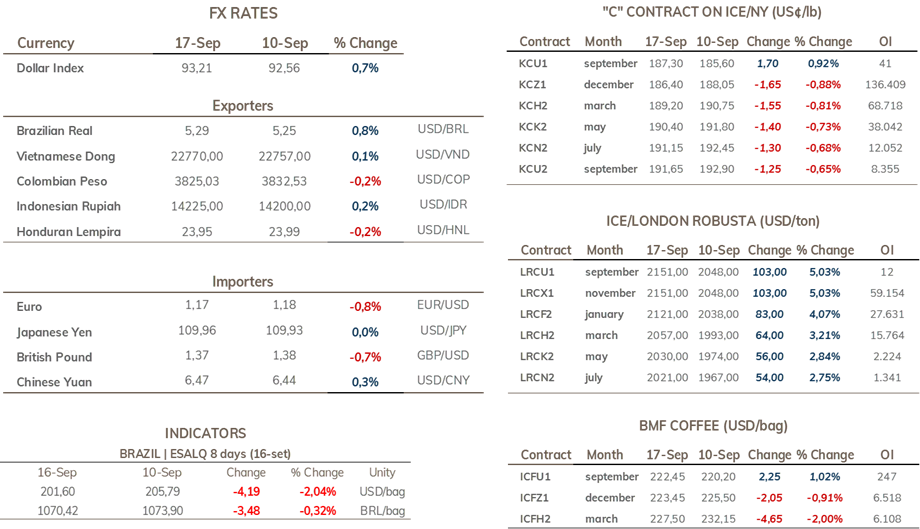
In Brazil, the CEPEA indicator for the Arabica remained almost unchanged, advancing only 0.06% to close the week quoted at BRL 1,074.55/bag. On the other hand, the CEPEA indicator for Robusta pointed to an increase of 3.69%, ending at BRL 762.89/bag. As mentioned in the last weekly report, the Robusta coffee market in Brazil continues with a positive differential, advancing to around USD 250/tonne. The strong increase in prices in Brazil is linked to an increase in demand from the industry, which has been looking more intensely for Robusta coffee as an alternative to offset the sharp rise in Arabica prices.
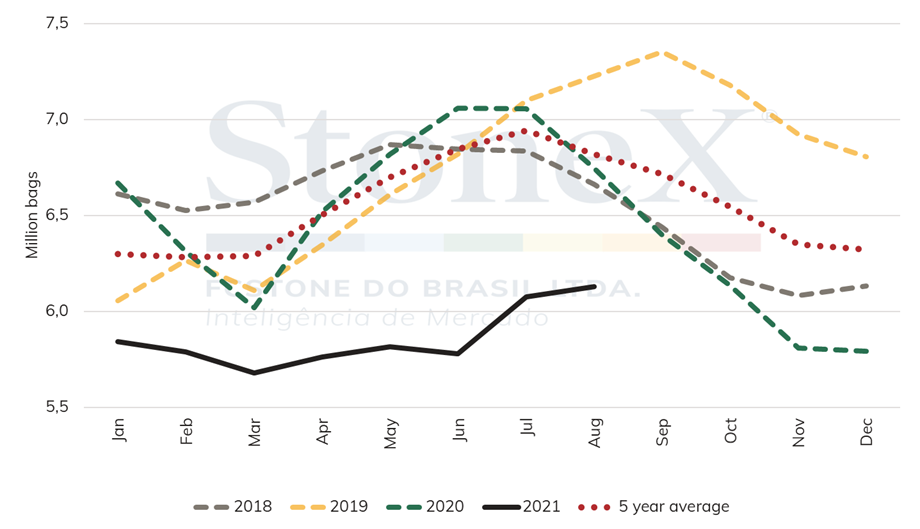
The last GCA report showed that coffee stocks at the US ports increased by over 56,000 bags, while the 5-year average for stocks dropped by 123,000 bags. The increase in coffee stocks volume may indicate a slowdown in the pace of consumption in the US. However, it is important to note that stocks were at a historically lower level.
GREEN COFFEE ASSOCIATION (GCA) COFFEE STOCKS
Source: GCA. Design: StoneX.
The rainfall forecast has reduced agents' concerns. The latest report published by StoneX points out that rainfall should return to the coffee belt from September 25. For the next 14 days, municipalities in the Southern Minas region should receive between 60 mm and 80 mm. The cerrado region continues to be the region with the most critical situation – historical data show that the volumes observed in the last 60 days were close to 0 mm. In addition, forecasts show that the accumulated rainfall for the next 14 days would be around 20mm for the municipalities in the Cerrado region of Minas Gerais. The rainfall levels from September 25 on, if confirmed, will be enough to start the crops' flowering process.
Market sentiment remains bullish due to the negative balance in 2021/22, logistical problems, and weather factors from a fundamental perspective.
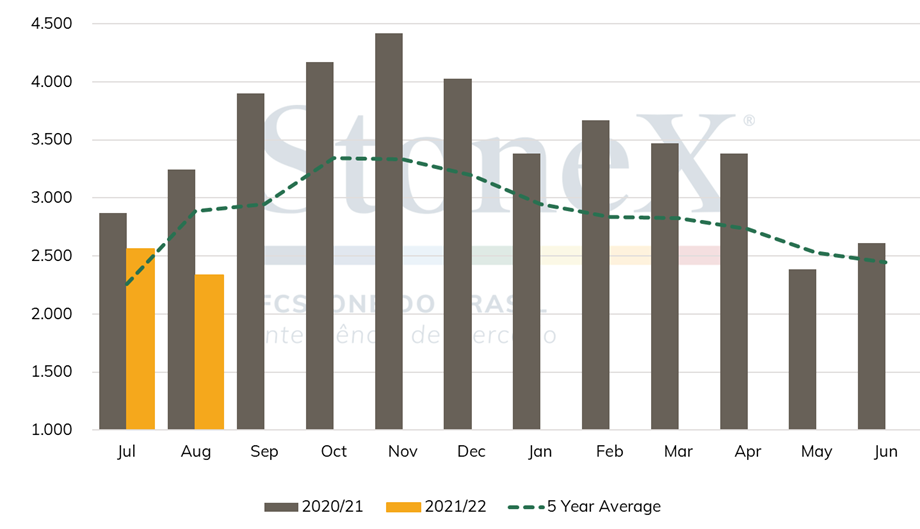
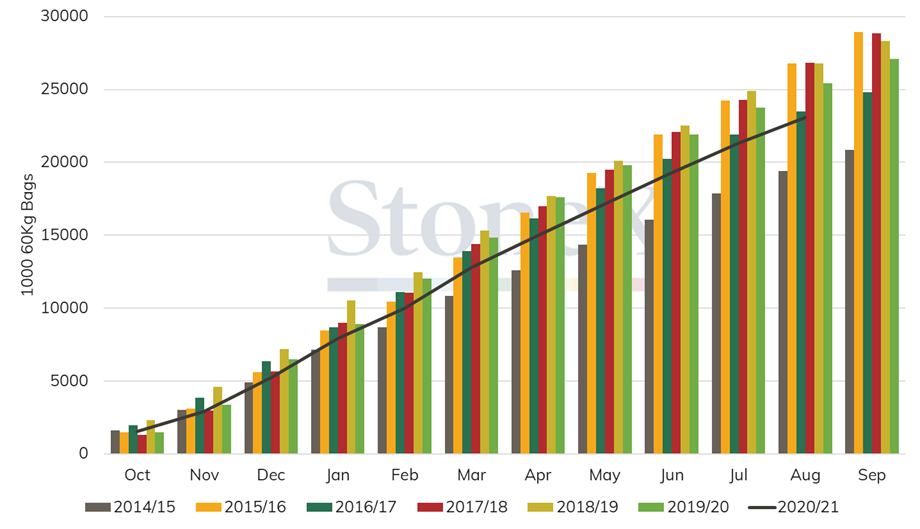
The latest export data from Cecafé indicated that there was a 28% drop in Brazilian coffee exports compared to August last year, resulting from the serious logistical problems that Brazil and other countries have been facing – the lack of containers and the large increase in logistical costs are the main factors behind the crisis. Furthermore, the council's logistical problems prevented Brazil from exporting 3.5 million bags between May and August this year. Other countries like Colombia and Vietnam also continue to face the same problems.
BRAZILIAN GREEN COFFEE EXPORTS
Source: Cecafé. Design: StoneX.
In Colombia, in addition to logistical issues, excessive rainfall has caused problems. As we mentioned in the last weekly report, Colombia's situation may worsen since the models of the American agency NOAA have increased to 70-80% the chance of La Niña occurring at the end of this year and the beginning of next year. The La Niña occurrence between December and February is associated with an increase in the rainfall volume in Colombia, Central America and Asia.
The weather market is expected to continue in the coming weeks. The rainfall return in the coffee belt would further cool the agents' concerns and bearish effect on the coffee market. However, if the dry weather prevails, the market sentiment would be more pessimistic and bullish for the coffee market. In addition, the market's focus should remain mainly on weather problems in other countries, exports and logistical problems.
The latest Commitment of Traders (COT) report, released by the CFTC, showed that between September 7 and September 14, spec funds reduced their long positions in futures and options to 52.419 from 49.646 the previous week with a net decline of 2,480 in their long positions to 34,031. During the period, prices of the most active contract in New York retreated 850 points, ending September 14 quoted at US₵ 185.45. Index funds reduced their long positions by 26 and short positions by 414 contracts, reducing their net long position by 440 contracts to 58,130. During the period, there was a reduction of 6,631 in the number of open contracts in NY.
Replanting Shows Success in Uganda
Uganda’s replanting of its coffee farms continue to show the success as the country’s coffee exports surge amid rising production levels. In August, the country’s exports were the highest since the liberalization of the coffee sector at 700,990 bags.
Increasing Robusta exports during the month compared to the previous year were due to newly planted coffee which started yielding supported by favorable weather. This was also compounded by a positive trend in global coffee prices in the month of July and August as Brazil faced the threat of frost, which prompted exporters to release their stocks.
During the month of August 2021, near normal rains were received in Eastern, Elgon & West Nile, favoring seedling distribution and survival rates. Distribution of Arabica coffee seed to nursery operators in Elgon was ongoing and a total of 629kgs Arabica seed was distributed to 19 nursery operators, while three (3) seed suppliers were pre-qualified to supply 3.5 MT of seed to 100 nursery operators. In Rwenzori, 2,200kg of Arabica seed was allocated. A cumulative of 4,106,050 Arabica seedlings were planted in Elgon region by 13,396 farmers. In Rwenzori, 4,500,000 Arabica seedlings were allocated and are yet to be distributed. A total of 9,145,000 Arabica coffee seedlings were verified for September to November 2021 planting Season in South West for 132 nursery operators. In West Nile, 11,675,805 Arabica seedlings were allocated, out of which 5,645,945 seedlings were planted. A total of 6,152,973 mature CWDr plantlets were verified for distribution to medium and large scale coffee farmers. During the period, collaborative arrangements were initiated with Ndejje University to allocate land for coffee planting. Similar engagements continued with Busoga Diocese, and 37,500 CWDr plantlets were procured and distributed to benefit diocese parishes. In an effort to promote coffee pests and disease control, pesticides such as Immidachloprid and tebuconazole were distributed to all regions to demonstrate pests and disease control. A total of 360,975 old unproductive coffee trees were stumped.
In 2013, Uganda launched the National Coffee Strategy, which targets production of 12 million bags by 2040. The area planted with coffee jumped from 335,000 hectares in 2019-2020 to 560,000 hectares in 2021-2022 with harvested area increasing from 525,000 hectares to 550,000 hectares over the same period. As part of “stumping,” a pruning process that removes trees from production for two to three years, production can decline temporarily, but increase in the long term as the tree becomes rejuvenated.
Robusta drives higher amid renewed concerns regarding Vietnamese lockdowns and weak export data from Brazil and Vietna
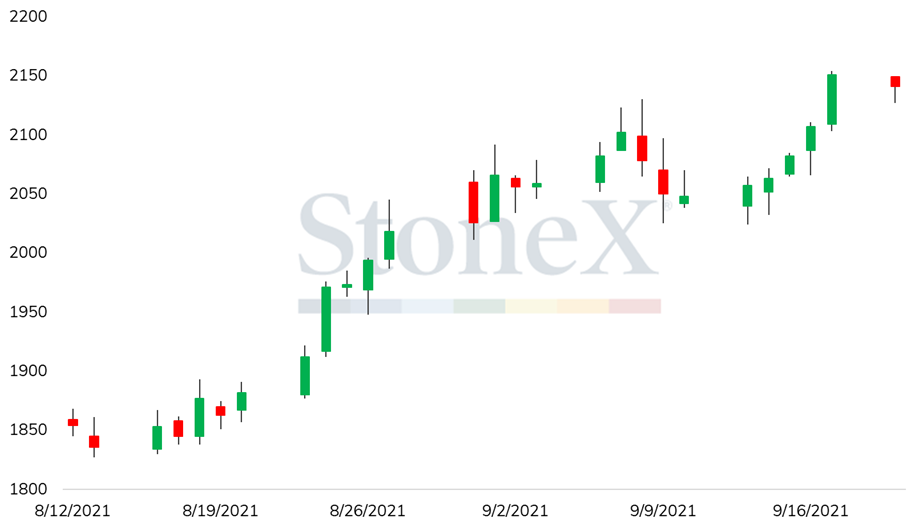
The Robusta complex in London staged a strong performance last week, with the most active November contract gaining 5.0% to settle at a fresh contract high of $2,151/t. The upward drive was lent further fundamental support in the middle of last week, when it was announced that Ho Chi Minh City will remain under lockdown restrictions through the second half of this month, once again renewing concerns over the impacts of the lockdown on the flow of goods out of HCMC port. While outflow from Vietnam is very limited due to the tight volumes of supply available at the end of the current marketing season, alongside the soaring cost of freight and general disruption caused by the lockdowns, the upward momentum, particularly in the front month, is a reflection of the shorter-term supply concerns that surround the Robusta market.
Robusta 2nd Continuation Candlestick - LONDON
Source: Bloomberg. Design: StoneX.
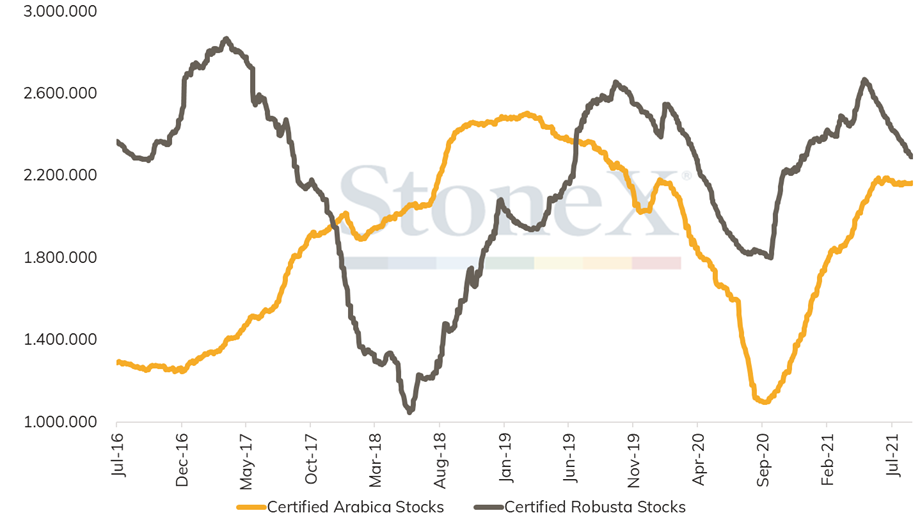
The disruption in the world’s largest exporting nation is likely to be turning demand towards the certified stockpile, which in turn has been on a steady downward trend for months now with no gradings reports published since May.
ICE Certified Arabica Stocks Vs Certified Robusta Stocks
Source: ICE. Design: StoneX.
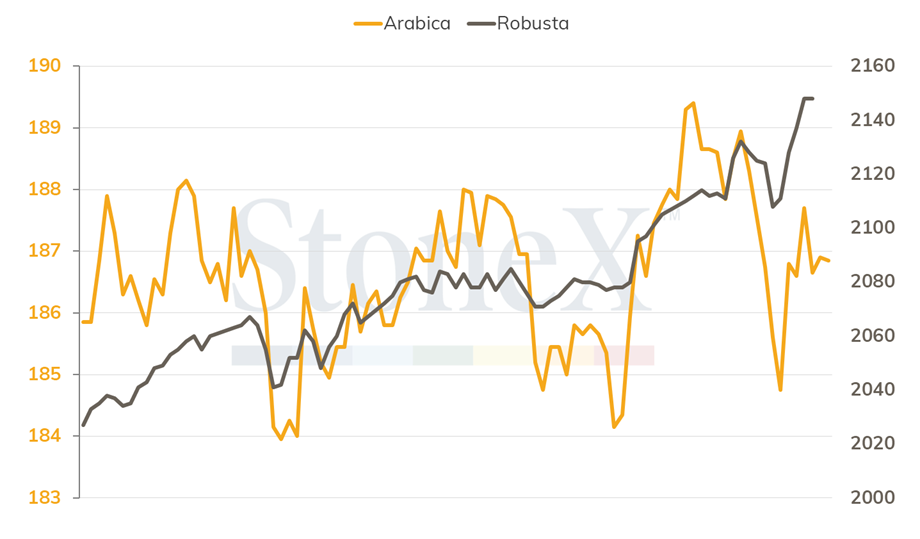
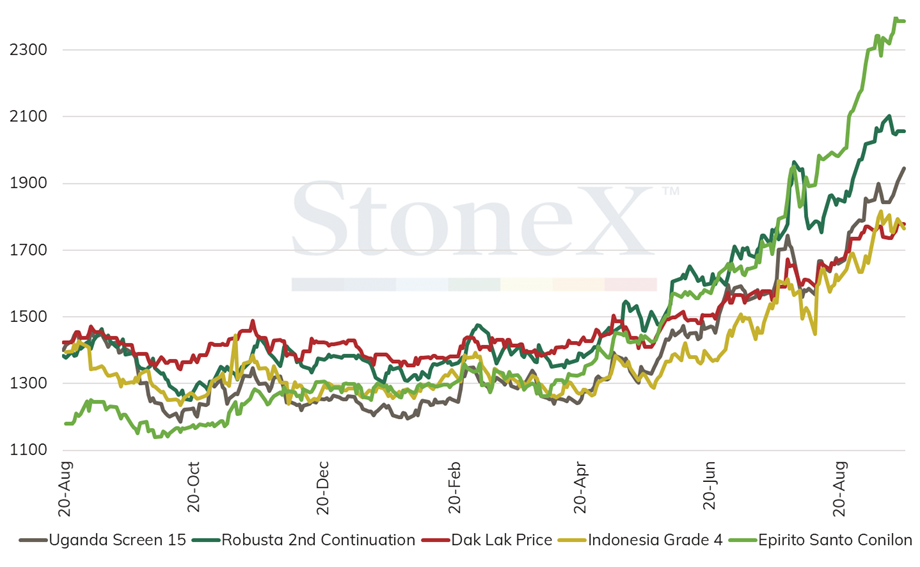
Indeed, the stockpile has declined to its smallest since November of 2020 with the gradual decline indicative of heightened demand for certified stocks. This is reflected by the premium on London vs origin, with the complex trading at notable premiums to Vietnamese, Indonesian & Ugandan.
ROBUSTA INTERNATIONAL PRICES
Source: ICE, Cepea, Bloomberg, Giacaphe. Design: StoneX.
Vietnamese customs data showed that 111,697t or 1.86M bags were shipped last month, which is down 8.7% M/M but up 11.5% Y/Y. Cumulative exports for the 2020/21 season now total 23.2M bags which is 8.7% behind last year’s rate and 10.3% behind the five year average, reflecting the ongoing disruption caused by all the issues previously discussed. Ultimately the market had been expecting lower shipments M/M due to the lockdown restrictions, tight supply and container shortages, but nonetheless the wider sentiment across the Robusta complex would indicate that the low levels of trade last month will also have provided support.
Data from Cecafé last week also showed Robusta exports fell significantly on a M/M and Y/Y basis. Shipments from Brazil last month totalled 228,460 bags, a decline of 42.85 M/M and 51.9% Y/Y. Weakness in Robusta shipments from Brazil adds further supply concerns for the complex with the world’s 2nd largest supplier also struggling with very high freight rates. Reports also indicate that Brazilian Robusta producers are reluctant to sell at current levels, waiting for further increases.
Source: General Department of Vietnam Customs. Design: StoneX.
Weather remains favourable for the development of the Vietnamese coffee crop this week, with abundant levels of precipitation aiding cherry filling. Indonesia is forecast for similar levels of rain, with light and consistent rains forecast for the week ahead.
Monetary policy decisions in Brazil and the United States should direct the foreign exchange market THIS WEEK
The USDBRL showed an increase of 0.8% last week, ending Friday (17) quoted at BRL 5.288, contributing to keeping coffee quotes under pressure in New York. Despite the release of favorable data for the Brazilian economy performance in July, the political news and apprehension on the eve of the week of monetary policy decisions in Brazil and the United States kept the USDBRL in an upward trend.
Domestically, the release of the Monthly Survey of Services revealed a 1.1% growth in the sector in July. In addition, the Central Bank of Brazil's Economic Activity Index (IBC-Br) gave some positive signs about the recovery of the country's economy at the beginning of the second half of the year, despite the difficulties faced by accelerating inflation. The IBC-Br, considered a preview of the GDP, showed an increase of 0.6% in July versus analysts' expectations of 0.4%. The services and retail sectors positively pulled the result, while the industry indicated a negative performance for the month.
Although the favorable data favored the Brazilian currency, the political scenario continued to contribute negatively. The government has been facing increasing difficulties in approving the PEC of judiciary bonds and the income tax reform, important measures to find room in the budget to accommodate the Auxílio Brasil program, which will expand the Bolsa Família basic income program. On Thursday (16), seeking alternatives to raise revenue to finance the program, President Bolsonaro issued a decree raising the Tax on Operations of Credit, Exchange and Insurance (IOF).
The measure led to a search for the dollar early Friday, with the exchange rate reaching levels near BRL 5.34 during the morning. The market should continue analyzing the measure with caution as it still needs Congressional approval and, despite favoring the implementation in the Auxílio Brasil program, it does not solve the need to contain spending against the spending cap. It maintains the concern with the country's fiscal risks.
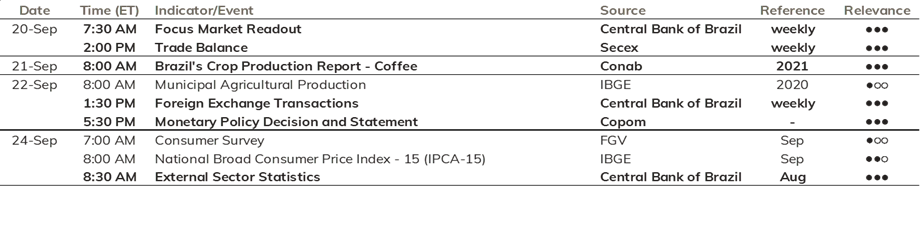
In general, the monetary policy decisions in Brazil and the United States, both on Wednesday (22), should have more weight for the negotiations in the foreign exchange market this week. In Brazil, since the release of strong inflation in August, bets have grown that the Monetary Policy Committee (Copom) will raise the Selic rate by more than 100 basis points, as signaled in the last meeting, and adjust the interest rate by 125 or 150 basis points. However, in an event last week, the Central Bank of Brazil's president, Roberto Campos Neto, emphasized that it will not "change the flight plan" after each release of high-frequency data, such as inflation, aiming at the longer horizon for decisions. The speech raised doubts about this week's monetary policy decision, contributing to a greater risk aversion among agents.
Abroad, the Fed's Federal Open Market Committee (FOMC) meeting should also inspire caution as agents wait for clearer signals about the beginning of a reduction in the Fed's asset purchase program. Despite lower-than-expected US consumer inflation data last week, still-strong producer inflation and activity and employment indicators generally signaling a warming scenario for labor demand in the country should weigh on the FOMC's decision. The meeting will also include the release of the Committee members' quarterly projections for the US economy, contributing to the market's assessment of the pace of recovery of the US economy and expectations for 2022.