
Daily Coffee Report 8/5/26
Daily coffee report
StoneX Coffee Team
- Coffee
By: StoneX Intelligence Brazil, StoneX Intelligence Brazil


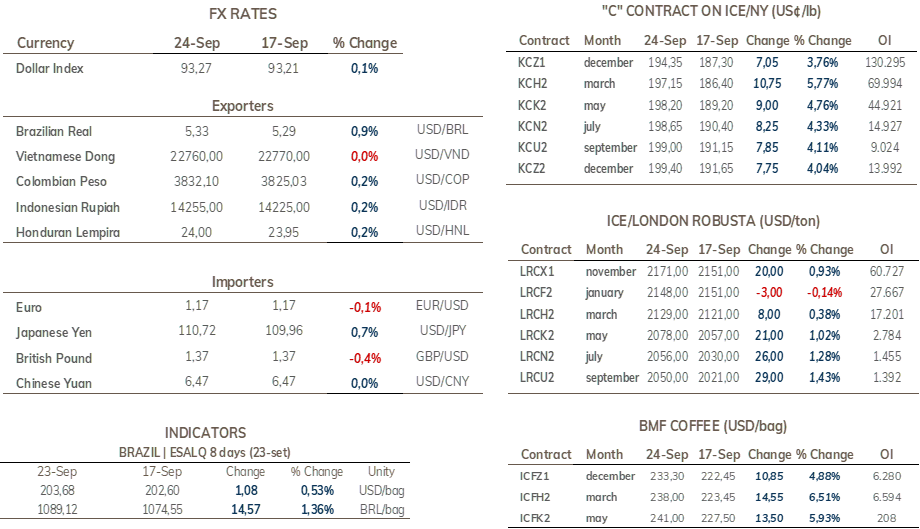
• Arabica coffee prices appreciated by 795 points (4.26%) in NY, with the Cepea indicator high by 3.45%.
• Robusta dropped by USD 3 (0.1%) in London, but increased by BRL 48.97/bag (6.4%) in Brazil
• Reduced certified stocks raise concerns about coffee supply 
• Costs and logistic problems have stimulated the withdrawal of coffee from certified stocks
• Robusta coffee still with differential close to USD 250/ton
• Dry weather continues to be a concern in Brazil
• First flowering may have its potential affected due to dry weather
• Regular rainfall in October may bring some relief to producers 
• Logistical complications should remain critical until January
• Specs increase their long positions; index funds weigh on prices
• Copom increases Selic rate by 1 percentage point
• FOMC to reduce asset purchases in November
• September IPCA-15 comes in higher than expected
• Ground coffee price expected to increase over 15.0% in two months in Brazil at the end of September
Bearish factors Bullish factors
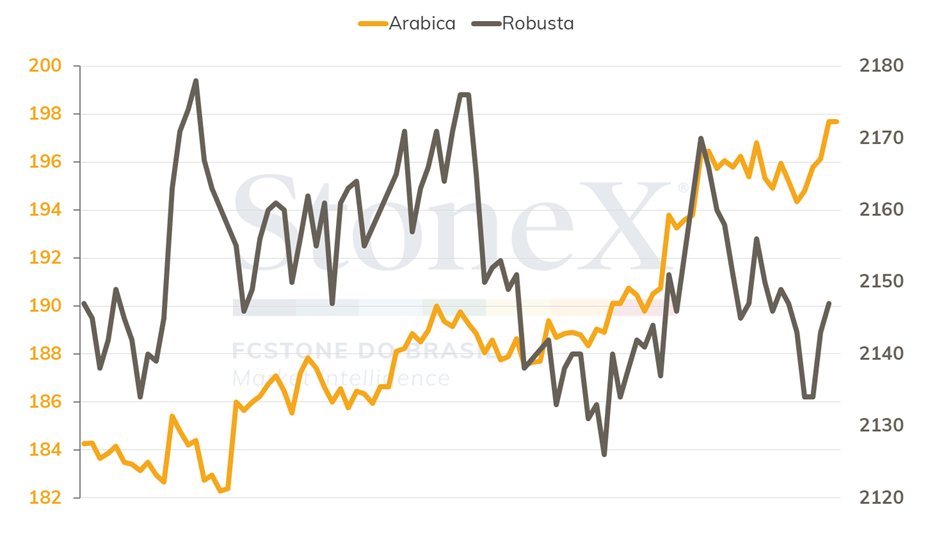
In addition to the weather and global logistics problems, Arabica coffee prices have been directed by the reduction in certified coffee stocks – last week, there were some rumors that commercial agents are withdrawing coffee from certified stocks. As noted in a special analysis published in May, certified stocks are related to price differentials at origin and logistics costs. Given the differentials levels in the main origins, logistical difficulties and costs, there is a lower probability that new coffees will be certified. Furthermore, costs and logistical problems encourage the withdrawal of coffee from certified stocks, a trend that is expected to continue over the next few weeks. The reduced certified stocks lead to a bullish tone in the coffee market.
In Brazil, the CEPEA indicator for the Arabica variety advanced 3.45% to close the week at BRL 1,111.63/bag. On the other hand, the CEPEA indicator for Robusta pointed to an increase of 6.4% to close at BRL 811.86/bag. As mentioned in the last weekly report and seen in the Weekly Coffee Basis Report, the Brazilian Robusta coffee market continues with a positive differential, reaching around USD 250/ton last week.
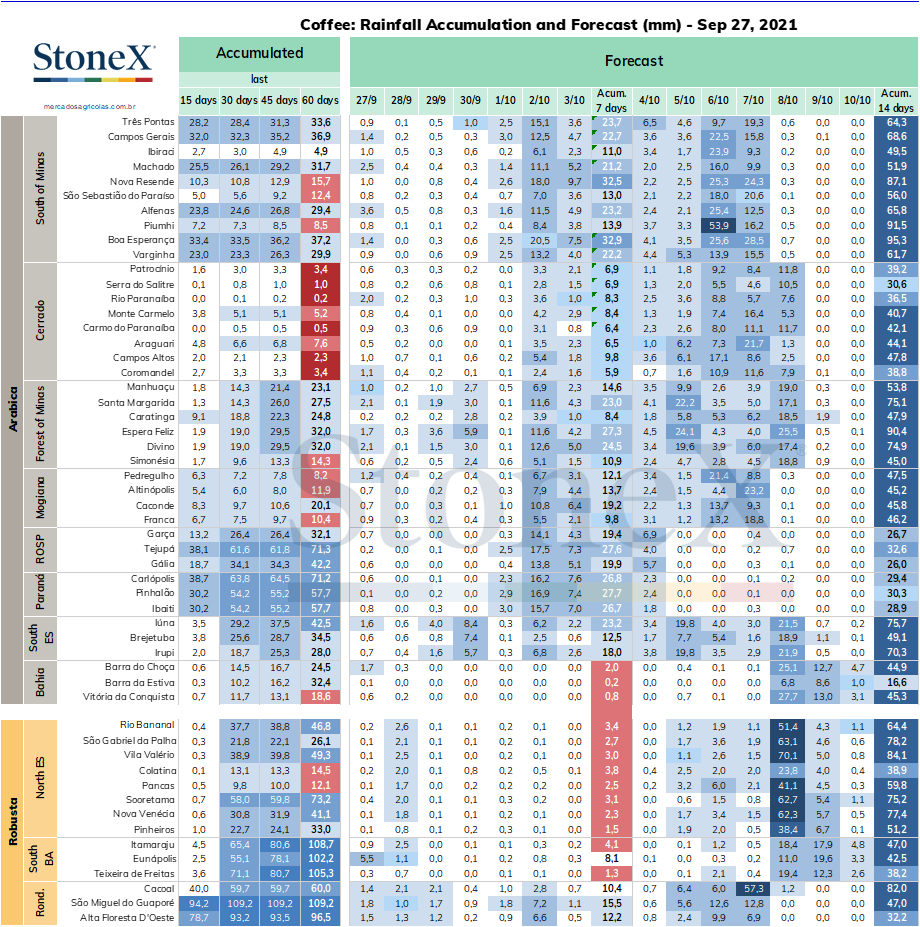
As often commented in recent weeks, prices likely become more sensitive to weather forecasts, especially the rainfall forecasts, which need to occur in volumes and at the correct time so the coffee flowering can reach its full potential. Amid the dry weather and rainfall below the historical average in the last 60 days in Southern Minas Gerais and the Cerrado region, the first flowering observed is at risk of suffering losses. The Cerrado, an area with the highest indications of drought stress in crops, holds the greatest potential for losses. Currently, the forecasts have pointed to rains only at moderate levels in the region, generating uncertainty regarding the second flowering period.
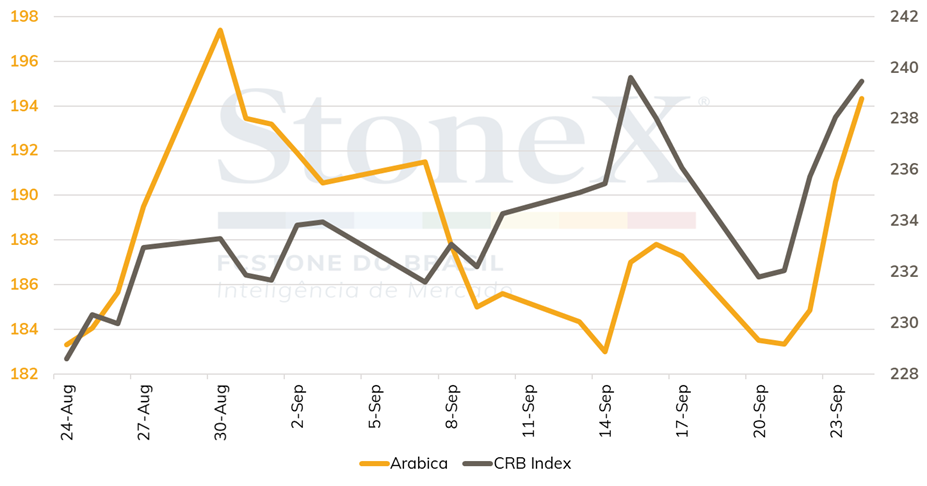
It is worth remembering that index funds do not respond directly to the fundamentals of the coffee market but rather to fundamentals linked to macroeconomic factors and a set of globally traded commodities. In this period, we have observed an increase in the dollar index and a drop in commodity prices in general, with the CRB commodities index posting a drop of 1.4%. In general, the commodities complex followed an increase in global risk aversion in this period due to the threat of insolvency of the Chinese property developer Evergrande, which could limit Chinese demand for several products.
In Nicaragua, the country’s coffee sector is being impacted by a trifecta of challenges; logistics, weather and the global pandemic have all put a strain on the supply chain.
There have been reports that major shipping lines have been skipping Nicaragua’s ports as ships continue to struggle to stay on schedules and avoid delays. Producers in Nicaragua have told CoffeeNetwork that there are increasing challenges in fulfilling contracts with limited space on ships departing. The latest data from the International Coffee Organization (ICO) showed that the cumulative export figures from Mexico and the traditional washed arabica Central American bloc; Costa Rica, Guatemala, Honduras, Nicaragua and El Salvador increased 1.40% in the first ten months of the current coffee year, however, Nicaragua’s exports fell 7.8%.
In terms of weather, Hurricanes ETA and IOTA hit the North Central Region of Nicaragua and the Caribbean Coast at the end of November and early December 2020. Producers reported significant losses due to the excessive rainfall due to the hurricanes. Some coffee companies estimate that hurricanes ETA and IOTA caused significant damage to at least 5% of the coffee plantations, several plantations suffered total losses from landslides. Since then, the country has seen a dry spell in late July and early August. Because of this, the USDA forecast limited growth for the 21-22 coffee year. Coffee associations anticipate a moderate growth of at least 5% for a total of 2.38 million 60-kilogram (KG) bags but do not foresee a full recovery since investments on the coffee sector remain stagnant.
And these investments that should be boosting the coffee sector are becoming less and less possible. Vaccination campaign and recent political challenges are likely to stall economic recovery. COVID-19 cases remain high, and there are rising concerns about the availability of labor.
Robusta coffee futures rallied last week, touching more than four-year highs. Overall, Robusta coffee has soared more than 55% this year after frosts in Brazil were said to have impacted the country’s Arabica crop, boosting the demand for Arabica. In top producer Vietnam, tightening COVID-19 restrictions have left the country struggling to find labor for harvesting, issues with trucks being able to travel within the country to transport the coffee to ports and challenges with availability of ships and shipping containers to export the coffee abroad.
The market failed to respond to a bearish report from Brazil’s supply agency, CONAB, which forecast a jump of 12.8% of the Robusta crop in 2021-2022 year on year. Traders say this increase in Robusta production was already factored in to the market.
Looking ahead, focus will be on the harvesting in Vietnam. Weather will be a key factor in the pace of harvesting. Logistical issues should begin to resolve following next week’s announcement from Prime Minister Pham Minh Chinh that the country plans to ease restrictions.
The Central Bank of Brazil's Monetary Policy Committee (Copom) raised the Selic rate by one percentage point, from 5.25% to 6.25% a year, indicating that it should make a similar increase at its next meeting in October, moving into "contractionary territory" to control the inflation acceleration. The decision came as expected, in line with signals made by the institution's president, Roberto Campos Neto, that the Central Bank would not "alter its flight plan" in reaction to each new monthly inflation announcement. "Copom considers that, at the current stage of the interest rate hikes, this pace of adjustment is the most appropriate to ensure the convergence of inflation to the target over the relevant horizon and, simultaneously, to allow the Committee to obtain more information about the economy and the degree of persistence of shocks." On Tuesday (28), the agents will follow the publication of Copom meeting minutes in search of members' further analysis about the country's current scenario.
In the United States, the Federal Reserve's Federal Open Market Committee (FOMC) also acted in line with expectations, maintaining the current range for the basic interest rate and not starting to reduce the asset purchase program. In a press conference, Fed Chairman Jerome Powell indicated that the beginning of tapering could happen as early as the next meeting, in early November. If the country's scenario goes as expected, it should be completed by mid-2022. In addition, the members of the collegiate also updated their quarterly projections for the main economic indicators. Among the highlights, there was an increase in expectations for interest rate hikes as early as 2022, with 9 out of 18 members believing in at least one increase next year, against only seven members in the last projection, in June.
In Brazil, the release of the IPCA-15 for September last Friday (24) raised investors' risk aversion and concerns about uncontrolled price acceleration. The indicator that measures the September inflation forecast pointed to an increase of 1.14%, the highest for the month in 27 years. The biggest impact came from the transport, food and beverage, and housing sectors, the latter affected by implementing the "Escassez Hídrica" tariff flag (water shortage), which again raised the cost of electricity for families. In addition, ground coffee showed an increase of 7.8% to the consumer, after increasing 7.5% in August, indicating an increase of more than 15% in two months in the value of the product on the country's shelves, reflecting the strong increases in grain prices on international exchanges and domestic markets. However, it is uncertain whether these strong price increases can impact total demand since the Brazilian culture of daily coffee consumption is historically very resilient. Still, there will certainly be significant changes both in the consumption pattern, with a migration towards lower quality coffees, and in the composition carried out by the industry, with an increased share of Robusta in the blend.
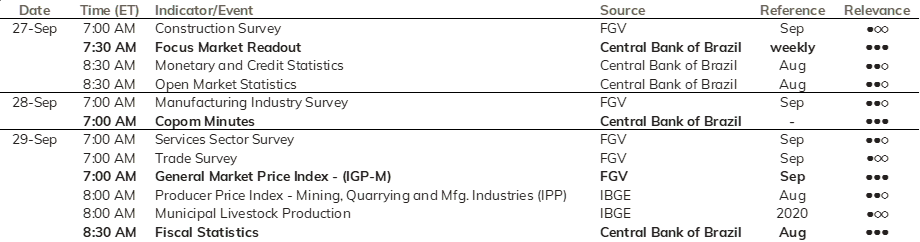
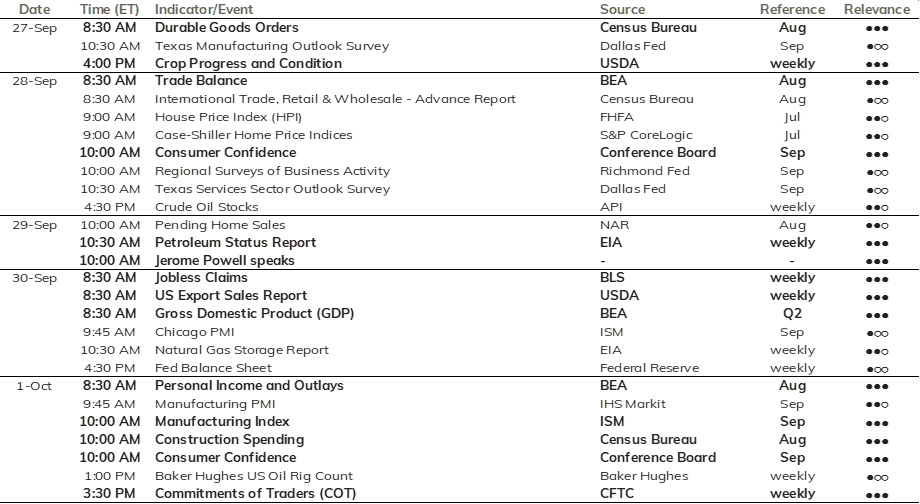
Among this week's highlights, besides the Copom meeting minutes, investors will also follow the quarterly inflation report from the Central Bank of Brazil to be released on Thursday (30), which will include its estimates for the GDP in 2021 and 2022. On Friday (1), the consolidated September trade balance data from the Foreign Trade Secretariat (Secex) will be released, a preview of Cecafé's official September export results and will give an insight into the logistical problems in the country.
WEEKLY AGENDA
The StoneX Group Inc. group of companies provides financial services worldwide through its subsidiaries, including physical commodities, securities, exchange-traded and over-the-counter derivatives, risk management, global payments and foreign exchange products in accordance with applicable law in the jurisdictions where services are provided. References to over-the-counter (“OTC”) products or swaps are made on behalf of StoneX Markets LLC (“SXM”), a member of the National Futures Association (“NFA”) and provisionally registered with the U.S. Commodity Futures Trading Commission (“CFTC”) as a swap dealer. SXM’s products are designed only for individuals or firms who qualify under CFTC rules as an ‘Eligible Contract Participant’ (“ECP”) and who have been accepted as customers of SXM. StoneX Financial Inc. (“SFI”) is a member of FINRA/NFA/SIPC and registered with the MSRB. SFI is registered with the U.S. Securities and Exchange Commission (“SEC”) as a Broker-Dealer and with the CFTC as a Futures Commission Merchant and Commodity Trading Adviser. References to securities trading are made on behalf of the BD Division of SFI and are intended only for an audience of institutional clients as defined by FINRA Rule 4512(c). References to exchange-traded futures and options are made on behalf of the FCM Division of SFI . StoneX is a trading name of StoneX Financial Ltd (“SFL”). SFL is registered in England and Wales, Company No. 5616586. SFL is authorized and regulated by the Financial Conduct Authority [FRN 446717] to provide to professional and eligible customers including: arrangement, execution and, where required, clearing derivative transactions in exchange traded futures and options. SFL is also authorised to engage in the arrangement and execution of transactions in certain OTC products, certain securities trading, precious metals trading and payment services to eligible customers. SFL is authorised & regulated by the Financial Conduct Authority under the Payment Services Regulations 2017 for the provision of payment services. SFL is a category 1 ring-dealing member of the London Metal Exchange. In addition SFL also engages in other physically delivered commodities business and other general business activities which are unregulated and not required to be authorised by the Financial Conduct Authority. StoneX Group Inc. acts as agent for SFL in New York with respect to its payments services business. StoneX APAC Pte. Ltd. acts as agent for SFL in Singapore with respect to its payments services business. ‘StoneX’ is the trade name used by StoneX Group Inc. and all its associated entities and subsidiaries.
Trading swaps and over-the-counter derivatives, exchange-traded derivatives and options and securities involves substantial risk and is not suitable for all investors. Past performance of any futures or option is not indicative of future success. Indicators are not a trading system and are not published as a specific trade recommendation. The information herein is not a recommendation to trade nor investment research or an offer to buy or sell any derivative or security. It does not take into account your particular investment objectives, financial situation or needs and does not create a binding obligation on any of the StoneX group of companies to enter into any transaction with you. You are advised to perform an independent investigation of any transaction to determine whether any transaction is suitable for you. No part of this material may be copied, photocopied or duplicated in any form by any means or redistributed without the prior written consent of StoneX Group Inc.
© 2026 StoneX Group Inc. All Rights Reserved.
Our subscribers have access to comprehensive market analysis from StoneX spanning commodities, equities, currencies and more.
Daily coffee report

August 5 – U.S. equities markets are on fire this week, with both the Dow Jones and S&P 500 setting new all-time highs yesterday with futures indicating further gains again today; the marketplace remains optimistic over a deal with Iran despite no evidence of such as of yet. Crude oil is working on a lower high and low today but remains slightly on the high side on the session, while the dollar is retreating back towards Monday’s nearly two-month low. The ten-year note is steady-to-lower this morning (though solidly lower so far this month) at 4.605%, while the VIX index continues to rebound into mid-week at almost a 17-point reading this morning.

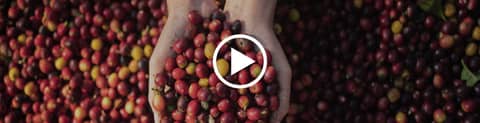
Brazil could still deliver a record arabica crop, but the bigger question for growers is what the next season holds. Out of season flowering and the swing of El Niño have put the spotlight on the rains still to come.

Our market expertise, advanced platforms, global reach, culture of full transparency and commitment to our clients’ success all set us apart in the financial marketplace.
Reach
With access to 40+ derivatives exchanges, 180+ foreign exchange markets, nearly every global securities marketplace and numerous bi-lateral liquidity venues, StoneX’s digital network and deep relationships can take clients anywhere they want to go.
Transparency
As a publicly traded company meeting the highest standards of regulatory compliance in the markets we serve, our financials and record of accomplishment are matters of public record. StoneX’s commitment to “doing the right thing over the easy thing” sets us apart in the industry and helps us build respect, client trust and new partnerships.
Expertise
From our proprietary Market Intelligence platform, to “boots on the ground” expertise from award-winning traders and professionals, we connect our clients directly to actionable insights they can use to make more informed decisions and achieve their goals in the global markets.