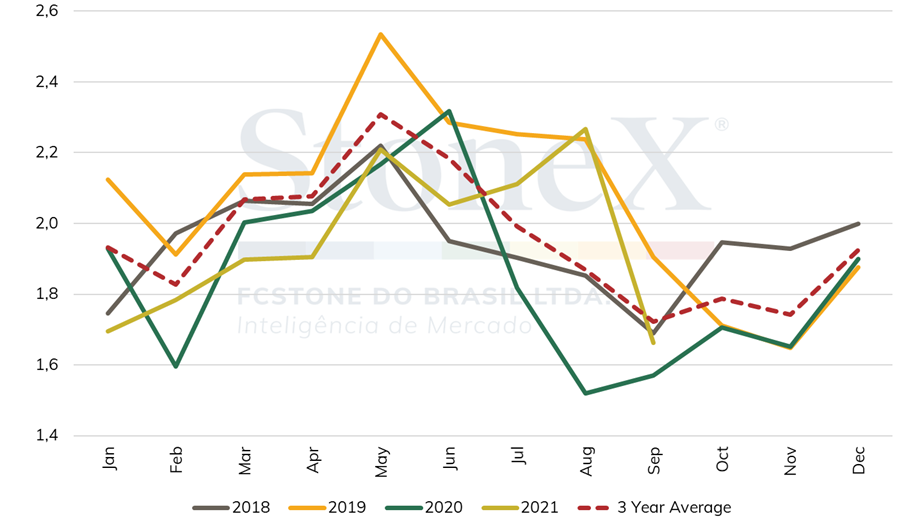
In general, data are in line with the global trend of reduced imports due to logistical bottlenecks and containers shortage. According to the International Coffee Organization (ICO), global exports totaled 10.07 million bags in September, 4.9% below the 10.59 million exported in the same month of 2020. In addition to Brazil’s export data this week, agents should wait for the released of inventory data in the United States in October by the Green Coffee Association (GCA), in order to better assess the rate of consumption in the main global consumer. The figures for the last five years point to an average 2.5% drop in stocks in the transition from September to October. Considering the producing countries’ difficulties in shipping the product, an historically low level of stocks, and surveys pointing to a return of US consumption to pre-pandemic levels, a drop in stocks that is more intense than average may indicate pressures on the consumption side and be bullish for prices.
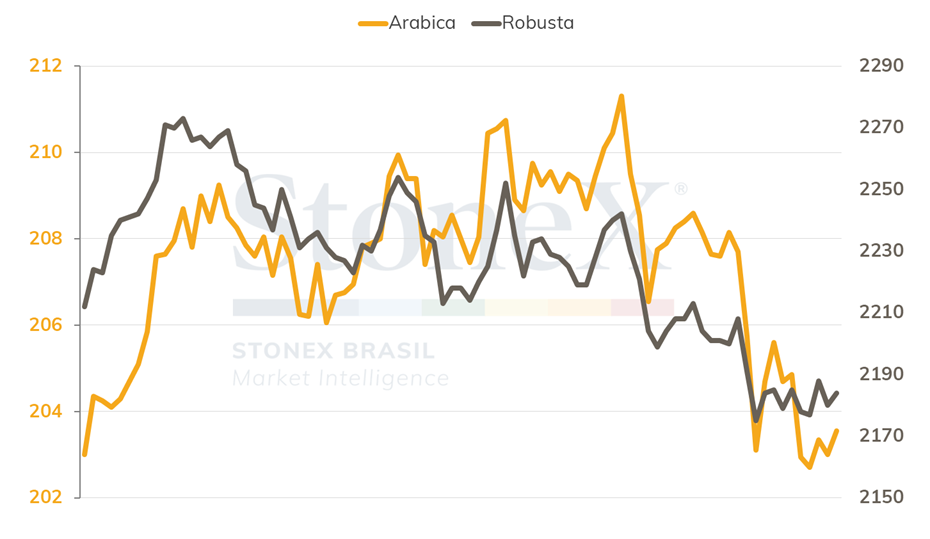
The latest CFTC report indicated a cut in speculative funds’ net long position in New York. Last Friday’s report (05) indicated that between October 26 and November 02, funds reduced long positions by 890 and expanded short positions by 1,104 to a net long balance of 42,864. In this period, the nearby contract quotes posted a drop of only 5 points, to 208.05 cents. Although fundamentals continue to be mostly bullish for prices in the long term, the historically high long position of funds is a factor of attention, with the potential to provoke eventual sudden short-term downward movements in the event of a more intense liquidation of funds.
Birth Place of Coffee, Ethiopia, Braces for War
Last week, Ethiopia, the so-called “birth place of coffee,” declared a six-month state of emergency as forces from the northern region of Tigray were gaining territory and considering marching on the capital Addis Ababa.
The Prime Minister, Abiy Ahmed, has urged citizens to take up arms to defend themselves against the Tigray People's Liberation Front (TPLF). According to local news sources, major roads are closed and operations at ports have ceased.
Additionally, the United States government recently announced that it plans to suspend Ethiopia from the Free-Trade Deal, the African Growth and Opportunity Act (AGOA), on human rights violations.
Ethiopia was the fifth top exporting nation under the act, according to U.S. International Trade Commission data. Under AGOA, Ethiopia exported $245 million worth of goods to the United States last year.
Ethiopia is the largest coffee producer in Africa, with production forecast to reach to 7.62 million bags (457,200 MT) in 2021/22. 50-55% of Ethiopia’s production is consumed domestically. Local consumption is estimated to increase to 3.55 million bags in MY 2020/21.
Robusta market still watching coffee harvest in Vietnam
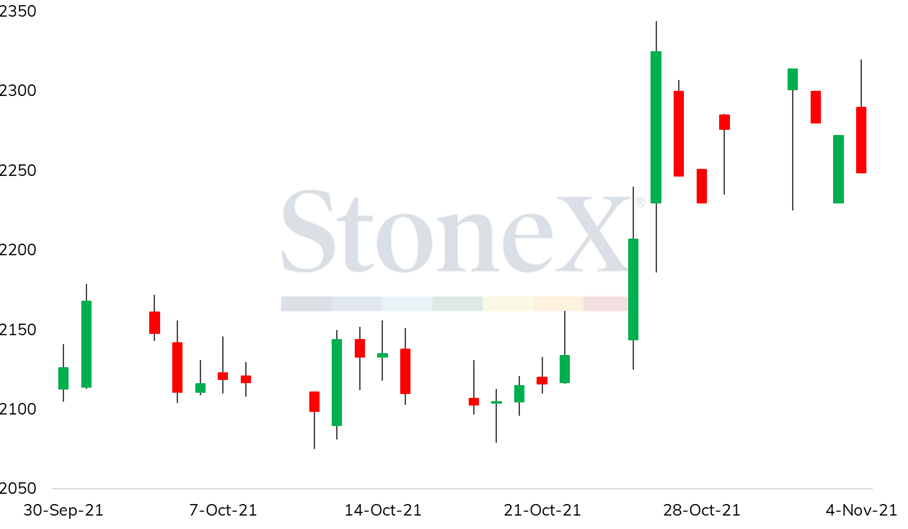
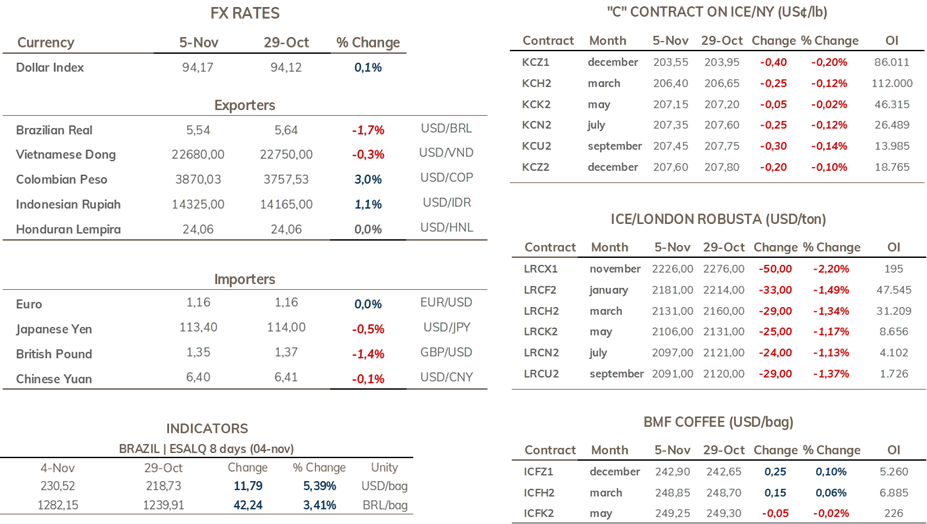
The most active Robusta January contract settled lower last week, losing 1.5% to close at $2,181/t. This followed an initial move higher with the contract pushing close to the contract highs made in the week prior, although it was unable to hold ground at these levels amid technical resistance at this contract high as well as weak upside momentum in the Arabica contract. January comes into this week hovering around its 50% support band at $2,181/t on the one-month retracement study, trending around the mid-way point of the RSI study (14-day) and the Bollinger band study, demonstrating technical neutrality moving into this week.
From a fundamental perspective the ongoing rise of COVID-19 cases in Vietnam poses a potential threat to the progress of the harvest there, with cases now being reported in the coffee belt. Indeed, some reports indicate a shortage of pickers in some areas, which could provide further delays in beans arriving to the farm gate following a wet month in October. New beans are expected to begin arriving in volume in the second half of this month, although the delays provided by a lack of pickers and the potential imposition of restrictions could extend that time frame even further. From a supply standpoint it seems that while coffee supplies are tight coming out of the end of the last marketing season, the difficulties in actually getting shipments out of Vietnam is where the real bottleneck is found. Nonetheless, delays in harvesting the cherries from the trees has implications for the quality of the beans, while also leaving more to chance in terms of exposure to adverse weather for example.
Source: Bloomberg. Design: StoneX.
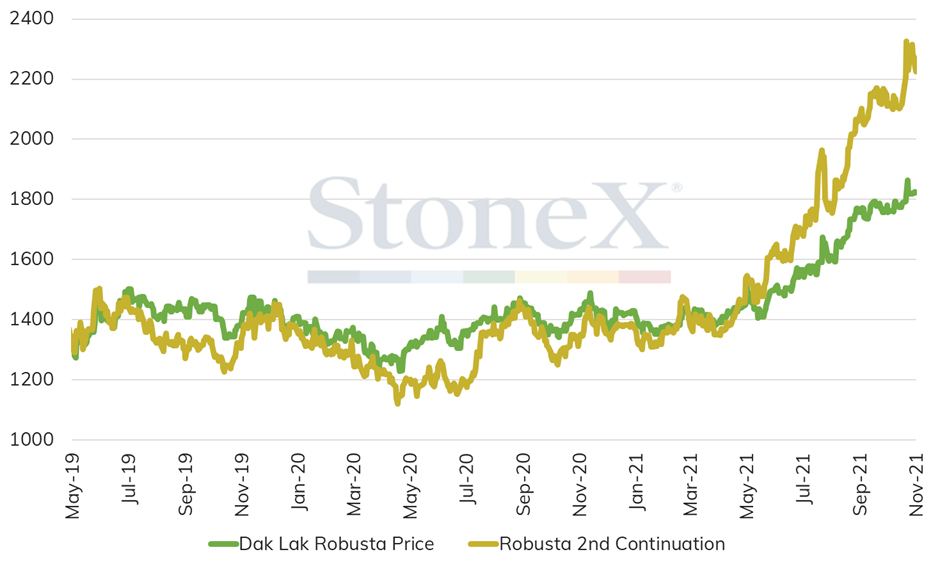
Domestic prices in Vietnam are hovering around $1,830/t as we move into this week, a gain of around $4/t W/W as of Friday’s settlement, marking a narrowing of the discount against the front month London contract. The discount narrowed by $54/t W/W which can be attributed to the $50/t decline in the November contract as we moved into the notice period. The comparative gains made in the domestic market reflect rising demand for new crop amid the delays to the start of the harvest, while growing concerns surrounding rising COVID cases may also be prompting some fresh demand in anticipation of potential logistical disruption.
Grade 4 Indonesian Robusta was offered at a near $380/t discount to the January contract last week, narrowing the discount against London last week from $400/t on the previous Friday. This is once again due to the downward momentum in the futures market rather than a drastic change in the domestic price. Sumatran Robusta exports were reported at 12,349.6t for October last week, declining by 51.5% Y/Y.
Robusta 1st Continuation vs Dak Lak Price
Source: Giacaphe, Bloomberg. Design: StoneX.
The Central Highlands is set for progressively heavier rainfall in the week ahead with a potential 55mm+ expected to fall on Saturday under the current GFS model, with up to 36mm on Saturday. This situation should be monitored as further heavy rains moving on from last month could provide further delays to the harvesting of the crop at a time when there are already fewer than normal workers, while also potentially impacting the quality of the crop.