StoneX logo

Coffee Weekly Report

By: StoneX Intelligence Brazil, StoneX Intelligence Brazil

Coffee prices have reached their highest level since 2014
 
Fernando Maximiliano
Leonardo Rossetti
William Rutherford-Roberts
Alexis Rubinstein
Estimates for Brazil's 2022/23 crop, the USD drop in the Brazilian market, and technical factors were behind the strong upward movement
HIGHLIGHTS

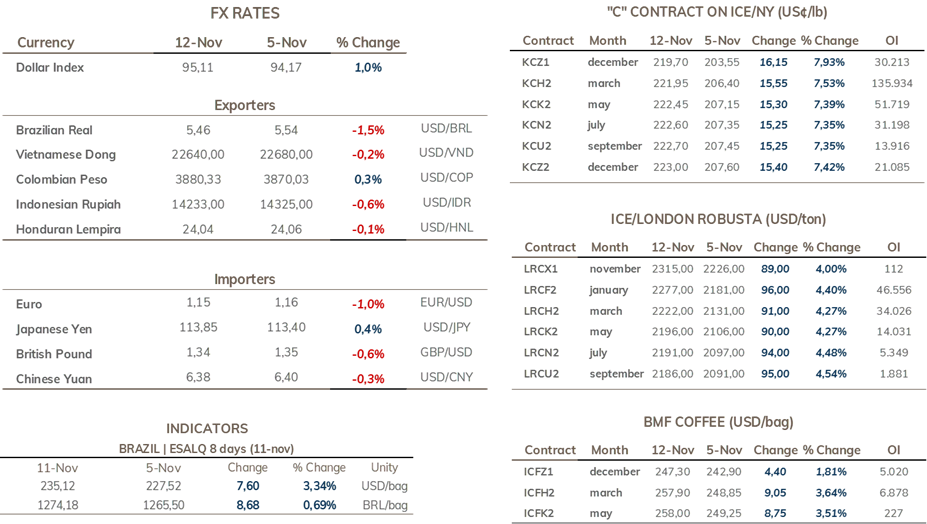
•    Arabica coffee prices advance 1555 points (7.5%) in NY, and the Cepea indicator advances BRL 53.5 (3.3%) to BRL 1307.85/bag, a historical high.
•    Robusta increases USD 96 (4.4%) in London and BRL 20.82/bag (2.6%) in Brazil to BRL 802.1/bag.
•    First estimates for 2022/23 crop consolidate feeling of crop losses
•    StoneX team begins the first stage of its crop tour for official estimates
•    NOAA indicates a high probability of moderate La Niña through March 2022
•    Concerns about the impact of rainfall on ongoing harvest in producing countries persist
•    Brazilian exports of green coffee dropped by 25.2% in October Logistics continues as the main factor for the fall of exports in Brazil
•    Port congestion continues to contribute to a drop in certified stocks
•    Lack of workers hampers the harvest process in Vietnam
•    USDBRL retreats amid expectations of further monetary tightening
•    Inflation advance in Brazil and increases bets on firmer Central Bank stance

   Bearish factors       Bullish factors


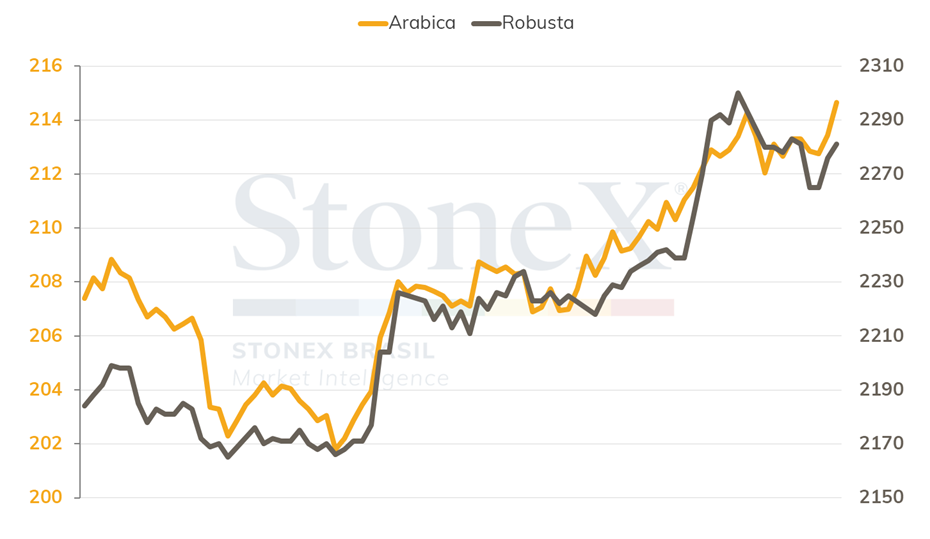
Coffee prices advanced significantly in the last week on the main exchanges. A combination of fundamentals, such as the concern with the short-term global supply of the bean and the next Brazilian crop, movements in the foreign exchange market and technical factors, with the approaching expiration of options, promoted a strong upward momentum in coffee prices. Thus, the most active contract of Arabica coffee in New York (March/22) showed a weekly appreciation of 1555 points (7.5%) to end Friday (12) quoted at US₵ 219.7/lb, its largest weekly gain since July and its highest level in more than seven years.

The gains were seen mainly in the last two sessions, when the arabica registered an increase of 660 points on Thursday (11) and 865 points on Friday, after the release of the first estimates for Brazilian production in 2022/23, which pointed to lower production than the last positive biennial crop cycle (2020/21). 

The Brazilian currency appreciation of 1.6% in the week also inhibited marketing in the country, giving support to bullish movements on the stock exchange. 
In Brazil, the CEPEA indicator for Arabica coffee showed an increase of 3.3%, about BRL 53.5/bag to close Friday (12), quoted at BRL 1307.85/bag, a historical high for the index.

WEEKLY INTRADAY (MOST ACTIVE CONTRACT) - Nov 08 to 12
image 21903
Source: Commodity Network Trader’s Pro. Design: StoneX.

Rabobank projected a Brazilian production of 63.5 million bags in 2022/23 last week, which represents a drop of 11.8% compared to the bank's estimates for 2020/21. However, it points out that it still considers a high degree of uncertainty about production. A private estimate showed that it is betting on a Brazilian Arabica coffee production of 40 million bags, representing a 20% decrease in the same comparison. The IBGE, on the other hand, considered that it is still too early for the Institute to make precise estimates.

In this sense, the estimates contribute to consolidating the market's feeling that, although it is still too early to quantify precisely how damaged the next Arabica coffee crop cycle will be in Brazil, it should not exceed or equal the historical production record in 2020/21. Although the rainfall return has provided for the flowering and an easing of the water deficit in the soil, the damage caused by frost, which may have affected the production potential from 2 million to 10 million bags, and the vegetative growth damaged by drought, have created irreversible damage in some areas. Furthermore, it will still be necessary to ascertain in what proportions the fruit set was successful after flowering, which may have suffered some difficulty in certain regions. Thus, taking into account the consensus that the possibility of a repeat of the record production should only be for the 2024/25 season, the signs that global demand has recovered and should grow steadily, and the logistical constraints limiting short-term coffee supplies, the fundamentals remain predominantly bullish for coffee prices.

StoneX Brazil coffee team has begun conducting field studies to produce a report with StoneX's official estimates for 2022/23 Brazilian production to ascertain more precisely what can be expected for next year's crop. At this first moment, the team is visiting the main Robusta producing regions, which are already in a more advanced development period, traveling through the states of Rondônia, northern Espírito Santo and southern Bahia.

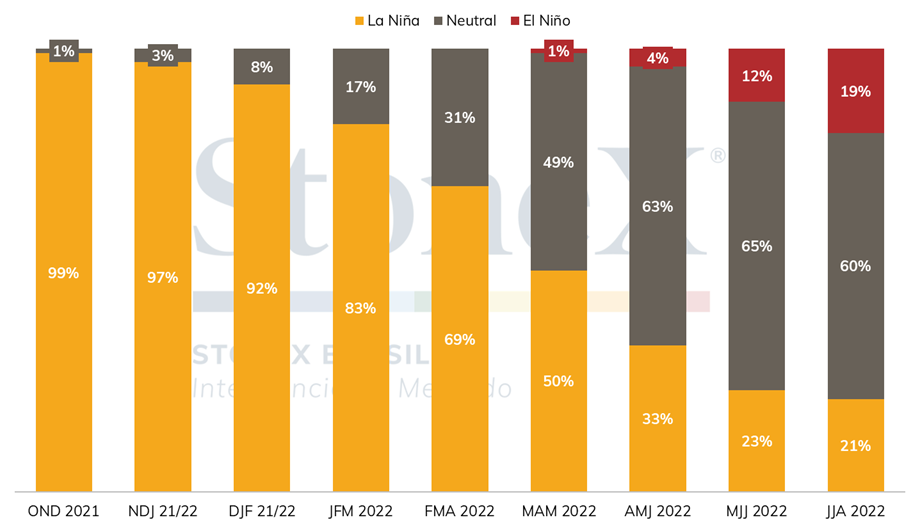
The latest update from the US National Oceanic and Atmospheric Administration (NOAA) also raises the dose of concern about other important producers. According to the report, there is an over 80% chance that the La Niña weather phenomenon will persist until March next year. The chances that the temperature variation index will remain below -1.0ºC between November and January are 66%, which is considered a moderate La Niña, with a 14% chance that the index will be below -1.5ºC, which would be considered of strong intensity. It is worth remembering that the La Niña is associated with above-average rainfall in Colombia, Central America, and Vietnam, regions currently in their harvest period.

PROBABILITY OF EL NINO/LA NInA OCCURRENCE (BY QUARTER)
image 21904
Source: NOAA. Design: StoneX.                                                                                       

As we highlighted in the last weekly report, due to heavy rains during this period for the second consecutive year, the National Federation of Coffee Growers (FNC) has reduced its estimates for Colombian production in 2021 from 14 million bags to somewhere between 13 and 13.5 million bags. Accordingly, the country's production could fall below around 14 million bags for the first time after a 6-year sequence at this level. The risks that excessive rainfall could also affect the production of important Central American countries should continue to be monitored by the market in the coming weeks. Negative impacts could occur through the obstruction of logistic routes, a drop in the quality of the grain or the productivity of crops since these have varieties of plants that are less resistant to fungal diseases caused by high levels of moisture compared to those grown in Colombia.

This week, besides the release of the stocks at US ports by the Green Coffee Association (GCA), which should give new signals regarding the country's demand, agents should continue to monitor the weather and coffee development in Brazil, the evolution of the global logistics situation and harvest in other countries.

Brazilian exports of green coffee dropped by 25.2% in October

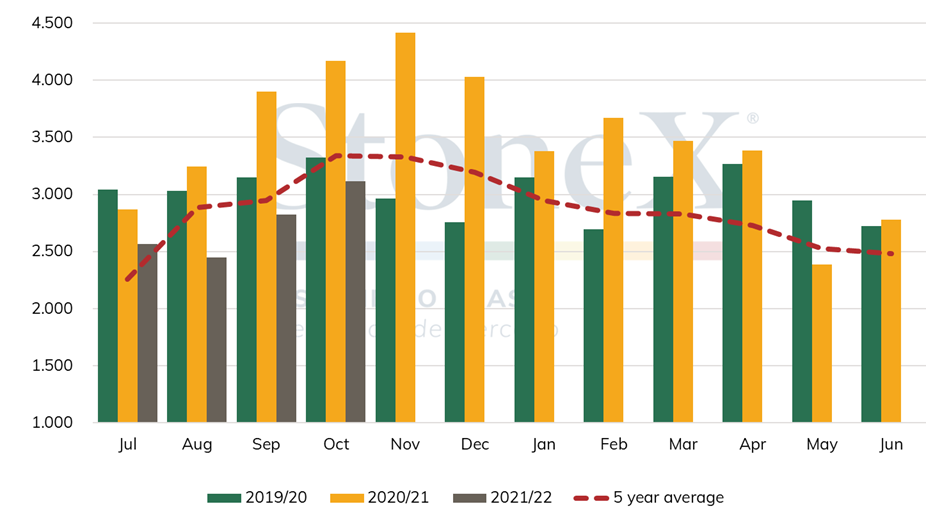
Cecafé released last week its monthly export report for October, indicating that total Brazilian exports reached 3.431 million bags, a drop of 23.8% compared to the 4.504 million bags shipped in the same month last year. Shipments of green coffee totaled 3.117 million bags, a drop of 25.2%, with Arabica coffee shipments totaling 2.883 million bags, down by 22% compared to 3.698 million bags in 2020, and Robusta coffee totaling 233 thousand bags, down by 50.4% compared to 470 thousand bags in the same month last year.

BRAZIL'S MONTHLY GREEN COFFEE EXPORTS BY CROP YEAR (THOUSAND BAGS)
image 21905
Source: Cecafé. Design: StoneX.

The logistic bottlenecks continued to be the main factor for the significant retraction in exports. According to Cecafé's president, Nicolas Rueda, "The drop in export volume reflects the continuity of the well-known logistic bottlenecks in world maritime trade. The scenario is worrying because industry experts, with whom we met at various national and international events, point out that these obstacles should drag on through 2022 due to the large volume of Brazilian agricultural products accumulated at the ports and crops that are shipped from the second semester on." 

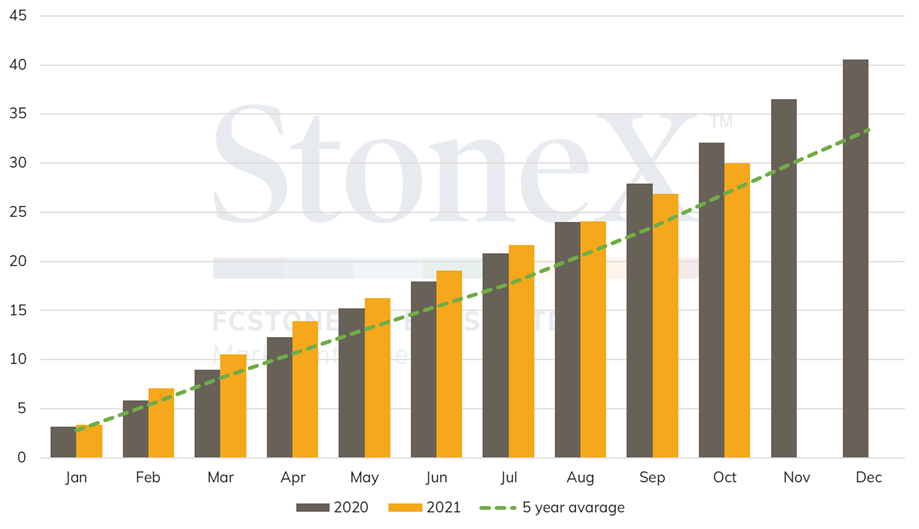
One can see that despite the lower volumes, the foreign exchange revenues continue to follow at higher levels, considering both the higher price levels for revenues in USD and the currency devaluation, in the case of BRL, which show even wider differences. While 32.1 million bags of green coffee were exported from January to October 2020, compared to 30.02 million bags in the same period in 2021, foreign exchange revenues in the current year surpass last year in both modalities. Considering revenues in USD, 2021 accumulates about USD 4.8 billion, 7.0% above last year's USD 4.5 billion, mainly due to the change in average prices from US₵ 167.53/lb to US₵ 191.43/lb.  The foreign exchange revenues in local currency have even more attractive values to exporters, advancing from BRL 23.1 billion to BRL 25.7 billion, an increase of 11.6%.  

GREEN COFFEE EXPORTS FROM BRAZIL YEAR-TO-DATE (MILLION BAGS)
image 21906
Source: Cecafé. Design: StoneX.

Thus, the average return per bag sold from January to October advanced from BRL 719.39/bag to BRL 858.31/bag. Considering the significantly higher price levels, especially since mid-July, after the frosts occurred in Brazil, this difference should widen even more in the next two months' reports.

Port Congestion Continues to Impact Global Trade, Logistical Concerns Send Arabica Stockpiles Dwindling

CoffeeNetwork (New York) – Global trade, and the international coffee sector, continue to be impacted by logistical issues including shipping container shortages and transport delays.

Issues have been seen from the United State’s West Coast to China and Europe. Aside from delays caused by COVID-19 related restrictions and container shortages, the backlog was worsened in China after Typhoon In-Fa hit eastern China in July, restricting access to major ports such as Shanghai and Ningbo.

In Europe, in the port of Felixstowe, which concentrates 40% of containerized imports in the United Kingdom, shipping containers are said to be stacking up after congestion and a shortage of lorry drivers force shipping companies to store empty containers in a field nearby.

Protests in Italy and Greece closed port operations temporarily and ongoing civil unrest in Ethiopia have halted all trade within the country.

Danish research and analysis company Sea-Intelligence has conducted an investigation to examine how bottlenecks in the maritime supply system have impacted vessel delays. The longest delays were seen from Asia to the West Coast of the US and Asia to the East Coast of the US.

Last week, Brazil’s Coffee Exporters Association, CeCafe, revealed that 3.7 million bags of coffee are delayed for export due to the ongoing logistical challenges.

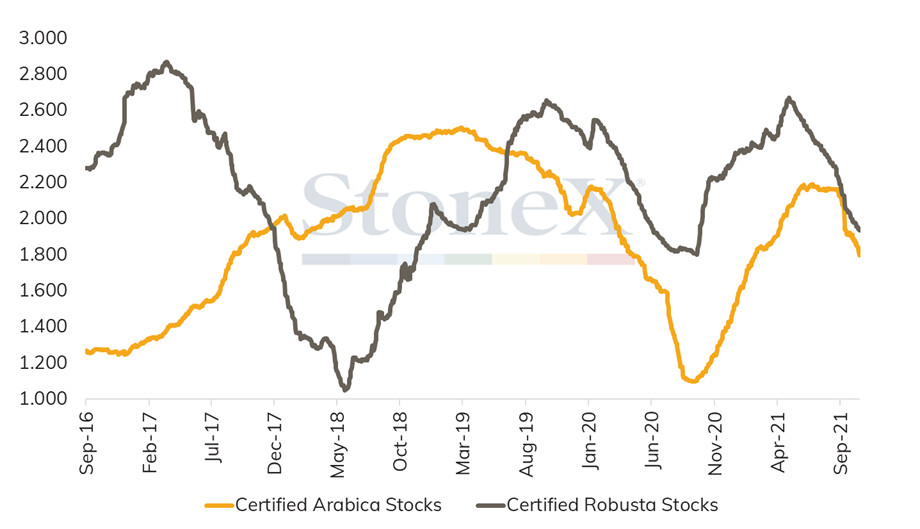
Increasing concerns surrounding the transport of coffee, coupled with the expectation of a shift to a supply deficit led to a pickup in industry buying a dwindling of stocks. While inventories touched their lowest level since April earlier this month, overall, stocks have risen 26% since the start of the 2021 calendar year.

The latest data showed certified stocks were at 1,798,415 bags as of November 11th, compared to the 1,427,057 bags registered on January 4th, the first official trading day of 2021.

Stocks from Honduras fell 8.3% in the period from 830,774 to 762,056 bags, whereas Brazilian certified stocks surged 143.4% from 381,746 bags to 929,299 bags.

ROBUSTA COFFEE PRICES surge during THE WEEK

A strong week for the most active Robusta contract which gained 4.4% W/W as of Friday’s close. Upside carries across from the Arabica complex last week, which pushed to the highest levels since mid-2014 last week, driven by the increasing levels of concern surrounding supply tightness on the global scale alongside fresh estimates from Bloomberg on next year’s crop potential in Brazil. Brazil’s Arabica production was estimated between 33.7-38.7M bags for 2022/23, according to Bloomberg reports driven by the ongoing impacts of dryness in the past year, the severe frost events and rising risk of fungal disease due to recent moisture levels. The Robusta complex by comparison did not perform as well as Arabica, which gained approximately 7.9% last week. The drawdown in the Arabica certified stockpile was also significant last week with over 53,000 bags withdrawn last year. By comparison the Robusta certified stockpile recorded a withdrawal of 18,500 bags. Nonetheless, despite the smaller W/W gains in Robusta, the second continuation touched reached its strongest level since 2nd January 2017, reflecting the wider strength of the bullish sentiment that surrounds the coffee complex currently.

 CERTIFIED ARABICA AND ROBUSTA STOCKS
image 21907
Source: ICE. Design: StoneX.

From a fundamental standpoint, while lockdown restrictions in Vietnam are reported to have eased, there remains difficulty in securing seasonal workers for the harvest, while logistical disruption remains as well. Furthermore, rains continue to cause harvest delays which is likely to aggravate concerns surrounding crop quality. The harvest was already behind schedule due to excessive rainfall during October. Rains remain present in the Highlands this week, although volumes are forecast to be limited.

Vietnamese customs published export data for October last week, with 99,249t shipped last month (1,654,150 bags). Despite ongoing logistical issues this represents an increase of 8.6% Y/Y, a likely reflection of the larger volumes being stored in Vietnam as a result of container issues. Fresh supply from the new harvest (which is expected to be around 6.9% larger Y/Y) is also likely to have contributed to the increased volumes shipped Y/Y. On a month on month basis shipments fell by 1.1%.

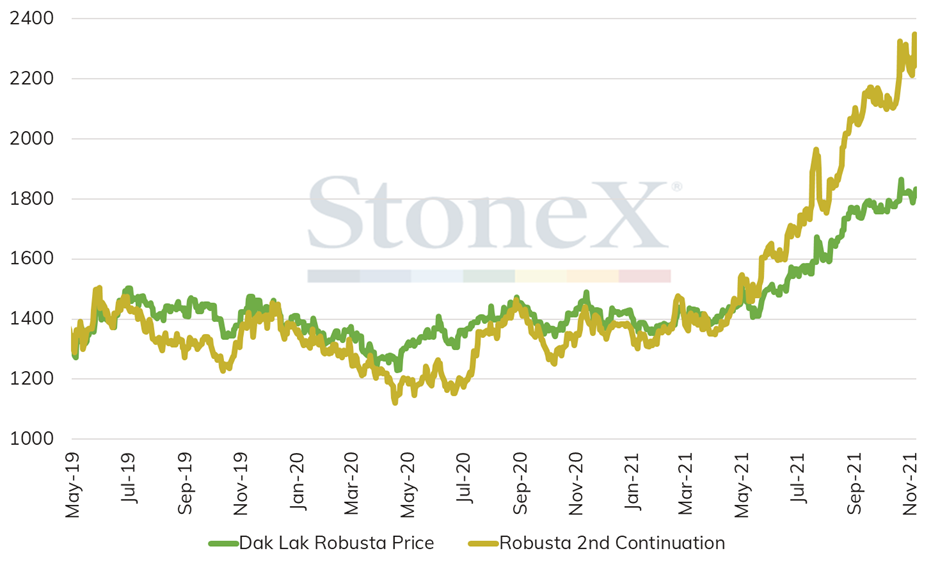
Domestic prices in Dak Lak rose by 1.2% W/W as of Friday to $1,832/t. This represents a widening of the discount against London futures (basis 2nd continuation) to $444/t

Robusta 1st Continuation vs Dak Lak Price
image 21908
Source: Giacaphe, Bloomberg. Design: StoneX.

USDBRL plunges, reflecting expectations of further monetary contraction


Contributing to the strength of the rally in coffee prices last week, the USDBRL posted a drop of 1.2% in the Brazilian exchange market last week, closing at BRL 5.457. Among the main factors, the higher than expected inflation result in October and the approval of the proposed constitutional amendment (PEC) of judiciary bonds contributed to strengthening the Brazilian currency.

According to the IBGE, the National Broad Consumer Price Index (IPCA) for October was 1.25%, the highest figure for the month since 2002 and significantly above analysts' expectations, expecting 1.0%. Thus, the IPCA reaches a high of +8.24% year-to-date, with the accumulated figure for the last 12 months reaching 10.67%. Among the main increases were Transportation (+2.62%), Clothing (+1.80%), Household items (+1.27%), Food and beverages (1.17%), and Housing (1.04%) groups. In addition, the price of ground coffee increased by 4.57%, reaching 29.9% year-to-date.

The result, significantly higher than expected by the market, raises the alarm about the risks of inflation persisting above the target also in 2022, as well as raising doubts concerning the capacity of the Central Bank of Brazil to control the acceleration of prices, which has led to adjustments in investors' expectations.
In this sense, several institutions raised last week their expectations for 12-month accumulated inflation in 2021, with part of the projections starting to signal an IPCA of around 10.0% by the end of December. Thus, bets are also growing that the Monetary Policy Committee (Copom) will adopt a more contractionary stance at its December meeting to try and combat the inflationary process. Although the committee has signaled that it foresees a 1.5 p.p. readjustment in the basic interest rate (Selic) in its next meeting in December, some analysts believe in an even higher increase, of 1.75 p.p. or even 2 p.p.

A greater increase in the differential between the basic interest rates in Brazil and the United States makes investments in assets denominated in BRL more attractive, which favors the inflow of foreign currency into the country. On the other hand, an even greater tightening of monetary policy increases the cost of credit and discourages investment, inhibiting the economy's capacity for growth. The change in market expectations should be more clearly established through the next Central Bank's Focus Bulletin, to be released next Tuesday (16).

It is also worth mentioning the approval of judiciary bonds in the Chamber of Deputies last Tuesday (9), which will open a BRL 91.6 billion space in the 2022 Budget, allowing the government to temporarily increase the Auxílio Brasil basic income transfer program from BRL 191 to BRL 400/month until the end of 2022, an election year. Despite fears about the fiscal risks of the PEC, which was one of the main reasons for the dollar's highs seen between September and the beginning of November, agents reacted with some optimism to the proposal's approval. In general, investors interpreted that if the PEC was not approved in an orderly manner, the Executive could perform maneuvers more damaging to public accounts to increase spending next year. The proposal will now be sent to the Senate for voting, the House in which the government faces more resistance to advance its agendas, a situation that the market should closely monitor in the coming weeks.

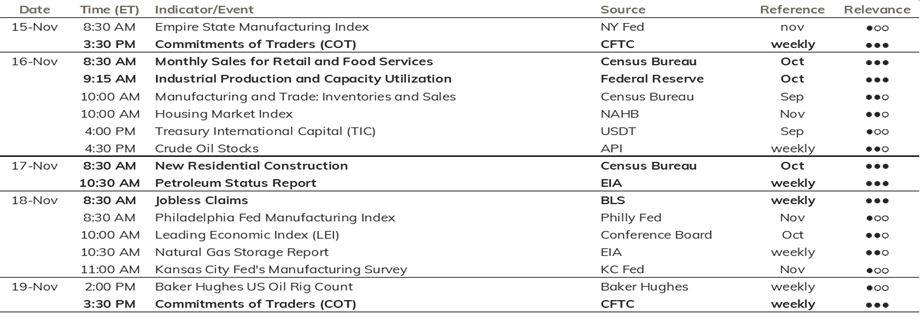
ECONOMIC AGENDA
BRAzIL
image 21909
UNITED STATES
image 21910
 
ECONOMIC INDICATORS
image 21911
Sources: ICE/NY, ICE/EU, B3, Commodity Network Trader’s Pro.
 
 
  • Coffee

The StoneX Group Inc. group of companies provides financial services worldwide through its subsidiaries, including physical commodities, securities, exchange-traded and over-the-counter derivatives, risk management, global payments and foreign exchange products in accordance with applicable law in the jurisdictions where services are provided. References to over-the-counter (“OTC”) products or swaps are made on behalf of StoneX Markets LLC (“SXM”), a member of the National Futures Association (“NFA”) and provisionally registered with the U.S. Commodity Futures Trading Commission (“CFTC”) as a swap dealer. SXM’s products are designed only for individuals or firms who qualify under CFTC rules as an ‘Eligible Contract Participant’ (“ECP”) and who have been accepted as customers of SXM. StoneX Financial Inc. (“SFI”) is a member of FINRA/NFA/SIPC and registered with the MSRB. SFI is registered with the U.S. Securities and Exchange Commission (“SEC”) as a Broker-Dealer and with the CFTC as a Futures Commission Merchant and Commodity Trading Adviser. References to securities trading are made on behalf of the BD Division of SFI and are intended only for an audience of institutional clients as defined by FINRA Rule 4512(c). References to exchange-traded futures and options are made on behalf of the FCM Division of SFI . StoneX is a trading name of StoneX Financial Ltd (“SFL”). SFL is registered in England and Wales, Company No. 5616586. SFL is authorized and regulated by the Financial Conduct Authority [FRN 446717] to provide to professional and eligible customers including: arrangement, execution and, where required, clearing derivative transactions in exchange traded futures and options. SFL is also authorised to engage in the arrangement and execution of transactions in certain OTC products, certain securities trading, precious metals trading and payment services to eligible customers. SFL is authorised & regulated by the Financial Conduct Authority under the Payment Services Regulations 2017 for the provision of payment services. SFL is a category 1 ring-dealing member of the London Metal Exchange. In addition SFL also engages in other physically delivered commodities business and other general business activities which are unregulated and not required to be authorised by the Financial Conduct Authority. StoneX Group Inc. acts as agent for SFL in New York with respect to its payments services business. StoneX APAC Pte. Ltd. acts as agent for SFL in Singapore with respect to its payments services business. ‘StoneX’ is the trade name used by StoneX Group Inc. and all its associated entities and subsidiaries.
 
Trading swaps and over-the-counter derivatives, exchange-traded derivatives and options and securities involves substantial risk and is not suitable for all investors. Past performance of any futures or option is not indicative of future success. Indicators are not a trading system and are not published as a specific trade recommendation. The information herein is not a recommendation to trade nor investment research or an offer to buy or sell any derivative or security. It does not take into account your particular investment objectives, financial situation or needs and does not create a binding obligation on any of the StoneX group of companies to enter into any transaction with you. You are advised to perform an independent investigation of any transaction to determine whether any transaction is suitable for you. No part of this material may be copied, photocopied or duplicated in any form by any means or redistributed without the prior written consent of StoneX Group Inc.
 
© 2026 StoneX Group Inc. All Rights Reserved.

Satellite view of Earth at night showing illuminated cities across Asia and the Middle East

Discover more insights

Our subscribers have access to comprehensive market analysis from StoneX spanning commodities, equities, currencies and more.

StoneX: We open markets

Our market expertise, advanced platforms, global reach, culture of full transparency and commitment to our clients’ success all set us apart in the financial marketplace.

Reach

With access to 40+ derivatives exchanges, 180+ foreign exchange markets, nearly every global securities marketplace and numerous bi-lateral liquidity venues, StoneX’s digital network and deep relationships can take clients anywhere they want to go.

Transparency

As a publicly traded company meeting the highest standards of regulatory compliance in the markets we serve, our financials and record of accomplishment are matters of public record. StoneX’s commitment to “doing the right thing over the easy thing” sets us apart in the industry and helps us build respect, client trust and new partnerships.

Expertise

From our proprietary Market Intelligence platform, to “boots on the ground” expertise from award-winning traders and professionals, we connect our clients directly to actionable insights they can use to make more informed decisions and achieve their goals in the global markets.