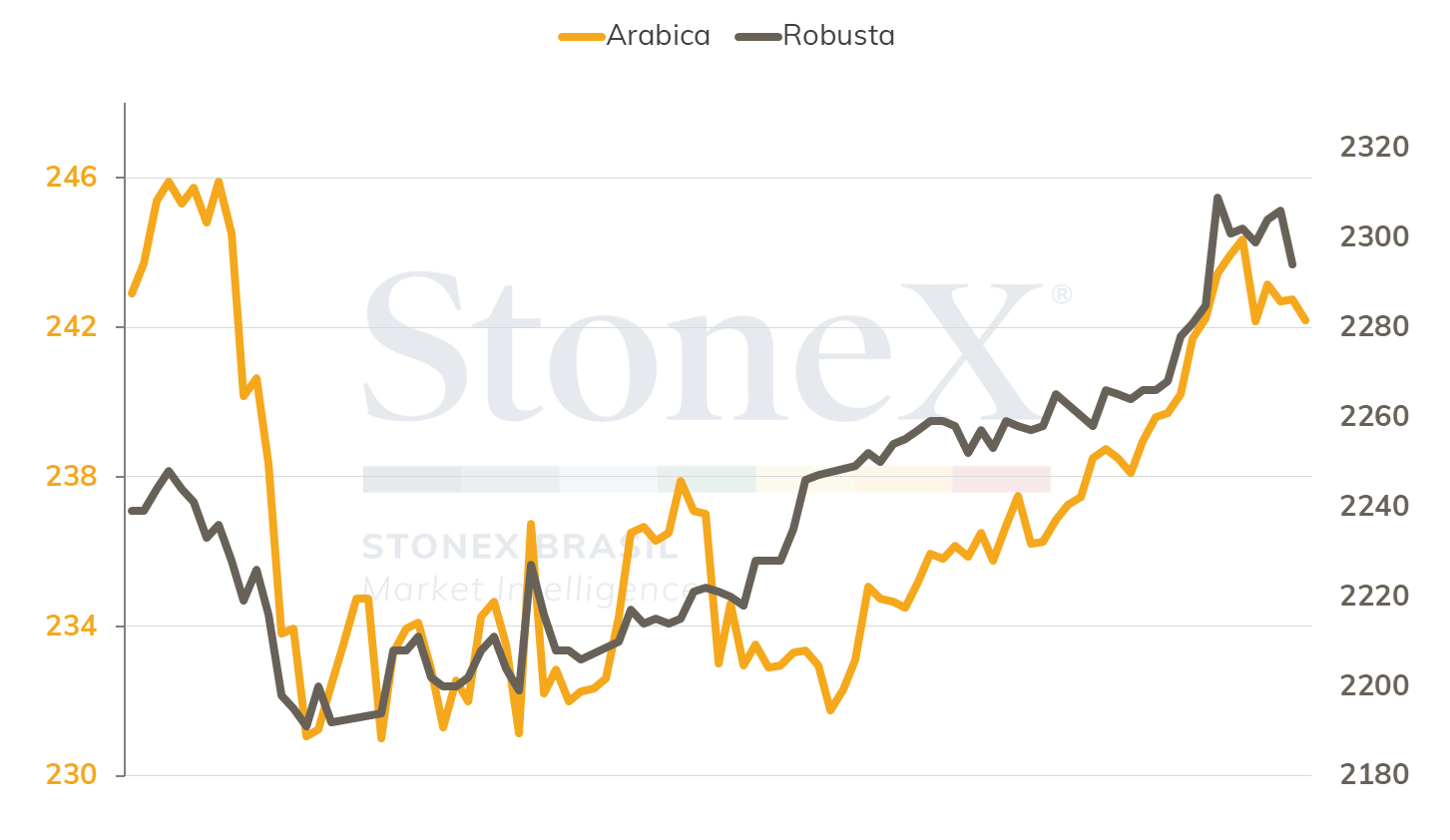
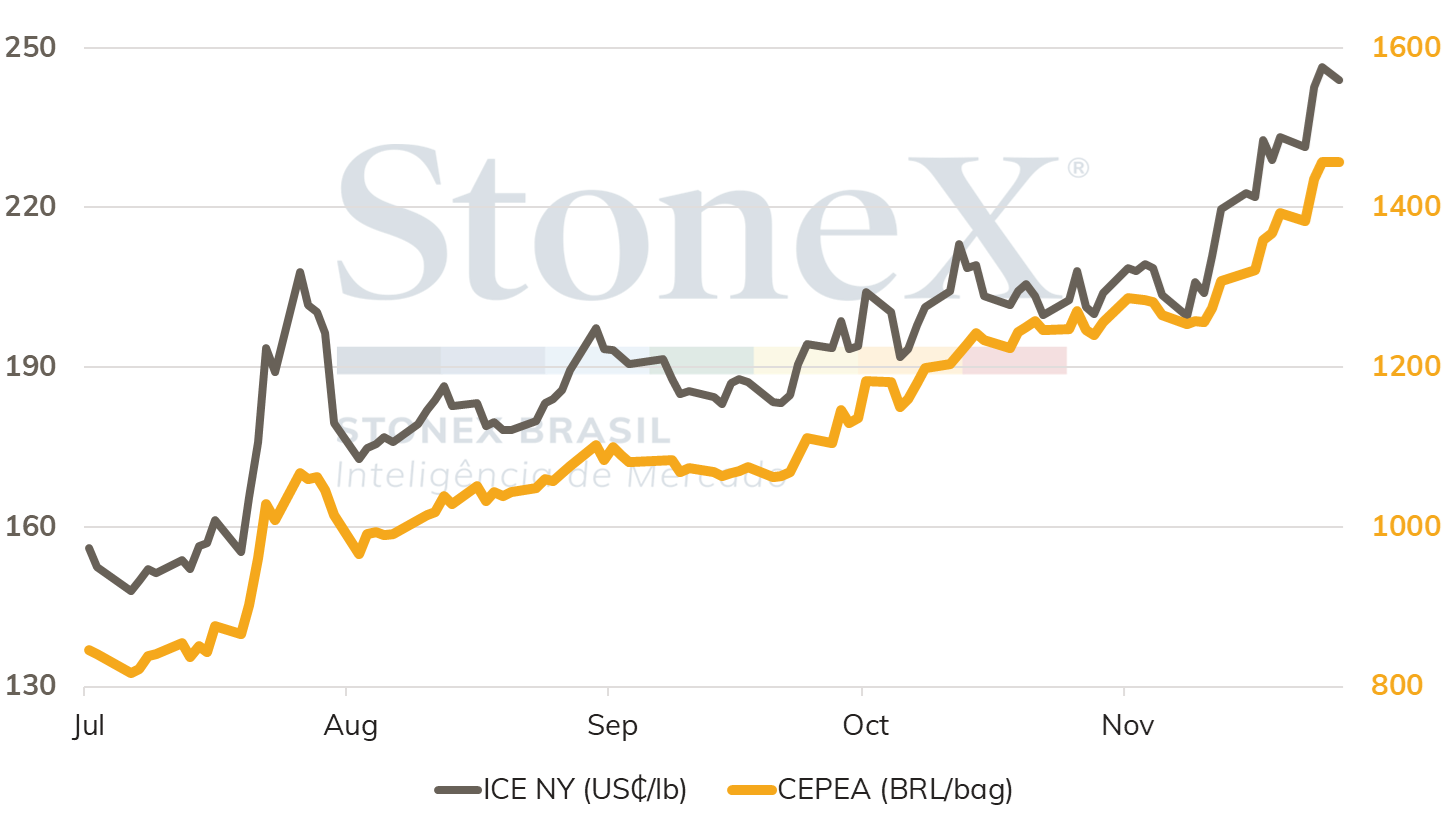
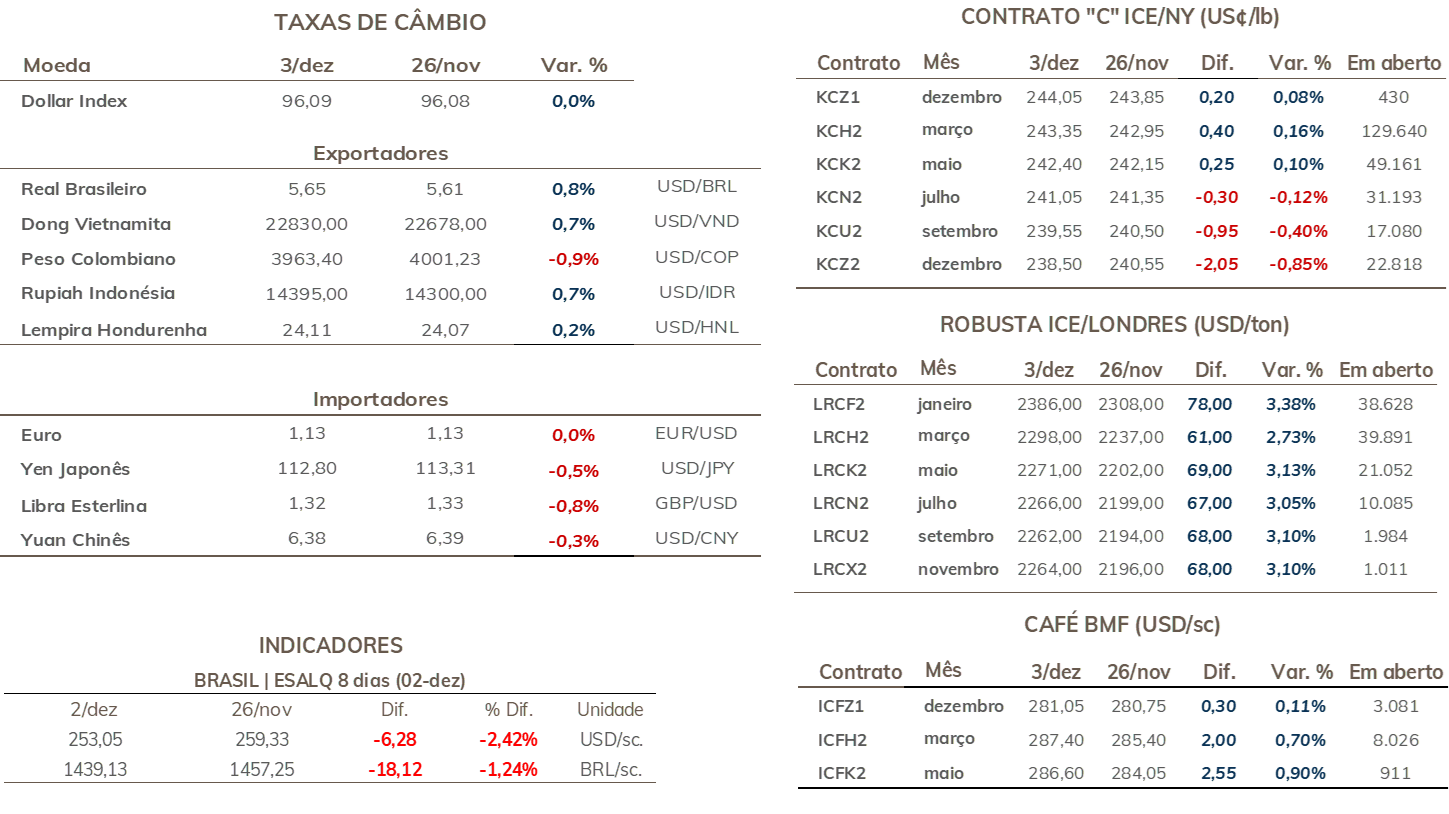
At the beginning of the week, the market showed a strong retreat, of more than a thousand points, between Friday (26) and Tuesday (30). After the discovery of the new Covid-19 variant, Omicron, there was a strong sell-off in coffee contracts, reflecting concerns about out-of-home consumption if social distancing measures were adopted again. However, some experts pointed out that the new variant may not be as severe throughout the week despite the uncertainties. Nevertheless, there are still many uncertainties regarding the new variant, so it should be monitored. After the cooling of concerns and the positive fundamental scenario, prices appreciated again in New York.
ARABICA COFFEE on the ICE NEW YORK VS. CEPEA INDICATOR
Source: CommodityNetwork Traders’ Pro. Design: StoneX.
During the week, Cooxupé released its new estimates for exports in 2021, which were reduced by almost 20%. This scenario shows the seriousness of the logistical problems faced by coffee exporters. Furthermore, sources connected to the sector indicate no expectation of normalization of this condition in the short term. In line with what was presented, preliminary export data, released by the Ministry of Development, Industry and Foreign Trade (MDIC), showed that Brazilian coffee exports fell by 36.5% in November – the official Brazilian export data will be released on December 10 by the Coffee Exporters Council (Cecafé).
Brazil has suffered from the lack of containers and the sharp rise in costs. Other countries like Colombia, Vietnam, Indonesia and several others have also suffered the impacts of the pandemic in global logistics. Recently the International Coffee Organization (ICO) reported that the world exported 9.68 million bags in October, representing a reduction of 4.4% compared to exports in the same month last year. In the recently published USDA Attaché reports, the agency reduced its exports estimates to major coffee-producing countries, with a 5.7% reduction in Brazilian exports to 33.22 million bags, 10.6% in Vietnamese exports to 25.8 million bags, and 10.3% in Indonesian exports to 6.95 million bags.
During the week, Rabobank changed its estimate for Brazilian production in 2022/23 and released its estimate for the global supply and demand balance for the next crop cycle. At the beginning of November, the bank had estimated Brazilian production at 63.5 million bags. However, in November, the organization increased its estimate for the Brazilian crop in 2022/23 by 3 million bags to 66.5 million bags. Accordingly, the organization sees world production at 177.1 million bags and consumption at 173.8 million bags, resulting in a surplus of 3.3 million in 2022/23.
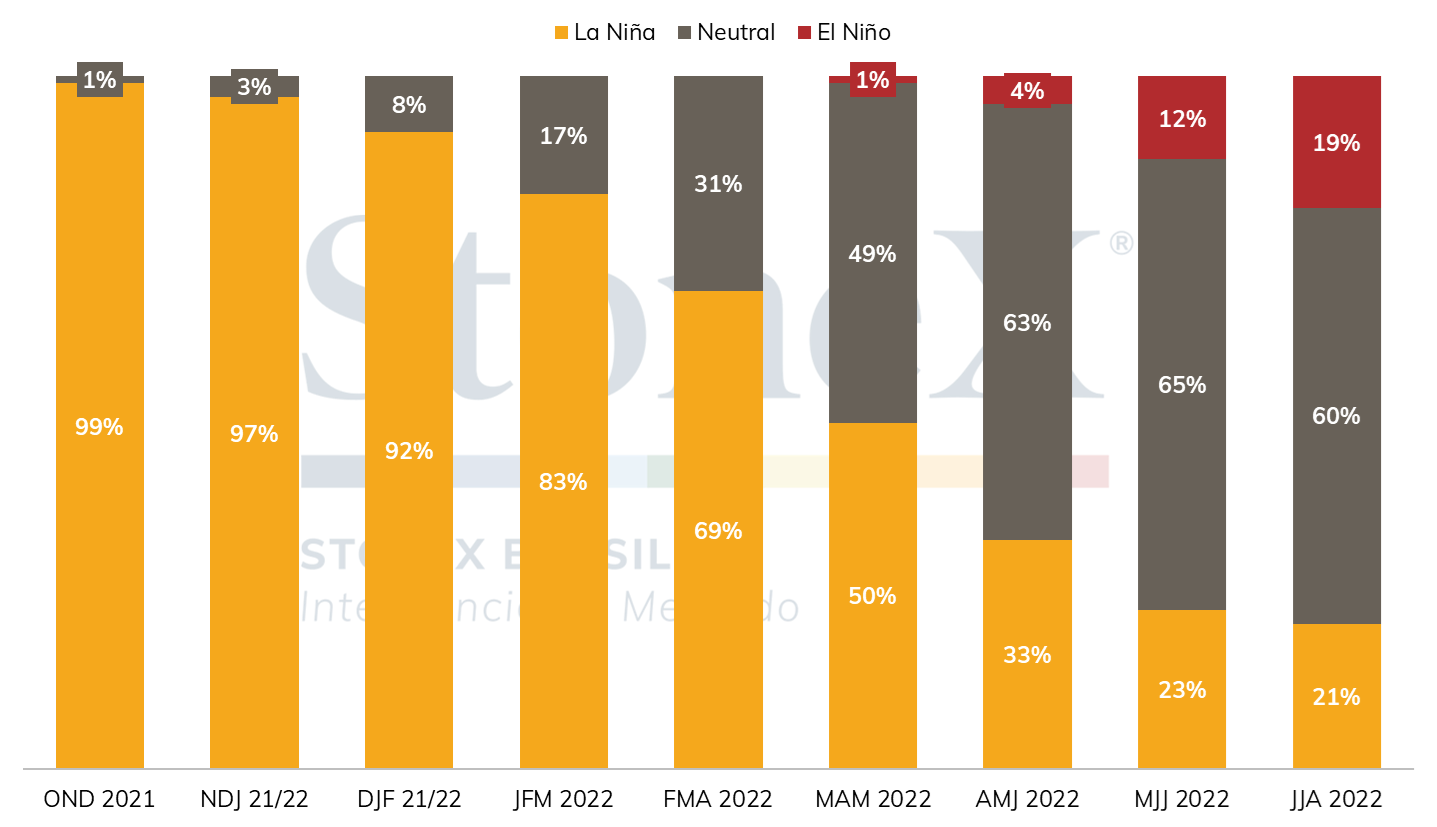
Regarding the weather, the latest available data indicate that the Pacific is expected to remain under the La Niña effect until March-April2022. This event has caused several problems linked to excess rainfall in Colombia, Central and Asia. In Brazil, the volume of rainfall observed in recent weeks has brought the accumulated rainfall for the last 60 days to within or above the historical average for the entire coffee belt, contributing to crops' development and recovery. For the next 15 days, accumulated volumes above 100 mm are expected for almost the entire production belt.
EL NIÑO/LA NIÑA PROBABILITY FORECAST (BY QUARTER)
Source: IRI/CPC. Design: StoneX.
Colombia Sees Rising Production Costs, Lower Yields
Last week, the Colombian Coffee Federation held the annual Colombia Coffee Growers Congress where they highlighted the struggle of the coffee farmer in today’s climate. The price of fertilizers in Colombia has increased 50% in 2021. Local prices of Colombian coffee (two bags of parchment coffee of 125kg) ended at COP2.136 million Colombian pesos ($551) on November 29. But production costs have risen from COP850,000 and COP900,000 last year to COP950,000-COP 1.050 million pesos.
The Colombian government is mulling launching a bailout to the most financially hurt coffee cooperatives hit by the default of delivery of coffee beans.
A working table has also been set up to understand the economic difficulties of coffee exporters, cooperatives. The working table will be comprised by the finance ministry, the Banco Agrario, The Agricultural Guarantee Fund, the cooperatives regulator SuperSolidaria, coffee exporters and the coffee growers federation. The government through the Legal Defense Agency will back up the cooperatives
that begin legal recovery against growers who unfulfilled with the delivery of beans in the futures market. In a lengthy process, the so-called “legal recovery” will allow cooperatives to take possession or liquidate the assets of the growers, who defaulted on coffee deliveries.
Many Colombian coffee cooperatives are on the risks of disappearing because Colombian coffee growers, who had committed to deliver beans in the futures’ market, have failed to deliver 50 million kilos of parchment coffee, or about 549,450 bags of 70-kg, according to Colombian economist Aurelio Suarez. In 2021-2022, more than 1 million bags of 60-kg will fail to be delivered, according to traders, analysts and market participants.
The growers committed to sell beans in the futures market at an average of 1 million and 1.2 million pesos per bag, but with coffee prices touching as high as COP2.1 million, many growers are unfulfilling with deliveries. The largest defaults are present in the provinces of Huila and Antioquia, Colombia’s first and second-largest coffee producing provinces respectively. They have failed to deliver 15 million kg of parchment coffee each.
The coffee growers´ federation has also launched a campaign that calls growers to meet with the delivery of beans. By 2021, domestic consumption of coffee in Colombia increased to 2.8 kg per capita & the incidence of coffee consumption increased from 86% in 2015 to 96% in 2021, that is, almost the population ceiling.
Vietnam’s Harvest Remains Focus of Robusta Market
Fundamental focus remains dominated by the progress of Vietnam’s ongoing coffee harvesting season. Reports of delays on heavier than average rainfall have circulated the media.
The Vietnam National Center for Hydro-Meteorological Forecasting (NCHMF) has warned of moderate to heavy rain of 2-4 cm (5-10 inches) of rainfall across Khanh Hoa, Ninh Thuan, and Binh Thuan provinces and the South Central Highlands region. The NCHMF has issued a level 1 warning of natural disaster risk due to heavy rain, tornadoes, lightning, and hail. Authorities have warned of a very high risk of flash flooding and landslides in the mountainous areas from Quang Nam to Ninh Thuan provinces and the Central Highlands region. Forecast models indicate that the heavy rainfall and thunderstorms are likely to continue through at least Dec. 9. Sustained heavy rainfall could trigger flooding in low-lying communities near rivers, streams, and creeks. Landslides are possible in hilly or mountainous areas, especially where the soil has become saturated by heavy rainfall.
Between January and November, natural disasters in Vietnam, such as typhoons, flash floods, whirlwinds and landslides have ravaged the country, adding further challenges to the coffee sector.
Disruptions to the coffee harvest would exacerbate the ongoing logistical challenges of port congestion, shipping delays and container shortages during a time when demand is on the rise.
The Institute of Policy and Strategy for Agriculture and Rural Development, Vietnam, has forecasted the country’s coffee exports to increase in the coming months due to an increased global demand. According to the Vietnam Coffee and Cocoa Association, coffee exports in November and December 2021 is expected to reach approximately 130,000 tons each month. If the current price can be maintained, it is expected to bring in US$600mn before the year ends and reach the annual coffee turnover threshold of US$3bn.
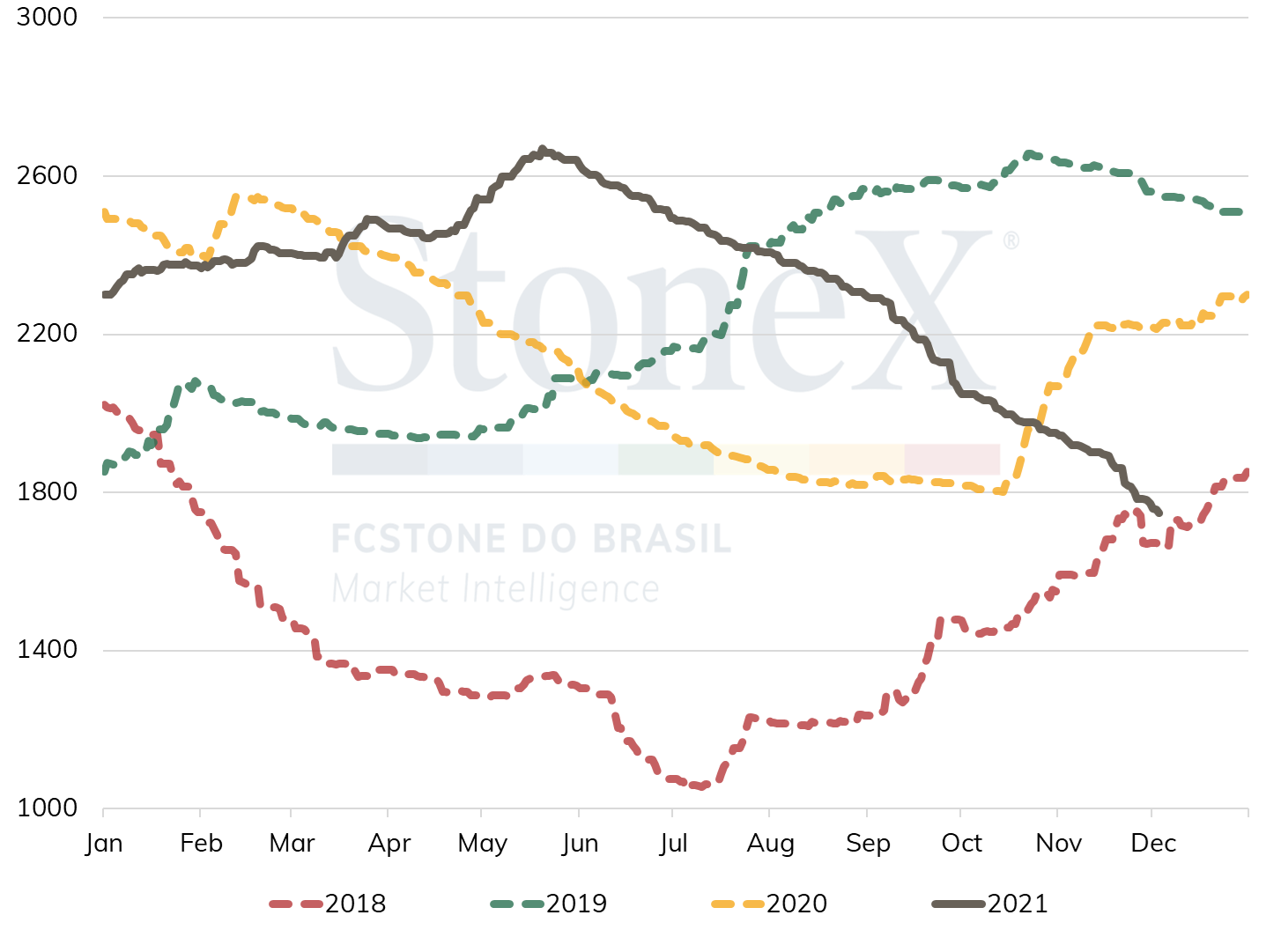
As a result of the growing demand, the latest data showed Robusta ICE stocks 1.747 million bags, as of Dec. 5, down from 1.920 million bags about a month ago.
ROBUSTA CERTIFIED STOCKS
Source: ICE. Design: StoneX.