

Daily Coffee Report 8/4/26
Daily coffee report

StoneX Coffee Team
- Coffee
By: StoneX Intelligence Brazil, StoneX Intelligence Brazil


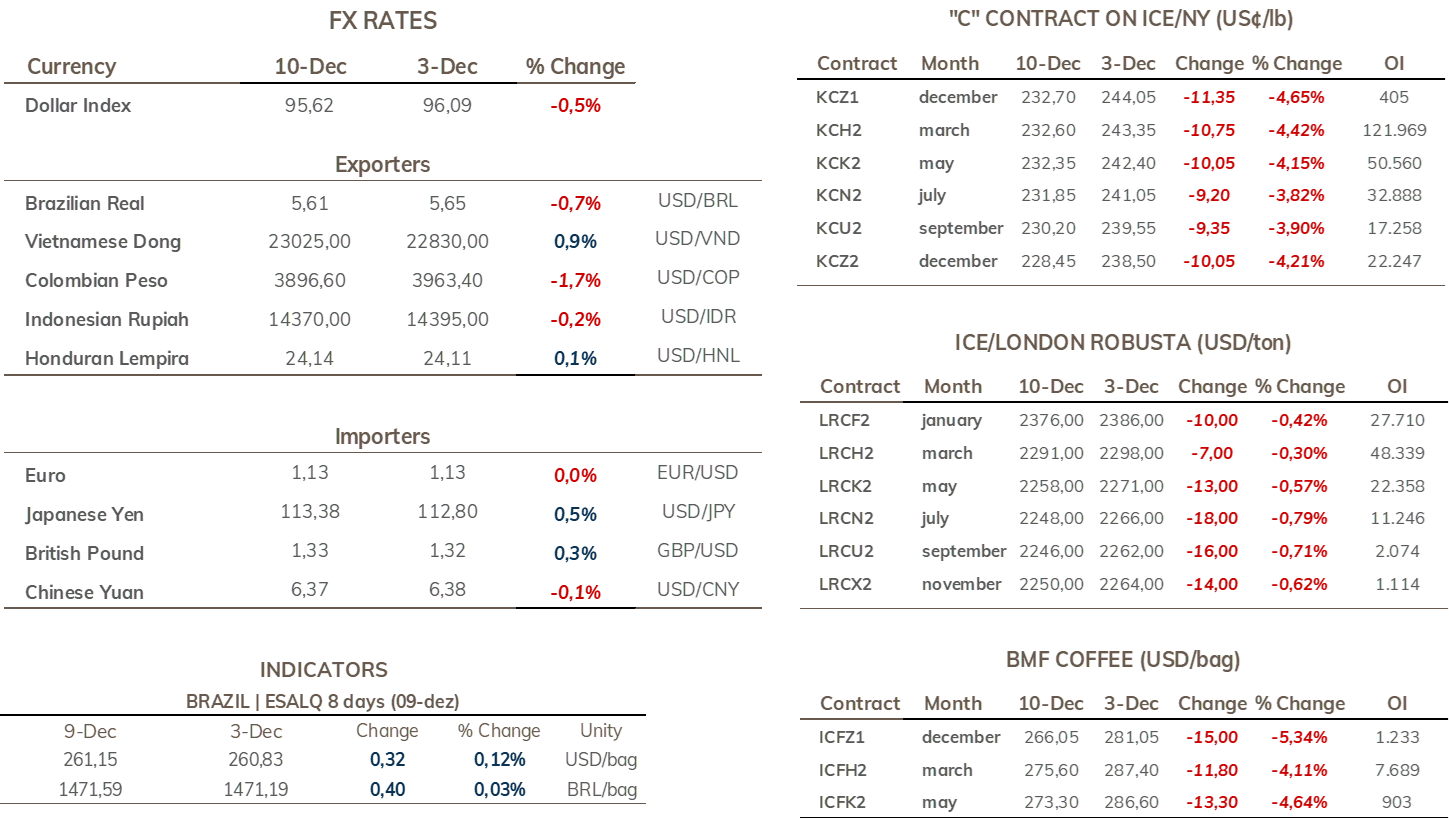
• Arabica coffee prices retreat 1075 points (4.4%) in NY, ending quoted at US₵ 232.60/lb. After a record high in the previous week, the Cepea indicator dropped by BRL 35.60 (2.4%) to BRL 1435.60/bag.
• After trading near 10-year highs, Robusta falls USD 7 (0.3%) to USD 2291/ton in London, with an advance of R$ 3.62/sc (0.43%) in Brazil to R$ 830.89/sc.
• After touching US₵ 250/lb earlier in the week, technical selling pressures quotes▼
• United States records strong rise in coffee imports in October ▲
• Market should follow the weather and GCA November stocks this week
• Brazilian exports dropped by 41.5% in November ▲
• Despite the drop in exports in the year, foreign exchange return advance
• Colombia turns to coffee imports amidst lower-than-expected production ▲
• Production in Colombia dropped by 22% last month as a result of torrential rains in producing regions ▲
• With increased consumption, Colombian coffee imports grow ▲
• Robusta coffee reaches nearly 10-year high in London
• Buyer pressure boosts London prices ▲
• Dollar retreats amid interest rate hike in Brazil▲
• FOMC decision and surge in Covid-19 cases may boost demand for dollar ▼
▼ Bearish factors ▲ Bullish factors
After renewing highs at the beginning of the week, coffee futures prices completed three sessions of losses and ended the week with a negative balance. The Arabica most active (March/22) showed a weekly retreat of 1075 points (4.4%) to end Friday (10) quoted at US₵ 232.60/lb in New York. In Brazil, the CEPEA indicator for Arabica coffee recorded a decrease of 2.4%, about BRL 35.60/bag to close Friday (10) quoted at BRL 1435.60/bag.
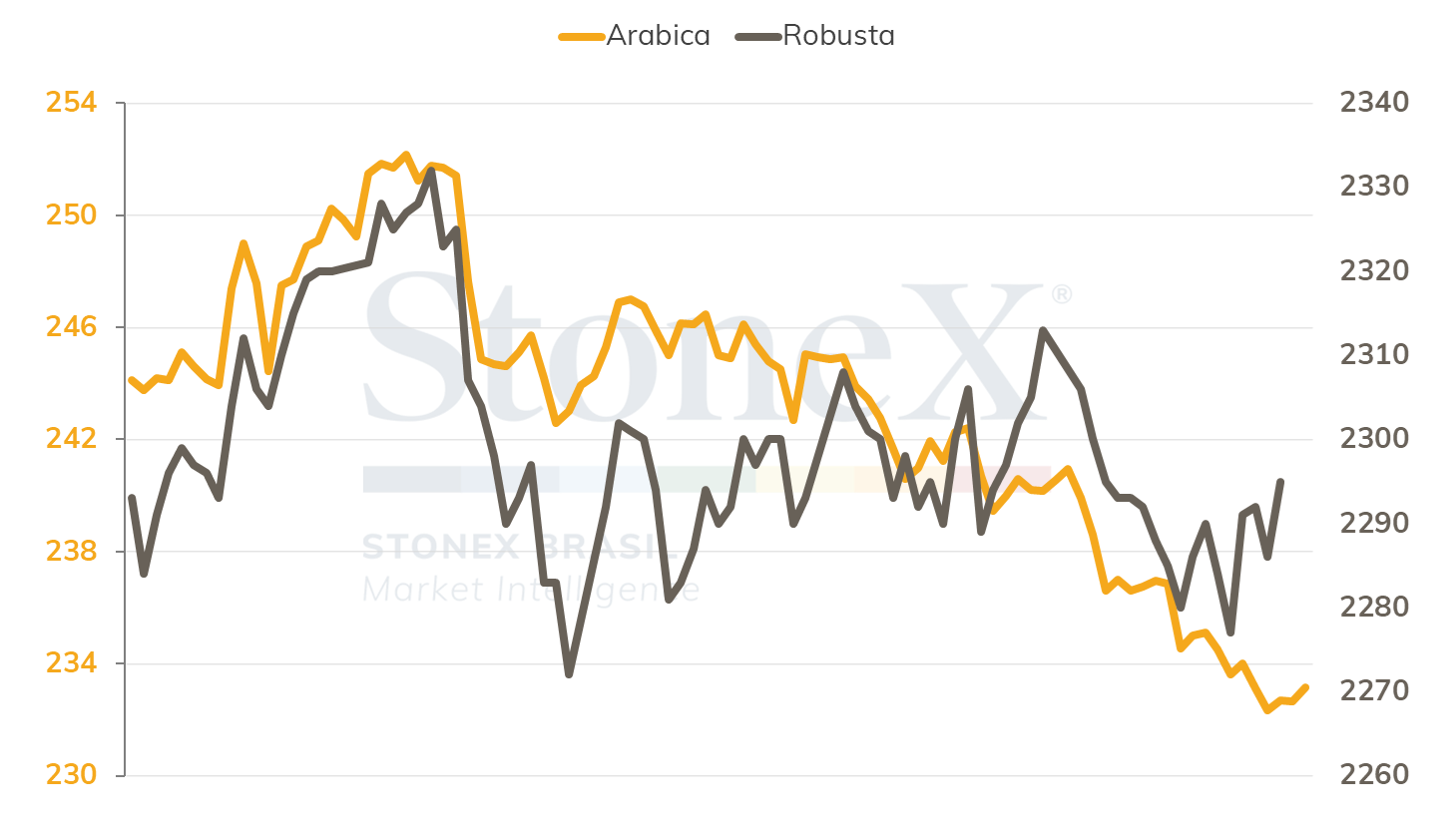
Arabica prices started the week following the strong upward movement observed since mid-November, as signs that the potential 2022/23 crop will have irreparable losses were consolidated, after a non-ideal flowering and some problems with setting in a part of the plantations. As a result, throughout the intraday on Tuesday (7), the most active contract reached its highest level in just over ten years, when prices touched US₵ 252.35/lb.
However, prices began to retreat significantly after reaching US₵ 250.00/lb, which can be considered a strong psychological resistance. On Tuesday, prices closed 655 points lower, and the movement continued, with retractions of 400 and 760 in the last two sessions of the week. Considering that the fundamentals remain predominantly bullish, the retraction seems to have occurred due to technical factors to correct the strong rise of 1660 points (7.1%) that occurred in the immediately preceding period, between December 1 and 6. Next Friday (December 17), the CFTC report, which will reveal the agents' movement between December 7 and 14, may confirm whether there were more intense volumes of selling on the part of speculative funds - which are currently at a high net long volume - indicating a technical profit-taking movement.
The USDA released last week the US imports data for October. The world's largest consumer imported 2.06 million bags of green coffee during the month, the highest volume for the month compared to the last six years, 20.7% higher than in October 2020 and 15.2% higher than the last 3-year average. However, as in the previous two months, the October result also showed a significant variation in imports compared to the average of recent years, reflecting the logistical issues affecting Brazil, the main supplier of coffee to the United States, and the other exporting countries. In addition, due to delays, longer periods of product in transit, and postponements of bookings, both import data from consuming countries and export data have not necessarily shown the real demand and supply for the bean worldwide, which has made the results more unpredictable and their interpretation more complex.
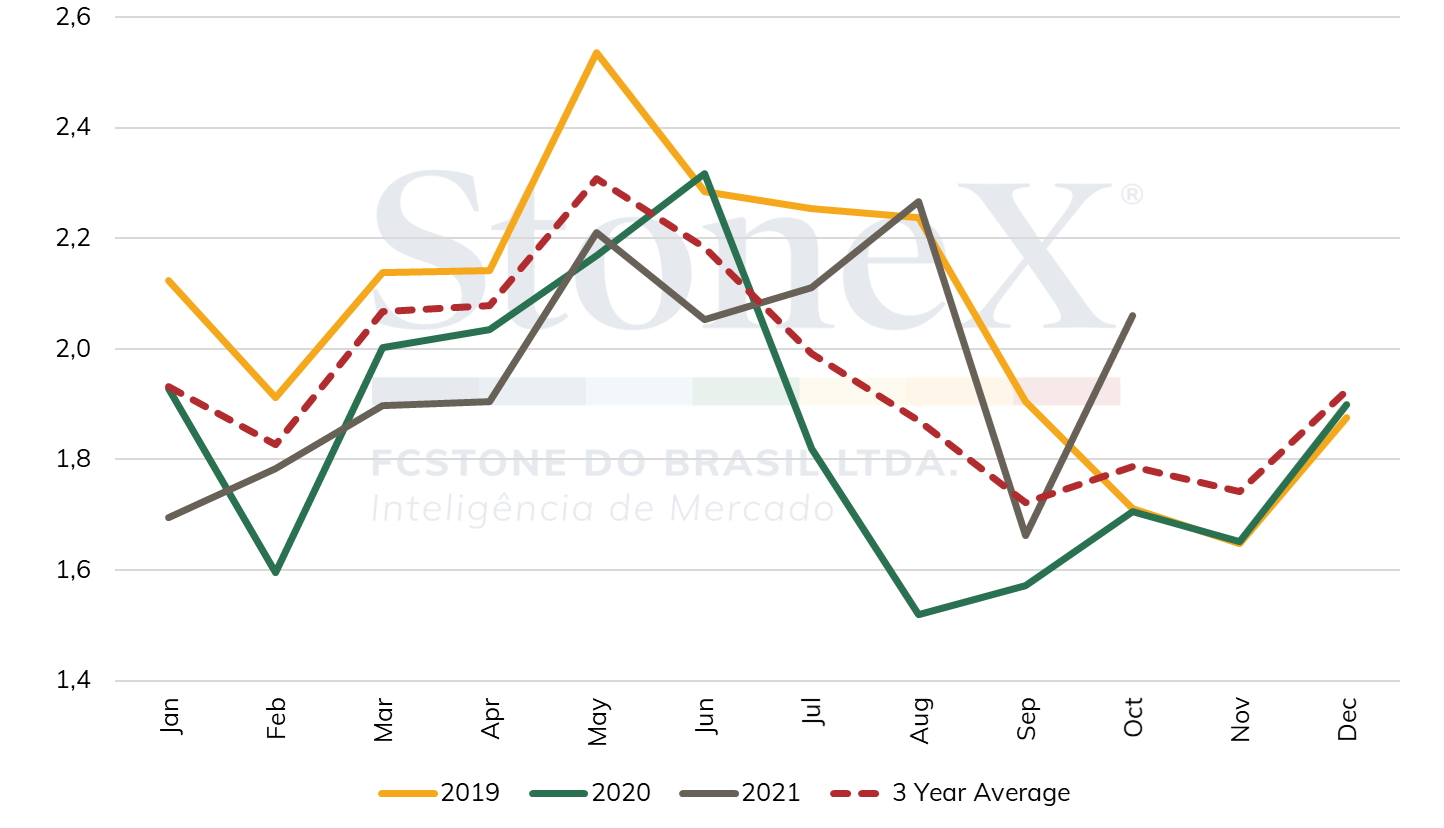
Among the main origins, coffee imports from Brazil advanced 2.1% compared to October 2020, totaling 460 thousand bags in the month, with Colombia advancing 23.5% to 697 thousand bags and a 23.3% rise for coffee imported from Vietnam, with 263 thousand bags. Another highlight was coffee imported from Honduras, which despite seasonally lower numbers in the last quarter of the year, recorded 59.8 thousand bags, up 212% compared to the same month last year and 180% compared to the average of 21 thousand bags in the last three years, with imports of Honduran coffee accumulating 1.5 million bags in the year, 35.9% higher than the same period in 2020.
This week, in addition to the weather in Brazil, which with good indications of rainfall may contribute to pressure prices in New York, agents should reflect on Wednesday (15) the release of inventories at US ports in November of the Green Coffee Association (GCA). The last five years' average points to a drop of 3.0% or 197 thousand bags from October to November. If a drop of similar magnitude is confirmed, the level of stocks at the ports could again be significantly away from the 6 million bag level, which could contribute to a new bullish tone in prices.
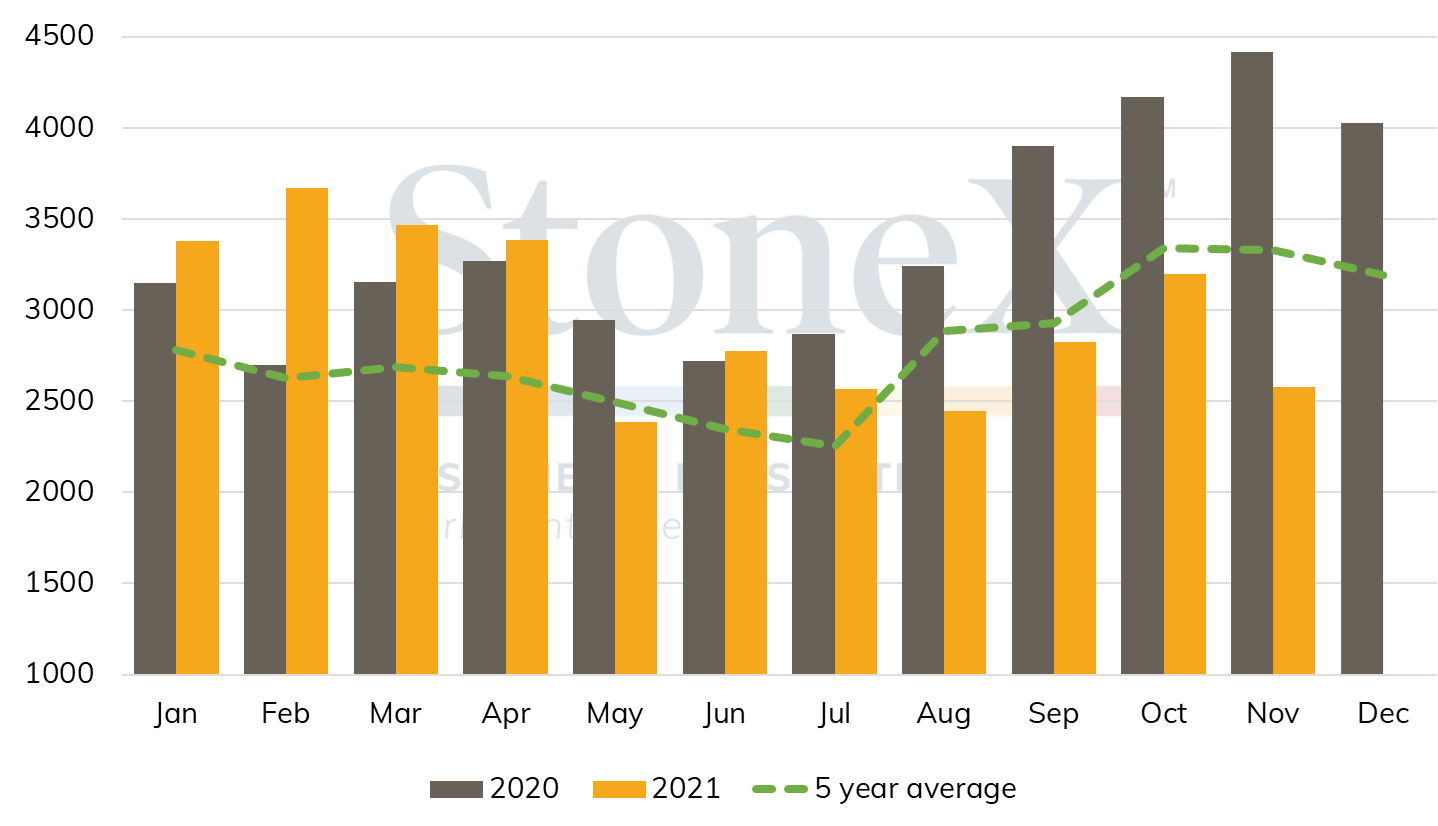
With 2.574 million bags shipped in November, green coffee exports dropped by 41.5% compared to the same month last year, when 4.415 million bags were sent abroad, according to the monthly export report released by Cecafé last Friday (10). Arabica coffee exports totaled 2.388 bags, down by 41.5% compared to the 4.080 in November 2020, while Robusta coffee exports reached 186,000 bags, down by 44.4% compared to the 334,000 bags of the previous year.
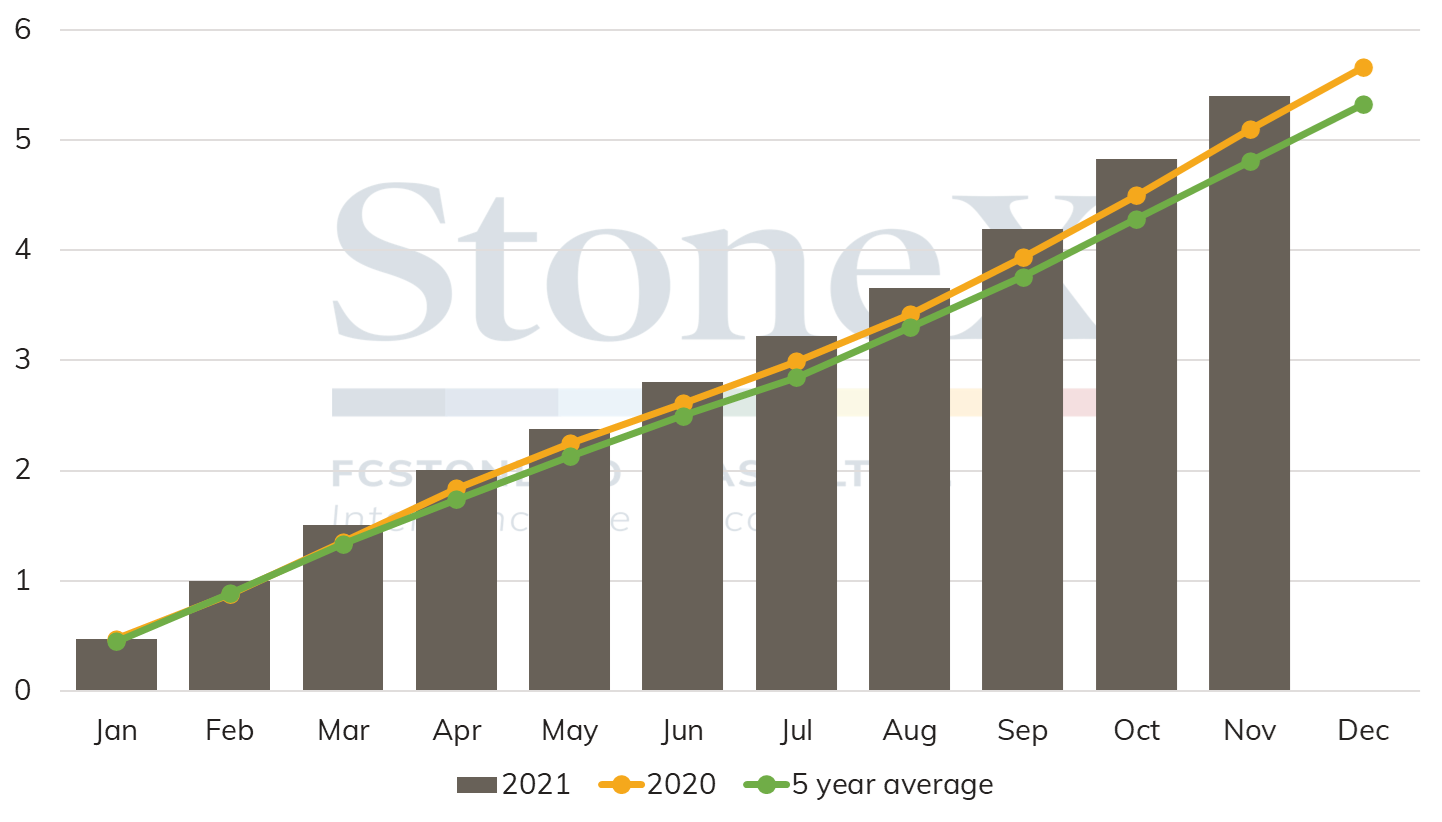
The National Coffee Growers Federation in Colombia have reported that the country’s coffee production for the month of November was 310,000 bags or 22% lower than the same month last year, at a total of 1,131,000 bags. Lower production is said to be the cause of torrential rains as the secondary rainy season merged with La Niña. The adverse weather conditions should impact output for the 2021-2022 coffee year as La Niña is expected to bring heavier rainfall during the key flowering period in January and February.
Coupled with lower output, Colombia has seen increased internal demand. By 2021, domestic consumption of coffee in Colombia increased to 2.8 kg per capita, according to new calculations based on a rigorous study by Reinova1. In the study itself, it was found that the incidence of coffee consumption increased from 86% in 2015 to 96% in 2021, that is, almost the population ceiling.
As a result, Colombia imported 1.23 million bags of 60-kg in January-September 2021, up 99.6% from the same period last year, according to figures from the country’s tax office DIAN. Imports almost doubled from the 615,933 bags of 60-kg imported in January-September 2020.
Colombia, the world’s third largest coffee producer, imports coffee from neighboring nations to supply the local market because of a shortage of low-quality coffee produced nationally. Colombia exports all of its high-quality Arabica beans, but it used to leave coffee affected by diseases such as broca worms or roya fungus for local consumption. However, in 2015, the coffee growers’ federation lifted a ban that had forbidden exporting low-grade beans. As a result, there are no leftovers of low-grade beans for the local industry, promoting the increase of imports.
Brazil is the largest supplier of coffee. Colombia imported 470,416 bags of 60-kg in January-September, almost six times higher the 85,700 bags in the same period last year. Peru shipped 208,850 bags in January-September, up from 163,983 bags on year. Colombia imported 69,400 bags of 60-kg bags from Honduras, up from 33,333 bags in the same period last year.
The Robusta market touched near decade highs last week, as “panic buying” was said to have fueled the rally. Coffee continues to be directly impacted by logistical challenges, including a labor shortage, lack of containers and major delays for shipping vessels. Vietnam, specifically, has been grappling with shipping delays during the peak time in their harvest. Traders believe that this “panic buying” will certainly ease following the holidays, although the logistical backlog is not expected to resolve until 2023 or later.
Supplies from main producer, Vietnam, are also tightening, which is adding support to the market. Exports since the start of the year until November are down 4.4% from last year.
The USDA most recently cut their forecast for exports for the 2021-2022 crop to 25.8 million bags from their previous forecast of 28.8 million bags.
Focus has also been on Vietnam’s weather, which has seen higher than average rainfall levels. Rain over last week slowed harvesting and drying, but sales have begun for the new crop.
Supported by the last monetary policy decision of the year in Brazil with a rise in the basic interest rate, the real/dollar pair fell 1.1% last week, ending the period quoted at BRL 5.614.
Last Wednesday (8), the Central Bank of Brazil's Monetary Policy Committee (Copom) decided to raise the basic interest rate (Selic) by 1.5 p.p., from 7.75% to 9.25% per annum. Despite the adjustment having occurred within market expectations, the tone of the communiqué released by the Committee came as a surprise, affirming its commitment to the continuity of a firm stance in monetary policy to guarantee price stability in the relevant horizon, namely 2022 and 2023. The week before, after the 0.1% retraction in Brazil's third-quarter GDP, which placed the economy in a situation of a technical recession, part of the analysts speculated that the collegiate could reduce its pace of Selic hikes to try to maintain some degree of stimulus to the economy. Copom also indicated that it should make another adjustment of the same magnitude in its next meeting in early February, which would take the interest rate to 10.75%. On Tuesday (14), the Central Bank will release the meeting minutes, bringing new elements to the discussions about how the monetary authority will act to maintain the balance between price stability and economic growth.
Given the rise in the Selic rate and the result of the November National Broad Consumer Price Index (IPCA), which showed a high of 0.95%, below expectations, the Central Bank's Focus Bulletin showed on Monday the first downward adjustment of market projections for inflation after 34 consecutive weeks of highs. According to the survey, the median of the market's bets is that the IPCA will end 2021 at 10.05%, below the previous week's projections of 10.18%. Still, inflation for the year is expected to stay in the double digits, significantly above the upper limit of the Central Bank's target of 5.25% p.a. for 2021, while the outlook for the economy and the Brazilian currency continues to deteriorate. For the year's GDP growth, the Focus showed a retraction in the projections for the 9th consecutive week, going from 4.71% growth in the previous survey to 4.65%, while expectations for the exchange rate evolved for the second week in a row, going from BRL 5.56 to BRL 5.59.
Abroad, global markets should continue to follow with some caution the growing number of Covid-19 cases in the northern hemisphere, while scientists are still trying to assess the possible impact of the omicron variant, in addition to pondering the decision of the Federal Reserve's Federal Open Market Committee (FOMC) meeting on Wednesday (15). The expectation is that the Fed will choose to reduce the pace of the monthly asset purchase program more rapidly to fight inflation, with the possibility that the committee members will begin a debate on the appropriate time to raise the basic interest rate next year. Suppose the Fed's more contractionary stance is confirmed. In that case, the expectation of reduced dollar liquidity and higher US fixed-income bond yields may stimulate an outflow of investors from emerging economies, which would act bullishly for the US currency. The FOMC is also expected to release its quarterly projections for the main indicators of the US economy, which will help visualize how the Committee members view interest rate adjustments in 2022, 2023 and 2024.

The StoneX Group Inc. group of companies provides financial services worldwide through its subsidiaries, including physical commodities, securities, exchange-traded and over-the-counter derivatives, risk management, global payments and foreign exchange products in accordance with applicable law in the jurisdictions where services are provided. References to over-the-counter (“OTC”) products or swaps are made on behalf of StoneX Markets LLC (“SXM”), a member of the National Futures Association (“NFA”) and provisionally registered with the U.S. Commodity Futures Trading Commission (“CFTC”) as a swap dealer. SXM’s products are designed only for individuals or firms who qualify under CFTC rules as an ‘Eligible Contract Participant’ (“ECP”) and who have been accepted as customers of SXM. StoneX Financial Inc. (“SFI”) is a member of FINRA/NFA/SIPC and registered with the MSRB. SFI is registered with the U.S. Securities and Exchange Commission (“SEC”) as a Broker-Dealer and with the CFTC as a Futures Commission Merchant and Commodity Trading Adviser. References to securities trading are made on behalf of the BD Division of SFI and are intended only for an audience of institutional clients as defined by FINRA Rule 4512(c). References to exchange-traded futures and options are made on behalf of the FCM Division of SFI . StoneX is a trading name of StoneX Financial Ltd (“SFL”). SFL is registered in England and Wales, Company No. 5616586. SFL is authorized and regulated by the Financial Conduct Authority [FRN 446717] to provide to professional and eligible customers including: arrangement, execution and, where required, clearing derivative transactions in exchange traded futures and options. SFL is also authorised to engage in the arrangement and execution of transactions in certain OTC products, certain securities trading, precious metals trading and payment services to eligible customers. SFL is authorised & regulated by the Financial Conduct Authority under the Payment Services Regulations 2017 for the provision of payment services. SFL is a category 1 ring-dealing member of the London Metal Exchange. In addition SFL also engages in other physically delivered commodities business and other general business activities which are unregulated and not required to be authorised by the Financial Conduct Authority. StoneX Group Inc. acts as agent for SFL in New York with respect to its payments services business. StoneX APAC Pte. Ltd. acts as agent for SFL in Singapore with respect to its payments services business. ‘StoneX’ is the trade name used by StoneX Group Inc. and all its associated entities and subsidiaries.
Trading swaps and over-the-counter derivatives, exchange-traded derivatives and options and securities involves substantial risk and is not suitable for all investors. Past performance of any futures or option is not indicative of future success. Indicators are not a trading system and are not published as a specific trade recommendation. The information herein is not a recommendation to trade nor investment research or an offer to buy or sell any derivative or security. It does not take into account your particular investment objectives, financial situation or needs and does not create a binding obligation on any of the StoneX group of companies to enter into any transaction with you. You are advised to perform an independent investigation of any transaction to determine whether any transaction is suitable for you. No part of this material may be copied, photocopied or duplicated in any form by any means or redistributed without the prior written consent of StoneX Group Inc.
© 2026 StoneX Group Inc. All Rights Reserved.
Our subscribers have access to comprehensive market analysis from StoneX spanning commodities, equities, currencies and more.
Daily coffee report

August 4 – The benchmark Dow Jones Industrial Average surged into the close yesterday to finish almost 700 points higher, at a record close of 53,178 points – easily clearing the previous top from almost a month ago. The S&P 500 is on the brink of its own record as well, while the NASDAQ index is short of June highs but working on a strong three-session rally. All three are pointing to positive openings today. Palantir (a U.S. software company) reported better-than-expected earnings yesterday afternoon post-close to boost the tech sector, though a host of other firms reported strong earnings as well. The ten-year note continues to retreat from Friday’s high, now at 4.67%, with the dollar on the high side of level-par, while the VIX index now under 16 shows reduced volatility.

Daily coffee report
Our market expertise, advanced platforms, global reach, culture of full transparency and commitment to our clients’ success all set us apart in the financial marketplace.
Reach
With access to 40+ derivatives exchanges, 180+ foreign exchange markets, nearly every global securities marketplace and numerous bi-lateral liquidity venues, StoneX’s digital network and deep relationships can take clients anywhere they want to go.
Transparency
As a publicly traded company meeting the highest standards of regulatory compliance in the markets we serve, our financials and record of accomplishment are matters of public record. StoneX’s commitment to “doing the right thing over the easy thing” sets us apart in the industry and helps us build respect, client trust and new partnerships.
Expertise
From our proprietary Market Intelligence platform, to “boots on the ground” expertise from award-winning traders and professionals, we connect our clients directly to actionable insights they can use to make more informed decisions and achieve their goals in the global markets.