As already mentioned in other editions, the market is still waiting for estimates for Brazil's 2022/23 crop. Conab announced that it would release its estimates on January 18. In addition to Conab, several private organizations are expected to release their estimates in the coming weeks. StoneX will release its estimates for Brazilian 2022/23 production in the first half of February.
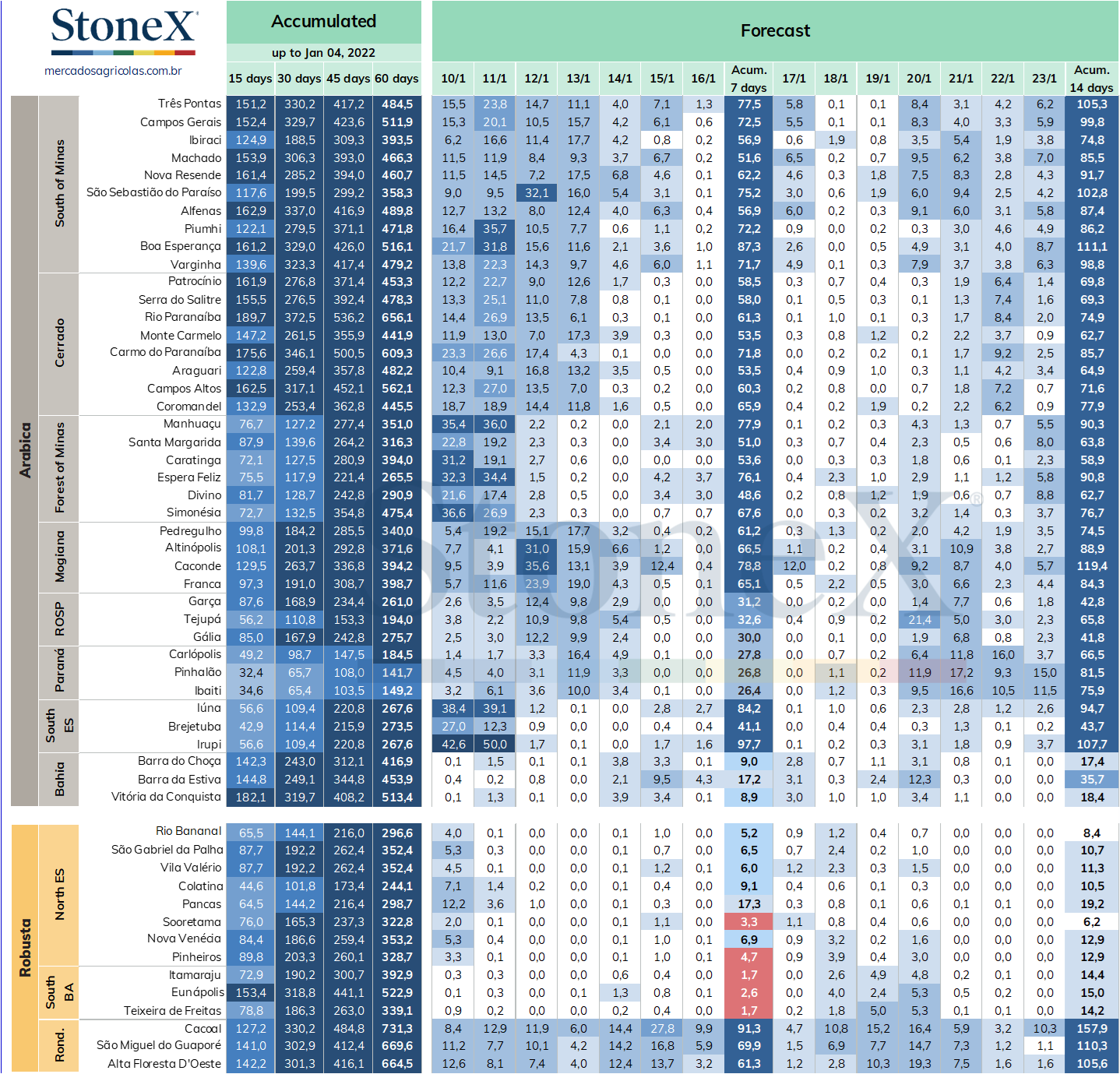
In Brazil, excessive rainfall has caused problems in some regions. A few weeks ago, the Southern region of Bahia, an important Robusta producer, suffered from excessive rainfall and flooding. More recently, the state of Minas Gerais has been punished by high rainfall volumes, with several places showing landslides and mudslides. Some affected areas near the state capital Belo Horizonte are not important in coffee production. Still, other important coffee-producing regions, such as Matas de Minas, have suffered from excessive rainfall, with landslides and impacts on some crops. For the coming week, the models indicate volumes of up to 100 mm of rainfall in some regions in the state of Minas Gerais.
HISTORY AND PRECIPITATION FORECAST (MM) FOR COFFEE PRODUCING REGIONS
Source: StoneX, with data from NOAA/NCEP/EMC (GFS: Global Forecast System), 2021.
Over the next two weeks, the coffee market will be keeping an eye on Brazil’s export data, which should continue to indicate the impact of the logistics crisis on Brazilian exports, and stock at US ports figures by the Green Coffee Association, which will be released on Monday (17). In Brazil, preliminary export data already pointed to a strong decline in December. According to Secex, coffee exports totaled 3.4 million bags in December and were 18.4% lower than the previous year.
Certified Stocks Continue to Decline
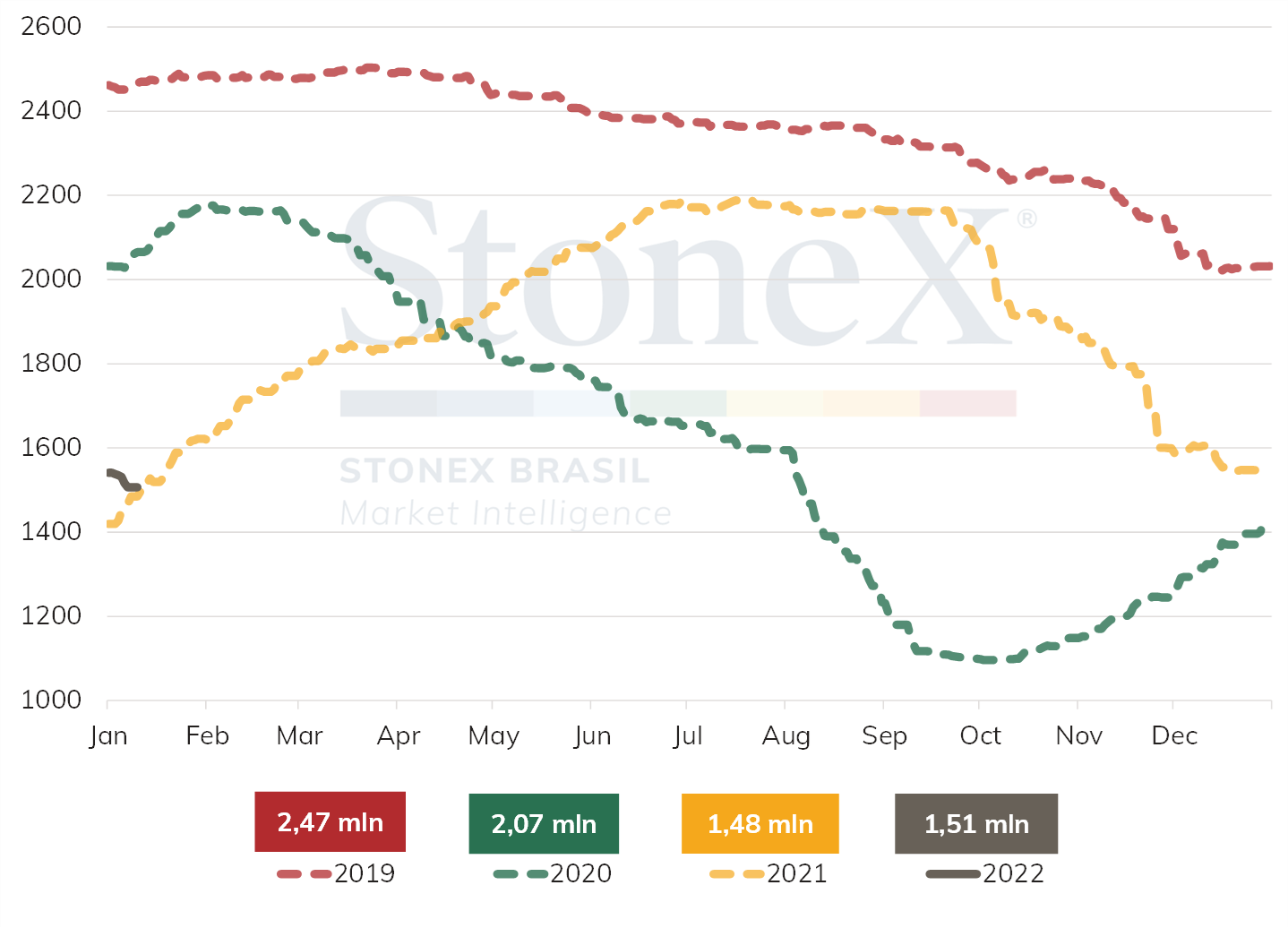
The latest data from the InterContinental Exchange showed that as of January 7th, certified stocks were 1.5 million bags. This is down 6.25% from the 1.6 million bags registered just 30 days prior. This sharp decline in such a short amount of time has triggered concerns that stocks could fall to 1 million bags or below this year. The last time stocks were that low was when they reached 1.096 million bags in October of 2020.
Last year, the market saw an unprecedented increase in certified stocks from Brazil, attributed to a falling differential, making it very profitable for producers to deliver their coffee to the Exchange.
EVOLUTION OF CERTIFIED STOCKS ON THE ICE/NY
Source: ICE/NY. Design: StoneX.
If differentials are weak compared to New York exchange price, meaning if there is a devaluation of coffee in a particular region, it makes sense for the exporter to buy coffee and deliver it to the exchange to certify. However, when differentials are stronger, a producer makes more money to sell the coffee FOB instead of delivering the coffee to the exchange.
Brazilian certified stocks have fall nearly 3% since the start of the year, from 699,087 bags on the first trading day of January 3rd to 678,847 bags as of January 7th.
Honduran coffee, which generally makes up the majority of certified stocks, have also fallen 1.4% since the start of the year, from 731,026 bags to 720,999 bags.
Robusta Futures Trade in Choppy Week
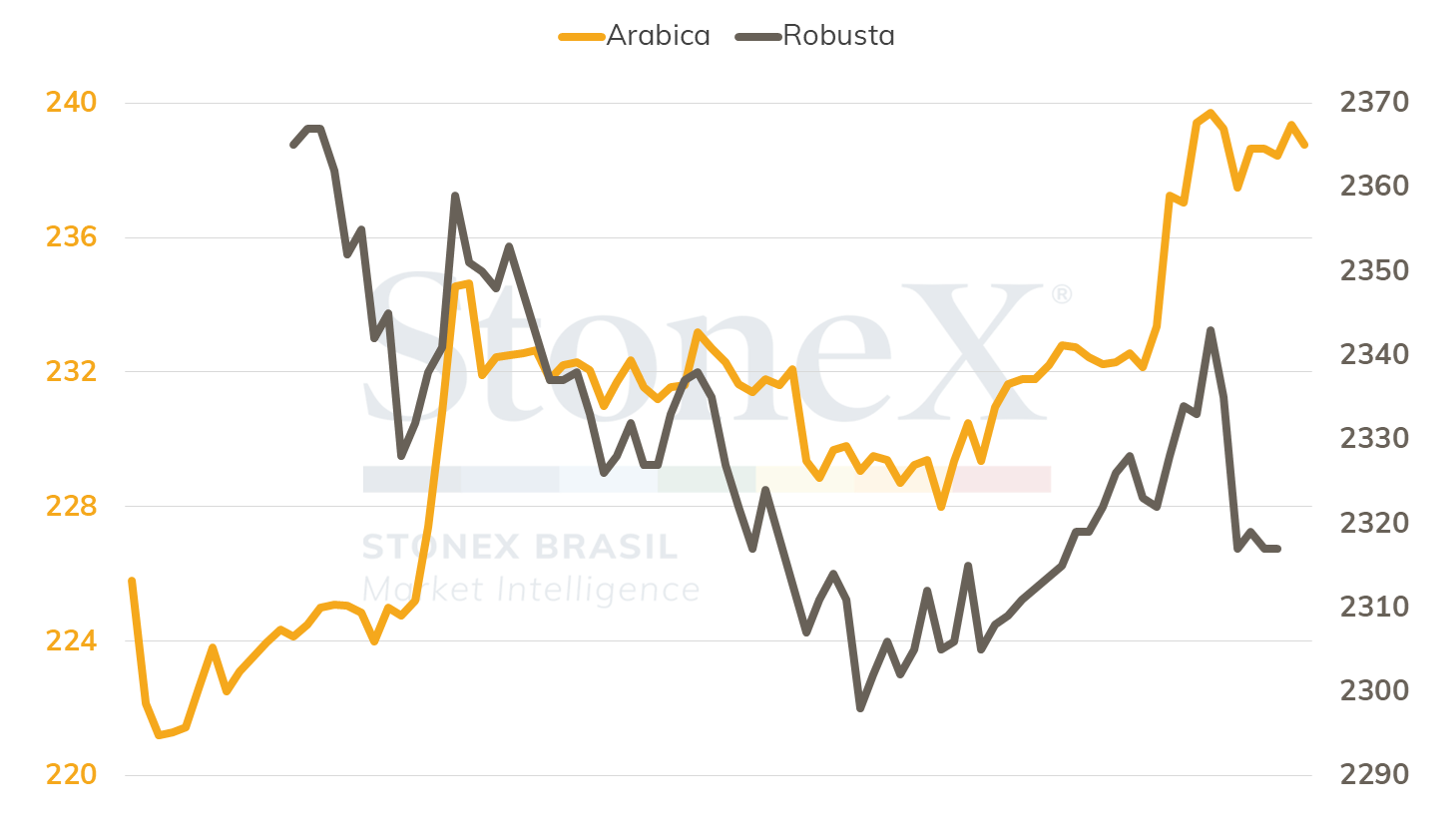
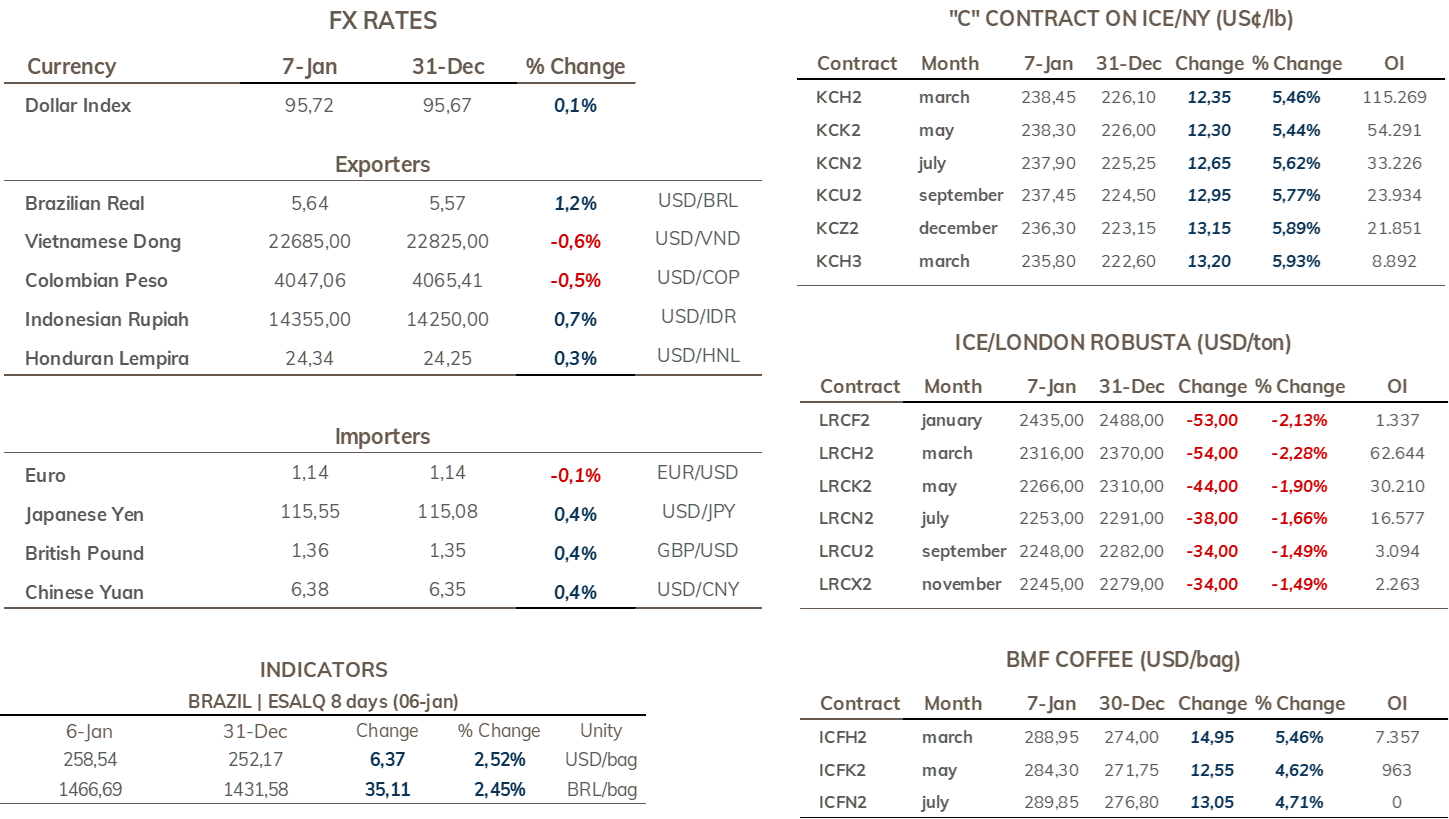
On Friday, Robusta coffee prices hovered near a 10-year high set in December, but overall, the variety has seen declines of 7.2% since the start of the year.
Fundamental focus remains on Vietnam which is now in its final stages of harvesting. Despite some difficulties obtaining cherry pickers and workers due to tightening COVID-19 restrictions, the harvest is said to be progressing well. Vietnam is getting scattered showers on the coast but dry conditions inland, and weather has been somewhat of a non-factor in terms of fieldwork delays. The country is still struggling with a lack of containers, however, which is impacting the availability of Vietnamese coffee on the international market and contributing to the drawdown of inventories in the major consuming markets.
From a technical standpoint, the Robusta market observed some price fixation hedge selling from exporters in Vietnam. This is typical this time of year as farmers need to increase sales ahead of the start of the Tet holiday, or Lunar New Year, which begins on February 1st.
Brazil’s Robusta crop is also gearing up for the start of the harvest in a few months, which will also attribute greatly to the global supply. Crop tours are underway and new forecasts for Brazil’s 2022-2023 crop should begin to circulate in the coming weeks.