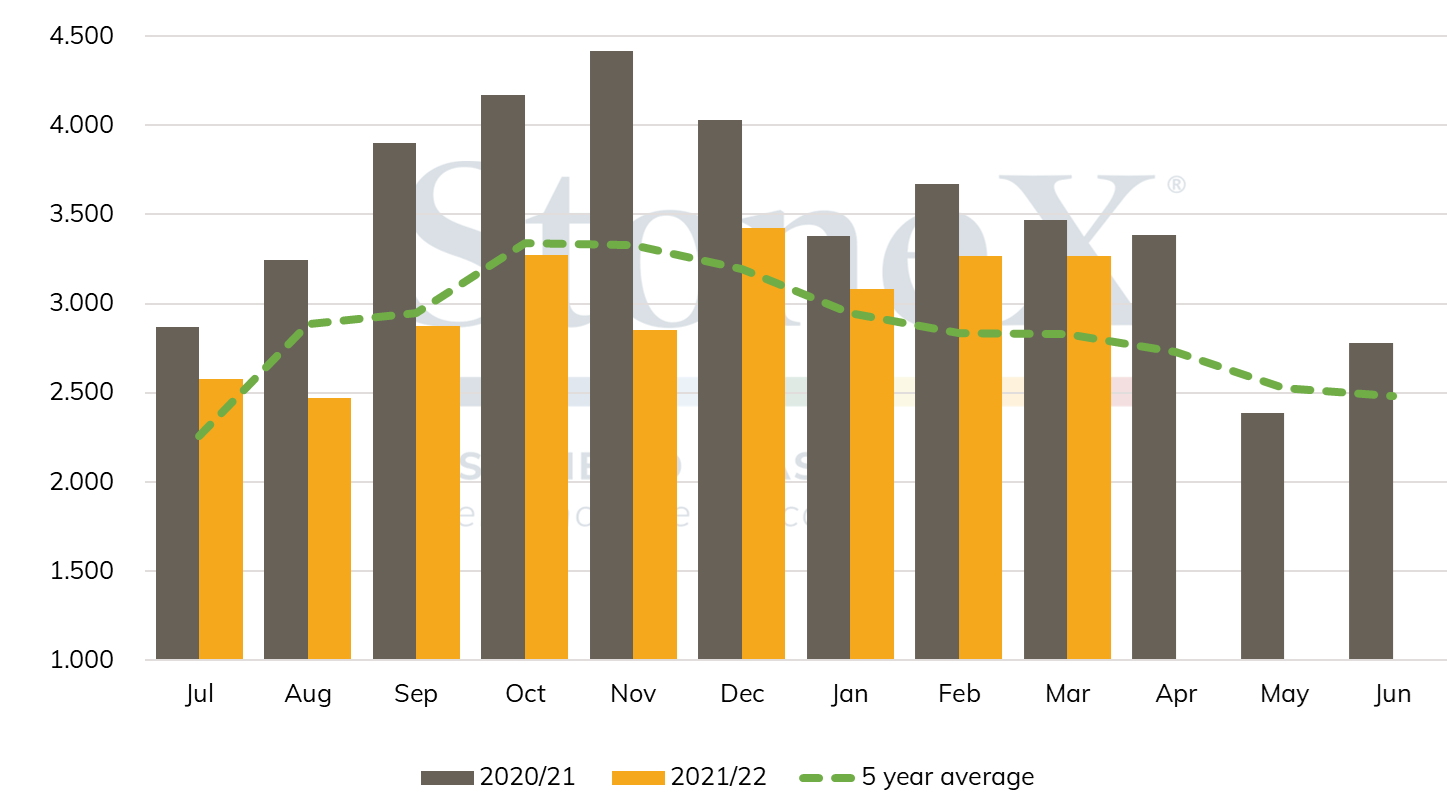
At the beginning of the month, the data released by the Secretariat of Foreign Trade (Secex) showed a decrease of 16% in coffee exports between March 2021 and March 2022. However, Cecafé's data, released on Monday (11), pointed to a decrease of only 6%. It is important to highlight that there is no great difference in the numbers presented for March this year, as much for Secex as Cecafé. However, the biggest impact of this disparity in the variations is in the difference in the export data for March 2021, with Secex pointing to 4.02 million while Cecafé indicated that 3.47 million were exported.
Cecafé's data showed that 3.27 million bags were exported in March, a decrease of 5.8% compared to the same month in 2021. Arabica exports totaled 3.14 million bags, representing a 0.7% increase. On the other hand, exports of Robusta coffee decreased by 64.6% to 123,400 bags.
Monthly green coffee exports from Brazil
Source: Cecafé. Design: StoneX.
As already presented in other editions of this report, the drop in Robusta coffee exports reflects the current differential condition, which does not favor exports of this type. The differential between the Brazilian domestic market and the London market has exceeded USD 800/ton in recent weeks. Therefore, it is much more viable to commercialize Robusta coffee in the domestic market than export it. The increase in Robusta prices reflects the strong increase in Arabica prices, which forced the Brazilian industry to increase the use of Robusta in the blend, thus increasing the demand for Robusta.
NOAA UPDATES LA NIÑA'S PROBABILITIES BY THE END OF THE YEAR
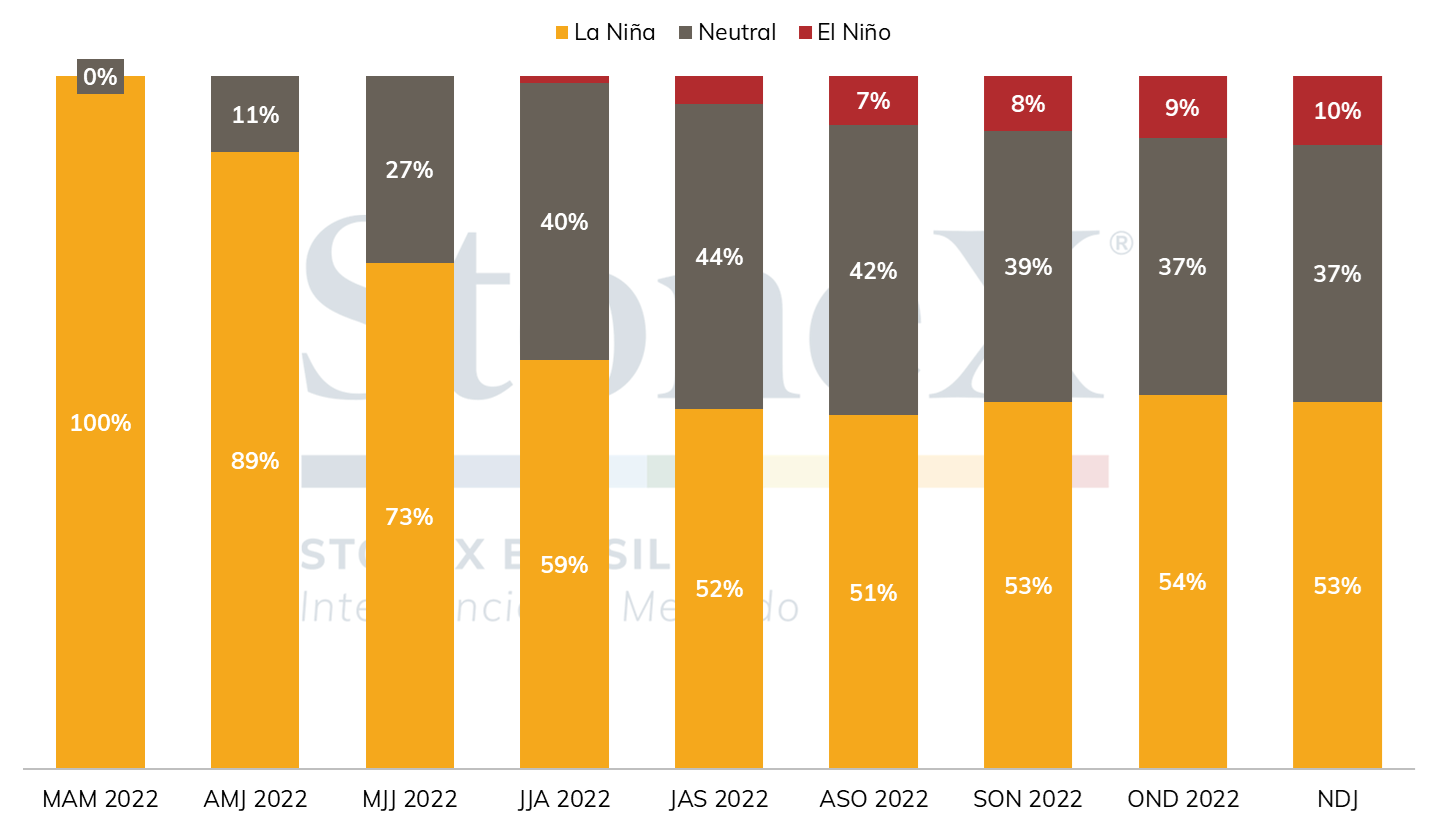
Last Thursday (14), the US National Oceanic and Atmospheric Administration (NOAA) updated its ENSO probability forecast, indicating greater chances that the La Niña phenomenon should remain longer than previously projected. The probabilities that La Niña will remain in the next few mobile quarters were significantly elevated, revised for the April-June quarter from 64% to 89%, for the May-July quarter from 46% to 73%, and remaining with chances above 50% until the end of the year, while the previous update pointed to higher probabilities of neutrality already starting in the May-June quarter. The data also indicate higher chances that the temperature variation should remain similar to recent months, between -0.5 °C and -1.0 °C, with intensity classified as weak.
EL NIÑO/LA NIÑA PROBABILITY FORECAST
Source: NOAA. Design: StoneX.
This update indicates that, in the short term, Colombian production, which has already been showing falling production figures in recent months due to the torrential rains in producing areas, tends to continue to suffer some damage due to the weather. In the medium to long term, the fear about the possible effects of La Niña on Brazil in the second half of the year returns, which could bring delays and reduction in rainfall in this period for the third year in a row.
Currently, Brazil is heading towards a dry season between May and October, where precipitation volumes tend to be lower. In the coffee-producing regions of Minas Gerais, the rainfall in March, the last month with more significant rainfall volumes, was significantly below average. According to StoneX's precipitation forecast model, these regions should receive significantly lower volumes, which should also cause the rainfall in April to be below the average of recent years. In this scenario, a delay or reduction in rainfall in the second half of the year could affect 2023/24, bringing a bullish trend to the market.
CFTC: funds increased, but commercial agents reduced positions
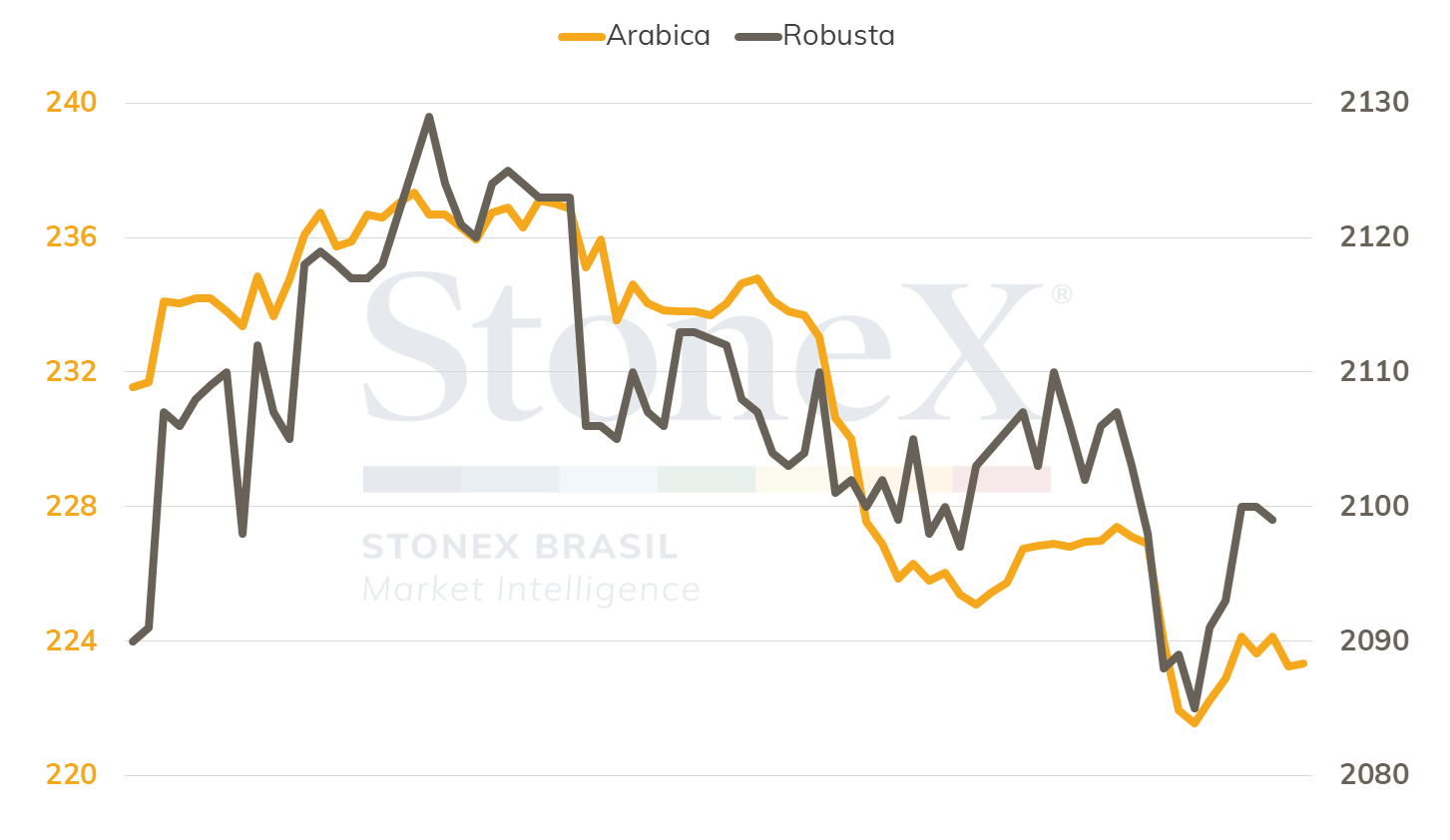
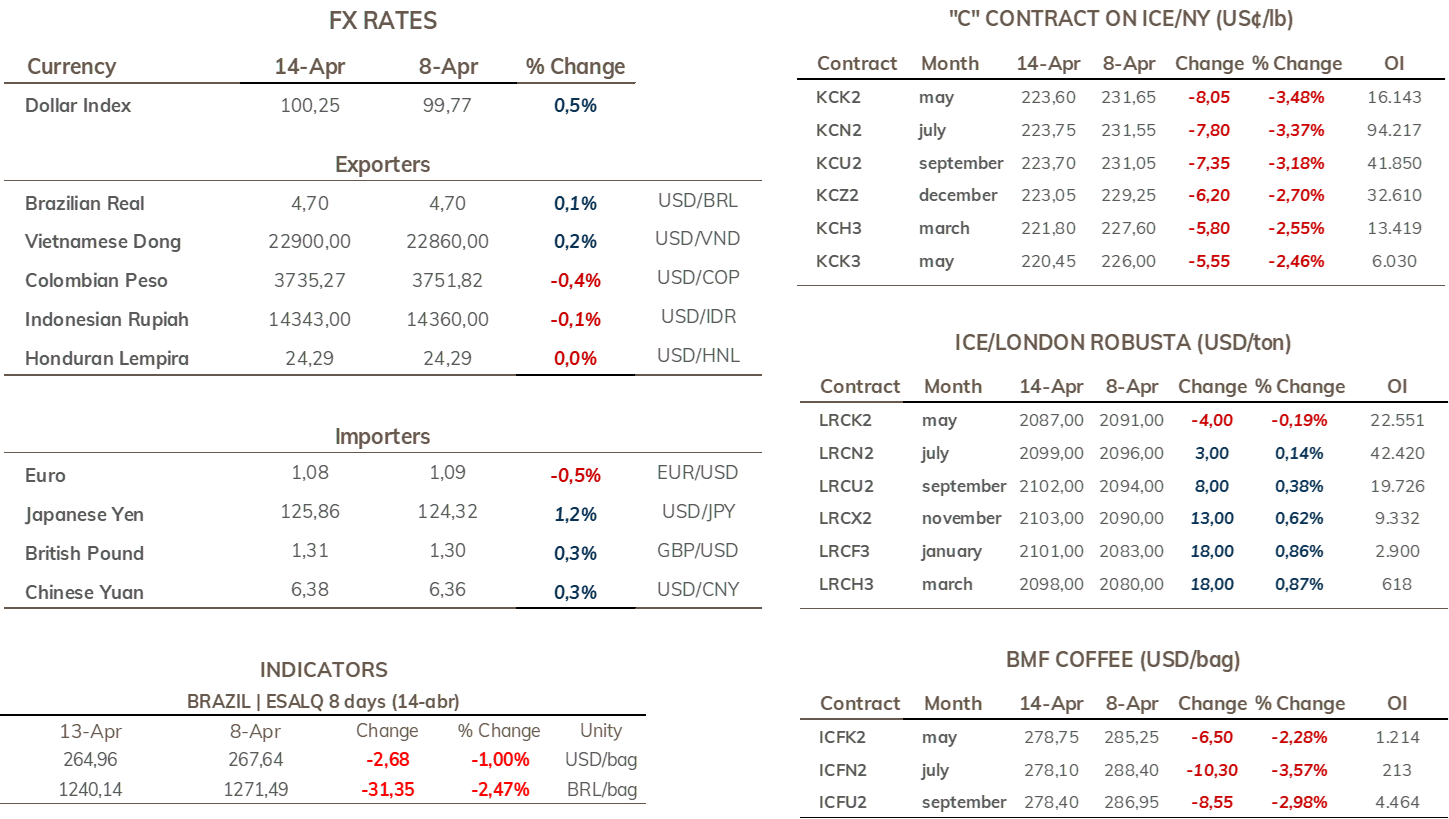
The CFTC's Commitment of Traders report revealed last week that spec funds increased their net long positions in coffee futures and options between April 5 and 12 on the New York exchange. According to the report, specs increased their long positions by 6,023 while reducing their short positions by 199 contracts, advancing their net long balance by 6,222 to 29,617 contracts. In the same period, prices increased by 230 points, going from US₵ 231.25/lb to US₵ 233.55/lb.
On the other hand, there was a strong decrease in commercial agents' positions, both for long and short. The report pointed out that the commercial agents reduced their net long positions by 10,500 contracts and their net short positions by 3,959 contracts, presenting an advance of 6,541 contracts in the net short balance to 74,627. With this reduction in the positions, there was a decrease of 23,771 in the number of open contracts.
Dollar records a slight retreat in the week, despite global risk aversion
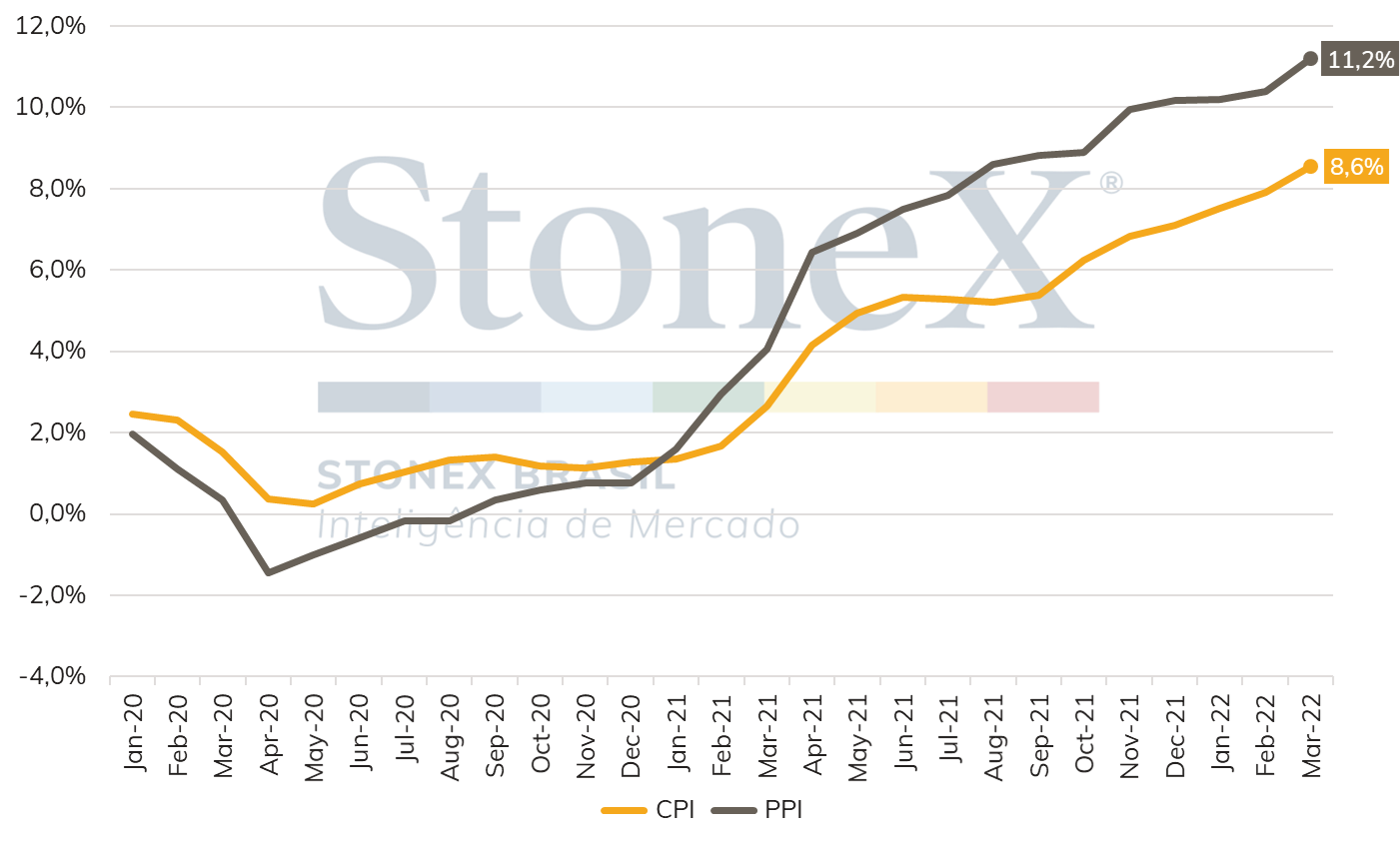
Last week, the USDBRL closed with a slight drop of 0.3% in the Brazilian exchange market, quoted at BRL 4.697. The expectation of a continued rise in the basic interest rate (Selic) after releasing a higher than expected IPCA in the previous week maintained the country's attractiveness for foreign exchange inflows, despite the rise in risk aversion in most global markets. Abroad, the release of data indicating still accelerated inflation in the United States and the less rigid posture of central banks in other countries significantly increased the demand for the American currency since investors expect the Fed to lead the process of monetary tightening in the world, increasing the attractiveness of investments in dollar-denominated securities. In this context, the dollar index, with a weekly gain of 0.5%, closed at 100.3, renewing its two-year highs.