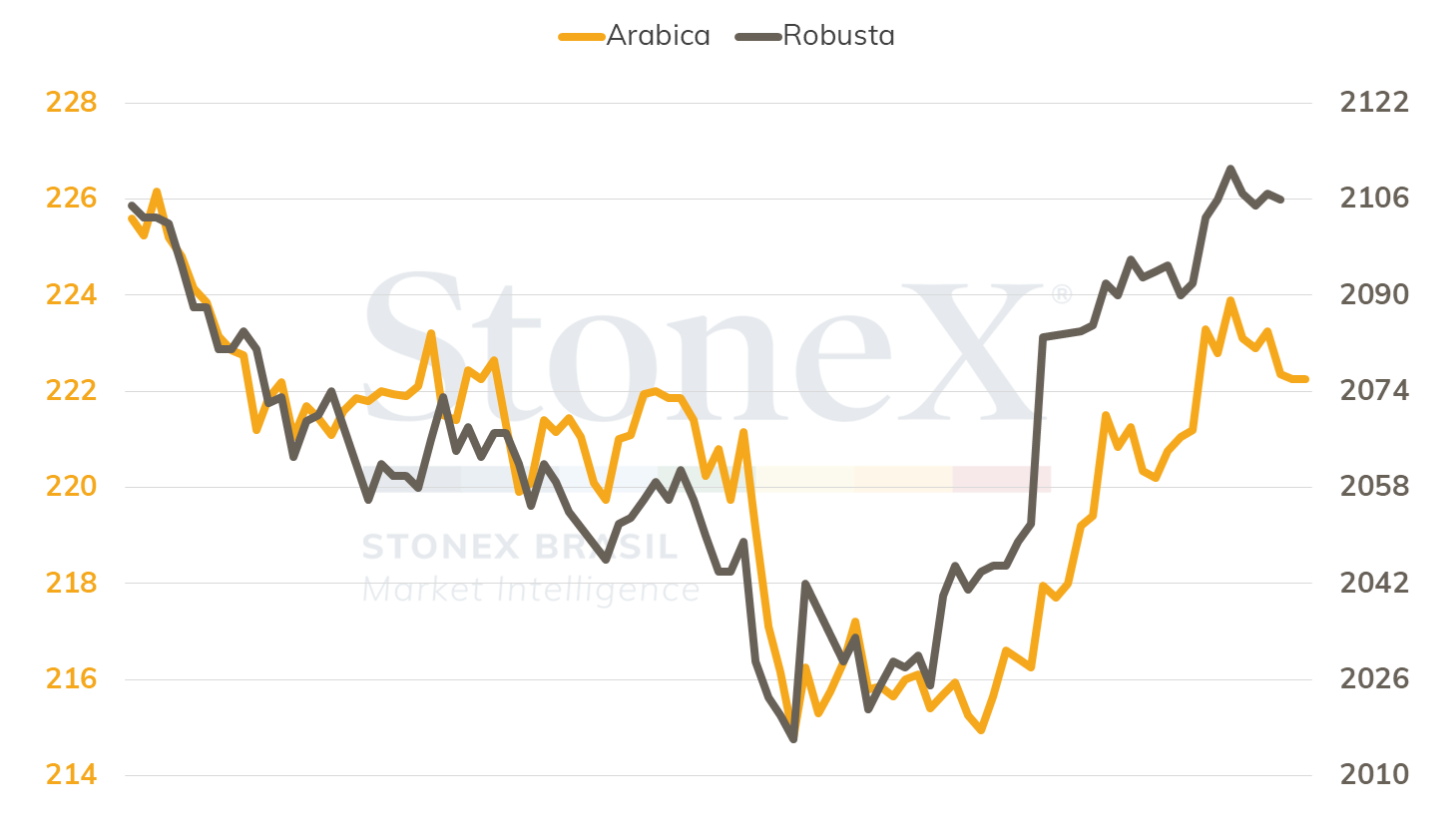
The coffee market is still trying to price the impacts of the war, which are still very uncertain, on global coffee demand. In addition to the direct impact of Russia and Ukraine, which consumed over 5 million bags in 2021, agents are trying to understand the economic impacts of the war on the world. As a reflection of the war, the increase in inflation and the lower growth of the global economy, as indicated by the last revision of the IMF projections in April, may act negatively on global coffee consumption. Due to the uncertain nature of the war, it is still very difficult to quantify the real impacts on the global coffee market.
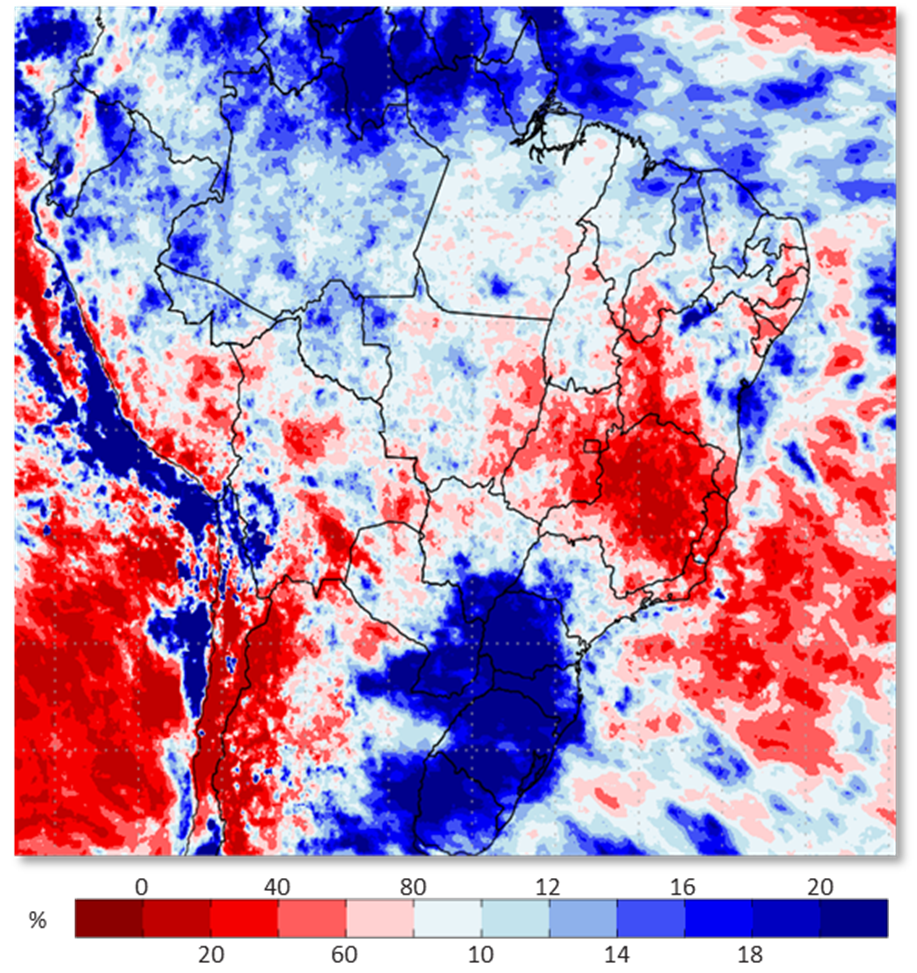
Regarding the weather, the below-average volumes in Brazil's main producing regions have caught the agents' attention. As can be seen in the anomaly map of the last 60 days, which compares the rainfall volume in the period with the historical average, important regions in Minas Gerais, Espírito Santo, and Bahia had below-average rainfall during the period. In addition, for the next two weeks, according to the StoneX forecast, with data from NOAA/NCEP/EMC, the weather is expected to remain dry in the main producing regions.
Rainfall anomaly for the last 60 days in Brazil (%)
Source: StoneX, with data provided by NOAA / NCEP / GFS. Design: StoneX.
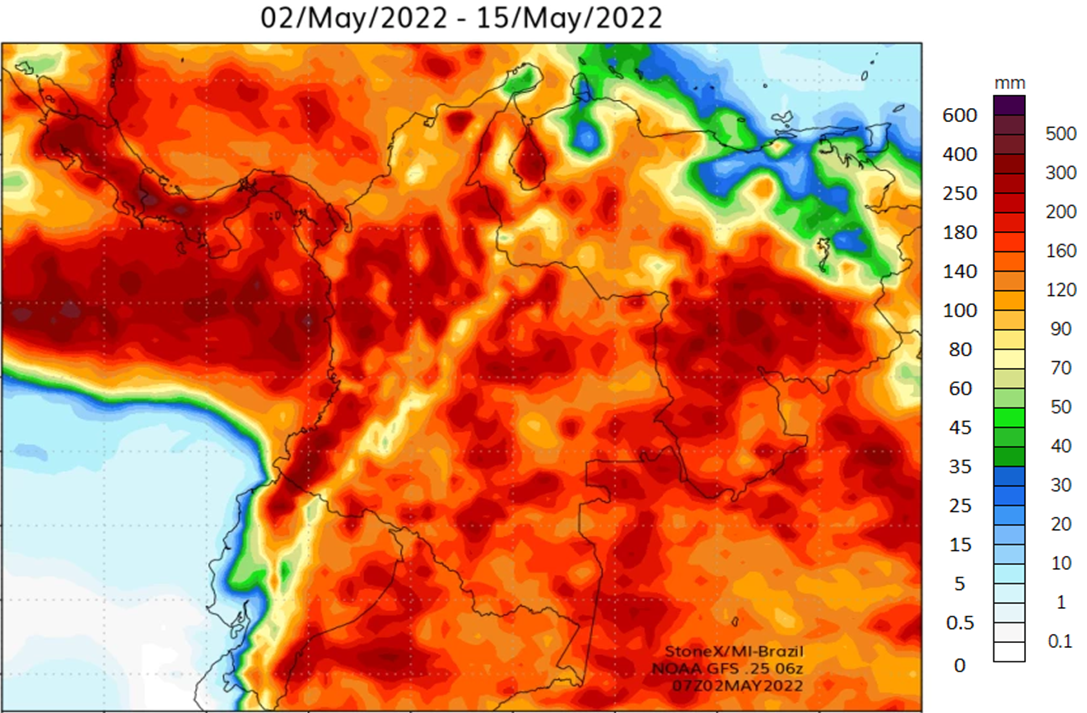
In Colombia, the excessive rainfall caused by La Niña continues to wreak havoc and decrease the country's production potential, especially for the secondary crop, also known as Mitaca. The country received above-average volumes in March and April. For the next 14 days, forecast models point to accumulated volumes of up to 250 mm in some regions.
Cumulative forecast for the next 14 days in Colombia
Source: StoneX, with data provided by NOAA / NCEP / GFS. Design: StoneX.
In the coming weeks, in addition to the influences of macroeconomic and exchange rate factors, the market will closely monitor the release of export data in Brazil for April, which should point to continued impacts on exports, mainly to Russia and Ukraine.
The export data from Brazil should point to lower export volumes for Robusta, reflecting the strengthened differentials in Brazil - although they have narrowed recently, the differentials for Robusta in Brazil remain high. While Brazilian exports of Robusta are dropping, the volumes shipped to Vietnam are advancing. The General Bureau of Statistics data indicated that 2.8 million bags were exported in April, 28.6% more than in the same month last year.
StoneX is already releasing daily minimum temperature forecasts for producing regions in Brazil. As already mentioned in other editions of this report, the approach of the Brazilian winter and the possible occurrence of cold waves should contribute to greater volatility in the market.
In general, it is important to remember that the estimates for the S&D available so far point to a more balanced scenario, with a slight surplus, after a year with a very negative balance, which cools agents' concerns. Average estimates point to a deficit of 6.9 million bags in 2021/22 and a surplus of around 1 million bags in 2022/23; estimates by major agencies such as the USDA and ICO have not yet been released.
Colombian cooperatives' losses reached 37.27 billion pesos (Coffee Network)
In a story reported by Coffee Network, the Superintendence of Solidarity Economy of Colombia (Supersolidaria) indicated that it received the financial results of 59 cooperatives, which reported a loss of 37.27 billion pesos, which equals approximately 10 million dollars. The loss resulted from producers not fulfilling futures contracts by failing to deliver as scheduled in previously agreed upon futures contracts. According to data from the superintendency in December 2021, 84% of the futures contracts had not been fulfilled.
Due to the large losses and the risks to the cooperatives, lawmakers have called for a hearing in the Colombian senate to address the issue. The hearing is scheduled to take place on May 3 and will be attended by several authorities and representatives of the sector in the country.
USDBRL appreciates for the week as agents await monetary policy decisions in Brazil and the United States
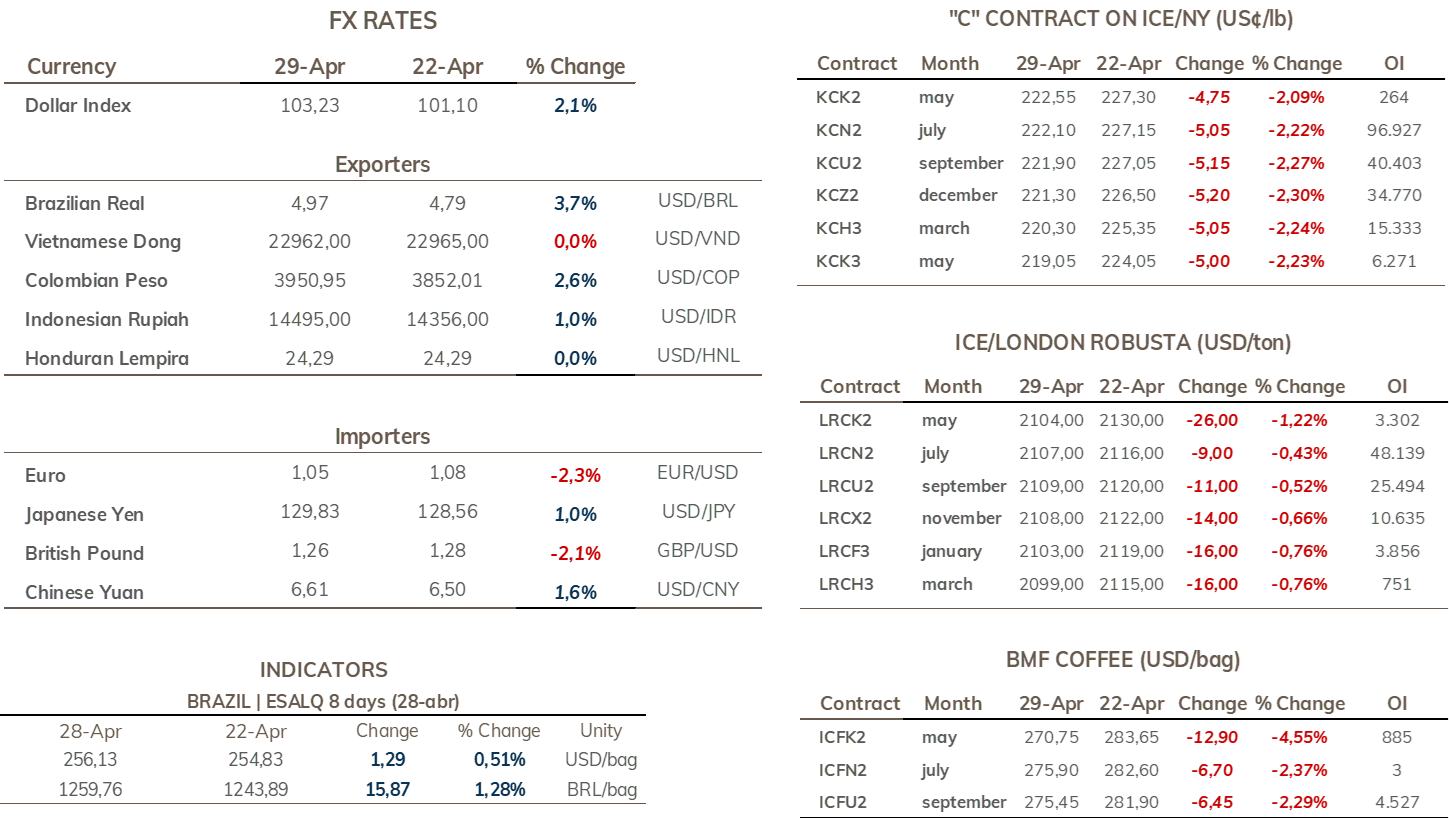
Besides the bearish fundamentals analyzed by the agents as the signs that the Russian-Ukrainian war will last for more weeks or even months and has been generating concerns on several fronts regarding the demand for coffee, the recent devaluation of the Brazilian currency has added another factor of pressure to the prices of the commodity in the last sessions. From April 22 to last Friday (29), the dollar accumulated a 7.0% rise in the Brazilian exchange market, with the real/dollar pair going from BRL 4.62 to BRL 4.94. If we consider the partial figures for this Monday, up to the time of writing, the advance in the period has already reached 9.0%, with the dollar surpassing the psychological threshold of BRL 5.00. During the same period, the most active contract in New York registered a retreat of 1255 points (-5.4%), from US₵ 228.15/lb to US₵ 215.9/lb at the close of the first session this week.
Until the beginning of this cycle, the Brazilian currency was moving in the opposite direction of most other currencies, appreciating, supported by the strong rise in commodities, by its position as an "alternative" to Russia regarding the supply of several primary products and by the high-interest differentials in Brazil compared to the American economy. However, new political tensions in Brasilia, as commented in the last weekly report and the firmer speech of the president of the Federal Reserve about raising the interest rate in the United States, consolidating the high probability that the Fed will initiate stronger increases in its interest rate, expanded the flow of foreign exchange for investments in dollar-denominated assets.