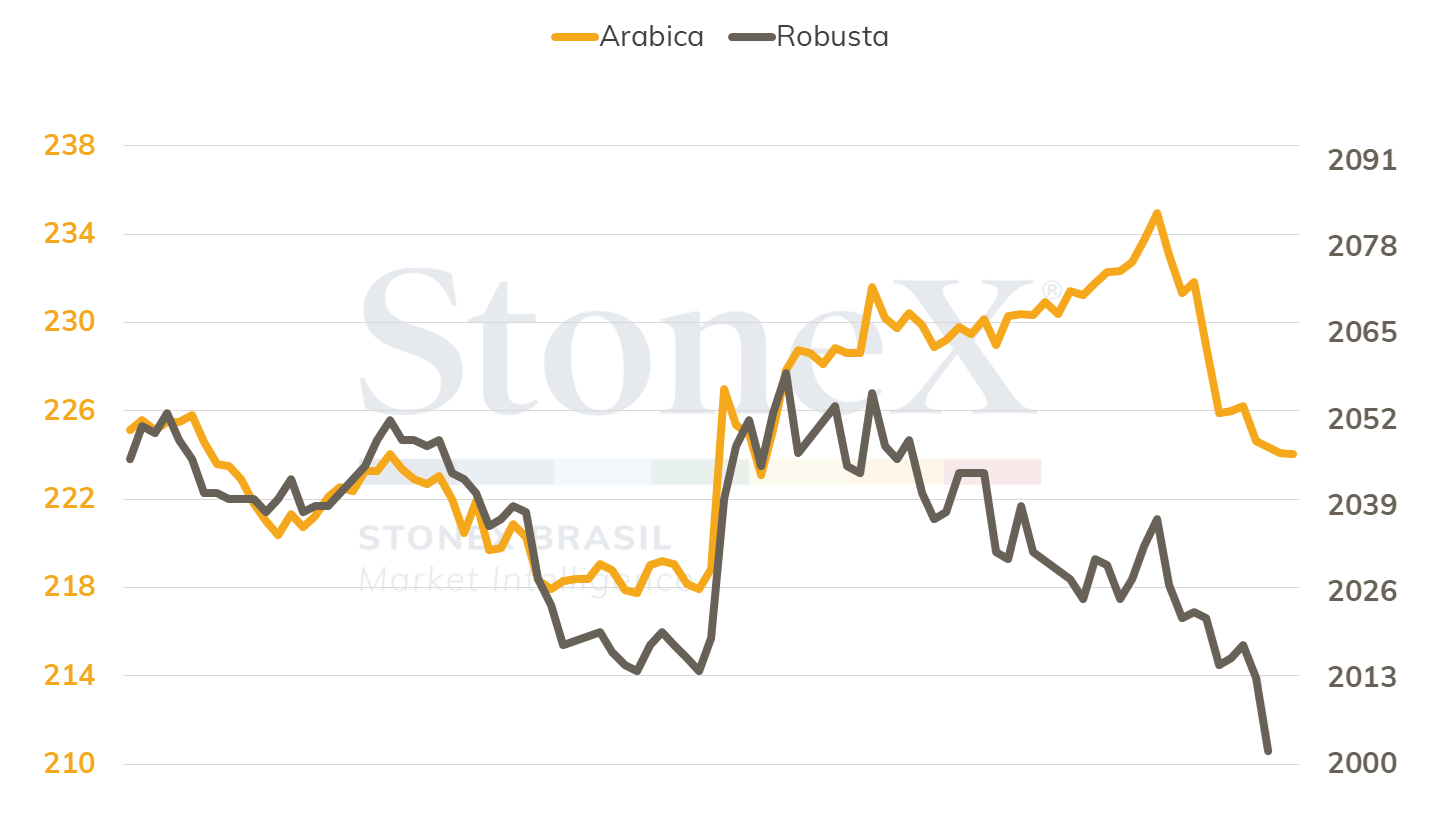
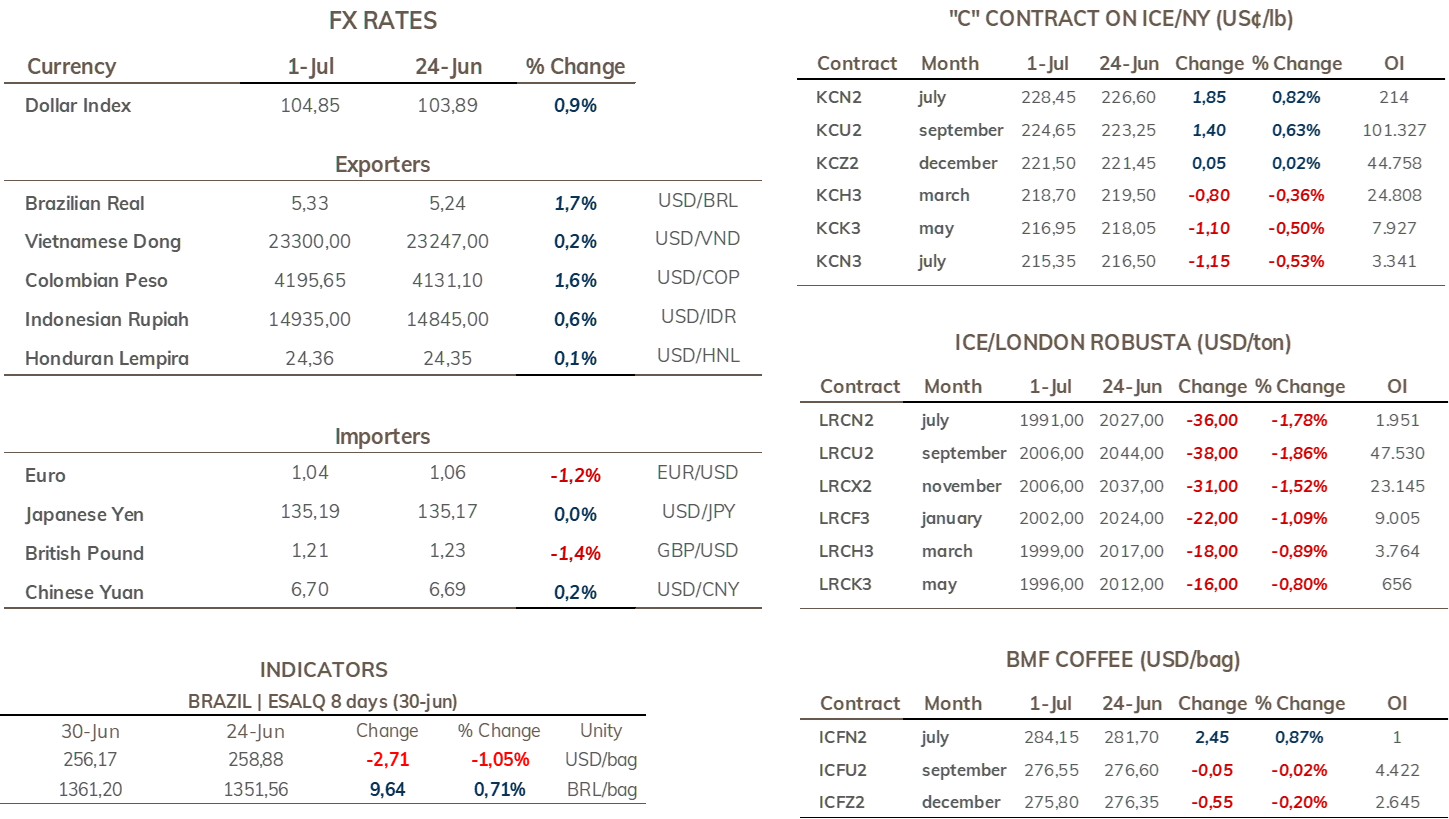
Following the movement in the international market, the Arabica coffee prices in the Brazilian domestic market ended the week with a slight increase. As a result, Cepea's Arabica indicator ended the week quoted at BRL 1358.71/bag, high by 0.5%. On the other hand, Cepea’s Robusta indicator ended high by 0.8% to close at BRL 703.65/bag.
On the fundamentals side, the coffee market will continue to keep an eye on the movements of Arabica coffee certified stocks. In addition, the weather in Brazil is in the spotlight, as agents are trying to anticipate what could happen in the flowering period, as well as react to any new cold wave that has the potential to generate damage. Besides, the export data from the countries and the US import data for May will be monitored and released on Thursday (07).
Sharp drop in certified stocks in New York keeps agents apprehensive about supply
In recent weeks, discussions about global coffee supply have dominated attention on the fundamentals front. While the latest USDA report suggested a comfortable surplus in the 2022/23 season, the certified stock's movement has kept agents apprehensive about coffee availability.
After the ICE reported a drop of just over 32,000 bags on Friday, bringing the volume to 854,000, certified stocks reached their lowest level since 1999. The accumulated drop for the week was 101,000 bags (-11%), while the decline for June totaled 189,000 bags (-18%). Considering the period since the beginning of the year, the decrease in certified stocks of Arabica coffee totals 686 thousand bags (-44.5%). Of these withdrawals, 337,000 (48%) were from Brazil, while 332,000 (45%) were from Honduras.
Certified stocks are usually a refuge for traders when there are concerns about short-term coffee availability, a pattern observed in the last half of 2021 when a significant volume of coffee was decertified at the height of the logistical crisis in the coffee market.
Thus, although there have been no major changes in market conditions, the decline in certified stocks suggests concern over availability, particularly in the United States and Europe, where ICE warehouses are located.
On the other hand, while historically low stocks are of concern to the market and have helped to support prices, the prospect of significant volumes of new coffee being certified seems unlikely. As we have mentioned in previous reports, the still high differentials amidst the large increase in freight costs have not financially justified the certification of new coffees from major origins such as Brazil and Honduras.
USDBRL appreciates amid fears of global stagflation and fiscal risk in Brazil
The US currency ended last week high by 1.3%, with the real/dollar pair at BRL 5.321. On Friday (1), the strong USDBRL appreciation (2.5%) contributed to the sharp correction of the coffee quotes in the session, as agents reflected fears of global stagflation and the deterioration of public accounts in Brazil, which took the exchange rate to its highest level in 5 months.
In Brazil, the forex market echoed concerns over the expected impacts on the country's fiscal statistics following the quick approval in the Federal Senate of the proposed constitutional amendment (PEC) 1/2022 last week, which seeks to increase the country’s income transfer program Auxílio Brasil and bottled gas aid Auxílio Gás, provide subsidies for ethanol and free transportation for the elderly, and create a voucher for self-employed truck drivers. After its reception and vote in the Senate, the project will go to the Chamber of Deputies. The measures contained in the PEC will have an estimated cost of BRL 41.25 billion, according to its rapporteur, Senator Fernando Bezerra Coelho (MDB-PE), and will not be accounted for in the spending cap, which has raised the perception of greater risks to the national public accounts and contributed to keeping investors away from the Brazilian currency in recent weeks.