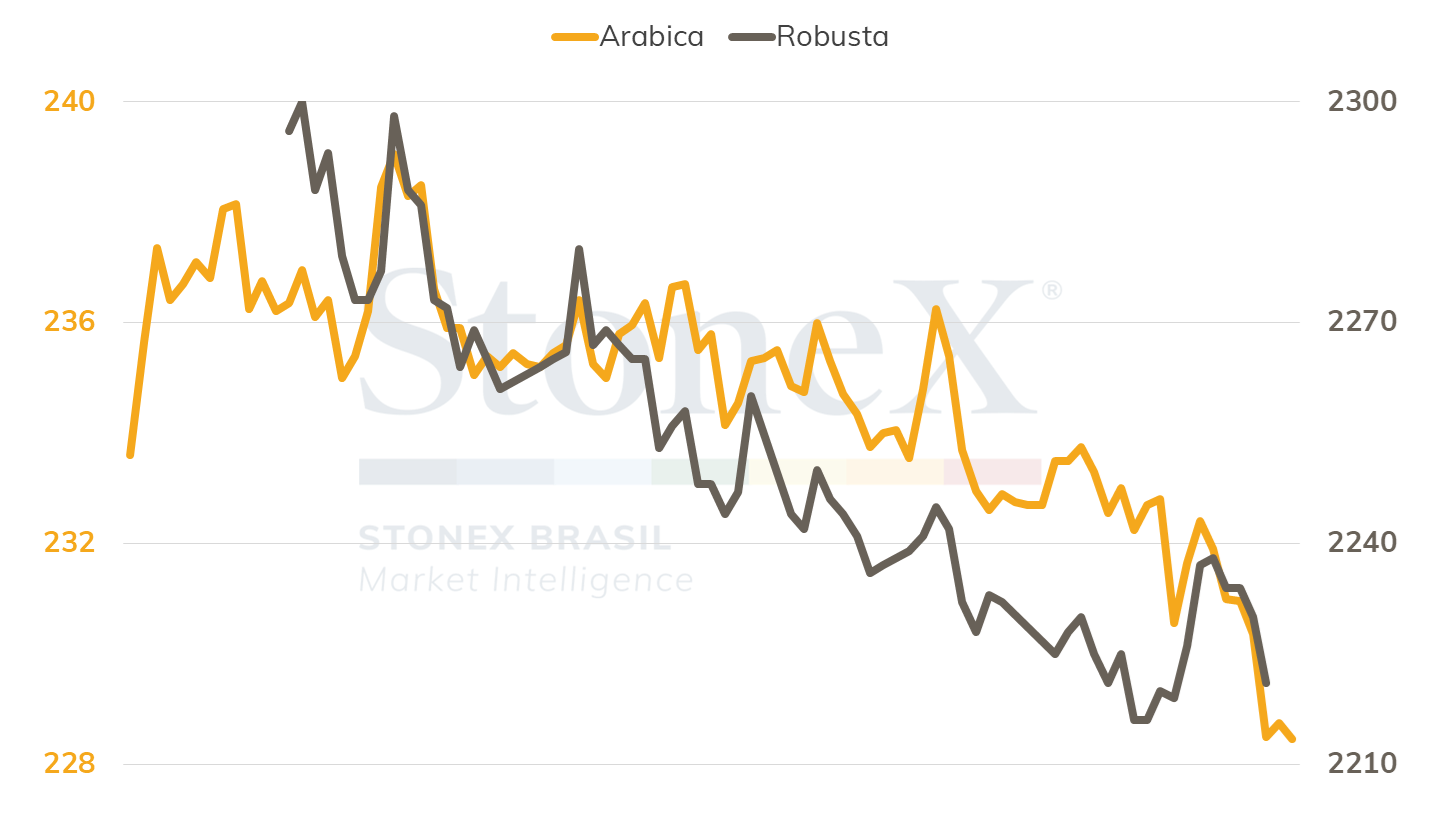
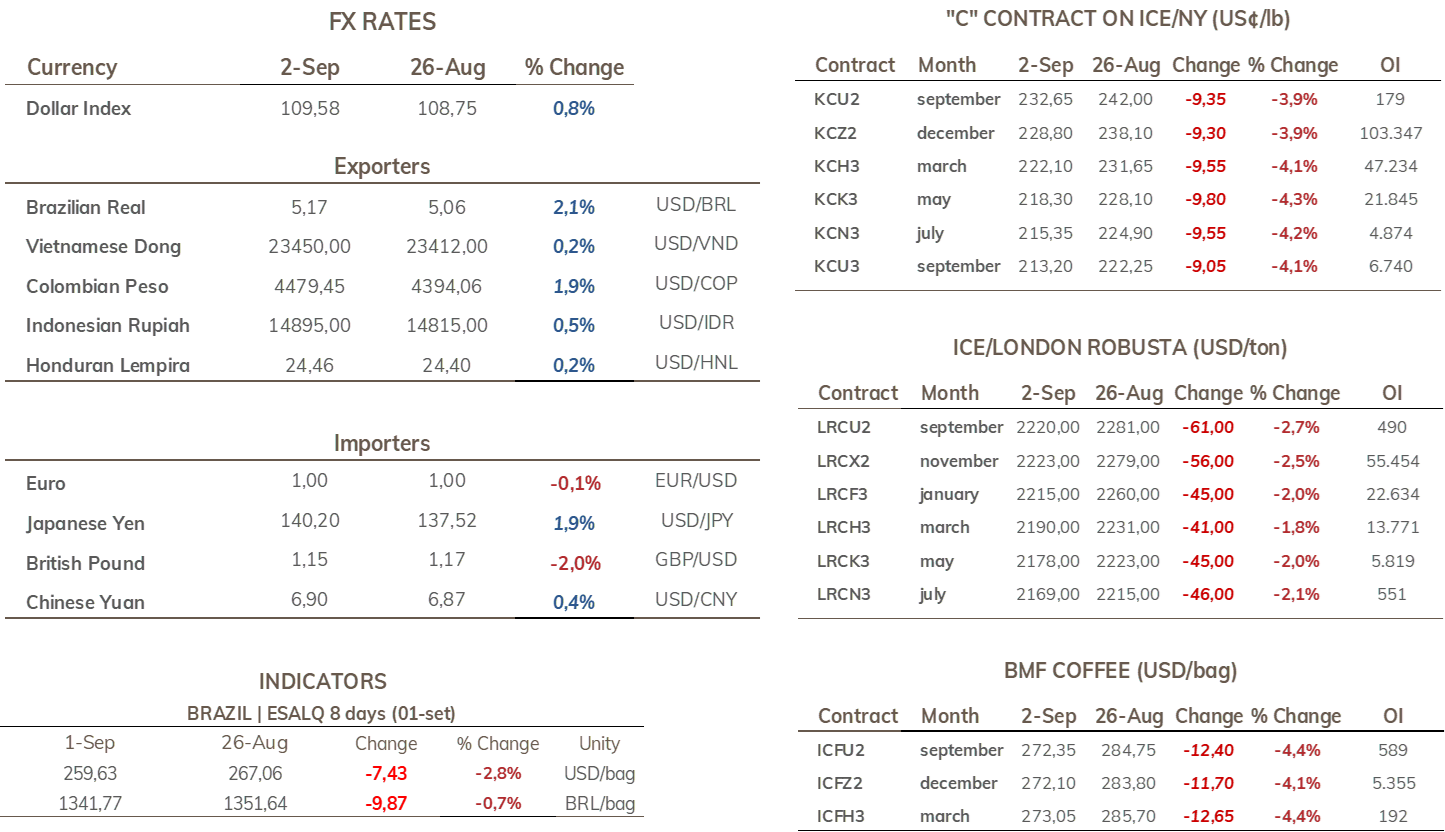
In New York (ICE), the most active contract (Dec/22) gradually retreated over the last few sessions, accumulating a drop of 930 points (3.9%) from the previous Friday (26) to close at US₵ 228.80/lb. It is worth mentioning that the most intense drop observed last Friday (2) was due to the forecasts of some rainfall in parts of the coffee belt for mid-September. In London (ICE Europe), the movements showed a similar trend, with the most active Robusta coffee contract (Nov/22) retreating USD 56 (-2.5%) to close the period at USD 2223/t.
In the domestic market, the oscillations showed less intensity compared to the international market. Cepea's Arabica indicator pointed to a trend in the same direction as the NY exchange, with a weekly drop of 1.5% to close at BRL 1331.04/bag. On the other hand, Robusta coffee registered a slight increase of 0.3%, closing at BRL 749.72/bag.
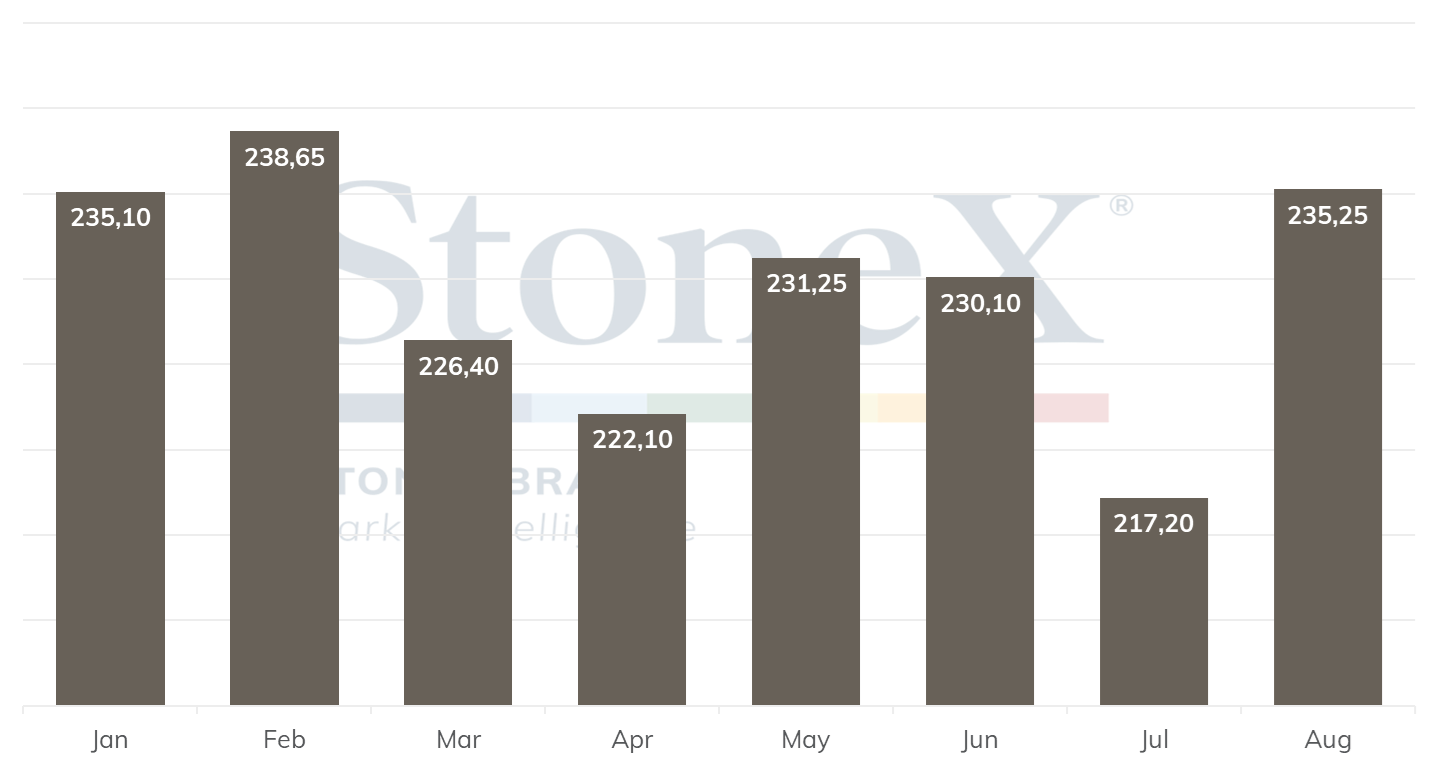
The pause in the rally of coffee quotes in the last week indicates that the most intense concerns about the Brazilian crop were largely priced between August 22 and 26. New events are necessary for prices to move again similarly. It is also noteworthy that despite the depreciation in recent days, coffee prices ended the month with a significant appreciation. In New York, the monthly gain was 10%, quoted at US₵ 235.25/lb on August 31 versus US₵ 213.8/lb at the end of July, the best monthly close since February. In London, the monthly gain was 10.9%, securing the best one-month close since December last year.
Monthly settlement of the most active contract on the New York Stock Exchange in 2022
Source: Commodity Network Trader’s Pro. Design: StoneX.
Despite last week's retreat, the trend is for coffee futures to remain in a higher price range since fears about the yield of the current crop and the flowering of the 2023/24 crop should still weigh more heavily on the market than fears about possible drops in consumption amid the risk of a global recession.
Last week, the Secretariat of Foreign Trade (Secex) updated the information on the Brazilian trade balance for the last month. The numbers, considered as a preview to Cecafé's official results, point to a total of 2.334 million bags exported, 19.0% less than the 2.882 million shipped in August of last year and a 4.8% drop in relation to the previous month. However, the information can generate some discomfort in the market while the official data from Cecafé are not revealed since, seasonally, Brazil usually presents a growth of 14.7% in the passage from July to August, according to the average of the last five years.
If confirmed, this information could add further insecurity in relation to the difficulties encountered by the Brazilian market in closing deals and disposing of the coffee from the current crop to the international markets. However, it is worth remembering that Secex and Cecafé's data eventually present significant disparities among themselves. The current information should be seen as a preview or a trend for what to expect from official data.
Additionally, on the supply side, data from other major Arabica coffee producers have not been optimistic either, such as the case of Honduras. The country, the 4th largest producer of Arabica coffee and an important supplier to the North American market, has seen strong impacts on its current crop due mainly to a high incidence of coffee leaf rust. This fungal disease affects the plants during periods of high moisture.
According to the data released by the Honduran Coffee Institute (IHCafe), the country exported last month 297 thousand bags of coffee, a significant decrease of 29% compared to the 418 thousand bags exported in August last year. As a result, total exports from Honduras for the current season (October 21 to September 22) have reached 4.58 million bags, 18.7% lower than the 5.63 million bags for the same period in the previous year, with only one month remaining in the crop year. It is worth remembering that due to the problems the country is facing, the USDA revised in May its estimates for the country's production in the current year from 6.8 million bags to 5.4 million bags, a decrease of 20.6%.
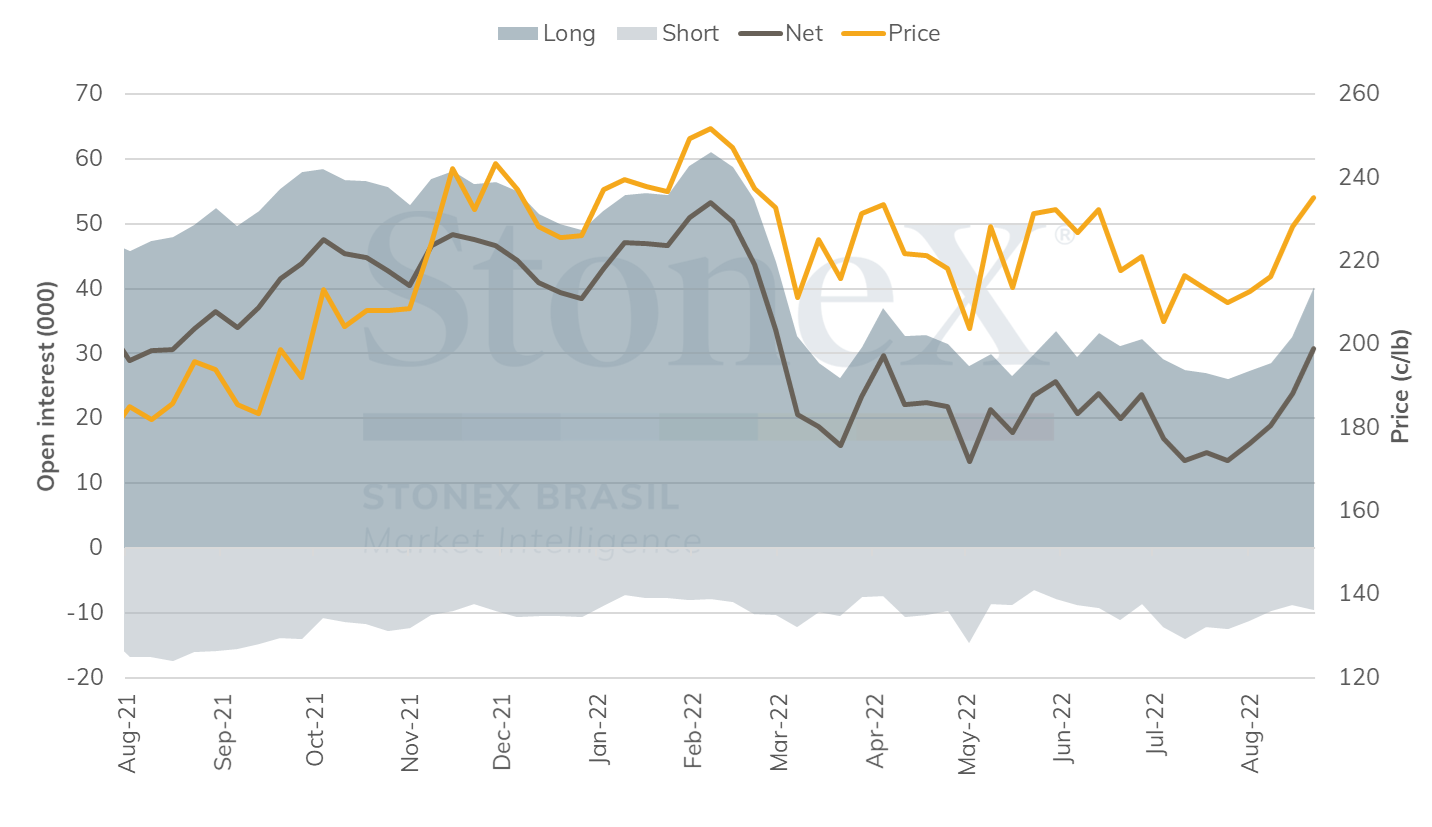
The latest Commitment of Traders report by the CFTC revealed a significant expansion in long positions by spec funds in New York coffee futures and options. According to the report, speculators increased their long positions by 7,755 between August 23 and 30, going to 40,278, with an increase of only 778 short positions to 9,524. Thus, the specs' net long position went from 23,777 to 30,754 lots. In the same period, prices advanced 695 points, going from US₵ 228.25/lb to US₵ 235.20/lb. Interestingly, with the changes, both the total lots bought and the net balance reached their highest positions since March 08, when the coffee market had been unwinding a significantly bullish bias after the start of the Russian-Ukrainian war on February 24. The move corroborates the more bullish bias generally observed in the coffee market in recent weeks. On the other hand, it should be noted that a significantly high long position by speculators opens room for a more abrupt reversal in the case of a change in fundamentals.
Spec funds position in coffee futures and options vs. most active contract on ICE NY
Source: CFTC, Trader's Pro. Design: StoneX.
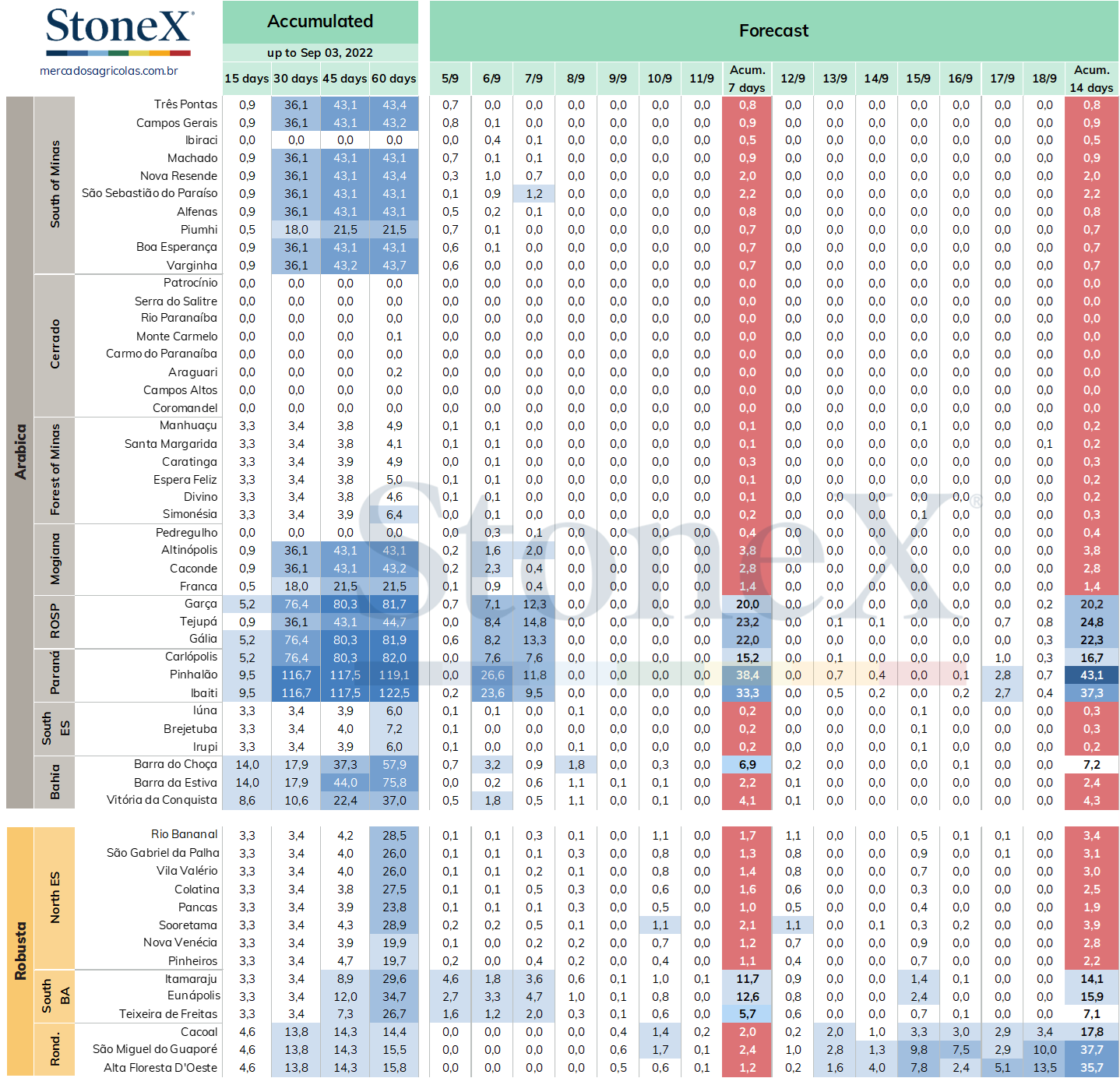
For this week, while the market awaits production and export data from Colombia, which should be released in the next few days, and from Cecafé, to be released between the end of this week and the beginning of next week, the weather, as expected for a pre-flowering period, should be in the spotlight. As mentioned in other editions of this report, rainfall forecasts beyond 48 hours are considered to have a high degree of inaccuracy and are likely to change. This type of change to long-term forecasts has proven frequent in recent weeks.
History and rainfall forecast for Brazil's coffee-producing regions (mm) - September 05, 2022
Source: StoneX, with data provided by NOAA / NCEP / GFS: Global Forecast System), 2022.
Last Friday (2), weather forecasts indicated the arrival of better rainfall volumes in the southern region of the coffee belt from September 10, which contributed to putting pressure on prices on the stock exchange. However, on Monday (September 05), the forecast models no longer count on the arrival of this rainfall, indicating a still dry climate for this week and next. If it remains in the next updates, this scenario may contribute to a new price boost at the trade opening on Tuesday (6) since the US stock exchange was closed today due to the Labor Day holiday in the United States. Market participants should also follow the update of the El Niño / La Niña probability forecasts from the NOAA, which is expected to be released on Thursday (8). They will contribute to understanding how strongly La Niña may continue to affect the weather in major global producers.
USDBRL appreciates amid global risk aversion
In a week of greater caution in the international market, with expectations for a tight monetary policy in the central banks of the United States and Europe, the USDBRL registered a 2.1% rise in the Brazilian exchange market, ending Friday (2) quoted at BRL 5.187. In the foreign scenario, investors' search for safe-haven assets boosted the dollar index to close at 109.6 points, a weekly gain of 0.8% and renewing its highest levels in nearly 20 years.