

Daily Coffee Report 8/4/26
Daily coffee report
StoneX Coffee Team
- Coffee
By: StoneX Intelligence Brazil, StoneX Intelligence Brazil


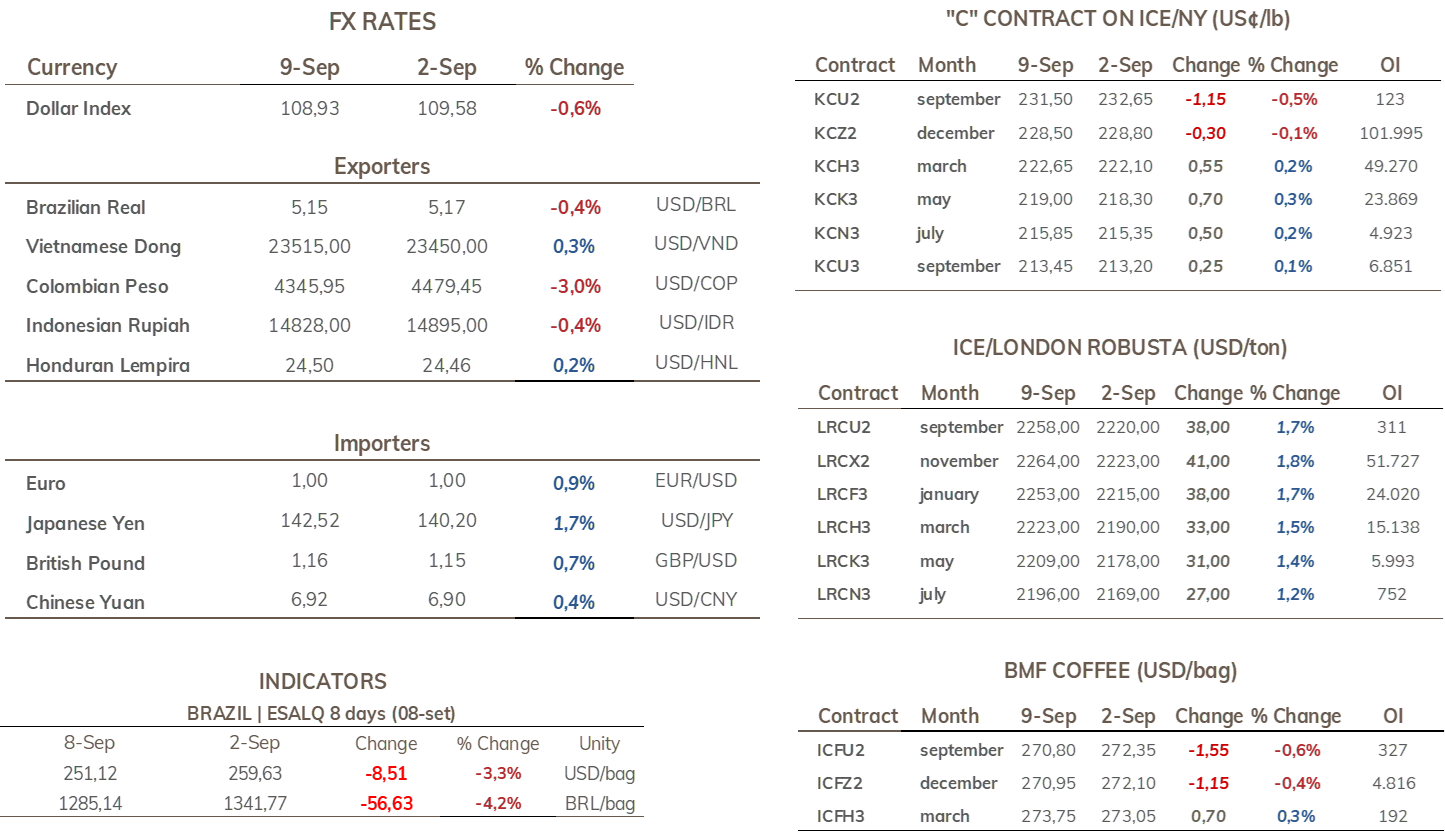
• Arabica prices dropped by 30 points (-0.1%) in NY, closing the week quoted at US₵ 228.50/lb
• Cepea’s Arabica indicator dropped by 1.1% in the week, quoted at BRL 1,316.06/bag
• Robusta prices increased by 1.8% in London to USD 2264//t
• Cepea's Robusta indicator closes near steady, quoted at BRL 750.22/bag
• Rainfall and USDBRL put pressure on prices of Arabica for most of the week ▼
• New rainfall at the end of the week can bring relief to producers ▼
• US records strong coffee imports in July ▲
• In addition to the weather, the market should reflect on the week Brazilian exports US stocks in August
• NOAA increases the probability of La Niña to the end of the year ▲
• Forecasts indicate La Niña with intensity similar to 2021 and weaker than 2020
• After a volatile week, USDBRL ends the week lower▲
• IPCA shows deflation in August ▲
• The price of roasted and ground coffee to the Brazilian consumer declined for the first time since February 2021
• US inflation data is the highlight among this week's indicators
▼ Fatores baixistas ▲ Fatores altistas
Read our latest analysis - Coffee flowering remains at risk with La Niña for the third consecutive year
Coffee futures ended the last week with mixed results, in a week marked by a lower volume of trading due to the Labor Day holiday in the United States on Monday (5) when the New York Stock Exchange (ICE) was closed, and the Brazilian Independence Day on Wednesday (7), when most domestic traders were away from the market.
Weekly intraday (most active contract) – Sept. 05 to 09
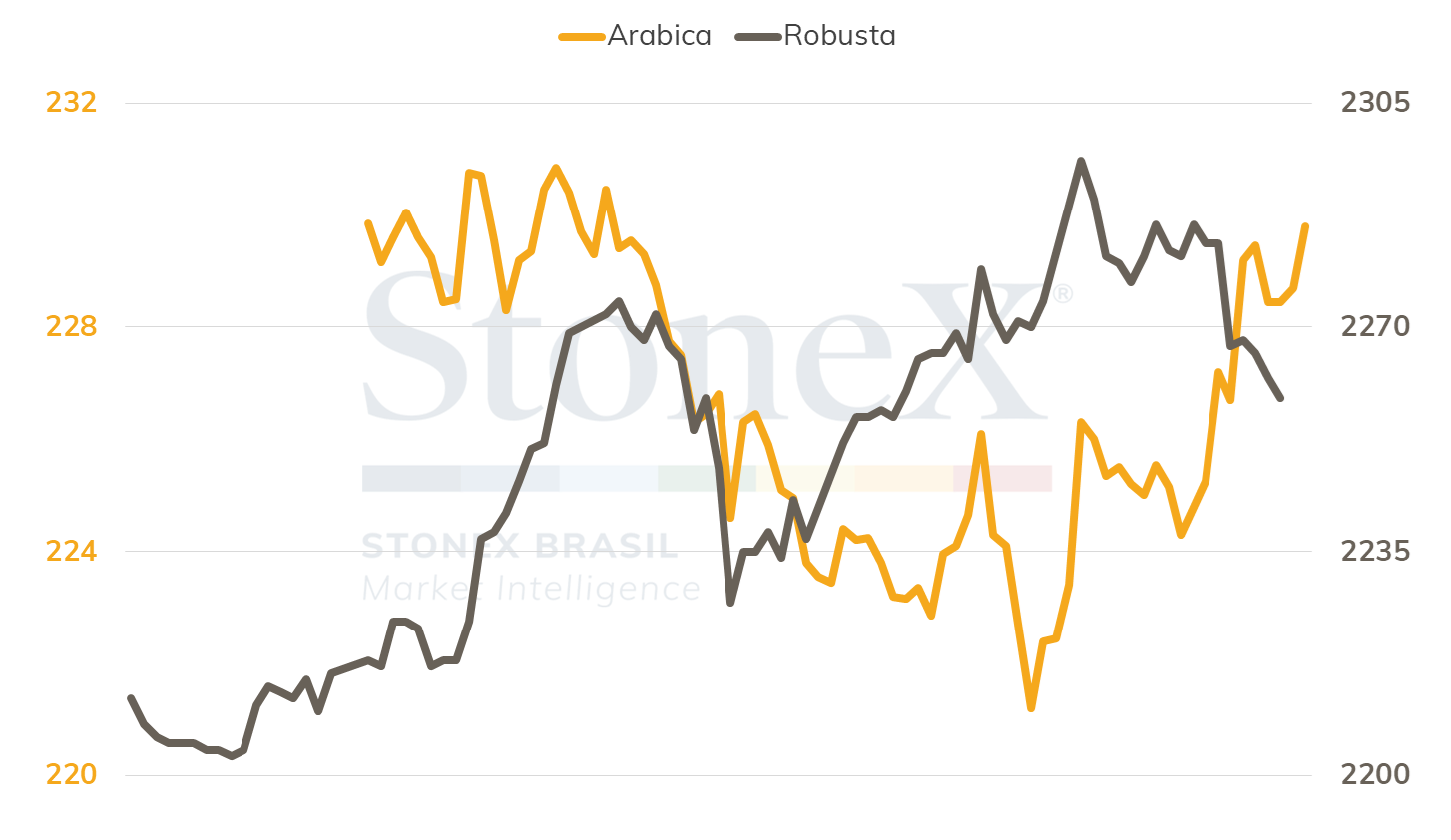
In New York, the most active contract (Dec/22) did not show a defined direction, ending the week quoted at US₵ 228.50/lb, practically stable in relation to the previous Friday (2). Without great fundamentals, Arabica prices started the week higher on Tuesday (6), correcting part of the fall recorded in the previous week. In the two following sessions, the market experienced downward pressures caused by occasional rainfall in producing areas in Minas Gerais and a greater aversion to risk in global markets amidst the contractionary measures adopted by the American and European central banks. By Thursday's session close (8), Arabica coffee had accumulated a weekly drop of 2.4%, which ended the day quoted at US₵ 223.40/lb. However, on Friday (9), coffee resumed a bullish trend, supported by a significant daily drop of the dollar in the Brazilian exchange market and a recovery of commodities in international markets after a week marked by greater caution.
In London, Robusta’s most active contract (Nov/22) appreciated by USD 41 (1.8%), closing the period at USD 2264/t. The Robusta market, in general, has been supported by the industry's higher demand for the variety to adjust to the high prices and lower availability of Arabica in the market. It is worth remembering that, although below the highs reached at the end of August, Robusta prices are at their highest since the end of February, when the Russian-Ukrainian war broke out.
In Brazil, the Cepea indicator showed a drop in Arabica prices of 1.1% for the week, closing at BRL 1316.06/bag. On the other hand, the Robusta coffee ended practically stable, quoted at BRL 750.22/bag.
As mentioned above, occasional rainfall in coffee-producing areas contributed to some market relief regarding Brazilian production, causing the price drops until last Thursday. However, a more significant volume is still needed to trigger most Brazilian flowering. Currently, the StoneX forecast model, based on the GFS model and NOAA data, points to the arrival of new rainfall at the end of the week, with the possibility of more intense volumes starting on September 23rd, especially in the Sul de Minas region. It will be necessary to follow up if the precipitations will materialize, which, in case they do, can generate some optimism about the crop performance.
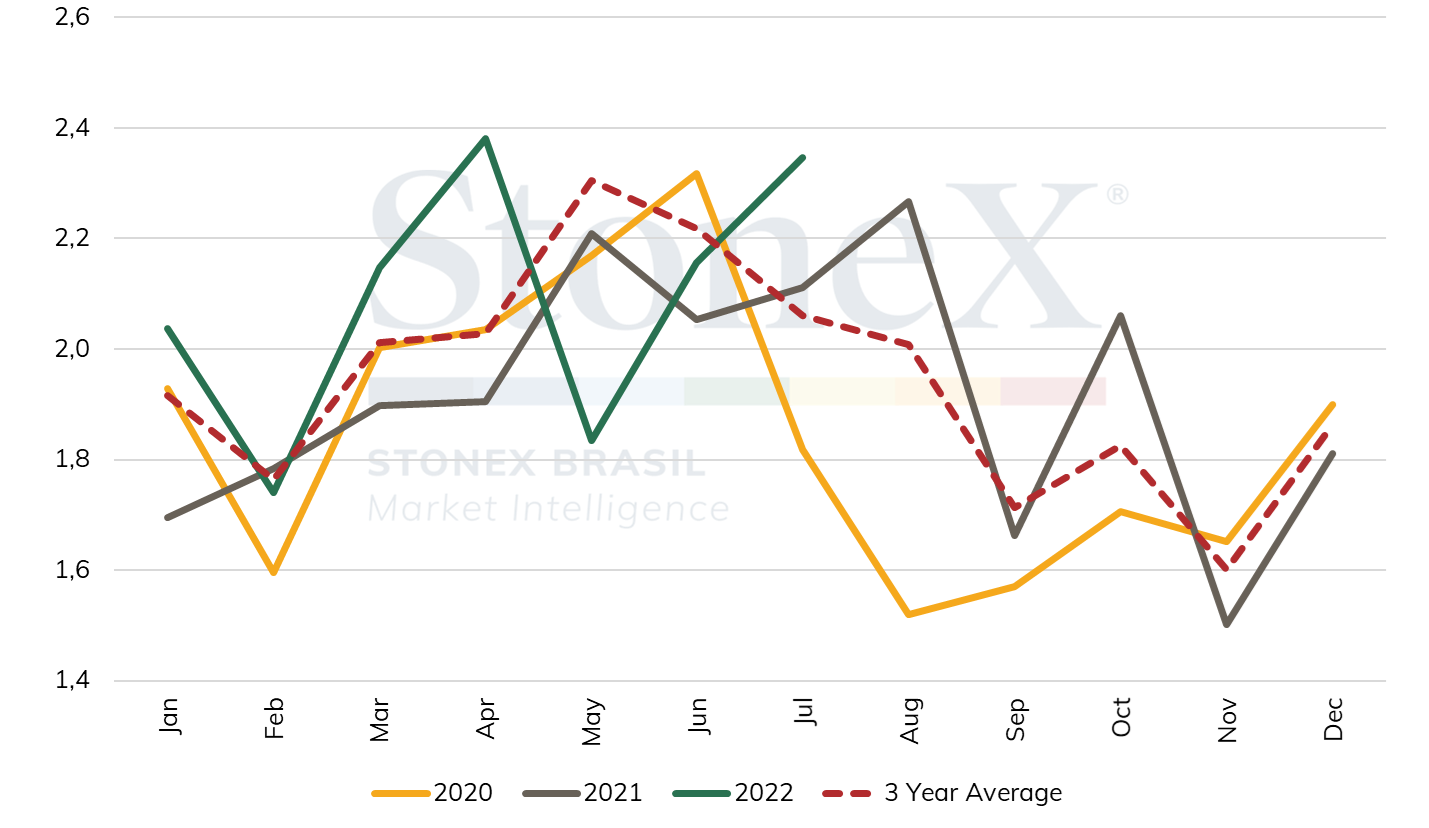
On the demand side, the USDA updated the US import data for July, indicating that the demand for the largest global coffee consumer remains strong. According to the data, the country imported 2.346 million bags of green coffee in the month, an increase of 8.9% compared to last year, when 2.110 million bags were unloaded at American ports and 16.2% above the average of the last five years. In the first seven months, the United States imported 14.6 million bags, 7.2% more than last year, when it reached 13.6 million. Brazilian coffee also continues to make its mark as the largest global consumer, accumulating 4.4 million bags this year. The volume is 1.0% below the same period last year but 17.5% above the average for the last five years.
US coffee monthly imports (million bags)
This week, market participants should reflect on the release of Brazilian export figures for August by Cecafé and stocks at American ports by the Green Coffee Association (GCA). It is worth remembering that the data of the Secretariat of Foreign Trade (Secex) indicated a decrease of 19.0% in the volume of coffee shipped by Brazil. As mentioned last week, if confirmed, the information could add more insecurity in relation to the difficulties of the Brazilian market to sell the coffee of the current crop to the international markets, remaining the indications of a harvest performance below the expected, which could act in a bullish way to the quotations.
La Niña probability forecast
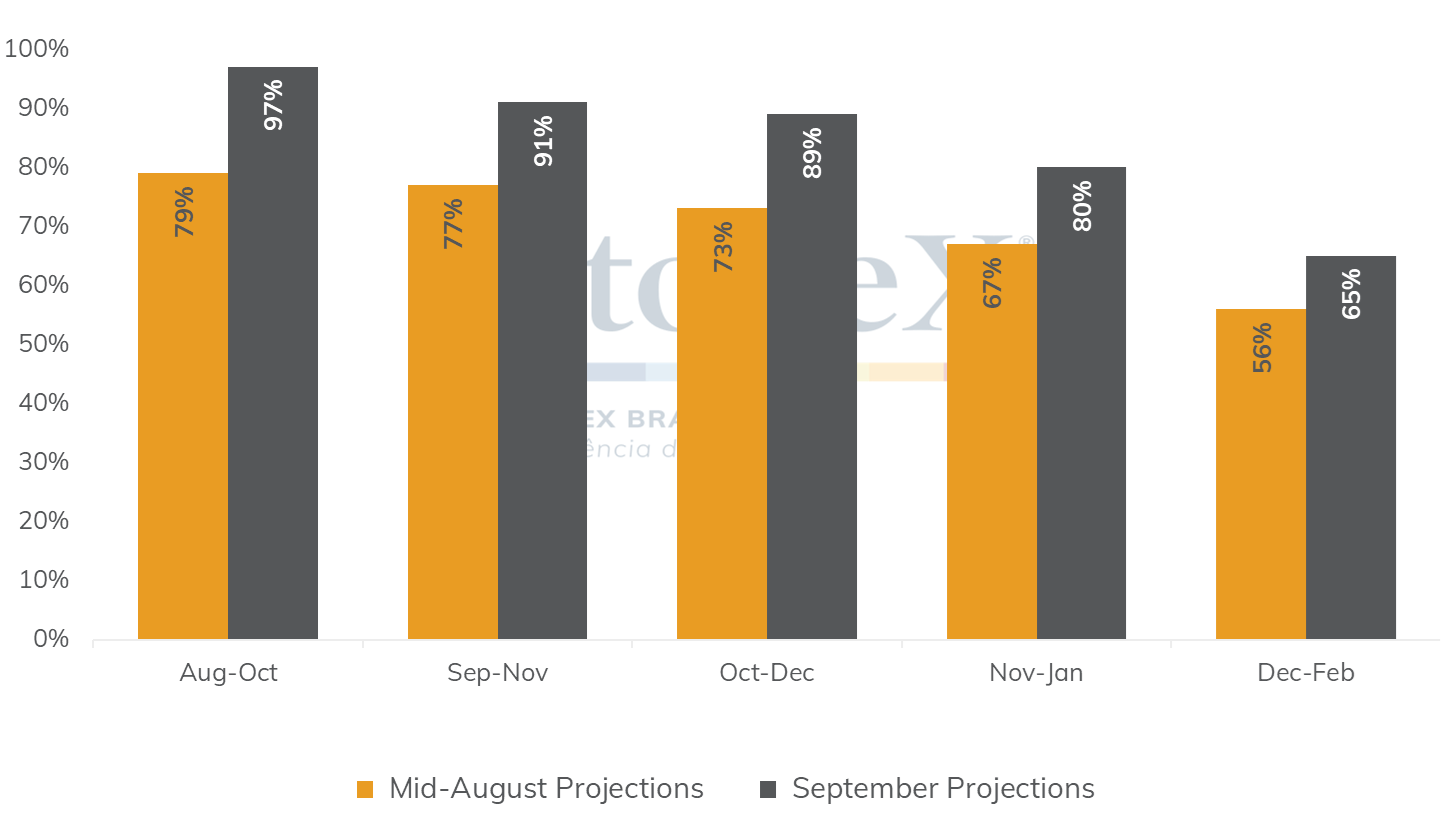
In this regard, it is worth looking at the level of intensity that the NOAA has pointed to. Observing the history available until the quarter JJA (Jun to Aug), it is noted that on average, for the three months, the ENSO presented a variation in temperatures of -0.8 °C, which characterizes a weak La Niña. It is worth remembering that the greater the intensity of the phenomenon, the greater its propensity to alter the weather pattern in the affected regions, and that its occurrence is associated with the delay in the arrival of rainfall to the coffee belt in the flowering period, a crucial period.
History and forecasts of changes in Pacific Ocean temperatures (°C)
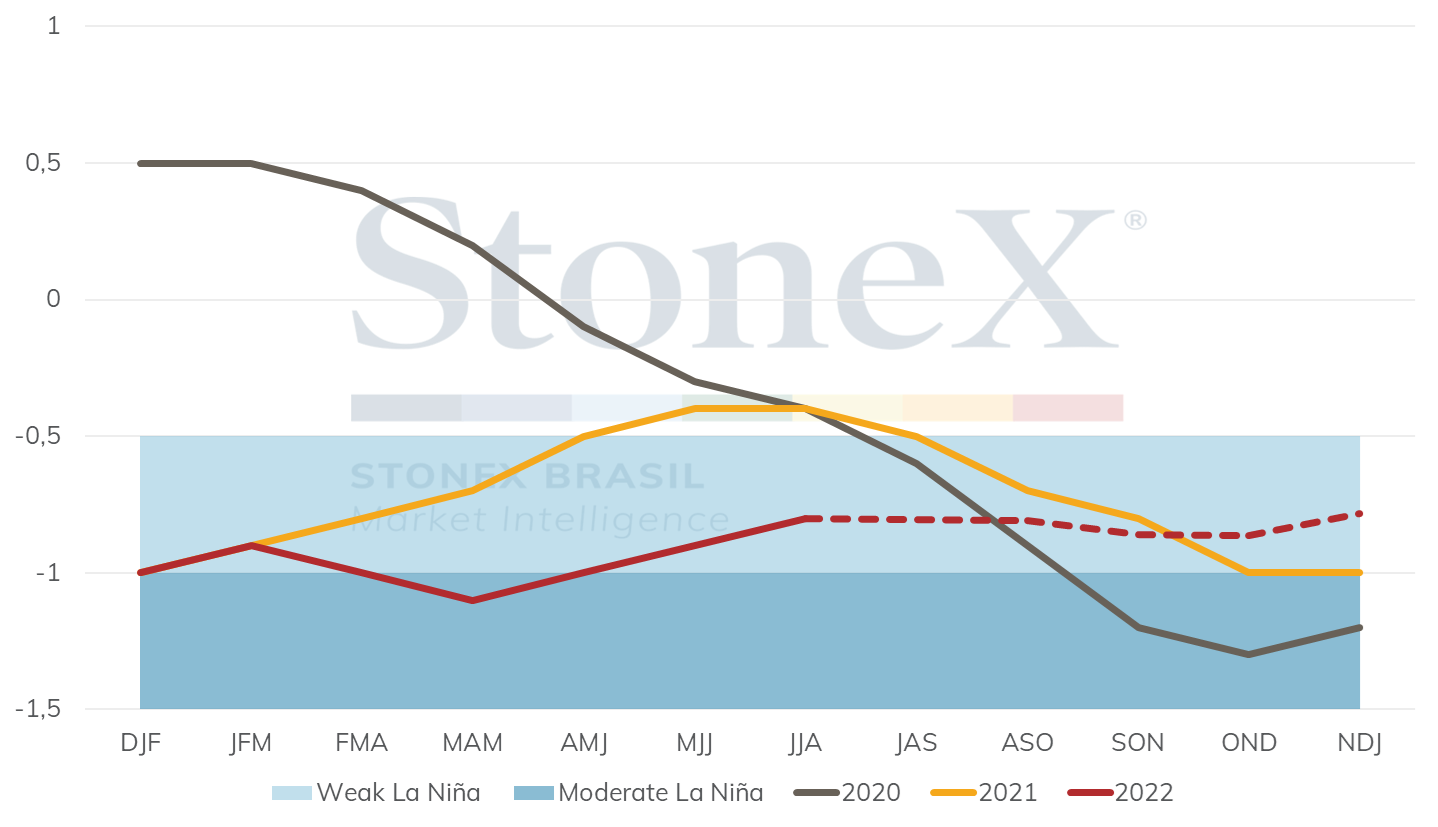
The history also shows that, compared to the last two years in which Brazil was affected by La Niña, 2022 registered greater intensity throughout the first semester, which helps explain the dry period and the water crisis of the first semester. According to the projection models used by the Climate Prediction Center (CPC) of the Columbia International Research Institute for Climate and Society (IRI), which uses the data provided by NOAA, the average of the projection models used so far points to the maintenance in the range of weak intensity, close to what occurred in 2021. In a special analysis published last Friday, we analyzed the current conditions, what may occur in the flowering process and the possible scenarios for the coming months.
Contributing to the strength of the Brazilian currency was the IBGE's announcement that the National Broad Consumer Price Index (IPCA) showed a variation of -0.36%, the second consecutive month of deflation, with the accumulated figure for the last 12 months falling from 10.07% in the previous month to 8.73%, its lowest value since June 2021. As pointed out in the FX Weekly report, this deflation was the result of the significant drop in prices of commodities with considerable weight in its calculation, namely, fuels – gasoline (-11.64%), hydrous ethanol (-8.67%), diesel oil (-3.76%) and vehicular natural gas (-2.12%) – and residential electricity (-1.27%). These products, in turn, still reflect federal and state tax subsidies issued by the government in July and the drop in Petrobras' fuel prices at its refineries. When one checks these five items' total impact on the August IPCA, one observes a reduction of -0.80% in the index. In other words, by removing these products from the August inflation calculation, the result would be an increase of 0.44%.
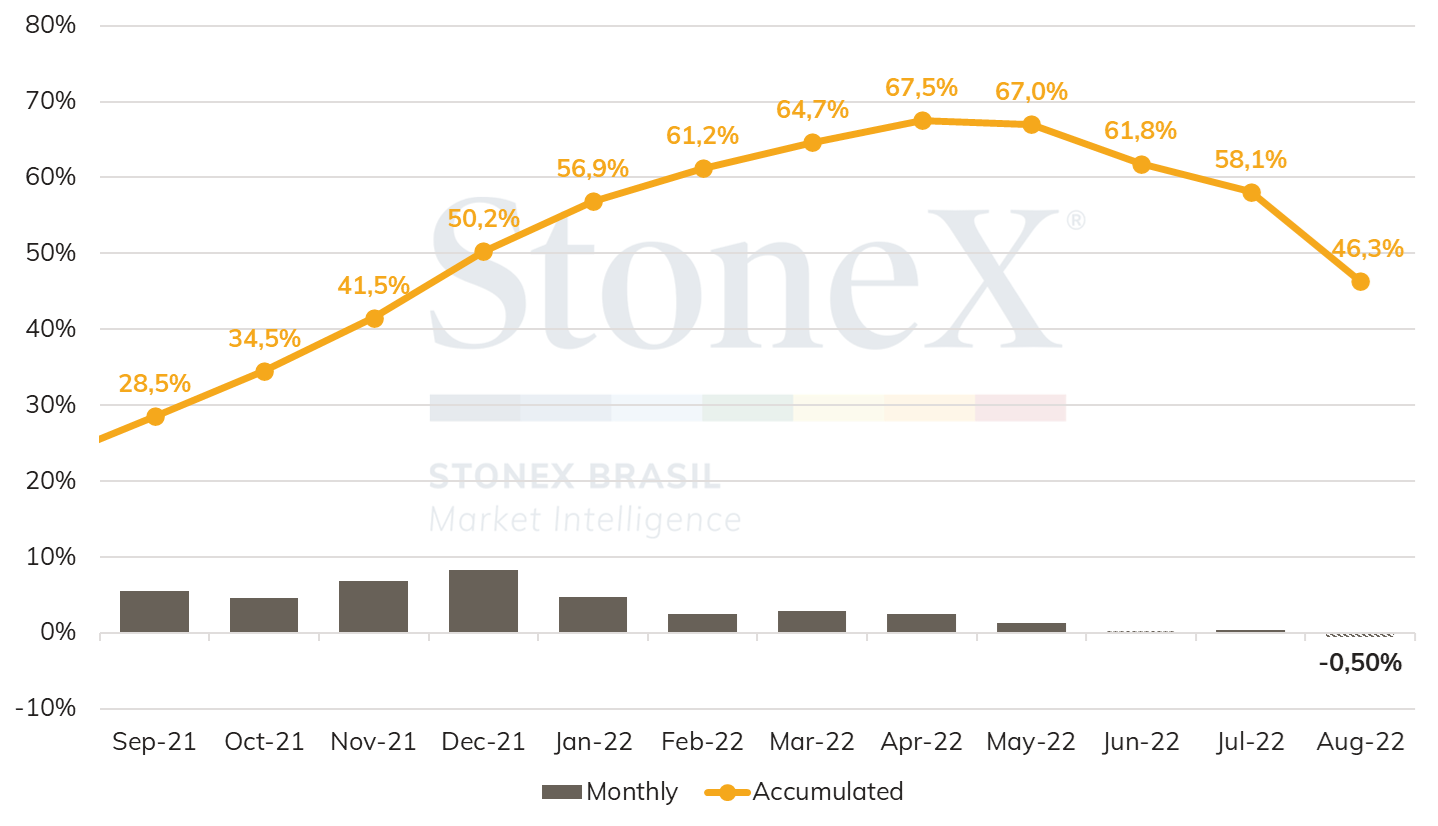
The price of roasted and ground coffee to the Brazilian consumer declined for the first time since February 2021. With the result, the accumulated figure for the last 12 months showed a significant retraction, from 58.1% in July to 46.3%. The sharp drop in the accumulated figure was due to the removal of the 7.51% increase in August 2021 from the calculation series. However, considering that the months from September to December 2021 showed significant increases (5.5%, 4.57%, 6.87%, and 8.24%), and the trend of smoother changes indicated in the last months, the expectation is that the accumulated in 12 months will show new decreases until the end of 2022. On the other hand, instant coffee showed a retraction of 1.01% last month, with the accumulated in 12 months going from 15.24% to 14.67%.
Evolution of roasted and ground coffee inflation in Brazil over the last 12 months
This week, global agents should follow mainly the inflation data in the United States, which may affect the outlook for the Federal Reserve's next monetary policy decision, which will take place on September 21. There is an expectation that the Consumer Price Index (CPI) and the Producer Price Index (PPI) will fall slightly in August, mainly due to the decline in international oil prices. However, a slight increase is expected in the "core" of the indicator, which excludes the volatile energy and food components, suggesting that the inflationary problem is not yet overcome.

The StoneX Group Inc. group of companies provides financial services worldwide through its subsidiaries, including physical commodities, securities, exchange-traded and over-the-counter derivatives, risk management, global payments and foreign exchange products in accordance with applicable law in the jurisdictions where services are provided. References to over-the-counter (“OTC”) products or swaps are made on behalf of StoneX Markets LLC (“SXM”), a member of the National Futures Association (“NFA”) and provisionally registered with the U.S. Commodity Futures Trading Commission (“CFTC”) as a swap dealer. SXM’s products are designed only for individuals or firms who qualify under CFTC rules as an ‘Eligible Contract Participant’ (“ECP”) and who have been accepted as customers of SXM. StoneX Financial Inc. (“SFI”) is a member of FINRA/NFA/SIPC and registered with the MSRB. SFI is registered with the U.S. Securities and Exchange Commission (“SEC”) as a Broker-Dealer and with the CFTC as a Futures Commission Merchant and Commodity Trading Adviser. References to securities trading are made on behalf of the BD Division of SFI and are intended only for an audience of institutional clients as defined by FINRA Rule 4512(c). References to exchange-traded futures and options are made on behalf of the FCM Division of SFI . StoneX is a trading name of StoneX Financial Ltd (“SFL”). SFL is registered in England and Wales, Company No. 5616586. SFL is authorized and regulated by the Financial Conduct Authority [FRN 446717] to provide to professional and eligible customers including: arrangement, execution and, where required, clearing derivative transactions in exchange traded futures and options. SFL is also authorised to engage in the arrangement and execution of transactions in certain OTC products, certain securities trading, precious metals trading and payment services to eligible customers. SFL is authorised & regulated by the Financial Conduct Authority under the Payment Services Regulations 2017 for the provision of payment services. SFL is a category 1 ring-dealing member of the London Metal Exchange. In addition SFL also engages in other physically delivered commodities business and other general business activities which are unregulated and not required to be authorised by the Financial Conduct Authority. StoneX Group Inc. acts as agent for SFL in New York with respect to its payments services business. StoneX APAC Pte. Ltd. acts as agent for SFL in Singapore with respect to its payments services business. ‘StoneX’ is the trade name used by StoneX Group Inc. and all its associated entities and subsidiaries.
Trading swaps and over-the-counter derivatives, exchange-traded derivatives and options and securities involves substantial risk and is not suitable for all investors. Past performance of any futures or option is not indicative of future success. Indicators are not a trading system and are not published as a specific trade recommendation. The information herein is not a recommendation to trade nor investment research or an offer to buy or sell any derivative or security. It does not take into account your particular investment objectives, financial situation or needs and does not create a binding obligation on any of the StoneX group of companies to enter into any transaction with you. You are advised to perform an independent investigation of any transaction to determine whether any transaction is suitable for you. No part of this material may be copied, photocopied or duplicated in any form by any means or redistributed without the prior written consent of StoneX Group Inc.
© 2026 StoneX Group Inc. All Rights Reserved.
Our subscribers have access to comprehensive market analysis from StoneX spanning commodities, equities, currencies and more.
Daily coffee report

August 4 – The benchmark Dow Jones Industrial Average surged into the close yesterday to finish almost 700 points higher, at a record close of 53,178 points – easily clearing the previous top from almost a month ago. The S&P 500 is on the brink of its own record as well, while the NASDAQ index is short of June highs but working on a strong three-session rally. All three are pointing to positive openings today. Palantir (a U.S. software company) reported better-than-expected earnings yesterday afternoon post-close to boost the tech sector, though a host of other firms reported strong earnings as well. The ten-year note continues to retreat from Friday’s high, now at 4.67%, with the dollar on the high side of level-par, while the VIX index now under 16 shows reduced volatility.

Daily coffee report
Our market expertise, advanced platforms, global reach, culture of full transparency and commitment to our clients’ success all set us apart in the financial marketplace.
Reach
With access to 40+ derivatives exchanges, 180+ foreign exchange markets, nearly every global securities marketplace and numerous bi-lateral liquidity venues, StoneX’s digital network and deep relationships can take clients anywhere they want to go.
Transparency
As a publicly traded company meeting the highest standards of regulatory compliance in the markets we serve, our financials and record of accomplishment are matters of public record. StoneX’s commitment to “doing the right thing over the easy thing” sets us apart in the industry and helps us build respect, client trust and new partnerships.
Expertise
From our proprietary Market Intelligence platform, to “boots on the ground” expertise from award-winning traders and professionals, we connect our clients directly to actionable insights they can use to make more informed decisions and achieve their goals in the global markets.