Accordingly, it will be important to follow the last speech of Fed Chairman Jerome Powell this week before the monetary policy decision on December 14, as well as if the main economic indicators released until then will continue to build a scenario of economic and inflationary deceleration. If the indicators confirm this perspective, the tendency would be to maintain the downward pressure on the American currency. In this sense, the highlights on this week's agenda are the release of the second revision of the third quarter GDP by the Bureau of Economic Analysis (BEA) on Wednesday (30), the November Industry PMI, to be published by the ISM Institute on Thursday (1), and the November Employment Situation report, released by the Bureau of Labor Statistics (BLS) on Friday (2).
In Brazil, the issues related to the Transition PEC and the definition of the ministers of Luiz Inácio Lula da Silva's administration, especially the Finance Minister, should continue to be a source of instability in the foreign exchange scenario. Furthermore, the lack of a conclusion about the final text of the PEC and about the future government's proposal to allocate the amount related to the Bolsa Família income transfer program (estimated at BRL 175 billion) outside the constitutional spending cap, raising investors' concern about the country's fiscal scenario, has been the main bullish factor for the exchange rate in recent weeks.
This week, the future president of the Republic returns to Brasília to personally deal with the strategies for the PEC approval and to follow the definition of officials of his administration. An eventual approval of the PEC with a deadline for Bolsa Família to remain outside the spending cap and a definition of a Finance Minister more in line with market expectations could relieve the recent USDBRL appreciation. In case of uncertainty prolongation, as well as the selection of a minister with less alignment to the liberal agenda – as the possibility of the former Minister of Education Fernando Haddad is rumored, it tends to increase instabilities and keep the USDBRL at higher levels.
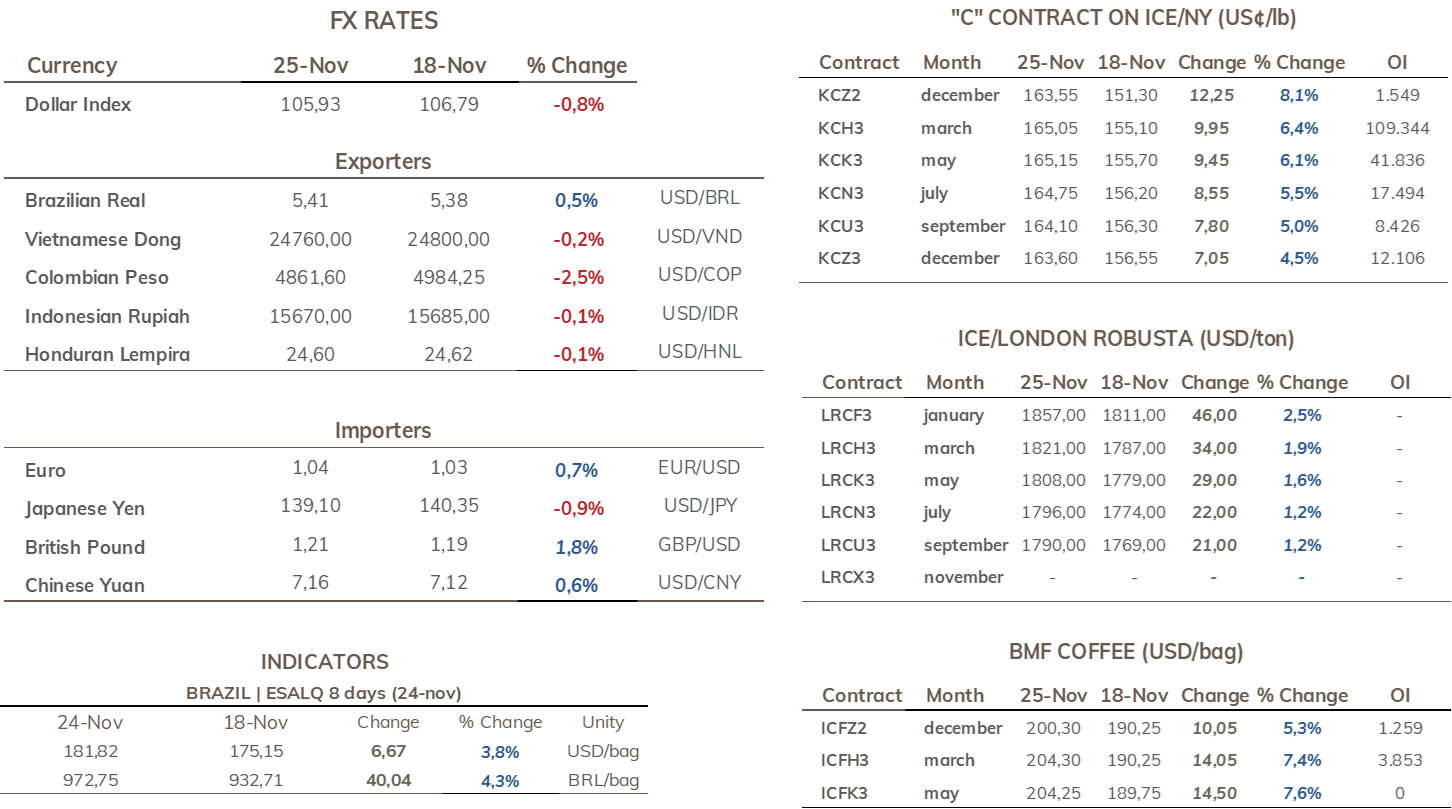
Sources: ICE/NY; ICE/EU; B3; Commodity Network Trader’s Pro.