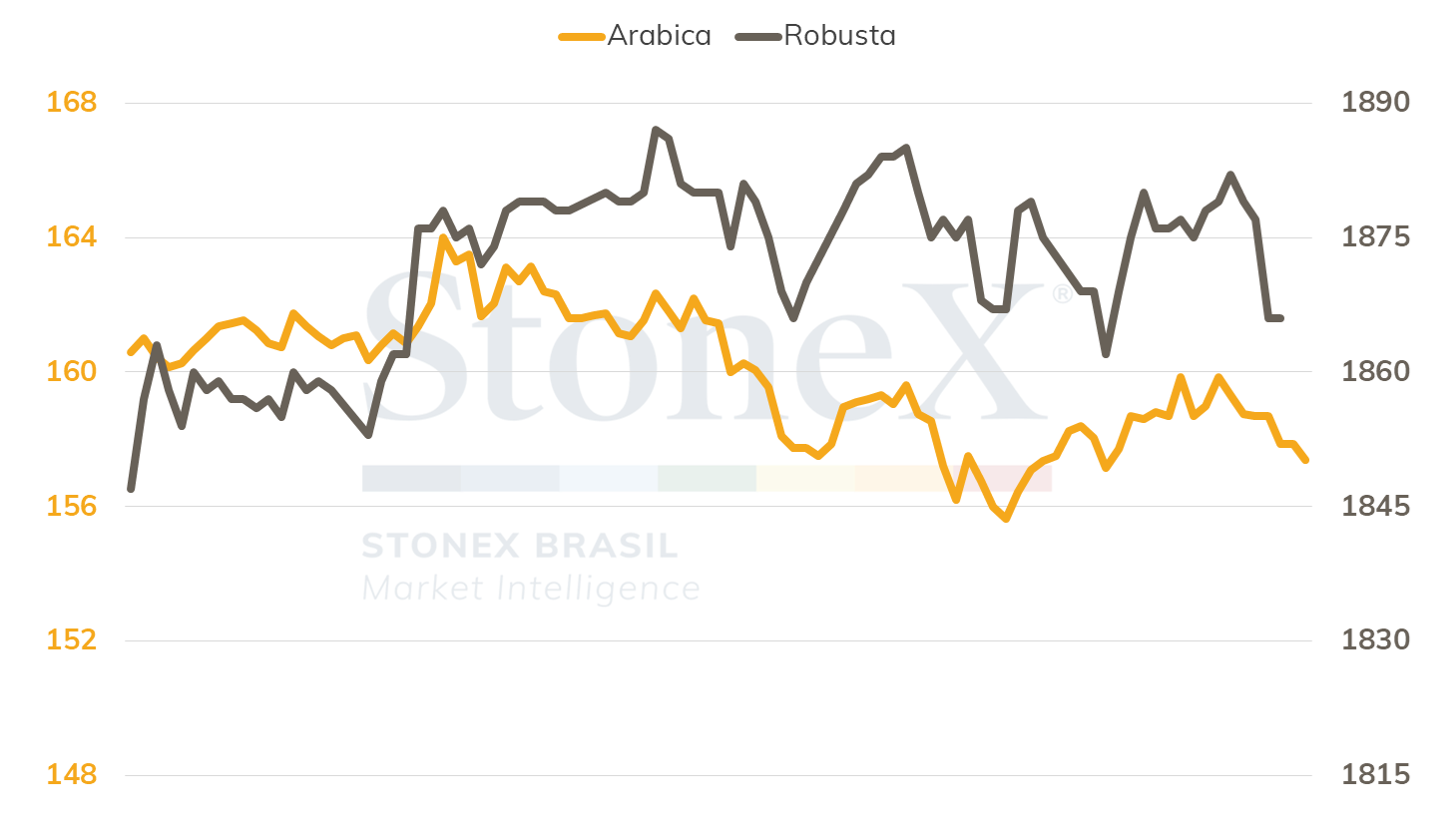
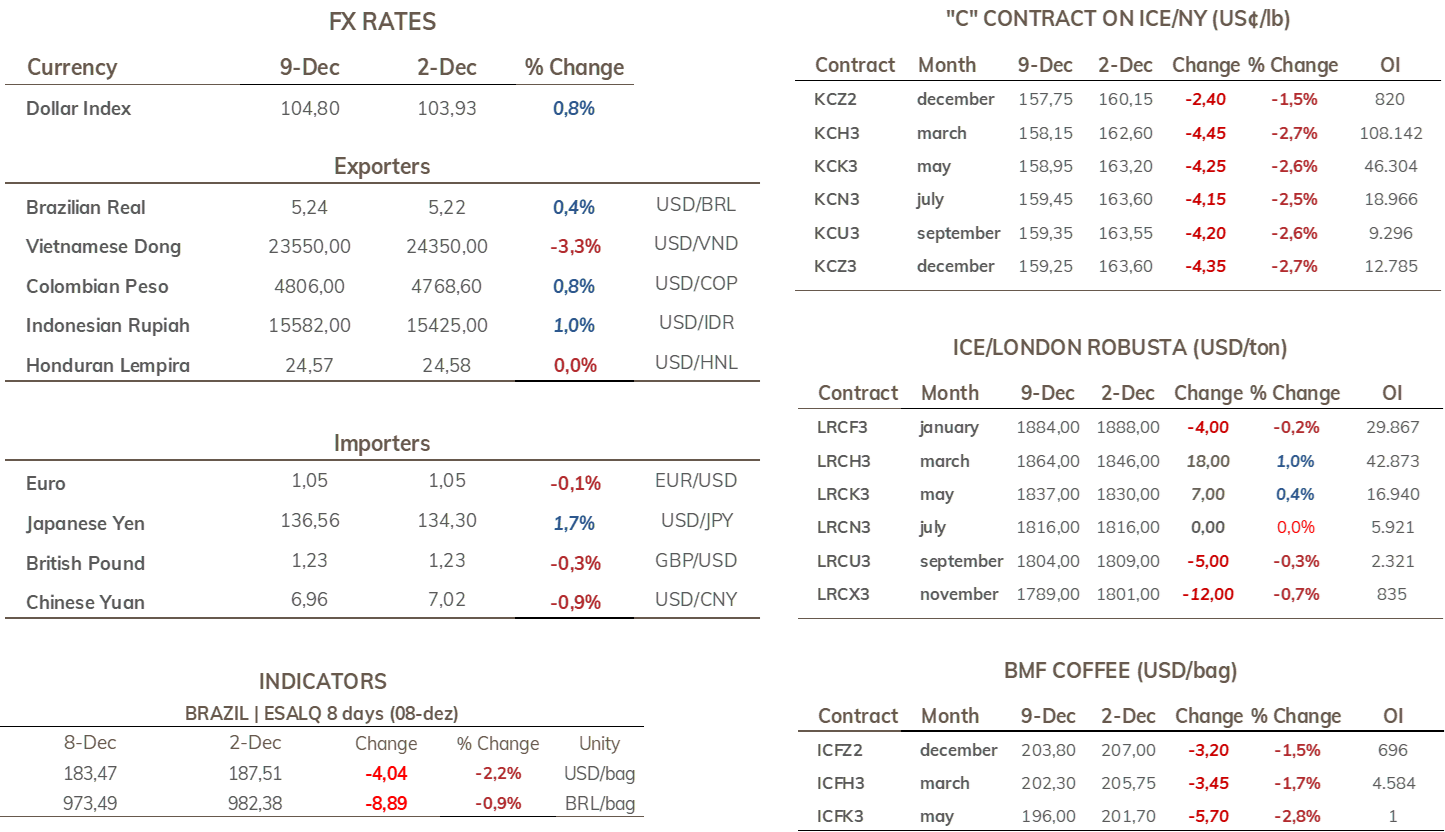
Following the market movements in New York, but with less intensity, the prices of Arabica coffee in Brazil showed a slight decline in the week, ending Friday (09) with the Cepea indicator quoted at BRL 979.85, down by only 0.25% compared to the previous Friday. On the other hand, due to demand by the Brazilian industry and the search for better values by producers, who are holding sales in search of better prices, the Cepea’s Robusta indicator ended the week high by 6.6%, closing at BRL 675.37/bag.
Concerning the 2023 crop, the outlook for a large crop has been based on adequate rainfall conditions in Brazil in recent weeks. The main Arabica and Robusta coffee-producing regions had accumulations of up to 350 mm in the last 60 days, with the forecast still pointing to accumulations of up to 200 mm from the coffee belt. Despite the positive outlook for Brazilian production, some players do not believe that the next crop can surpass the record observed in 2020. However, optimism should continue to weigh on prices until new estimates indicating a different scenario are released.
For Robusta coffee, the scenario has been a little different. As mentioned before, in Brazil, Robusta prices remain strong amid strong demand from the industry. The appreciation of Robusta coffee in the Brazilian market supports the increase in price differentials and disfavors Robusta exports, which places Vietnam and Indonesia as the main suppliers of Robusta to the international market. In recent weeks, Robusta differentials have advanced again, exceeding USD 200/t last week, indicating that Cepea's Robusta indicator is USD 200 more expensive than London. Access here the interactive report with the differentials of coffee prices in Brazil.
Considering that Vietnam remains the main supplier for the international market, it is worth mentioning that the country's coffee production should be slightly lower this season, according to the USDA, but should still exceed 30 million bags. In 2022, the TET holiday, the lunar new year, will take place earlier than last year, starting on Jan. 22 and stopping activities for nine days, which reduces the buying window and has supported the movements observed in recent weeks. The harvest there started in mid-November and should continue until January.
This week, prices should react to export data in Brazil by Cecafé, which will be released today (12). The prospect is that important export volumes will be reported for November, which should indicate how coffee's logistical situation and availability are in this crop year. In addition, prices should react to the stock data at US ports, which will be released on Thursday (15).
On Dec. 12, the USDA will release its final report with the global supply and demand balance. The feeling is that the agency will revise the supply and demand balance, considering that in the last attaché reports, the agency had already reduced its outlook for Brazilian production in 2022/23. In addition, the report indicated a lower production in Colombia compared to the previous estimate.
NOAA maintains La Niña forecast as of early 2023
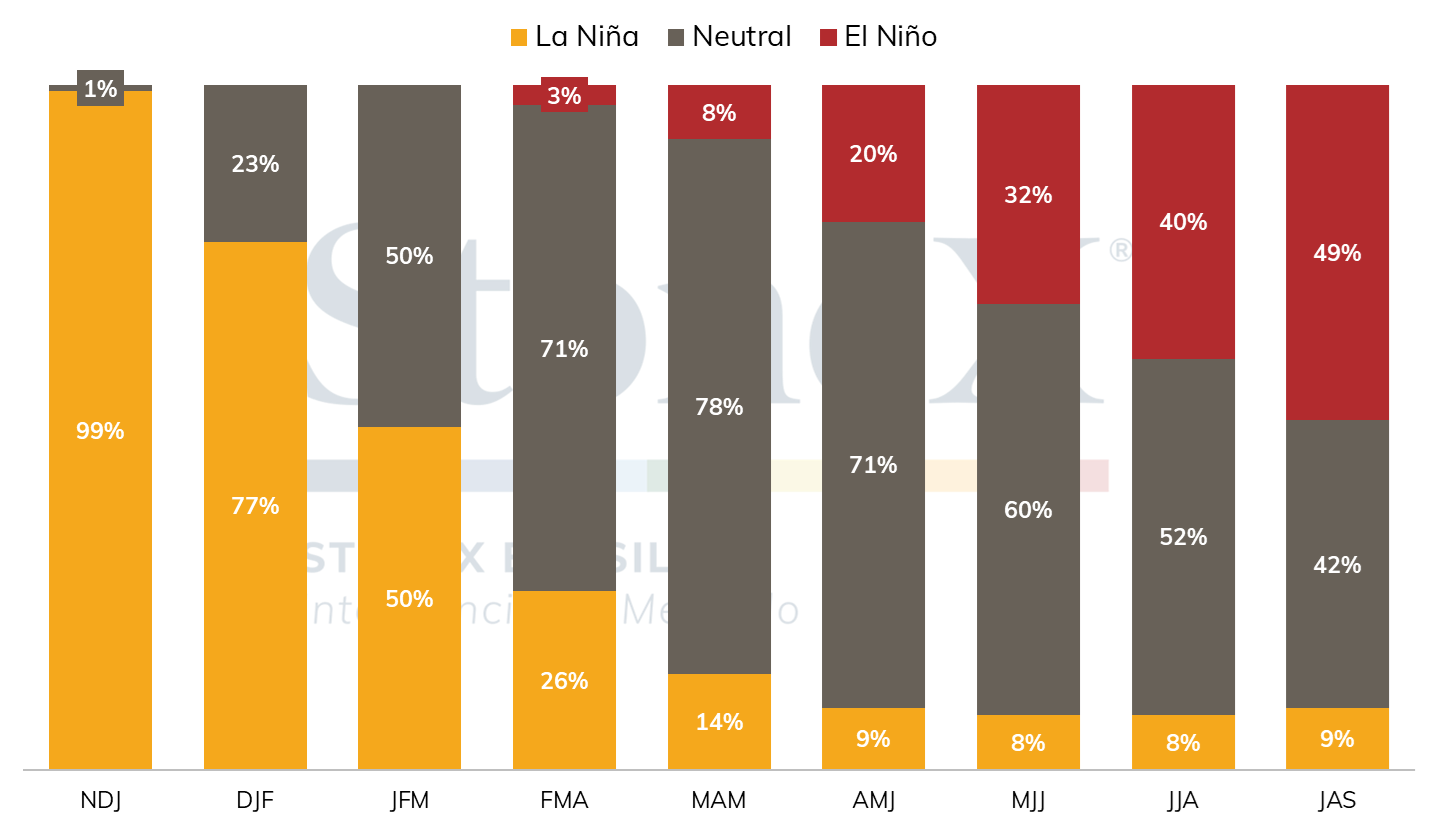
American agency NOAA released its El Niño/La Niña probability report. According to the agency's report, La Niña should continue until early next year, when the scenario should shift to a neutral condition. It is worth pointing out that the report indicated a 49% probability of El Niño occurrence starting in the July/Aug/September quarter. In Brazil, the El Niño occurrence may be associated with dry weather, especially in the Robusta coffee-producing region in Espírito Santo. It was due to a strong El Niño between 2014 and 2016 that a strong reduction in Brazilian Robusta coffee production in Brazil was observed.
EL NIÑO/LA NIÑA PROBABILITY FORECAST
Source: IRI/CPC NOAA. Design: StoneX.
Funds follow different trends between Nov. 29 and Dec. 6
In New York, funds reflected the optimistic sentiment of the last few weeks, reaching a net short position of almost 25,000 contracts last Dec. 6, an increase of more than 2,000 contracts compared to the previous Tuesday. The scenario for the funds in New York indicates that the next crop would be ample amidst a possibly weakened consumption. Between 11/29 and 12/06, futures prices for the most active contract retreated 540 points, going from US₵ 168.9/lb to US₵ 163.5/lb. In this same period, open interest increased by 8736 contracts to 263,531.
In London, funds followed an opposite trend, reducing their net short position by more than 7,000 contracts to more than 20,500 short positions between 11/29 and 12/06. During the period, the most active contract advanced USD 57/t, closing the session on 12/06 at USD 1916/ton. The number of open interest fell by 1322 contracts to 134,088.
USDBRL appreciates amid fiscal concerns in Brazil and caution over Fed's decision
Reflecting concerns regarding the fiscal risks in the country with the Transition PEC and the expectations for the first definitions of the ministerial cadre of President-elect Luiz Inácio Lula da Silva's government, the USDBRL ended last week high by 0.6%, quoted at BRL 5.246. Abroad, on the eve of the Federal Reserve's last decision on monetary policy, the dollar index registered a weekly advance of 0.3%, ending the week quoted at 104.8 points.