Despite the favorable weather in much of the coffee belt in Brazil, with volumes above the historical average in the coffee-producing regions of Southern Espírito Santo, Minas Gerais, São Paulo, Paraná, and Rondônia, the Northern Espírito Santo and far South of Bahia has faced a period of reduced rainfall. As can be seen from the anomaly map, the accumulated rainfall over the last 30 days is at or slightly below the 30-year average for the region. The forecast for the next two weeks points to accumulations of up to 50 mm in these regions, with the return of rains in the second week.
Despite the slightly below-average accumulation in part of these two regions, it is worth mentioning that both rely on the wide use of irrigation systems, with more than 90% of productive areas in Espírito Santo, for example, relying on irrigation systems. Therefore, an important indicator in this context is the volume of water in the reservoirs, which to date, follows without major problems. Accordingly, a long period of drought is necessary for the water reservoirs to run out.
Rainfall anomaly in the last 30 days in Brazil
Source: StoneX, with data from NOAA / NCEP / EMC (GFS: Global Forecast System), 2023.
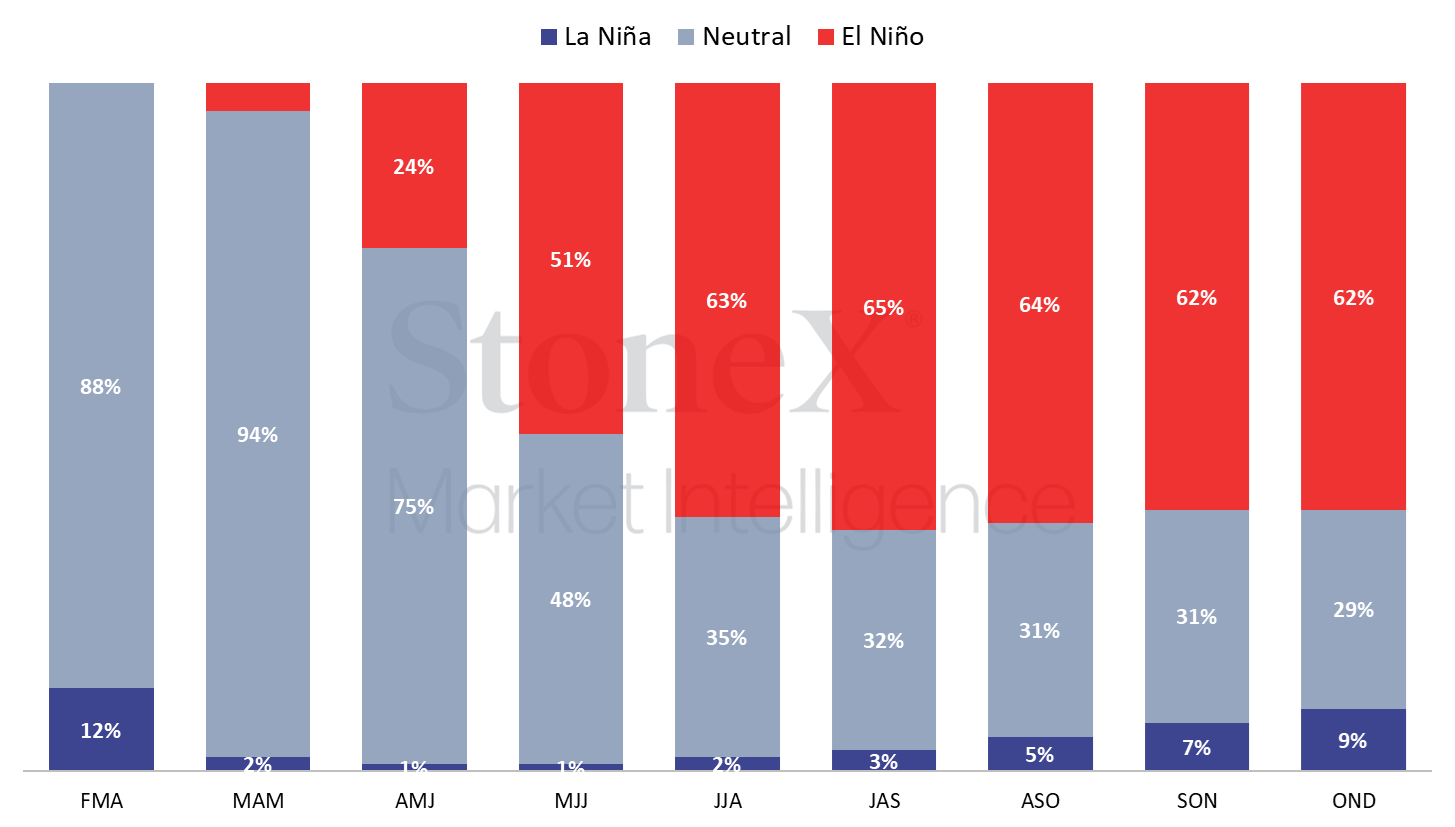
A key point in the long term is the possible impact of El Niño on the region – the latest El Niño/La Niña probability report from NOAA indicated a probability of around 60% in the year's second half. Between 2014 and 2016, a long drought associated with a strong El Niño caused the reduction in the water reservoirs of Espírito Santo and Bahia to an alarming level, which made crop irrigation unfeasible and directly affected Robusta production. USDA estimates show Brazilian Robusta production fell 38% between 2014/15 and 2016/17, from 17 million to 10.5 million bags.
El Niño/La Niña Probability Forecast
Source: IRI/CPC NOAA. Design: StoneX.
It is worth mentioning that, even in a scenario of strong El Niño and a long drought period, the impact level could be different from that observed in 2014-2016, given that there were significant advances in the productive system in Espírito Santo and South of Bahia, mainly from the implementation of new irrigation systems and replacement of old systems with more efficient ones. Moreover, after the reported episode, new water reservoirs and dams were built, even with the support of the local government, which substantially increased the water storage capacity in the region.