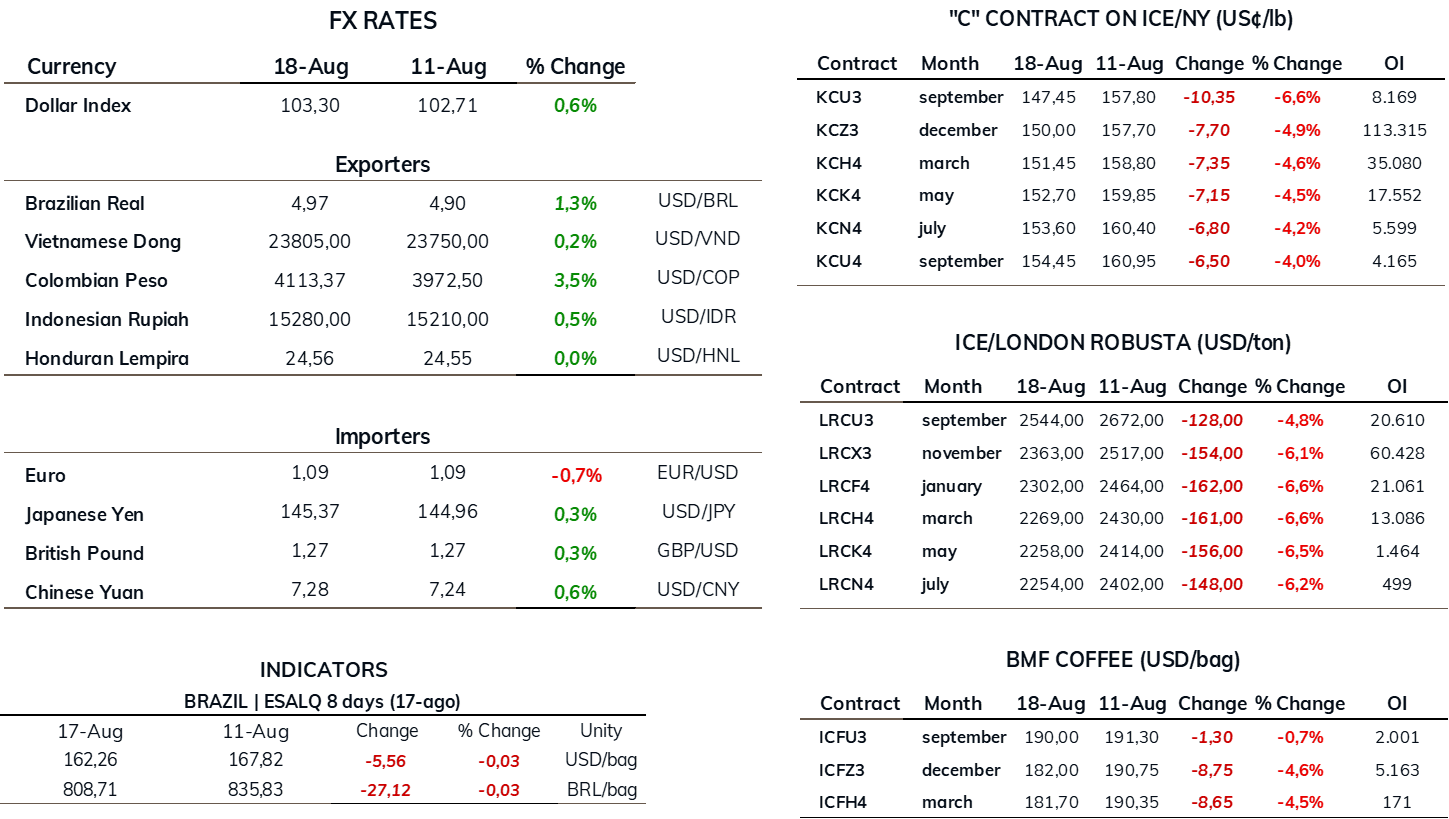
• Arabica coffee ends the week quoted at 150.00 c/lb, a sharp drop of 4.9%
• Robusta coffee prices fell 6.1% to USD 2363/t.
• The Cepea indicator for Arabica coffee ended the week down 3.3% at BRL 808.2/bag.
• The Cepea indicator for Robusta coffee fell 3.3% to BRL 644.3/bag.
• Harvest progress and greater availability put pressure on prices
• High dollar influenced drops on the exchanges
• Macro environment of risk aversion acts as a bearish factor for commodities
• Robusta follows Arabica and technical factors to retreat in London
• IRI/CPC/NOAA: Models point to a more intense El Niño.
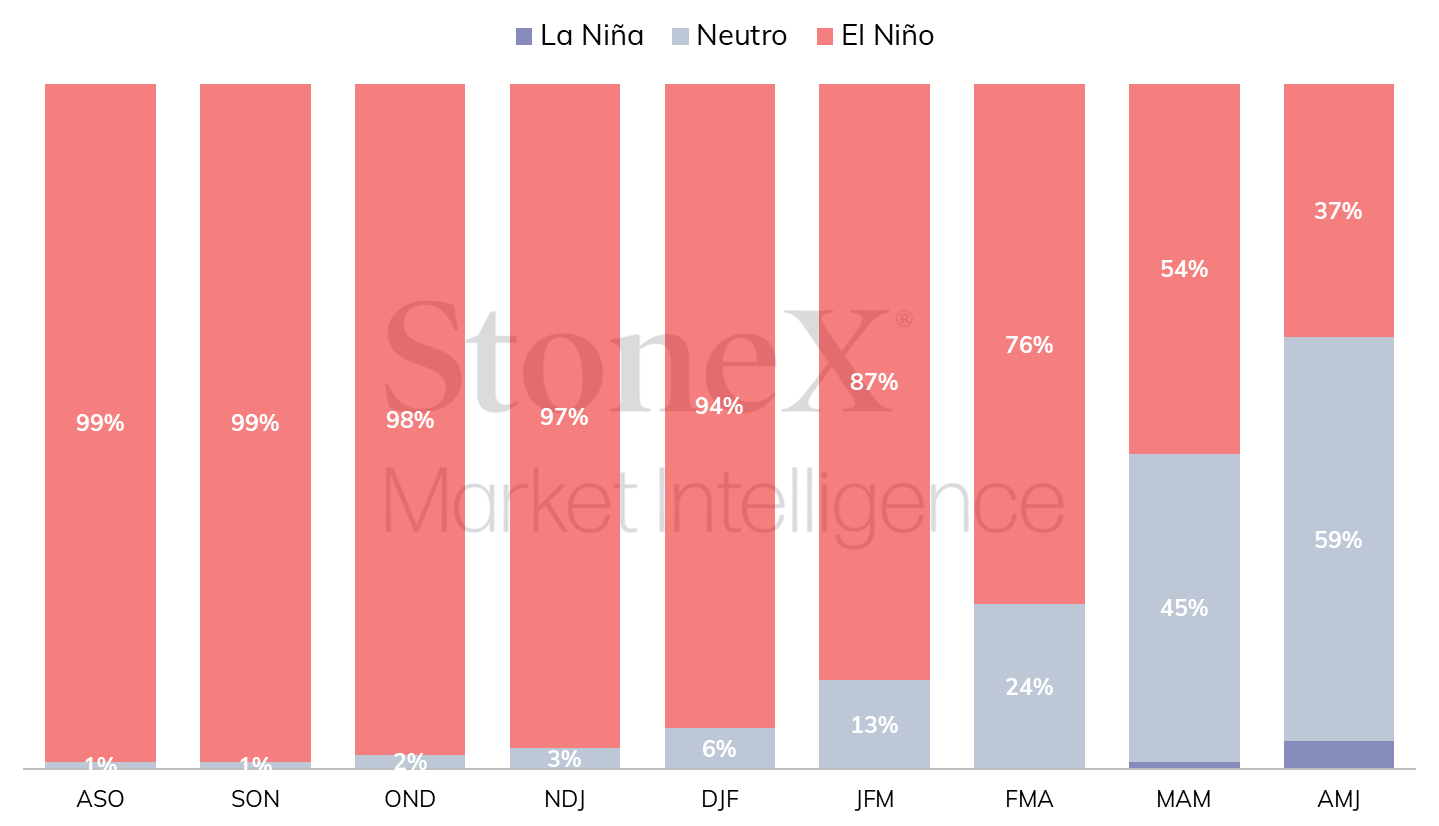
• 76% probability of El Niño until February, March, and April.
• The occurrence of a strong phenomenon could affect Robusta crops
Coffee futures fell significantly last week on their main trading exchanges, influenced by the exchange rate scenario, with the rise in the dollar against the Brazilian real stimulating adjustments on the exchange, and by the progress of Brazil's harvest, which is nearing completion and causing a perception of wider availability. Meanwhile, the scenario of a potential drop in consumption continues to be a factor limiting significant price recoveries.
As a result, the December/23 Arabica coffee contract closed last Friday (18) at 150.00 c/lb on the New York exchange, a sharp drop of 770 points or 4.9% compared to the previous week, reaching its lowest levels for the most active contract since mid-January. Robusta coffee in London, in turn, followed the movement observed in the US terminal and recorded a retraction of USD 154 (-6.1%) for the November/23 contract, closing at USD 2363/t.
On the Brazilian domestic market, the Cepea indicator recorded a devaluation of 3.3% for Arabica coffee, which closed the week at BRL 808.18/bag. The indicator for Robusta coffee also registered losses of 3.3%, ending the period quoted at BRL 644.34/bag.
Weekly Intraday (most active contract) – August 14 to 18
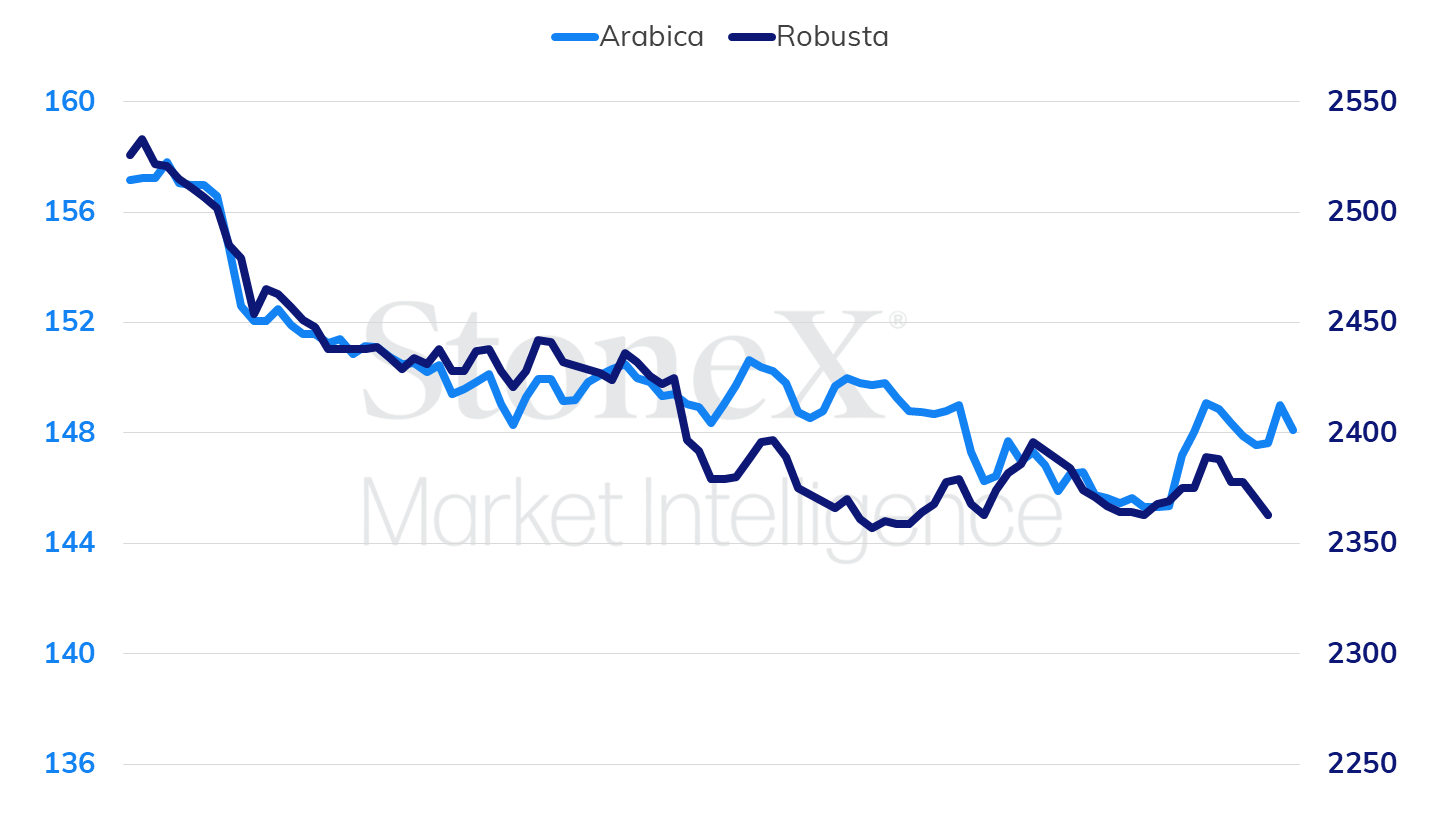
As mentioned, Arabica coffee was significantly influenced by the macroeconomic and exchange rate environment, with the dollar rising significantly on the Brazilian exchange market on Monday, when it jumped from BRL 4.906 to 4.963, setting the tone for the week. As a result, on Monday alone, Arabica coffee accumulated almost half of its losses for the week.
On the London exchange, Robusta coffee adjusted considerably, influenced by the devaluation of Arabica, a movement that can be seen in the intense losses recorded on Monday (14). In addition, technical factors were also behind the week's falls, with the expiration of September options on the exchange also contributing to push prices down.
The environment of greater risk aversion in the global markets had a bullish influence on the dollar and kept investors away from commodities and risk assets, with agents reflecting on the minutes of the Federal Reserve's latest monetary policy decision and concerns about the Chinese economy and real estate sector as the main elements.
In China, in addition to the release of industrial production data for July, which, despite having grown 3.7% compared to last year, was below market expectations (+4.6%), concerns about the country's real estate sector were heightened last week. The news that companies in the sector have been having difficulties honoring their financial commitments, which has even led the local government to announce a reduction in interest rates on one-year loans from 2.65% p.a. to 2.50% p.a., further raises doubts about the Chinese economy's ability to recover, which tends to affect the global economy in general.
Still on the macro front, this week agents will be paying close attention to the Annual Jackson Hole Monetary Policy Symposium, held by the Federal Reserve between Thursday (24) and Saturday (26). The event brings together various central bank authorities from around the world, with the main focus being the speech by Fed chair Jerome Powell on Friday (25). Expectations have risen mainly after the minutes of the Fed's last decision showed divergence among the members, in which most continue to see significant inflationary risks for the US economy, which would require even greater monetary tightening in the country.
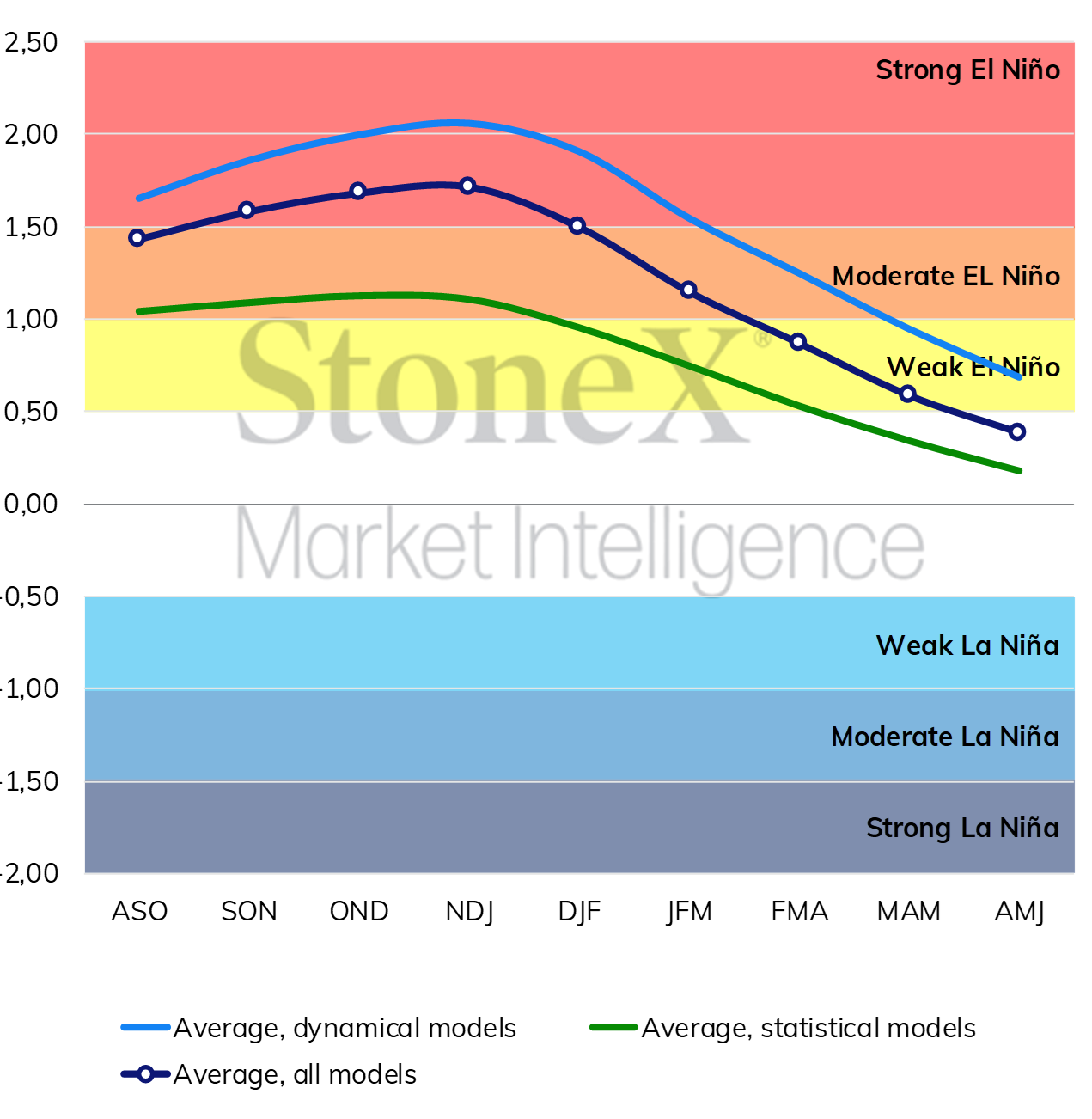
According to the latest IRI/CPC/NOAA update, models have pointed to the possibility of a strong El Niño starting in the SON quarter (September, October, and November), with greater intensity than the models had indicated in the previous update. The average of dynamic models already points to a strong El Niño from the ASO quarter (August, September, and October) until the JFM quarter (January, February, and March), but continuing with moderate intensity until the FMA quarter (February, March, and April).
However, the statistical models indicate a less intense phenomenon, rated only as moderate between the ASO and NDJ quarters (November, December, and January). Considering the average of all the models, the phenomenon would have a strong intensity from the SON quarter until DJF (December, January, and February), with a peak in NDJ (November, December, and January).
Prediction models for El Niño intensity
In addition to its intensity, considering the probabilistic forecasting model, the phenomenon is expected to last until the first quarter of 2024. The latest update of the probabilistic model points to a 76% chance of El Niño extending until the FMA quarter, 54% of continuing until MAM (March, April, and May) and only 37% of persisting until the AMJ quarter (April, May, and June). Therefore, the probability of Pacific temperatures returning to a neutral condition is 59% in the AMJ quarter.
La Niña/El Niño Probabilities
As we have seen in other reports, the occurrence of El Niño is associated with above-average temperatures in parts of southeastern and northeastern Brazil, mainly affecting Robusta coffee-growing regions in the north of Espírito Santo and the extreme south of the state of Bahia. The importance of these regions can be seen in the fact that in 2022/23, the Robusta coffee crop in these regions accounted for 81.5% of national Robusta production and 28% of all Brazilian production.
Considering the periods of this weather condition and the production cycle of Robusta coffee in Brazil, we can point out that it will occur during crucial periods for the development of production. Given that the average of the models indicates a strong El Niño between September 2023 and February 2024, during this entire period, Brazilian Robusta coffee plantations will go through critical development stages and any problem could impact the production potential of 2024.
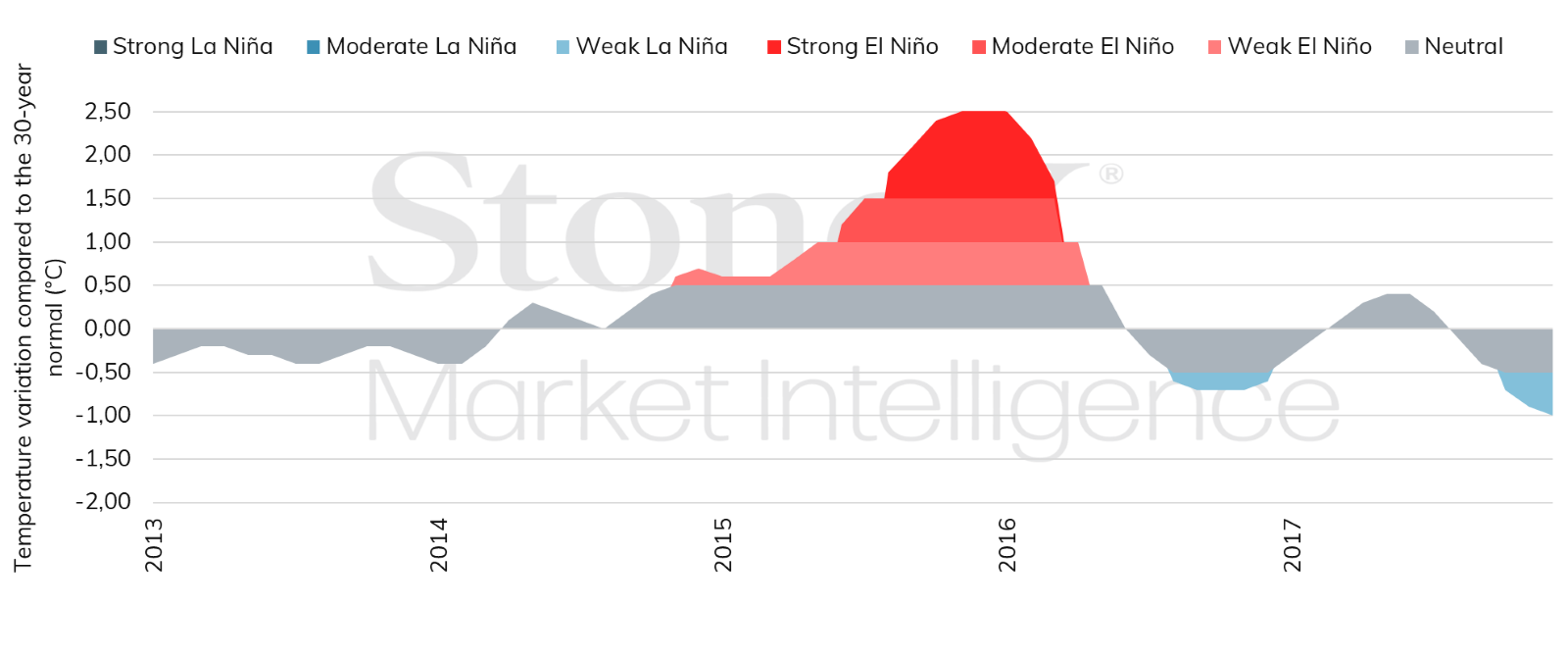
The last time the crops faced an El Niño was between 2014 and 2016, which severely impacted Brazil's production of Robusta coffee, which, according to USDA data, went from 17 million in 2014/15 to 10.5 million bags in 2016/17, representing a drop of over 38% in the period.
Looking at the historical data, it is worth mentioning that the conditions presented are partly similar to those observed in the second half of 2015 and early 2016, when El Niño reached a strong intensity from the JJA quarter (June, July, and August) to the FMA quarter (February, March, and April). One difference between the 2015 scenario is that, in addition to a longer period with strong intensity, when the phenomenon reached strong intensity, El Niño had already been persisting since the SON quarter of the previous year (2014).
History of temperature changes in the Pacific Ocean
It is essential to note that conditions are quite different today compared to 2015, so the impact of El Niño on Robusta crops would be limited. On that occasion, the phenomenon lasted a long time, extending the period of dry and hot weather in the regions. In addition, producers had fewer water reservoirs available for irrigation and used less efficient systems. In addition, during the peak of the water crisis, the use of irrigation systems was banned by the government in several producing cities, as water was allocated to more essential uses, such as human consumption.
Although conditions are different today, the scenario of a strong El Niño occurring during such critical stages of production could have a negative impact on next season's production potential. Despite the widespread use of irrigation systems, the vast majority of which are drip irrigation, which is more efficient in its use of water, it is not able to alleviate the high temperatures and the direct sun rays on the tops of plants.
Despite the soil water availability, on days with very high temperatures, water loss in the canopy is greater than the capacity of the plant's roots to absorb and replace the lost water. In this condition, the plant can wilt in very hot periods, and this would mainly have a negative impact on the period of fruit expansion and filling, between December and February. In addition, the sun and excessive heat can burn part of the leaves and fruit, a process known as scalding.
Considering the current scenario of restricted supply of Robusta in the world, reflecting the lower availability of coffee in Asian countries such as Vietnam and Indonesia, a condition of excessive heat in Robusta producing regions could further aggravate the current condition and support Robusta coffee prices at first, but could also favor Arabica prices.