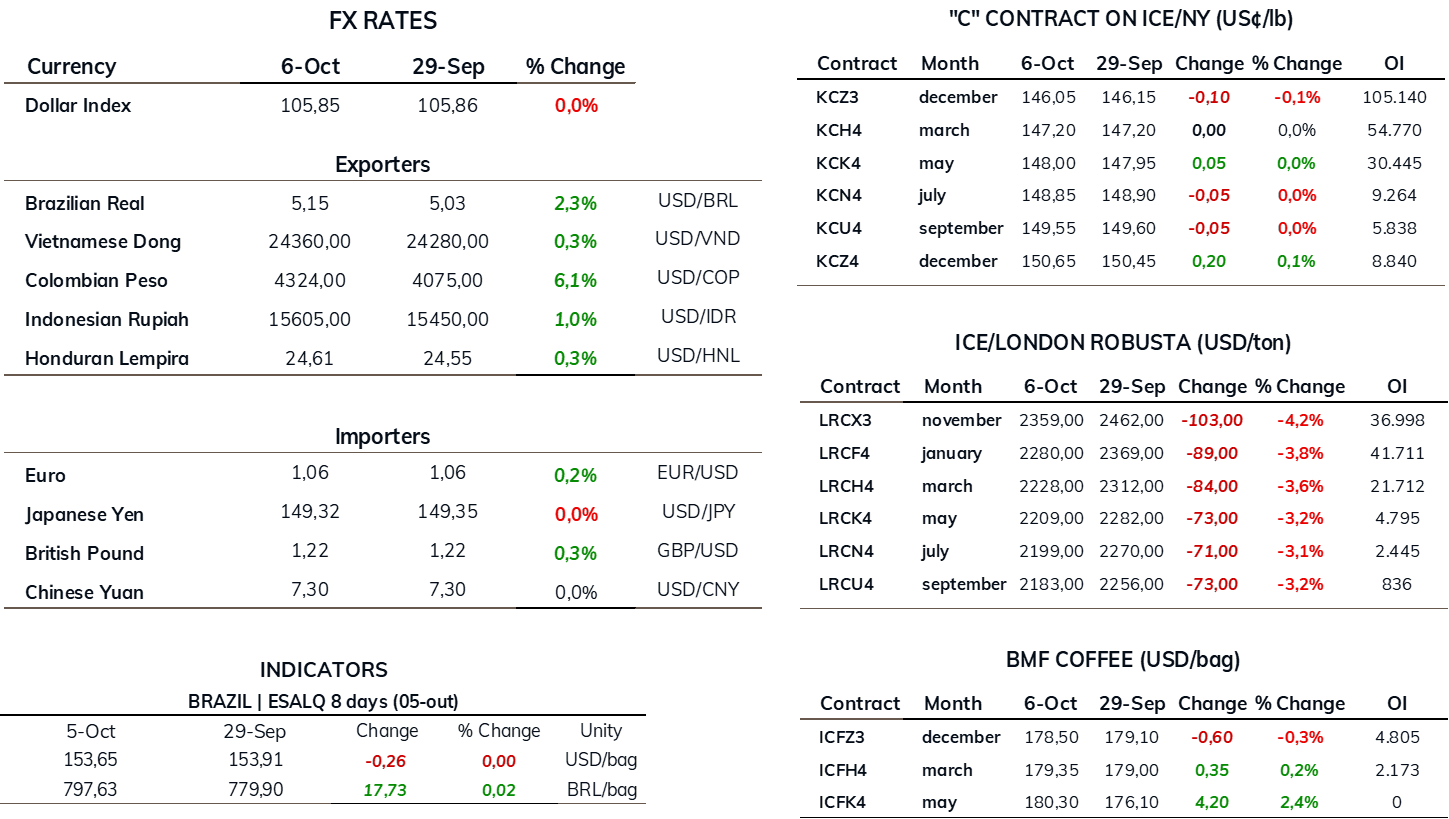
• Arabica coffee down just 0.1% to 146.05 c/lb
• Robusta coffee prices posted significant losses of 3.8%
• Cepea indicator up 2.9% for Arabica and 0.2% for Robusta
• Weather in Brazil continues to be a focus of market attention
• US coffee imports down 16% in August
• Preliminary data points to a 5% rise in Brazilian exports in September
• Dollar rise continues to put pressure on coffee prices
• Macro environment has been bearish for commodities
• Inflation rates in the US and Brazil have the potential to move the markets
• Coffee fluctuations have been more correlated with the behavior of global markets
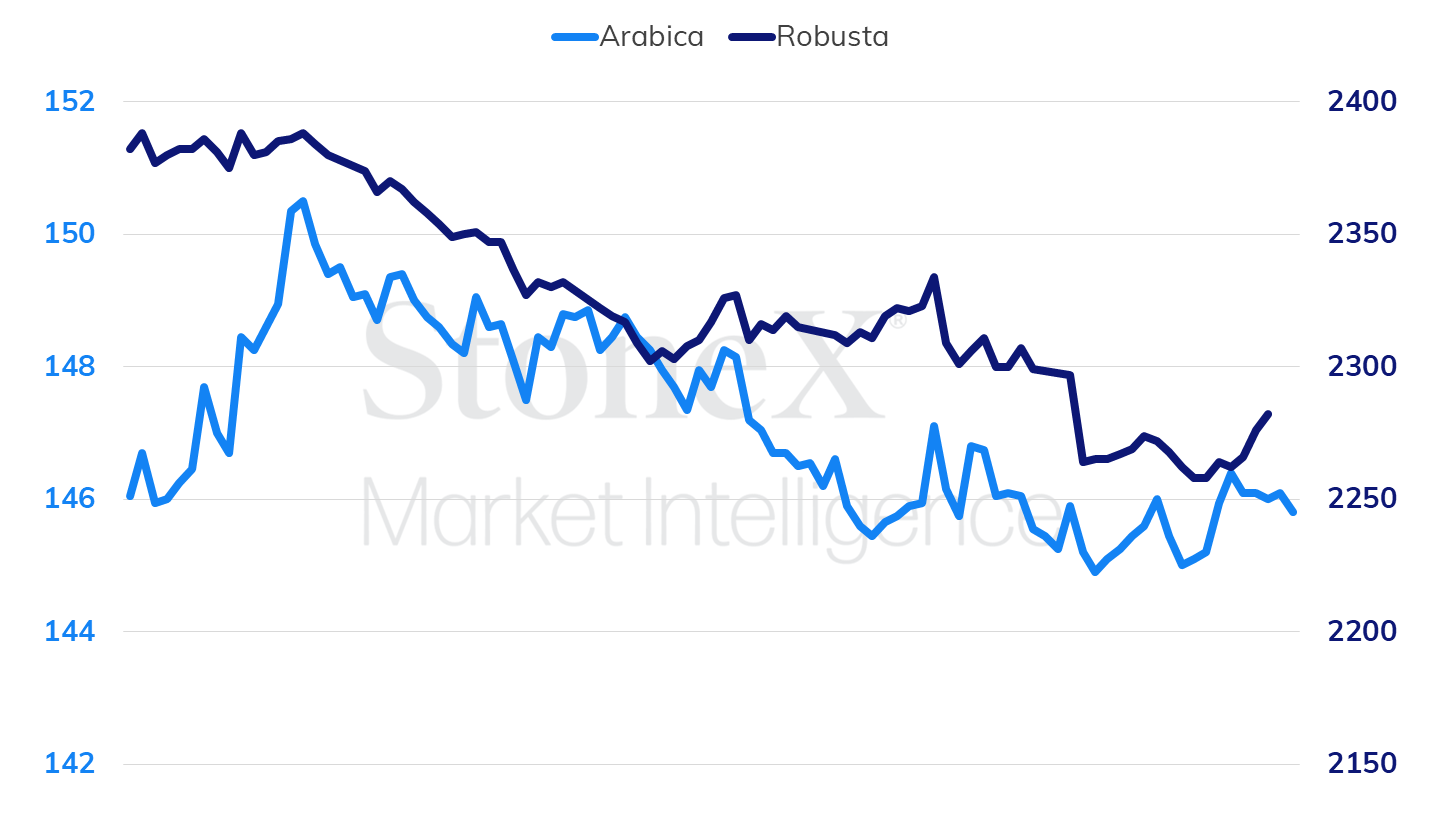
With no change in fundamentals, Arabica coffee futures ended last week almost unchanged, while Robusta coffee futures continued their downward trend. While there are no changes in fundamentals, coffee futures prices tend to react more to macroeconomic and exchange rate factors. The significant rise in the dollar during the week helped to pressure Robusta coffee prices in London. In addition, the upcoming start of the harvest in Vietnam, which usually takes place in mid-November, also added to the pressure on prices.
In New York, the most active contract, for December, fell by just 0.1%, closing the week quoted at 146.05 c/lb. For Robusta coffee, the most liquid contract, expiring in January, posted losses of USD 89/t (3.8%), closing the week quoted at USD 2,280/t. The USDBRL pair rose by a significant 2.7%, closing the week at USDBRL 5.16. For more details, read the macroeconomic analysis in this report.
Weekly intraday (most active contract) - October 2 to 6
On the Brazilian domestic market, Arabica coffee prices ended the week higher, while Robusta finished the period almost unchanged. The rise in the dollar is the main factor behind the appreciation of domestic Arabica coffee prices. The Cepea indicator for the variety posted gains of 2.9% over the week, closing Friday (06) at BRL 802.84/bag. The Cepea indicator for Robusta coffee rose slightly by 0.2%, closing the week at BRL 646.44/bag.
From the point of view of fundamentals, the focus remains on the early stages of development and the weather in Brazil. While the models' indication of significant volumes of rain in the coming weeks in part of the coffee belt is easing concerns and feeding expectations of a large crop in 2024, the occurrence of El Niño is still a cause for concern.
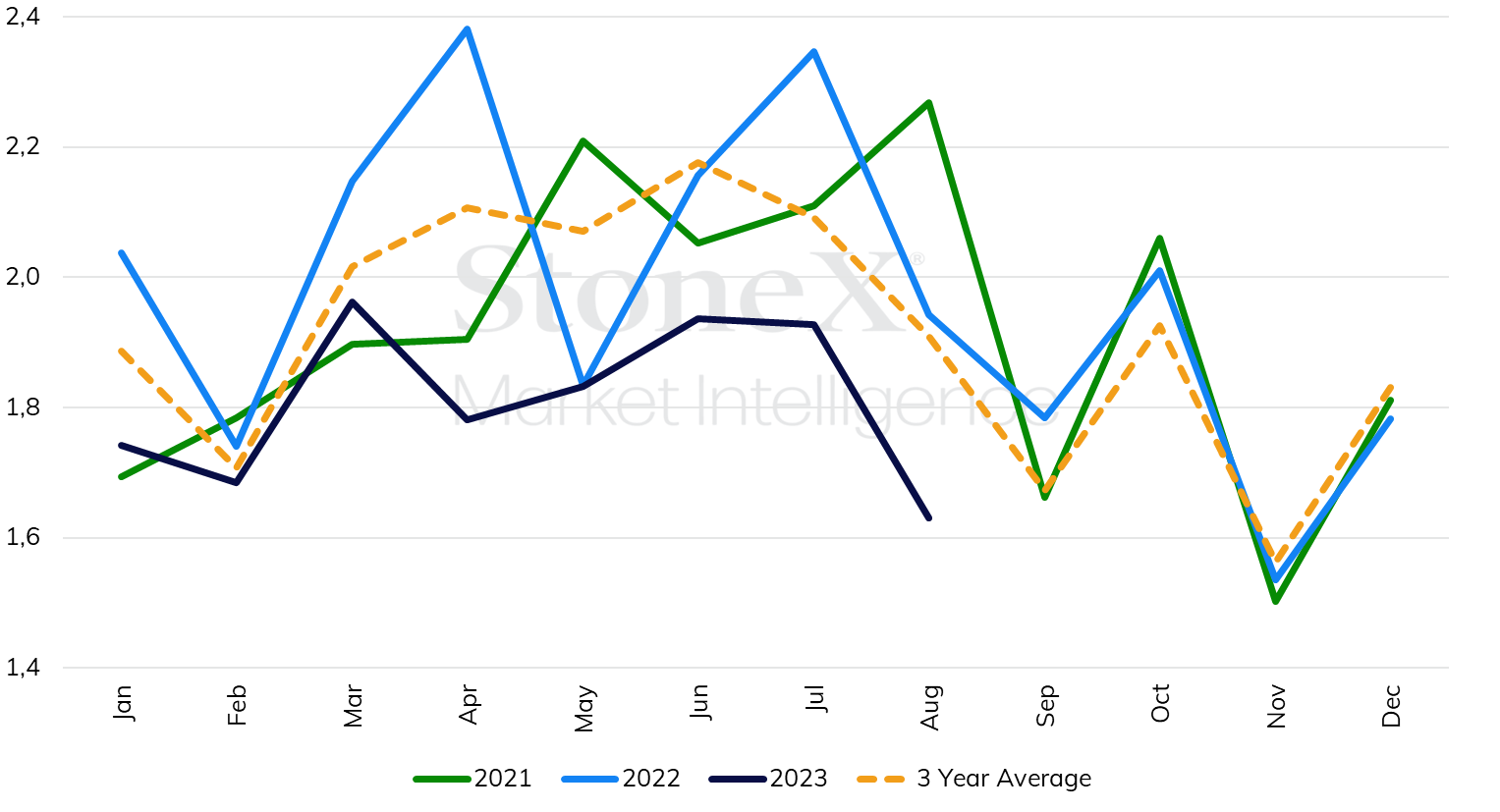
In addition to the weather, as has already been mentioned in other editions of this report, issues related to coffee consumption continue to be a point of attention. Although there is no clear data on the pace of coffee consumption, import data from producing countries are key indicators. According to the USDA, the US imported 1.63 million bags of coffee in August, 15.5% less than the total imported in the previous month and 16% less than imports in the same month last year. Considering the accumulated total for the first eight months of the year, the US imported 14.5 million bags, 13% less than in the same period in 2022.
Seasonality of US coffee imports (million bags)
This week, agents' attention will be focused on Brazil's coffee export data for September, which will be released by Cecafé. Preliminary data released by the Foreign Trade Secretariat (Secex) indicated that the volume exported was 5% higher in September.
The macroeconomic scenario continues to have an influence on Arabica coffee prices on the New York exchange, with the dollar/real pair registering another significant rise this week on the Brazilian currency market and contributing to pressure coffee prices. This was influenced by the more risk-averse global market following stronger than expected economic data for the US economy, with a sharp rise in US treasury bonds. The dollar ended last Friday quoted at BRL 5.1621, a +2.7% change for the week.
The release of data indicating a stronger-than-expected US economy, particularly the manufacturing PMI, which measures the level of activity in the sector, and especially the Employment Situation Report for September, contributed to the US currency's rise in the week. Data from the US Bureau of Labor Statistics (BLS) showed that 336,000 new jobs were created in September, a result well above the median of estimates, which expected an increase of 160,000 jobs, and the amount recorded for the previous month, when 227,000 new positions were created.
Following the results, bets that the Federal Reserve will keep interest rates at high levels for a longer period in order to control the country's inflation accelerated investor demand for US fixed-income assets, strengthening the dollar against most global currencies and acting in a bearish way for commodities, which are considered riskier assets.
In this sense, the release of the US Consumer Price Index (CPI) on Thursday (12), as well as the country's September employment data published last Friday (6), may surprise on the upside and contribute to greater risk aversion in the global markets, further favoring demand for the dollar and putting pressure on commodities and the Brazilian real. On Wednesday, the Consumer Price Index (IPCA) will be released in Brazil, which could also have an impact on the currency market.
In addition, in the context of coffee's greater correlation with global movements, it is worth mentioning that over the next few days the markets are likely to reflect the escalation of the conflict in the Middle East between Israel and Hamas, which has caused a sharp rise in crude oil prices at the start of the week.
Something interesting to note is the change in the correlation of Arabica coffee prices in New York with the dollar index and the CRB (commodities). As can be seen in the graph, due to its specific characteristics, such as having a low-income elasticity, coffee does not always show a correlation in line with most commodities. It is therefore possible to see that at various times during the year, coffee prices have shown an inverse correlation with the CRB commodity index, i.e., in the opposite direction to most commodities.
Correlation of Arabica coffee in NY with the dollar index and the CRB commodity index
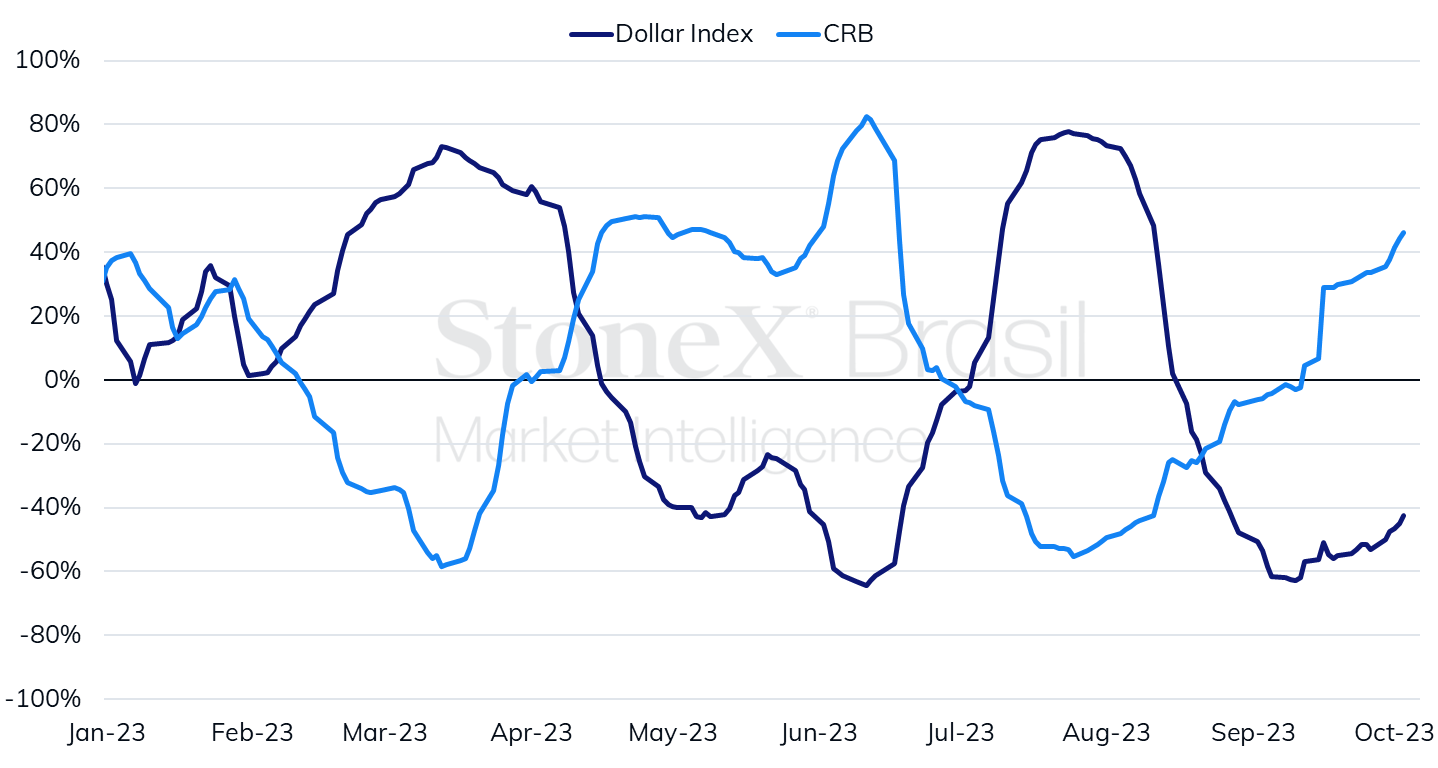
It is also worth noting that, in general, commodities tend to move in the opposite direction to the dollar index. In other words, in many cases, dollar index gains that point to a greater interest in the US currency represent a moment of greater global risk aversion, in which investors flee from assets considered riskier, such as commodities and emerging currencies, putting pressure on the latter in search of safe assets, such as the dollar or US treasury bonds.
As a result, one can see that since mid-September, coffee has corresponded more closely to movements in the macroeconomic environment: fluctuating more closely to commodities, represented by the positive correlation, and operating in the opposite direction to the dollar index, represented by the negative correlation. Therefore, for the coming weeks, it is important to monitor factors outside the coffee market in order to understand the direction that prices may take.