• Arabica coffee fell 2.6% in the week, but rose 7.8% in the month
• Robusta coffee prices fell 3.9% in the week, but rose 4.3% in the month
• Cepea registered a drop of 2.2% for Arabica coffee and 0.8% for Robusta coffee
• Focus on the impact of El Niño in Brazil and Indonesia
• Dr. Pepper and Coca Cola release their financial results
• Certified stocks in New York fall below 400,000 bags
• Brazilian differentials have not been conducive to certification on the exchange
• Speculators significantly reduce short positions on the exchange
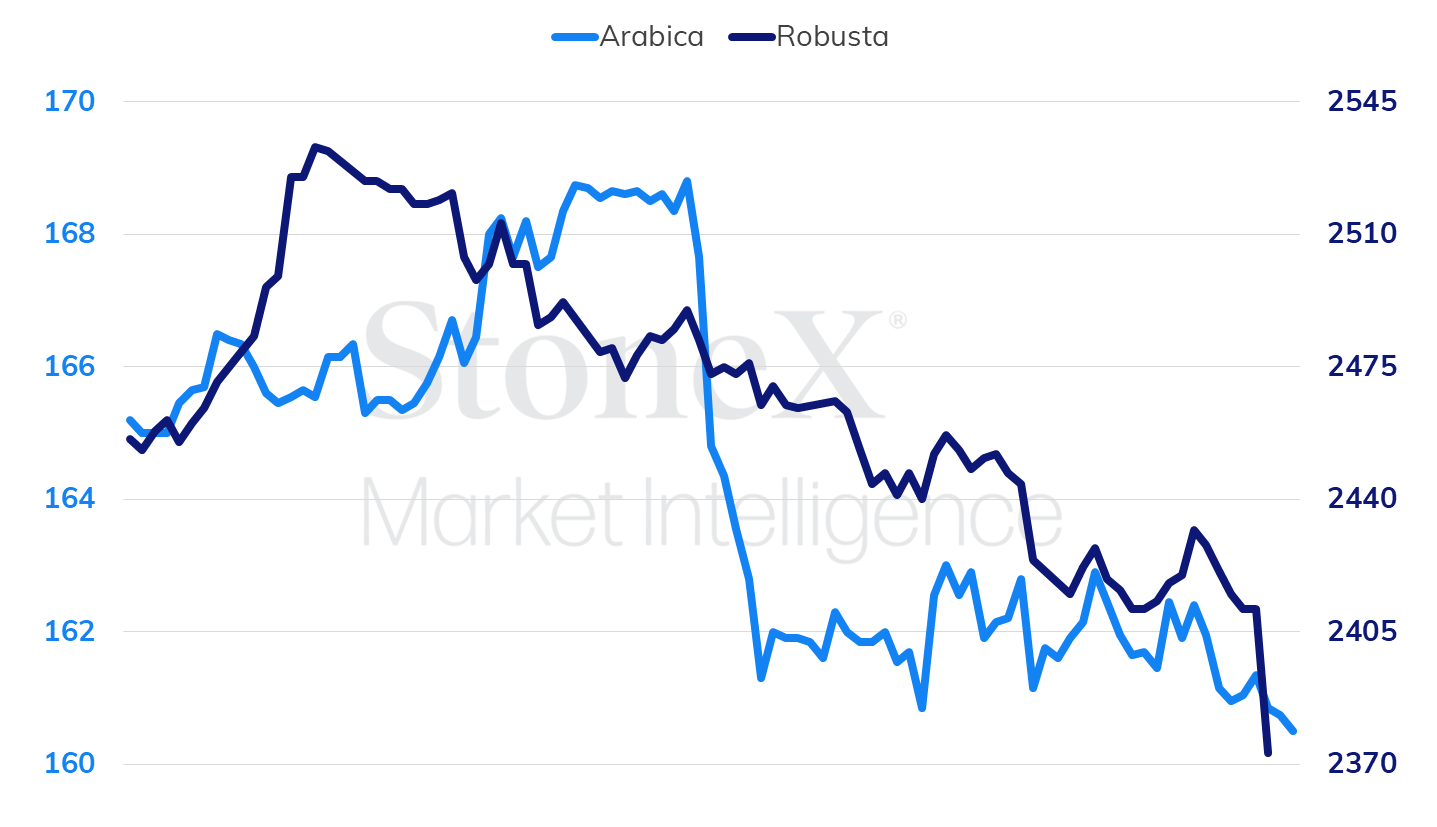
Reflecting the end of short-covering by agents and the overbought technical scenario, coffee futures prices reversed the upward movement seen in previous weeks and posted sharp losses in New York and London last week. In a scenario of significant price rises, as seen in previous weeks, it would be natural to expect a correction movement on the exchanges.
In New York, prices for the most active December contract fell 430 points (-2.6%) in the week and rose 1170 points (7.8%) in the month, closing last Friday at 160.95 c/lb. In London, Robusta coffee futures fell by USD 96/t (-3.9%) in the week and rose by USD 106 (4.3%) in the month for the January contract, which closed at USD 2383/t.
Weekly intraday (most active contract) - Oct. 23 to Oct. 27
In Brazil, domestic coffee prices followed the movements abroad and ended the week down. The Cepea indicator for Arabica coffee fell by 2.2%, closing last Friday (27) at BRL 841.65/bag. For Robusta coffee, the indicator fell 0.8% to BRL 647.05/bag.
From the point of view of fundamentals, there have been no major changes in recent weeks. Agents continue to look at the development of the Brazilian crop to be harvested in 2024, with the main focus on weather issues and the possible impacts of El Niño. In Asia, data has pointed to excessively dry weather in Indonesia, with below-average rainfall, which is also a reflection of El Niño.
In addition to the weather, the pace of consumption is another point of attention. One of the key aspects is the upcoming winter in the Northern Hemisphere, a period during which the pace of coffee consumption in the US and Europe tends to increase. However, other indicators point to a potentially weakened consumption. Recently, the release of financial data from Dr. Pepper and Coca Cola showed mixed results for coffee in the third quarter.
According to Dr. Pepper's financial results, revenues from the company's coffee division fell by 3.2% to just over USD 1 billion, mainly reflecting a 6.3% drop in volume/blend. On the other hand, Coca Cola's results pointed to an increase of 6%, driven mainly by the good performance of "Costa Coffee" in the UK and China.
Certified stocks of Arabica coffee, which fell more sharply last week, should once again be on traders' radar and could help to support prices. Last week, ICE recorded a reduction of 27,000 bags (-6.5%) of Arabica coffee stocks in its certified warehouses. As a result, stocks ended Friday at 394,000 bags, operating under 400,000 bags for the first time since November 2022 and approaching the 20-year lows recorded at that time last year.
Certified stocks of Arabica coffee in ICE warehouses ('000 bags)
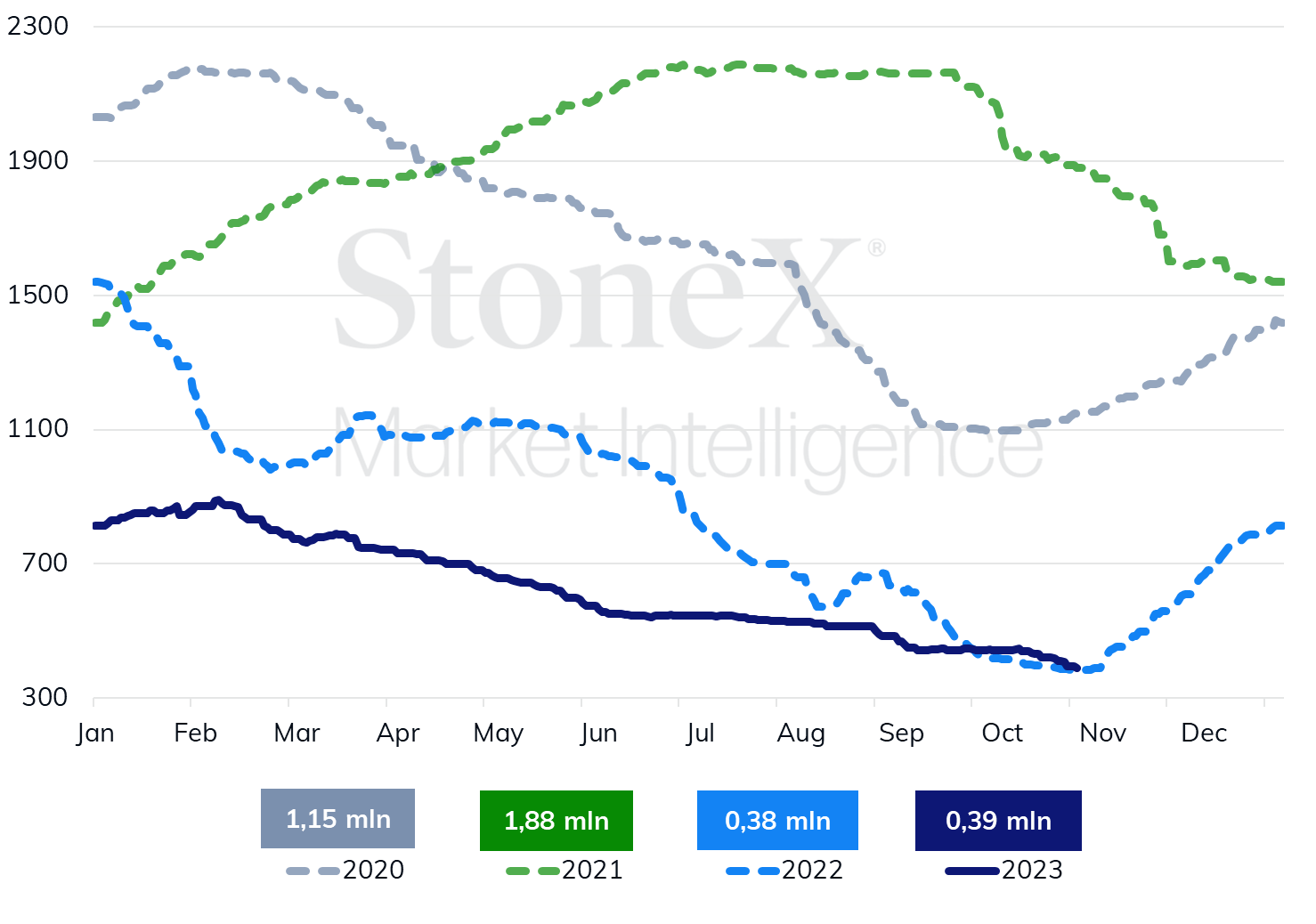
Looking at StoneX's price differentials report, it is clear that since August the differentials for bicam type 6 coffee have been significantly above the levels seen last year and the average for the last three years. This has been due to the fact that the price on the Brazilian spot market, after falling sharply between April and June, has remained more stable than the prices on the exchange, even after the start of the new Brazilian crop. Against this backdrop, while much of the certified Brazilian coffee on the exchange has been withdrawn, falling by around 342,000 bags or 75% since the start of the year to the current level of 112,000 bags, the occurrence of new certified Brazilian coffees has been rare this year, which has contributed to the reduction in volumes seen in warehouses.
It is worth noting that, as stocks approach historically low levels and continue to fall, fears of more limited availability in the short term may affect market participants, which, despite the fact that the world is still facing difficulties in re-establishing a more robust growth in consumption, tends to act as a support factor at the end of the year.
The CFTC's latest Commitment of Traders report showed that speculative funds made more intense moves on the New York exchange. According to the report, between October 17 and 24, the agents reduced their long positions in Arabica coffee futures and options by 2,224 to 31,275 lots, however, the positions went from 49,280 to 33,427 lots, a reduction of 15,853 positions. In this context, the funds went from being short 15,781 lots to just 2,152. During the same period of this sharp sell-off in the funds' bearish bets, coffee prices jumped 1110 points on the exchange.
However, despite the significant change over the period, it is unlikely that the funds will maintain a bullish bias for prices in the coming weeks. In light of the bearish moves seen from the 25th onwards, when there was a technical profit-taking move by specs after the Relative Strength Index (RSI) showed the market to be overbought, it seems likely that the next CFTC report will show us at least a partial recovery of these agents' net short balance.