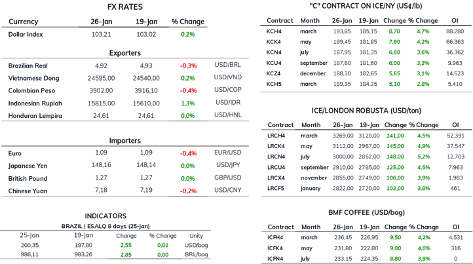
• Arabica coffee up 4.7% on the week in New York, closing at US₵ 193.85/lb
• Robusta coffee rises 4.9% to USD 3269/t on the London exchange
• Cepea indicator for Arabica coffee rises 2.8% to R$1010.84/bag
• Cepea indicator for Robusta coffee up 3.1% to R$831.22/bag
• StoneX Commodity Tracker points to rise in cash in circulation in soft commodities
• Cases of mealybug identified in Brazilian Robusta coffee plantations
• Robusta coffee stocks also reach historic lows
• Market awaits consolidated data on Vietnamese exports in December
• Drought and forest fires in Colombia raise fears for the country's coffee production
Last week, coffee futures prices extended their positive trend, ending the period with a big rise in both New York and London. However, the highlight continues to be Robusta coffee, whose supply is limited due to the problems generated by El Niño in Indonesia and Vietnam, which has compromised part of these countries' production. In addition, as mentioned in the last report, the scale of the conflict in the Middle East and the attacks by the Houthi group on merchant ships has led to a sharp increase in logistical costs and supported the rise in prices in Londo. As a reflection of this scenario, there is greater interest from importers in Brazilian Robusta coffee. Even so, according to sources in Brazil, a reduced supply of containers has been a challenge for export logistics.
In New York, futures prices for Arabica coffee rose by 870 points (4.7%) for the most active contract, which ended the period quoted at US₵ 193.85/lb. For Robusta coffee, prices in London rose by USD 141/t (4.5%), closing the week quoted at USD 3269/t. In the same period, the USDBRL pair fell 0.3% to USDBRL 4.92 and the Dollar Index moved up 0.2% to 103.21 points. On the Brazilian market, coffee prices followed the movements abroad and ended the week higher. The Cepea indicator for Arabica coffee rose by 2.8%, closing Friday (26) at R$1010.84/bag. For Robusta coffee, the indicator rose 3.1% to R$831.22/bag.
Weekly intraday (most active contract) - Jan. 22 to Jan. 26
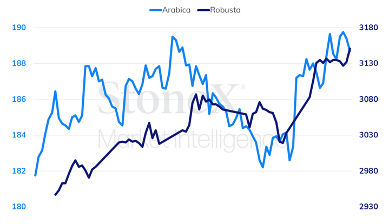
Some technical aspects have become more evident in the last week, such as the inversion of the futures curve and the influx of resources into the commodities complex, more specifically into commodities categorized as softs, a group that includes coffee. The inversion of the futures curve, known as backwardation, reflects a scenario of limited supply in the short term, a condition in which the first coffee contracts find themselves. In addition to the inversion between the first and second contracts, according to traders, the inversion for the other contracts indicates that the scenario of lower supply in the short term could extend into the second quarter of the year.
One of the factors behind the rise in prices is the greater appetite of speculative agents and funds for soft commodity contracts, including coffee. According to the StoneX Commodity Tracker, an index by StoneX for monitoring commodity prices, in the previous week, funds had added 1 billion dollars in soft commodities, which supported the 7.99% advance in sugar prices, 5.7% in cocoa, 2.53% in coffee and 3.09% in cotton.
For the coming weeks, in addition to the developments of the above-mentioned issues, the coffee market will continue to keep an eye on the weather conditions in Brazil and the outlook for the country's 2024/25 crop. Within this context, the phytosanitary condition of Robusta coffee plantations in Espírito Santo and Bahia has gained relevance. There are reports that an outbreak of mealybugs has affected the crops in these regions. StoneX, while continuing its visits to the producing regions for the 2024 crop estimate, which will be released in mid-February, is assessing the potential impact of the mealybug attack on production. It has not yet been possible to quantify the potential impact, but it will be included in the final report with StoneX's projections for the crop.
Plants under attack by the mealybug in the state of Espírito Santo (26/01/2024) - Photo taken by the StoneX team

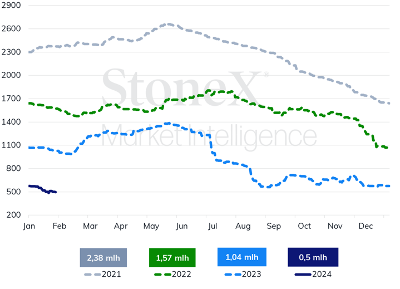
As well as historically low stocks of Arabica coffee, stocks of Robusta coffee have also fallen significantly. The European Coffee Federation (ECF) released its annual report on stocks in the region's ports, showing a drop in volumes of both types. According to the data, in December 2023, European ports had 7.3 million bags, a drop of 43% compared to the same time in 2022. Of these, around 2.4 million bags were Robusta coffee, 47% less than the 4.5 million recorded at the end of the previous year. It is worth noting that the report takes into account both stocks at ICE Europe warehouses and other warehouses. Certified stocks of Robusta coffee currently stand at 496,000 bags, down 52% from just over 1 million at the same time last year.
Certified stocks of Robusta coffee (thousand bags)
In this sense, the tightening supply of Robusta coffee tends to continue to support prices in London, which may also continue to influence Arabica coffee prices in New York. In addition, demand for the variety has also been more positive. In Brazil, according to an update from the Brazilian Soluble Coffee Industry Association (Abics), consumption of soluble coffee, which primarily uses Robusta as its raw material, reached 1.05 million bags in 2023, up 5.2% from the previous year.
Over the next few days, the market is expected to reflect on Vietnam's January export figures, which may provide more clarity on the extent to which lower production and logistical problems in the region are limiting supply in the short term. Despite the news of complications in shipments, previous data from the Vietnamese General Statistics Office (GSO) pointed to an increase of 4.2% in the first 15 days of January compared to the same period in 2022.
In addition, the significantly dry weather at the start of the year in Colombia, which has experienced above-average temperatures in recent years due to the effects of El Niño should also be monitored and has the potential to support Arabica coffee. Last week, the Colombian government declared a national disaster due to several forest fires, which have intensified in recent weeks. The adverse weather has already negatively affected some of the country's coffee producing areas, and if it continues, it could have a more significant impact on the crop.