• Coffee falls amid macroeconomic instability
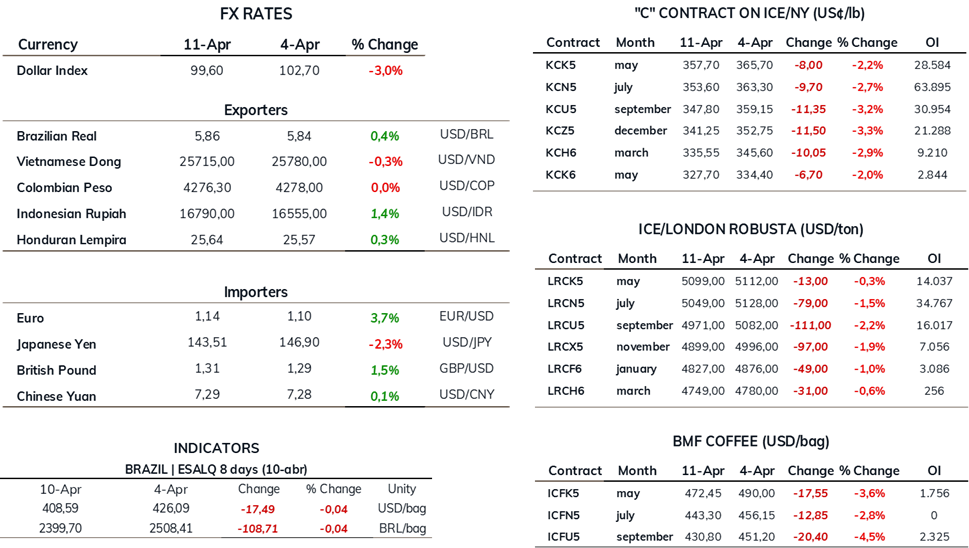
• New York ends week down 2.7%, at US¢ 353.60/lb
• London declines 1.5%, to USD 5,049/ton
• Arabica drops 3.4%, robusta 6.4% in Brazil
• Funds heavily liquidate coffee contracts
• Brazilian exports fall 25%, but revenue rises 63.7% in March
• U.S., Germany, and Italy reduce Brazilian coffee imports
• Russia and Turkey increase Brazil coffee imports in Q1
• 2025/26 crop harvest begins in Brazil on a limited scale
Futures prices for both arabica and robusta coffee ended last week lower, reflecting a turbulent macroeconomic backdrop. Prices were highly volatile throughout the week, impacted by newly announced U.S. tariffs on imports from various countries and abrupt changes in President Donald Trump’s decisions.
Initially, Trump announced tariffs on imports from several countries, including a 10% tariff on imports from Brazil and Colombia, as well as higher rates for other major coffee producers such as Vietnam (46%) and Indonesia (32%). The announcement raised significant concern in the market over the possibility of a global recession, which increased risk aversion among investors, who moved toward safer assets and unwound positions in commodities — including coffee.
Subsequently, the U.S. government softened the measure, announcing a 10% reduction in tariffs for all countries except China, along with a 90-day suspension of the tariffs. While this reversal offered temporary relief to the markets, the increase in tariffs specifically targeting China reignited fears of a broader economic slowdown.
In this uncertain environment, coffee futures experienced significant volatility. On Wednesday (April 9), for instance, contracts were down 6.3% from the previous Friday (April 4), hitting a low of US¢ 323.90/lb. Currency markets also reacted: on Tuesday (April 8), the USDBRL exchange rate closed at 6.01 — up 2.9% from the previous week’s close — peaking at 6.11 on Wednesday (April 9).
By Friday (April 11), the July arabica contract on ICE had settled at US¢ 353.60/lb, down 2.7% on the week. In London, the July robusta contract closed at USD 5,049 per ton, a weekly decline of 1.5%. After reaching the 6.11 high, the dollar weakened slightly and ended the week at 5.86 BRL/USD, a 0.4% increase compared to the previous week.
Weekly Intraday (most active contract) – April 7 to 11
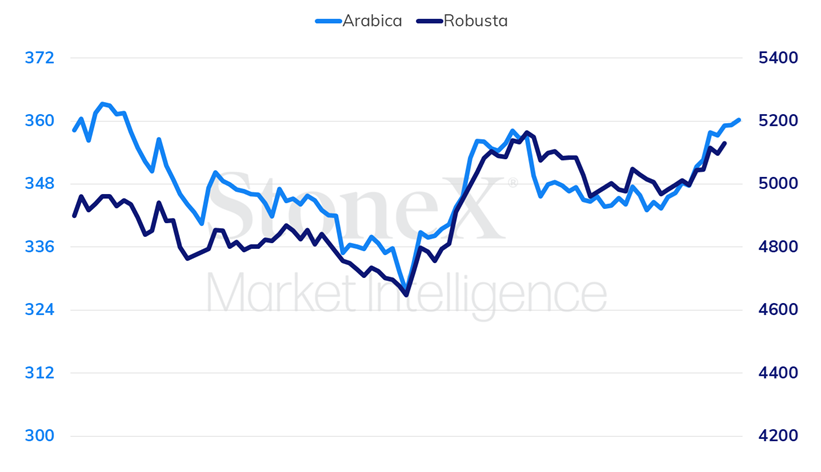
In Brazil, physical coffee prices followed the global trend. The Cepea indicator for arabica ended Friday at BRL 2,424 per 60kg bag, down 3.4% on the week. Robusta was quoted at BRL 1,609 per bag, a weekly decline of 6.4%.
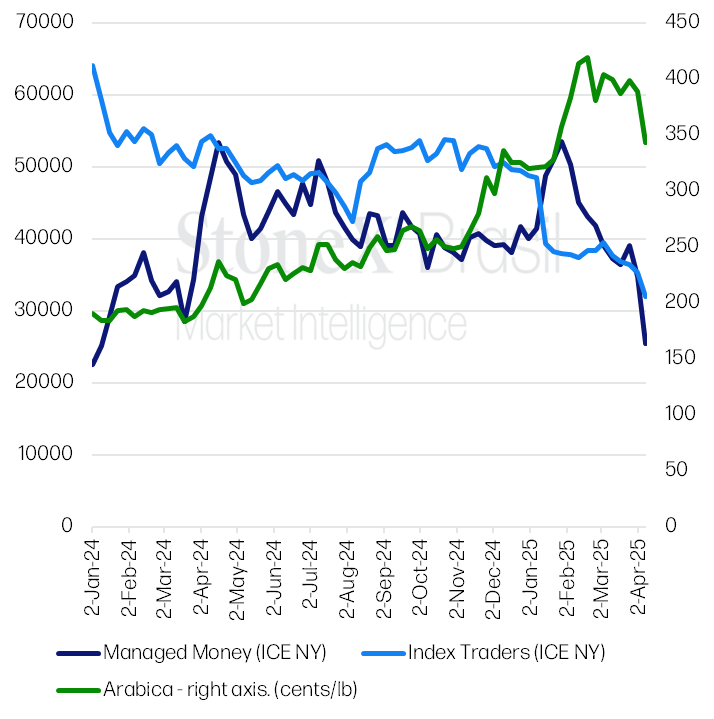
The risk-off sentiment and liquidation of commodity positions were confirmed by CFTC data released on Friday (April 11), showing fund positions as of Tuesday (April 8). In New York, funds liquidated more than 9,290 contracts between April 1 and 8, reducing their net long position from 34,812 to 25,518 — selling 8,785 long contracts and opening 509 new short positions. Index funds also reduced their net long positions by over 3,340 contracts. On the other hand, commercial traders cut their net short positions by more than 13,520 contracts, adding over 10,000 long contracts — particularly from the industry, which capitalized on the lowest prices seen since late January.
Net fund positions in New York (left) and London (right) vs. futures prices
Sources: CFTC and ICE. Design: StoneX.
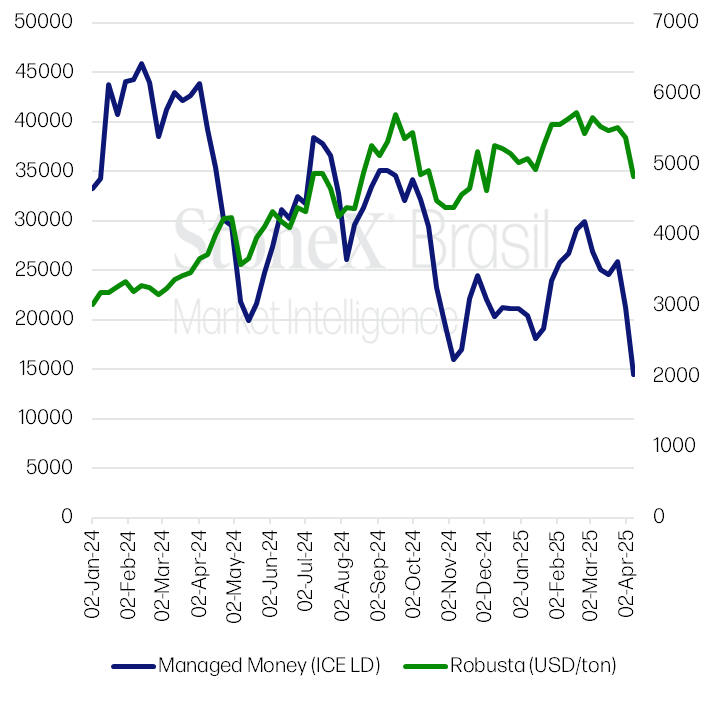
The robusta market showed similar behavior. In London, funds cut their net long positions by 6,792 contracts, from 21,251 to 14,459. Industry players again used the opportunity to expand their long exposure.
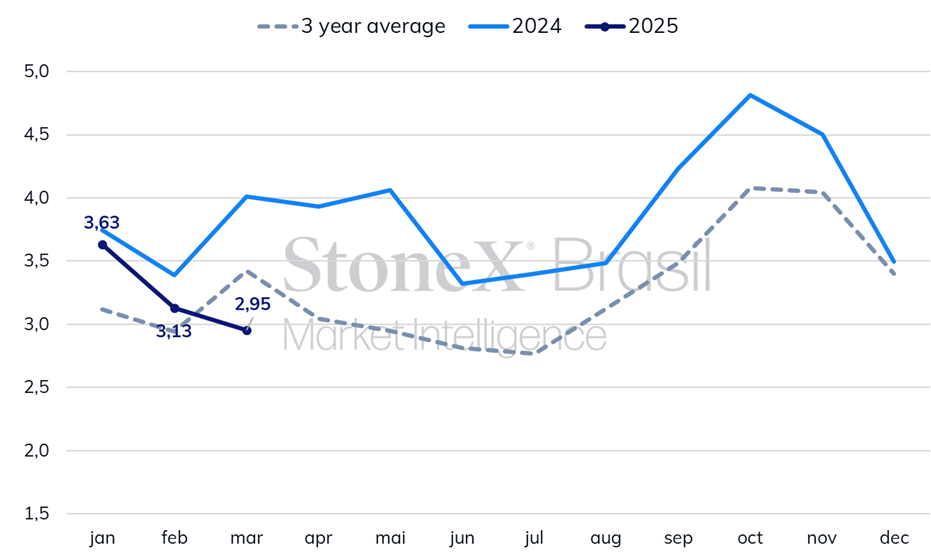
On the export front, Brazil’s Coffee Exporters Council (Cecafé) reported that the country exported 3.29 million bags in March 2025 — a nearly 25% drop from March 2024. Green coffee exports totaled 2.95 million bags, down 26.5%. Robusta exports plunged almost 84% (to 138.6 thousand bags), while arabica shipments fell 10.7% (to 2.8 million bags). Processed coffee exports also declined 7.1%, totaling approximately 335 thousand bags.
Brazilian green coffee exports (million bags)
Source: Cecafé. Design: StoneX.
Despite lower volume, March export revenue surged 63.7% year-over-year, reaching nearly BRL 7.6 billion. The main destinations were the United States, Germany, Italy, Japan, and Belgium — most of which saw lower volumes in Q1 2025 compared to Q1 2024. U.S. imports dropped 11.7% (to 1.8 million bags), Germany fell 19.3% (to 1.4 million), and Italy declined 15.8% (to just over 800 thousand bags). Japan rose 10% (to 675 thousand bags), while Belgium declined nearly 61% (to just over 500 thousand). Meanwhile, exports to Russia surged 90% (to 374.8 thousand bags), Turkey rose 47.5% (to 494.6 thousand), and Spain increased 29.5% (to 367.5 thousand).
With no major changes in fundamentals, the market remains sensitive to macroeconomic conditions — particularly the impact of U.S. tariffs on the global economy. As the largest destination for Brazilian coffee, a tariff on U.S. imports could negatively affect the American industry and, consequently, reduce demand. Additionally, tariffs on other coffee-producing countries could shift the competitive balance and alter trade flows.
Domestically, the market is monitoring the progress of Brazil’s 2025/26 harvest, which has begun in some regions. Harvesting is expected to pick up pace in late April and continue into May. The arrival of new crop supply tends to exert downward pressure on prices in the short and medium term, easing supply concerns. However, in the longer term, the global balance remains tight. Weather during the Brazilian winter will also be crucial, as potential cold fronts and frost risks could act as a bullish factor for prices.
-
What we are reading:
-
Vietnam Reacts to Tariffs, Arabica Being Added as Deliverable Origin on ICE
-
CeCafe: Brazil’s March Green Coffee Exports Down 26.5% Year on Year
-
Trump’s Tariff Pause Brings Temporary Relief to Coffee Sector
-
Honduras on Track to Meet Newly Revised Coffee Export Forecast
-
Colombia Completes Six Months of Coffee Exports Above 1 Million Bags: Asoexport
INDICATORS