• Coffee futures prices advanced in international markets
• Arabica rises and robusta remains stable in the Brazilian domestic market
• 2025/26 crop harvest progresses, mainly in robusta areas
• Brazilian exports fall with reduced supply and logistical problems
• Inflation pressures coffee consumption in Brazil and the United States
• U.S. imports increase at the beginning of 2025, but robusta falls
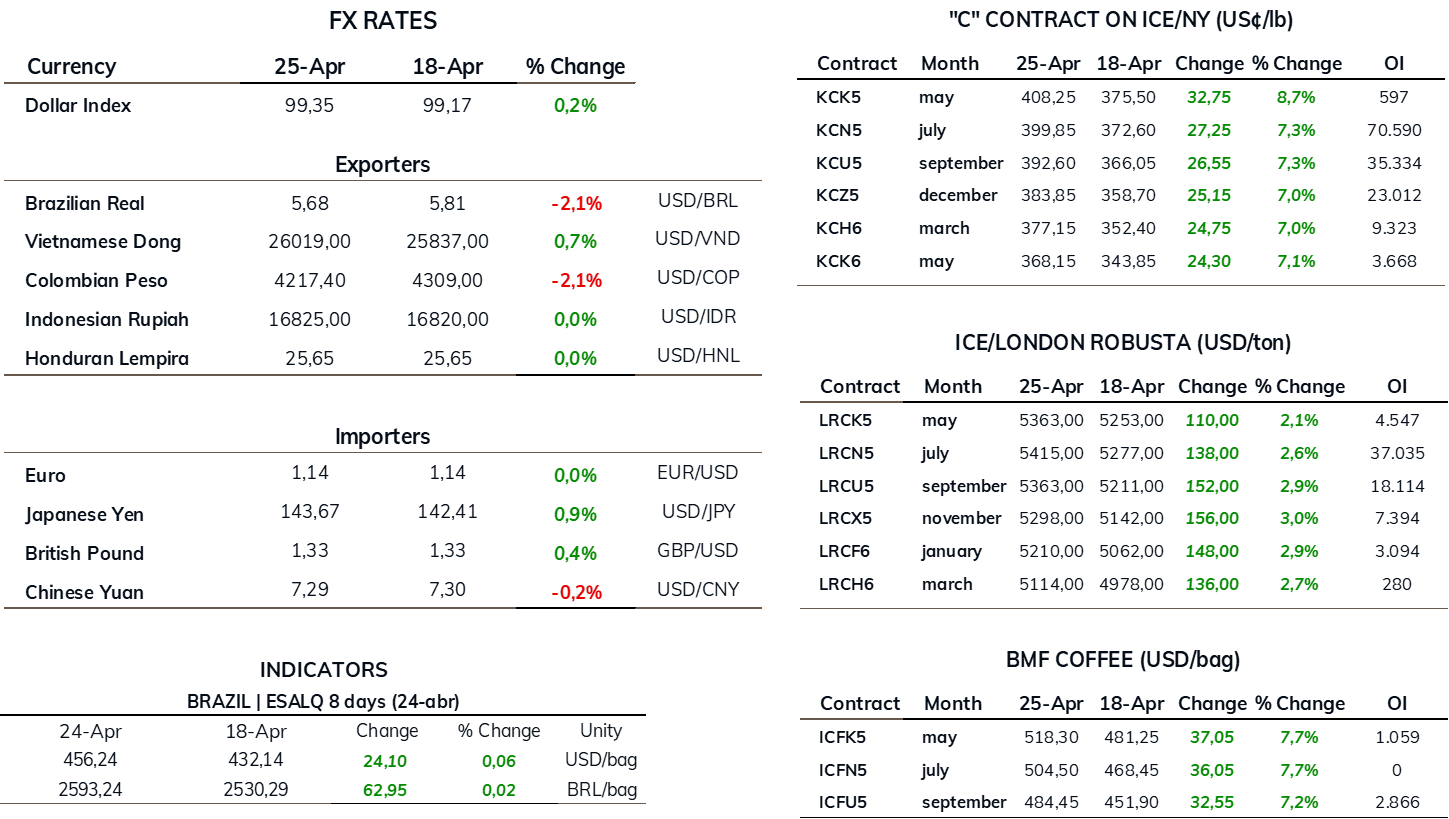
With predominance of macroeconomic and technical factors, coffee futures prices closed higher last week. There were no major changes from a fundamentals point of view, but there was an improvement in risk appetite among agents after the moment of uncertainty and liquidation caused by the announcement of tariffs by the United States.
In addition, the dollar decline last week helped support external prices. There is an inverse correlation between the U.S. dollar quotation in Brazil and international coffee futures prices. Market movements were also somewhat limited due to the holiday in Brazil on Monday (21st).
This scenario of improved investor appetite was also observed in the latest COT-CFTC report, released on Friday, April 25, referring to the agents’ positions on April 22. While in previous weeks the report showed strong liquidation by managed money funds, last week there was a change in behavior.
For the arabica coffee contract in New York, managed money funds increased their net long position by more than 1,350 contracts, totaling 25,655 net long contracts. Index funds, however, slightly reduced their net long position by just 82 contracts, from 31,918 to 31,836 contracts. In the robusta coffee market in London, the movement was also similar. After weeks of liquidation, between April 15 and 22, funds increased their net long position by more than 1,360 contracts, reaching 10,224 contracts.
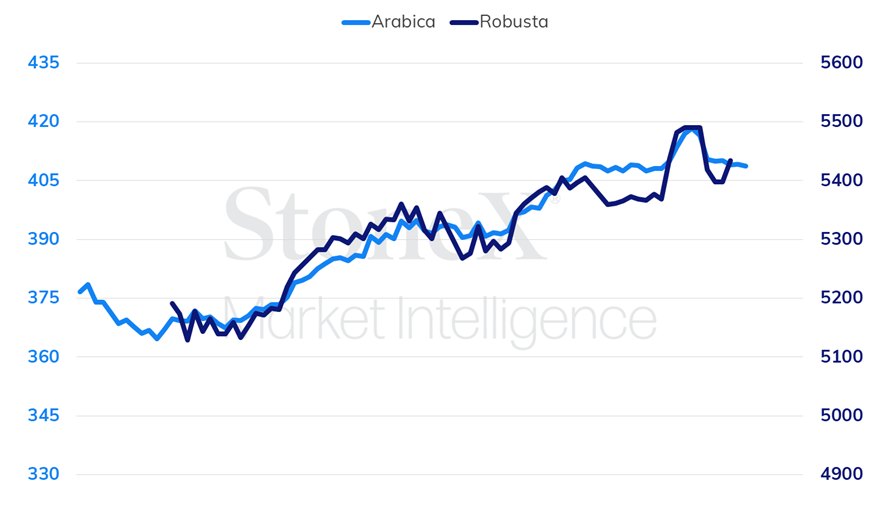
In New York, the most active contract, for July delivery, ended the week with a gain of more than 7%, closing at US¢ 399.85/lb on April 25. In the robusta market, the price closed at USD 5,415 per ton, an increase of 2.6% compared to the previous week's closing. Last week, the USDBRL exchange rate dropped more than 2% to 5.68.
Intraday Weekly (Most Active Contract) – 04/21 to 04/25
In the Brazilian domestic market, arabica coffee prices advanced, while robusta prices remained practically stable. The CEPEA indicator for arabica recorded a 3.6% increase, quoted above BRL 2,610.00 per 60-kg bag. The indicator for robusta pointed to a slight increase of 0.2%, quoted above BRL 1,716.00 per bag.
From a fundamentals point of view, one of the main focuses of attention among agents is the beginning of the 2025/26 crop harvest in Brazil. The activity has already started in several robusta-producing regions, and the expectation is that the harvest pace will gain strength throughout May.
Another important point is the release of the agricultural attaché reports by the United States Department of Agriculture (USDA) in major coffee-producing countries. Although there is no specific date, these reports are usually published throughout May and will bring the first estimates for the production of these countries in the 2025/26 season, serving as a basis for the USDA’s official report expected in mid-June, which will also present projections for the global supply and demand balance.
Another point of attention is the performance of Brazilian coffee exports in April. Exports have been slowing down due to reduced domestic supply and logistical bottlenecks. According to the Brazilian Coffee Exporters Council (Cecafé), Brazil failed to export around 640 thousand bags in March due to logistical problems, resulting in estimated losses of BRL 8.9 million for companies. Cecafé's preliminary report indicates that by April 25, more than 2.28 million bags had been shipped, representing an 8.8% drop compared to the same period of the previous month.
Another relevant aspect is the impact of inflation on retail coffee prices. In the United States, coffee consumer inflation accumulated a 23.8% increase over the last year until March. In Brazil, retail coffee inflation reached almost 78% over the same period.
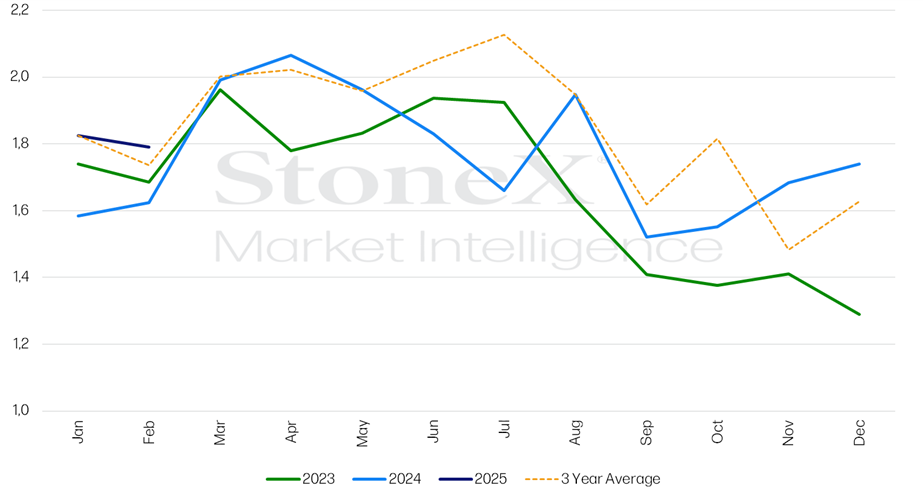
Regarding U.S. coffee imports, the year 2024 ended with a 5.9% recovery compared to the previous year, totaling 21.17 million bags. However, this volume was still 15% below the historical peak recorded in 2019, when imports reached 24.7 million bags.
For 2025, import data up to March have not yet been released — publication is expected on May 6. So far, considering January and February, the United States imported more than 3.6 million bags, an increase of 12.6% compared to the same period of the previous year.
U.S. Coffee Imports (Million Bags)
Source: USDA. Design: StoneX.
On the other hand, Cecafé data show that Brazilian coffee exports to the United States totaled 1.8 million bags through March, representing an 11.5% decrease compared to the same period in 2024. This reduction was mainly due to the sharp drop in robusta coffee exports to the U.S. market in March. In March 2024, Brazil exported more than 271 thousand bags of robusta to the United States, while in March 2025, the volume fell to just 14.6 thousand bags, reflecting the scarcity of the product in the domestic market.
Finally, agents will closely monitor the release of financial results from companies linked to the coffee sector. These results may indicate how the coffee consumption pace is evolving in the regions where these companies operate and may serve as a thermometer to understand the impact of inflation on global coffee consumption.
INDICATORS