• Arabica falls 14.5% in May; robusta drops 16% in the month
• Coffee inflation exceeds 80% in Brazil
• Brazil harvested 23.6% of the crop by 06/02
• Robusta harvesting ahead of arabica
• Supply eases market after months of scarcity
• Funds liquidate positions in NY and London
• Funds cut 69% of position in London
• Consumption may fall with consumer inflation
Reflecting the progress of Brazil’s coffee harvest, arabica and robusta futures registered a sharp drop last week. As mentioned in previous editions of this report, the harvest arrives at an important moment, bringing relief to a market that faced very tight supply, especially in the first four months of the year. Despite delays caused by rain, the harvest pace accelerated in recent weeks.
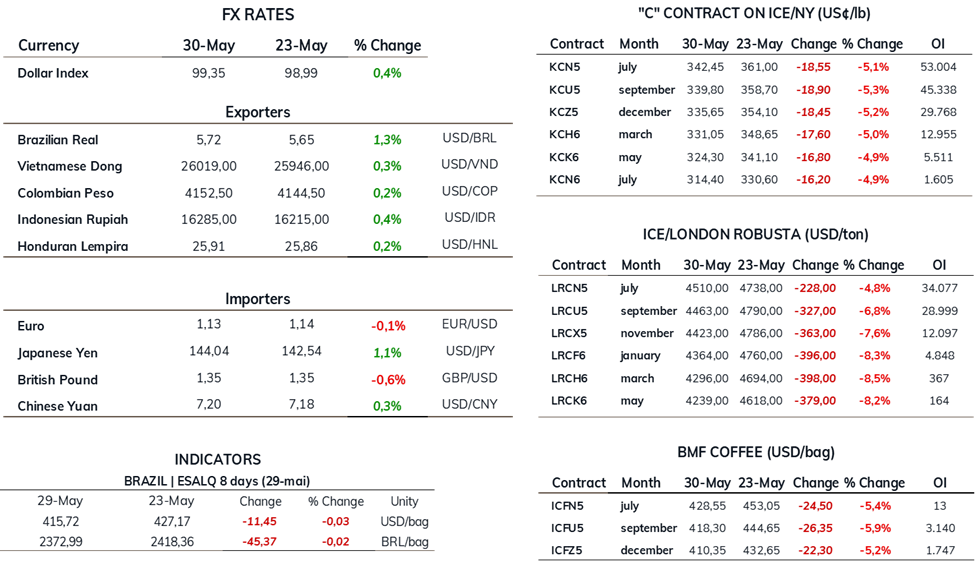
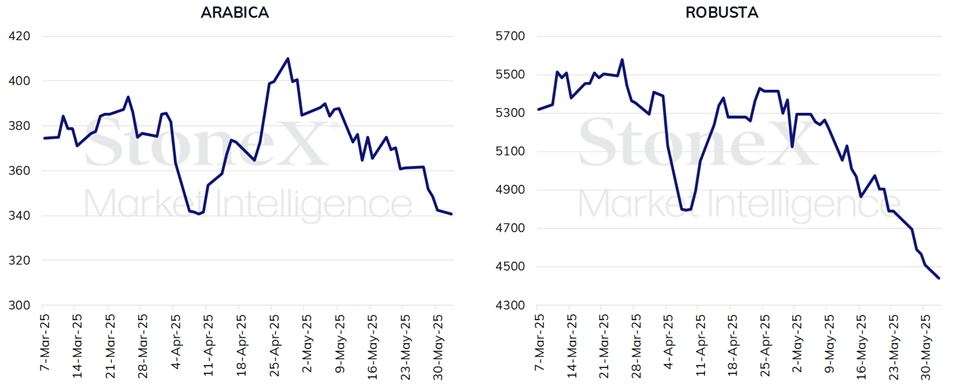
Last week, the most active contract in New York (July) fell by 1,855 points (-5.1%), closing Friday at US¢ 342.45/lb. In May, prices in New York fell 14.5%. In London, the most active robusta contract (July) dropped US$ 228/ton (-4.8%), closing at US$ 4,510/ton. The monthly decline was 16%.
Also last week, the commercial dollar rose 1.3%, closing at USDBRL 5.72, while the dollar index (DXY) rose 0.4% to 99.35 points.
Arabica coffee futures (US¢/lb), robusta coffee (USD/ton)
In the Brazilian domestic market, the harvest progress also pressured prices. The Cepea index for arabica coffee ended the week down 3.42%, quoted at approximately BRL 2,336 per bag, accumulating a 10.7% drop in the month. For robusta, the index dropped 6.12% in the week, closing at BRL 1,394 per bag — a 18.1% monthly decline.
The price drop reflects, in addition to the harvest progress, a potentially weakened consumption scenario amid high consumer inflation and expectations of higher production in key countries. The USDA report points to a 7% increase in Vietnam’s production next season, as well as over 5% growth in Indonesia. Partial USDA data indicate a 1.9% increase in global production among reported countries.
Despite initial delays due to rain, the harvest in Brazil gained pace. According to StoneX, by June 2nd Brazil had harvested 23.6% of its national crop — 31.4% of robusta and 18.4% of arabica. Based on StoneX’s 2025/26 crop estimate of 64.5 million bags, Brazil had already harvested about 15.22 million bags. The entry of this volume into the market has helped ease concerns over limited supply.
Coffee harvest pace in Brazil
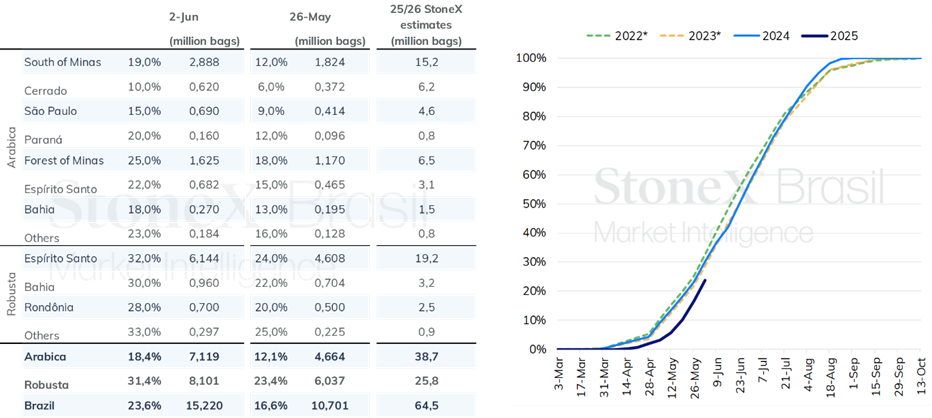
Source: StoneX.
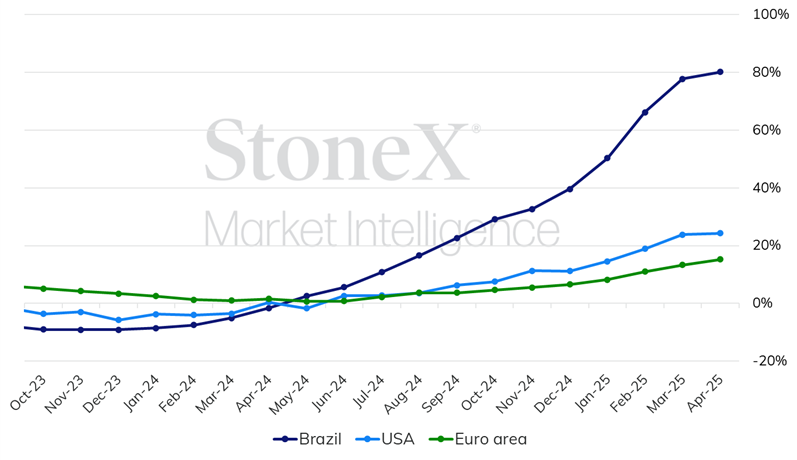
Another point of concern is consumption. Data updated through April show that 12-month consumer coffee inflation exceeded 80% in Brazil. In the U.S., the increase was 24.3%, and in Europe, 15.3%. This sharp rise in prices may negatively impact global consumption.
Consumer inflation for roasted and ground coffee
Source: IBGE, BLS and Eurostat. Prepared by: StoneX.
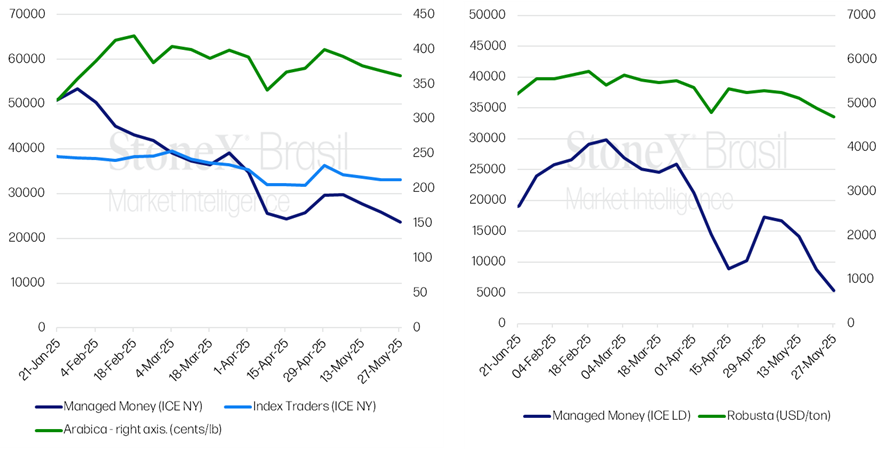
Given this scenario, speculative funds significantly reduced their positions. Between May 20 and 27 alone, funds in New York liquidated 9% of their net long positions, while prices dropped over 2% in the same period. Between April 29 and May 27, the reduction was 20.4%, with a 9.5% decline in prices. In London, the reduction was even more aggressive: -39.2% in the week and -69% in the month, while prices dropped 4.2% and 11.4%, respectively. This movement reflects both the greater supply expected in Brazil and the crop recovery in Vietnam and Indonesia.
Net fund positions in New York (left) and London (right) vs. futures prices
Sources: CFTC and ICE. Prepared by: StoneX.
In the coming weeks, the market will closely monitor Brazil’s harvest progress, which should continue to pressure prices. In addition, weather remains a key factor: although the recent cold front did not cause damage, future events may increase volatility. Export data from producing countries will also be important — with Brazil in focus, as exports may recover in the coming months with the harvest's advance, after months of weak shipments due to limited availability.
INDICATORS