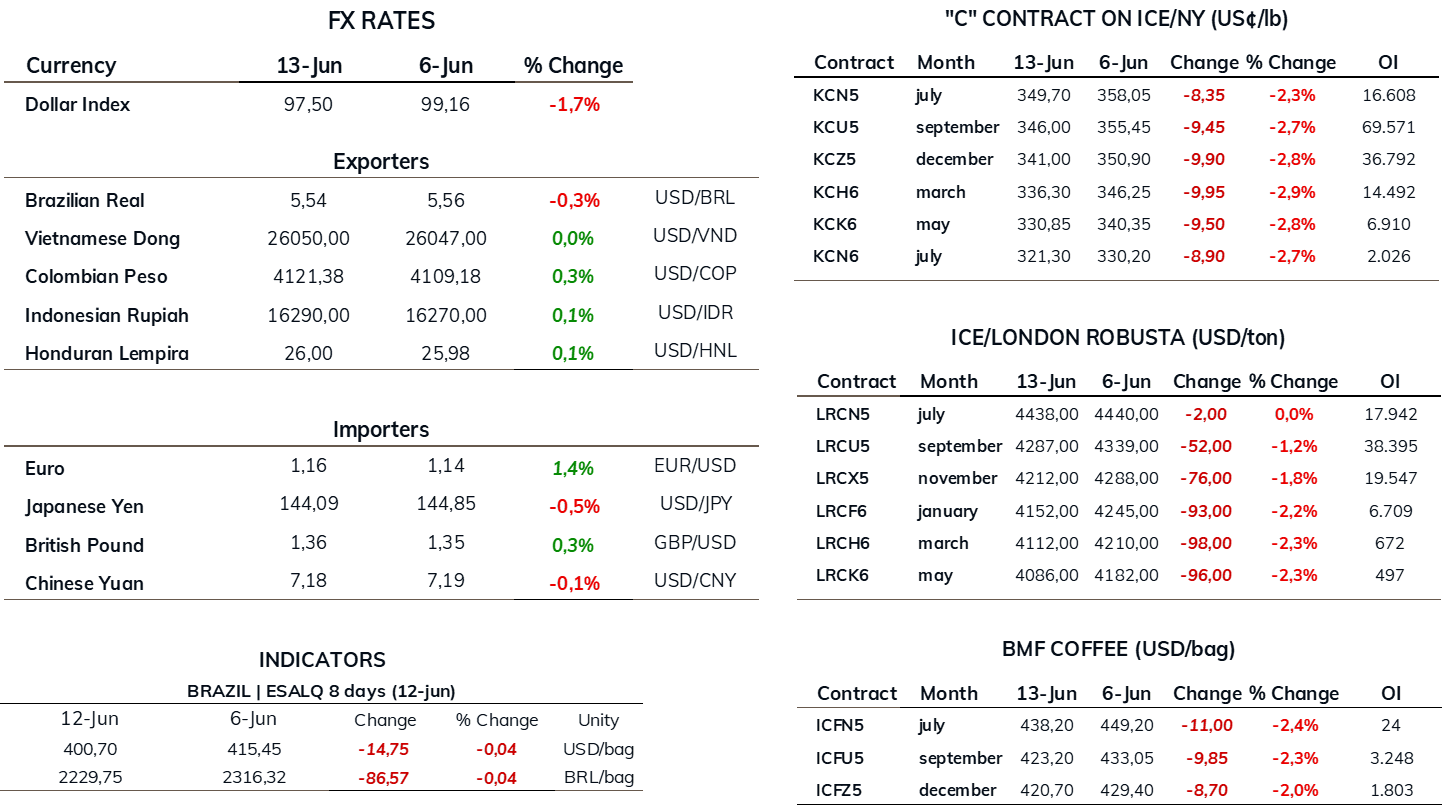
• New York recorded a 2.7% drop in futures contracts
• London also fell: 1.2% drop in per-ton prices
• Domestic prices fell: arabica down 5.12%; robusta down 5.9%
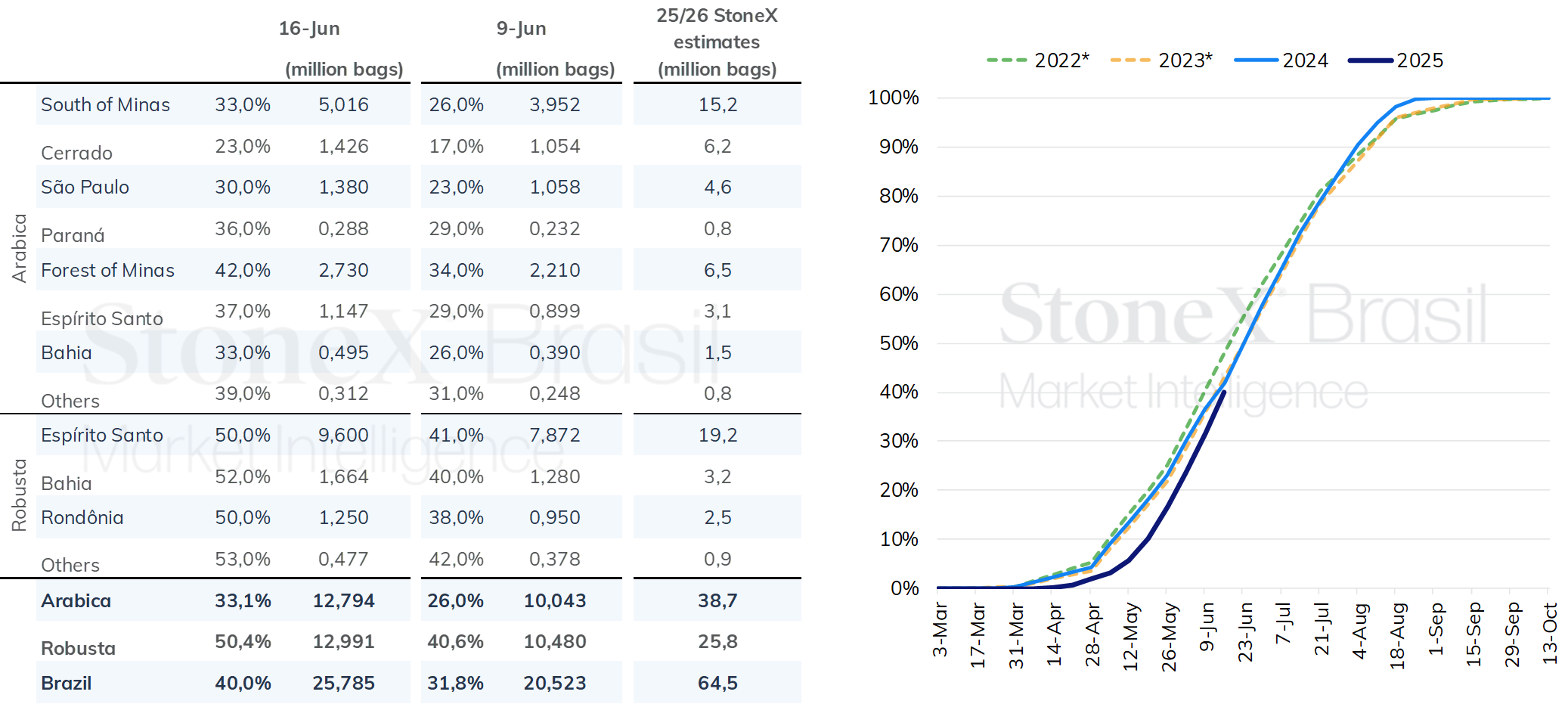
• Brazil's coffee harvest reached 40% as of 06/16
• The harvest negatively pressures prices in both physical and futures markets
• Weather remains on the radar; cold front caused no frosts
• May exports fell 33.3% compared to May 2024
• Market remains attentive to the harvest and weather risks
The downward trend in prices observed in recent weeks had already been anticipated in previous editions of the weekly reports. The increased availability of coffee in the physical market has put pressure on prices. With the pace of the harvest accelerating, operators have observed a higher volume of sales from origin, both for arabica and robusta coffee. It is worth noting that the robusta coffee harvest is more advanced compared to arabica.
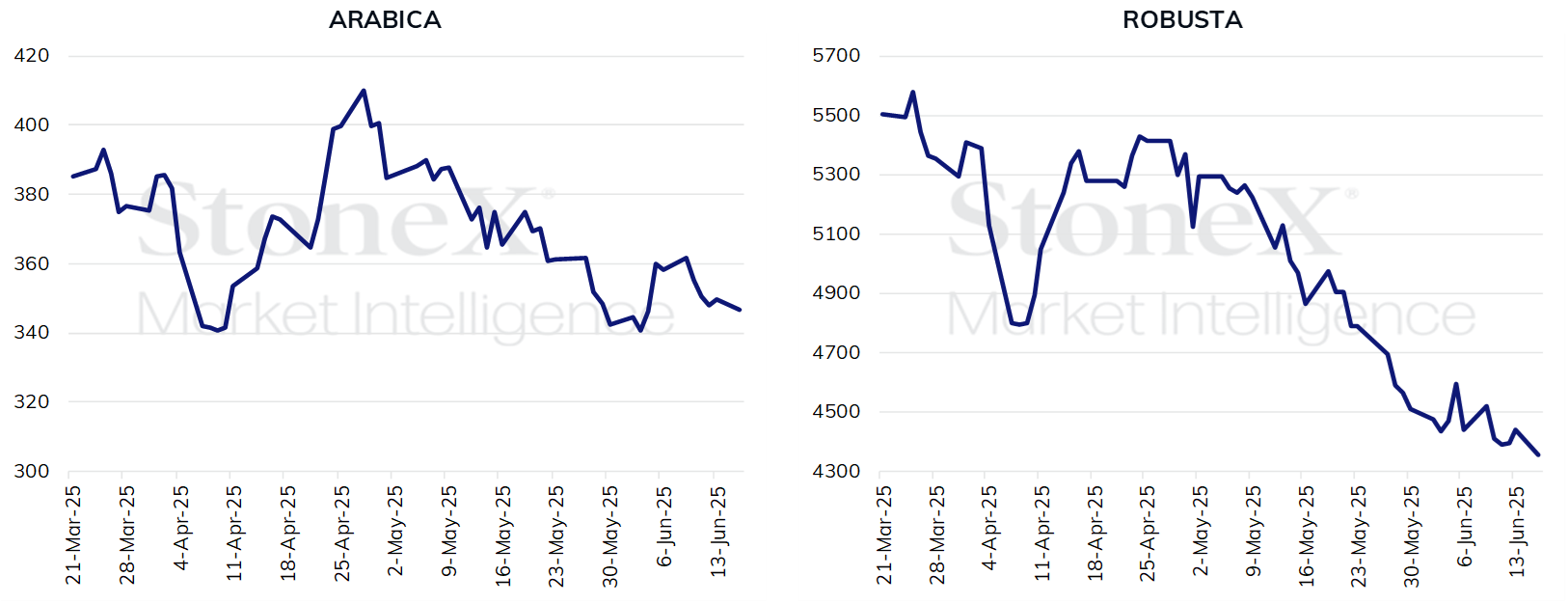
Additionally, prices declined even with a weaker dollar, which generally has a bullish effect on external quotations. While the dollar dropped 0.3% during the week, closing at R$5.54, in New York the most active contract for September fell by 945 points (2.7%), ending the week at US¢346.00 per pound. In London, the September contract also dropped by US$52 per ton (1.2%), closing at USD 4,287 per ton.
Future coffee prices arabica (US¢/lb) and robusta (USD/ton)
In the Brazilian domestic market, prices also fell. The Cepea index for arabica dropped 5.12%, closing Friday at around R$2,198 per bag. For robusta, the decline was even greater, almost 5.9%, with bags priced around R$1,283.
From a fundamentals perspective, there were no major changes over the past week. The market remains attentive to the progress of the harvest in Brazil, which continues to exert downward pressure on prices, especially due to the significant increase in robusta production compared to the previous year. Arabica production is lower, but this drop is partially offset by the robusta volume.
According to StoneX data, as of June 16, Brazil’s coffee harvest reached 40%, equivalent to approximately 25.8 million bags. For arabica coffee, more than 33% of the crop has been harvested, totaling around 12.8 million bags. Robusta is further ahead, with over 50% harvested, totaling nearly 13 million bags.
Coffee Harvest Pace in Brazil
Source: StoneX.
Weather also remains a focus of the market. In recent days, a cold front lowered temperatures in Brazil, but no frosts were reported. Temperatures did not reach critical levels in the main producing regions. For example, in municipalities like Caparaó and Maria da Fé, lows ranged between 4.2 °C and 5 °C — insufficient for frost formation. Furthermore, these locations are in higher altitude areas of Minas Gerais. For the coming weeks, no new cold fronts are forecasted, but the weather scenario should continue to be monitored due to ongoing uncertainties.
The market is also starting to anticipate weather conditions for the second half of the year, especially with regard to flowering. Robusta flowering is expected to begin in the second half of July. Arabica flowering should start at the end of August and continue into September.
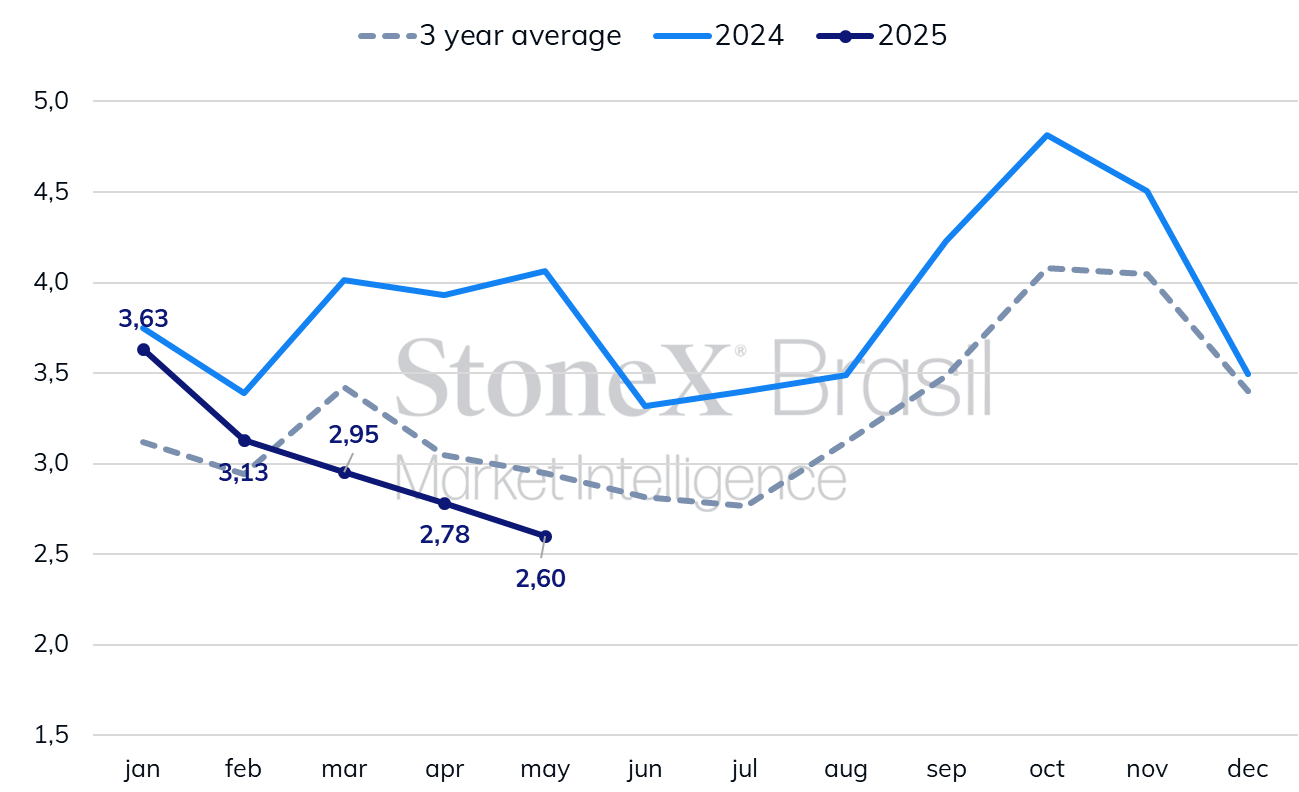
Last week, Cecafé published its export report for May. According to the document, Brazil exported 2.96 million bags during the month, a 33.3% decrease compared to May 2024. Green coffee exports totaled 2.6 million bags, a drop of 35.9%, with robusta exports down 77%, totaling just over 202.7 thousand bags. Arabica exports also fell, down 24.6% to 2.4 million bags. Industrialized coffee exports dropped 6.2%, totaling 360.3 thousand bags.
Brazilian Green Coffee Exports (million bags)
Source: Cecafé. Prepared by: StoneX.
On the other hand, export revenues increased 33.7%, surpassing R$7 billion. In the first five months of the year, total exports declined 19.2%, reaching nearly 16.8 million bags. Green coffee exports fell 21%, to 15.1 million bags. The biggest drop continues to be in robusta, down over 70%, with just over 1 million bags. Arabica exports fell 10%, exceeding 14.1 million bags.
The drop in Brazilian exports is linked to the lower availability of coffee in the physical market, especially following record export volumes in 2024, which exceeded 50 million bags. In the coming months, exports are expected to recover as the 2025/26 crop advances and supply increases.
A preliminary report from Cecafé dated June 13 shows that, as of that date, Brazil had shipped 750,000 bags of arabica — which, if the pace continues, would result in a lower volume than in May. On the other hand, robusta shipments remain strong, reflecting the more advanced harvest. By the 13th, nearly 174,000 robusta bags had already been shipped — almost the total shipped in May. If this pace holds, June robusta exports could reach 348,000 bags, well above the 202.7 thousand bags shipped in May. From July onwards, arabica exports are also expected to gain momentum as harvested volumes become available.
Thus, the market remains focused on Brazil’s harvest progress, which should continue to pressure prices in both the physical and external markets. In the short term, weather risks — especially new cold fronts during winter — remain in focus. In the medium term, attention turns to climate conditions during the flowering stage, which is critical for next season’s development — for both arabica and robusta. Additionally, market participants will monitor inflation and its impact on consumer coffee prices and overall consumption.
INDICATORS