• Coffee prices dropped with harvest progress in Brazil
• New York fell 4.7%; London saw a slight gain of 0.4%
• Market remains under pressure from adverse macroeconomic scenario
• Brazilian harvest reached 63.8% of total crop
• Cepea reports 7.5% drop for arabica and 2.5% for robusta
• Brazilian robusta exports may benefit from new tariffs
• Cold front arrives, but no immediate frost risk
• Rainfall will be key for the 2026 crop flowering
• Market awaits official export data for June
• Tight global stocks may limit further price drops
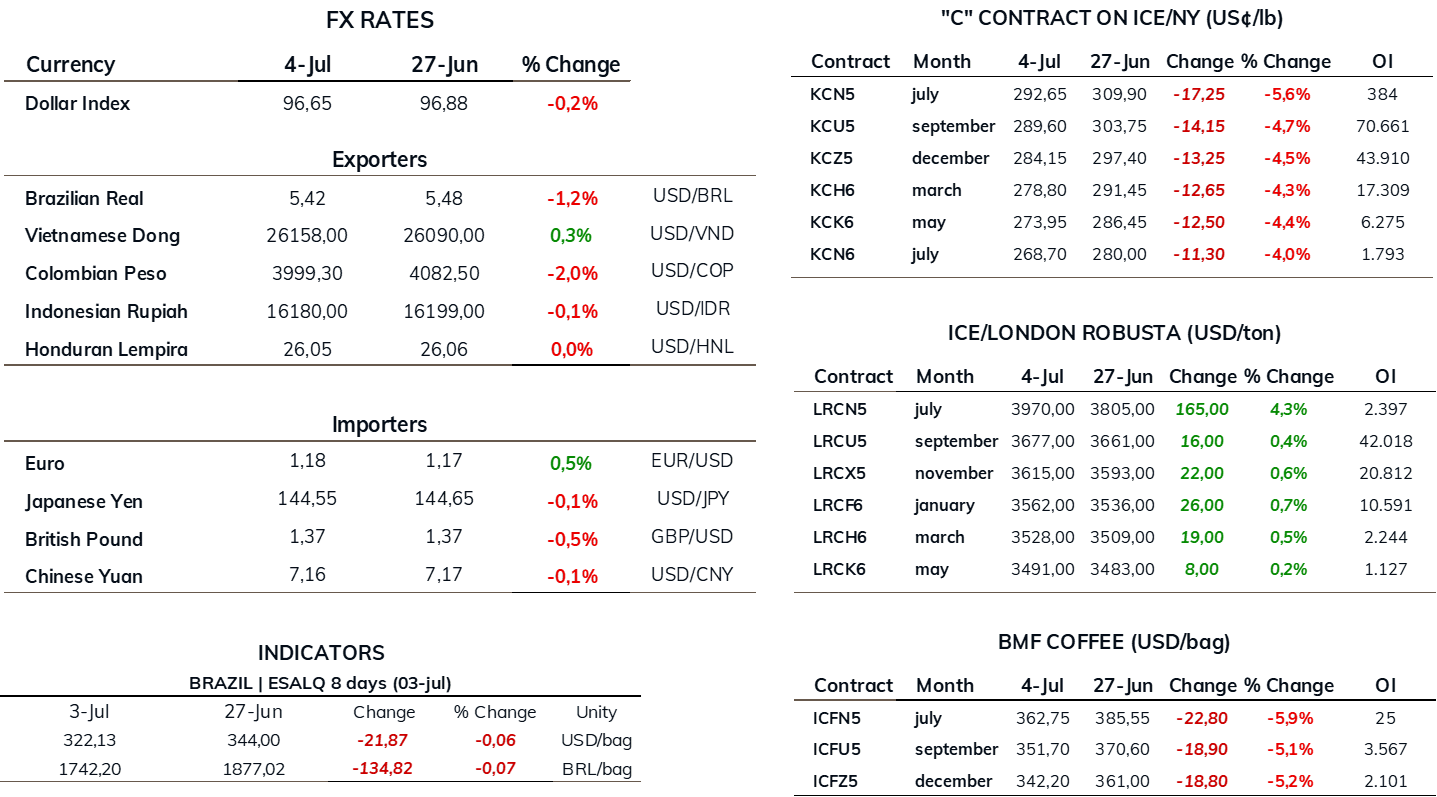
Coffee prices declined last week, pressured by the progress of the harvest in Brazil and global macroeconomic factors. The most active contract in New York dropped 1,415 points, equivalent to 4.7%, ending the week quoted at US¢ 289.60 per pound. In London, the market was more stable, with a slight gain of 0.4%, closing the week at USD 3,677 per ton.
This Monday, the market continues to decline, reflecting the increase in physical coffee availability with the advancement of the Brazilian harvest, in addition to an adverse macroeconomic scenario. The market is closely monitoring decisions from the U.S. government regarding import tariffs.
Future coffee prices: Arabica (US¢/lb), Robusta (USD/ton)
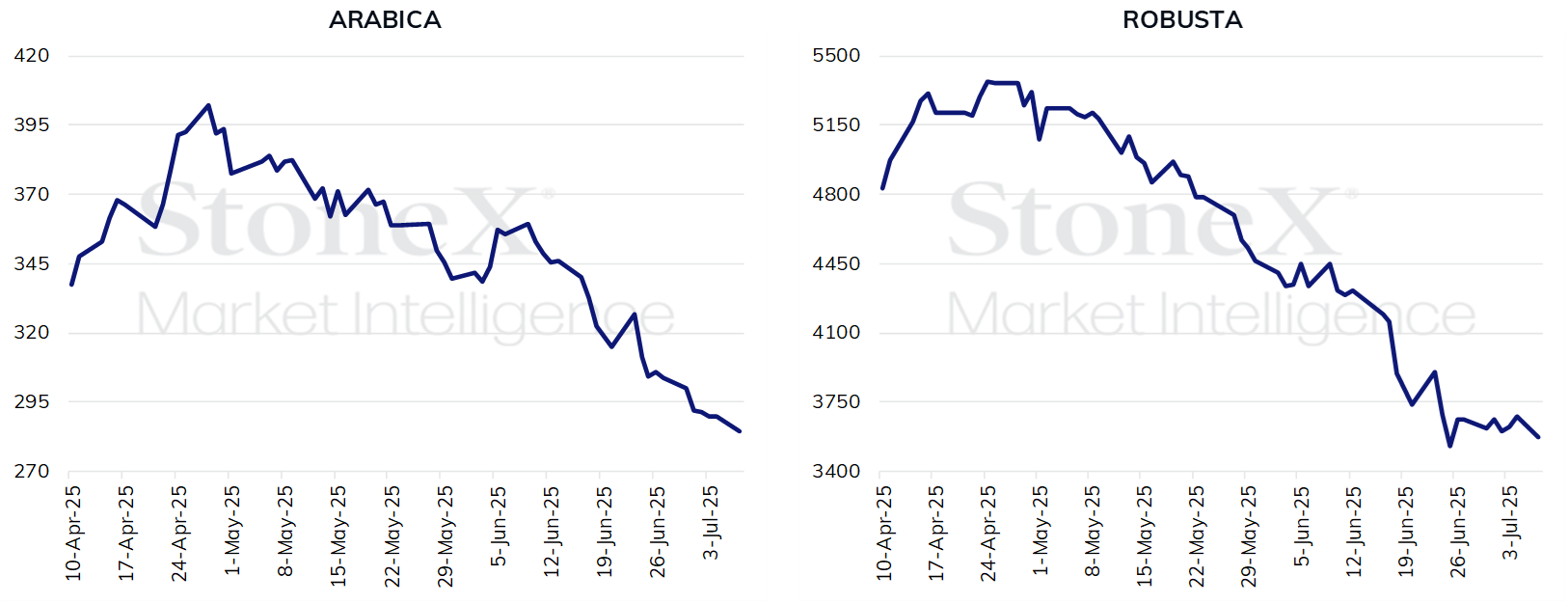
In the Brazilian physical market, prices also fell. The Cepea indicator for arabica coffee dropped 7.5% during the week, closing at approximately BRL 1,737 per 60kg bag. Robusta fell 2.5%, quoted at BRL 1,087 per bag. Price pressure intensifies as the harvest progresses and short- to medium-term supply increases.
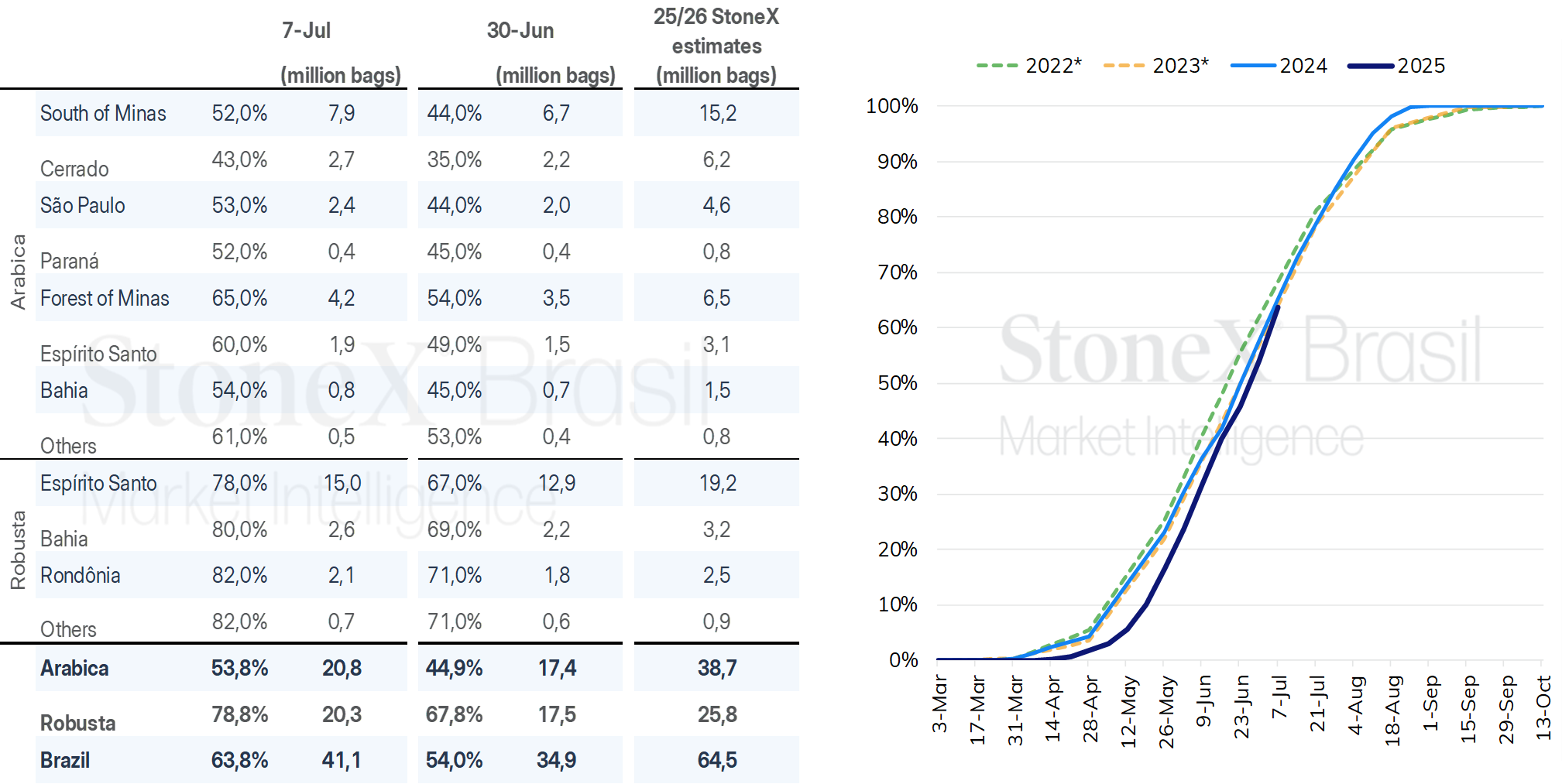
According to StoneX data, as of July 7, 63.8% of the Brazilian crop had been harvested, equivalent to 41.1 million bags. The robusta harvest is more advanced, with 78.8% completed (20.3 million bags), while arabica reached 53.8% (20.8 million bags).
Brazilian coffee harvest progress
Source: StoneX.
In April, the U.S. government announced tariffs on imports from several countries, including Brazil. For countries that already had rates above 10%, a 90-day pause was granted, ending this Wednesday, July 9, when the U.S. will resume full application of the planned tariffs; initially, Vietnam and Indonesia would be taxed at 46% and 32%, respectively.
Recently, the U.S. announced a deal with Vietnam, setting tariffs at 20% on Vietnamese products exported to the U.S. This move tends to favor Brazilian robusta exports, which remain taxed at only 10%. Geopolitical tensions have also increased market concerns. On the evening of July 6, the U.S. president declared on social media his intention to raise tariffs on countries aligning with BRICS policies. The group is holding its 17th summit on July 6 and 7 in Rio de Janeiro. Such statements reinforce a climate of risk aversion.
As of the writing of this report, on Monday, July 7, New York was recording another 840-point drop in the most active contract, down 2.9%, quoted at around US¢ 281.20 per pound. Additional pressure comes from the dollar appreciation, which rose 0.77% on the day, trading at BRL 5.46. In London, the market also fell: the most active robusta contract dropped USD 141 per ton, or 3.8%, quoted at around USD 3,536 per ton.
Although downward pressure comes from increased availability, weather may once again support prices. The European model forecast released Monday indicates a cold front moving through producing regions, causing temperatures to drop. However, the predicted lows, such as 8 °C in parts of Minas Gerais, do not yet suggest frost risk. No new polar air mass is expected over the next 15 days, but weather monitoring remains essential throughout July and early August.
In addition to temperatures, the market will also monitor rainfall forecasts. The return of precipitation to the coffee belt is crucial to ensure proper flowering. If rains are delayed, concerns may arise about Brazil’s 2026 crop yield potential. Thus, weather returns as a key factor in price formation both domestically and abroad.
In the coming days, the market awaits the release of official export data for June by Cecafé. Preliminary data points to an increase of more than 80% in Brazilian robusta exports compared to May, reflecting greater product availability. However, the volume is still below June 2024 exports. Arabica exports are expected to decline in June, but recovery is anticipated as the harvest progresses.
Despite short- and medium-term downward pressure, global stocks are still not considered comfortable, which should limit steeper price declines, especially after the end of the harvest and entry into the off-season.
INDICATORS